
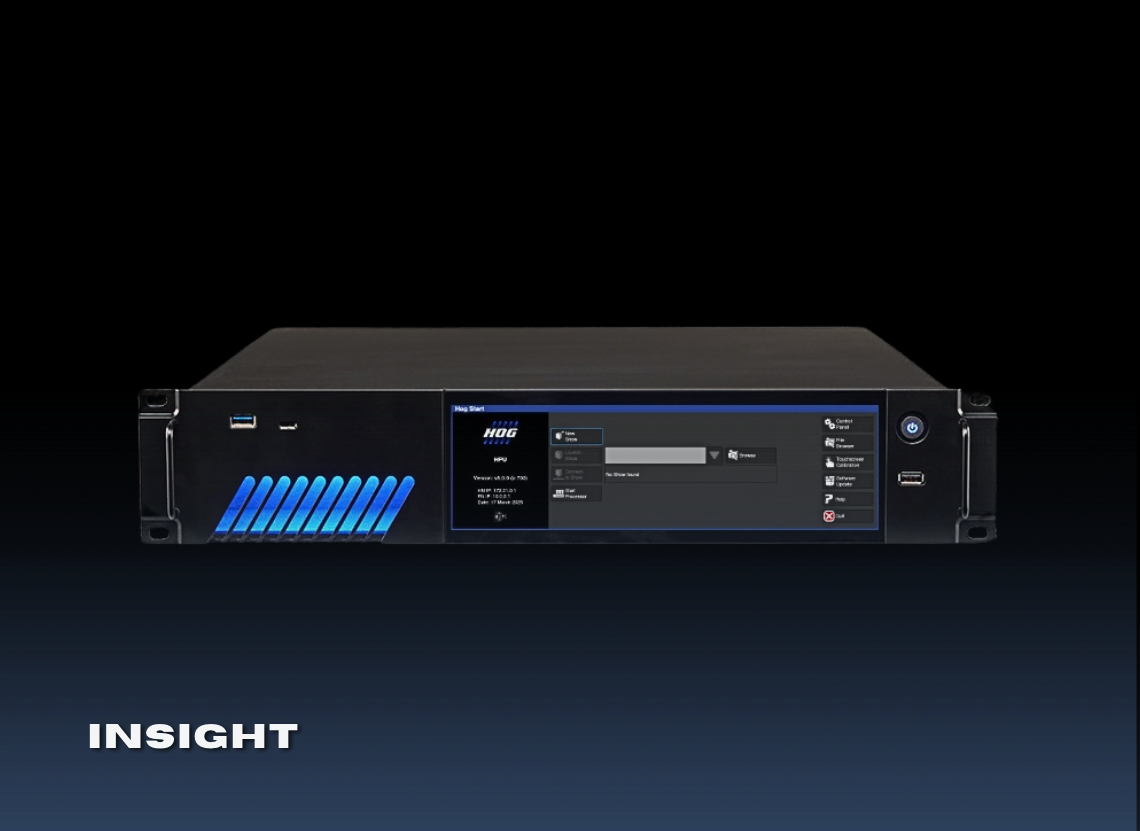
United States – In an industry where lighting systems are becoming increasingly complex and technical infrastructures require greater flexibility, ETC finds in HOG HPU+ an intelligent response to the new challenges of professional control. The solution draws on HOG’s accumulated experience and transforms it into a tool capable of integrating seamlessly into installations and productions where efficiency is also part of the show.
The evolution of professional lighting is not only about more powerful fixtures, smarter systems or increasingly complex networks. It also requires new ways of thinking about control. In this context, ETC’s HOG HPU+ proposes a solution that addresses a specific need in professional environments: having the full processing power of a HOG system without necessarily being tied to a conventional console.
For years, HOG has been a reference in professional lighting control. Its presence in theatres, museums, convention centers and demanding entertainment venues demonstrates that its working philosophy has transcended generations of hardware and become a platform recognized by designers and programmers around the world. In Latin America, that track record has also made HOG an essential platform within the professional scene.
In this context, HPU+ emerges as a hybrid processor that brings that philosophy to a compact 2U rack format. Its concept is as simple as it is strategic: it can operate as a rack-mounted HOG console or as a DMX processor connected to another console from the HOG family.
And that is precisely where its value begins.
When control no longer needs a console
Not every project needs a large control surface in front of the operator. There are installations where programming is handled differently, spaces where the system remains virtually hidden, or applications where control needs to be integrated into an existing technical infrastructure.
HPU+ responds to that reality. Its ability to function as a rack-mounted console makes it possible to bring Hog OS into installations where a traditional physical console may be unnecessary. Cruise ships, theme parks, museums, convention centers, permanent installations and other applications can benefit from a professional control system that takes up little space and can be integrated directly into the technical rack.
But HPU+ does not abandon the HOG philosophy to achieve this. The operator continues working within the same programming environment, with the same tools and the same logic that define the HOG ecosystem. That continuity is particularly important in installations where the knowledge of the human team represents one of the system’s most valuable assets.
A tool that can also expand what already exists
Perhaps one of the most interesting aspects of HPU+ is that it should not be understood solely as an independent solution. It can also become an expansion component.
In DMX Processor mode, HPU+ provides up to 32,768 parameters, equivalent to 64 universes, and can expand existing HOG systems through additional units. This makes it possible to build control architectures that grow according to the needs of the project, without requiring the replacement of the core of a system that is already operating.
This capability becomes especially important as shows and installations cease to be simple lighting systems and begin integrating an increasing number of devices, protocols and sources of information.
DMX, Art-Net, sACN, HogNet, OSC, MIDI, LTC and SMPTE are part of an ecosystem in which control must communicate with multiple elements. HPU+ is designed to operate within that reality.
Power that does not need to take up space
The engineering behind HPU+ also responds to an increasingly evident trend in the industry: making infrastructure more compact, modular and easier to transport.
At just 2U in height and weighing approximately 6.8 kg, HPU+ concentrates considerable processing capacity in a rack-oriented format. Its simplified mechanical design also facilitates maintenance and enhances its suitability for touring applications.
ETC has also updated the connections to align them with the new generation of HOG consoles, incorporating etherCON connectors, opticalCON Duo fiber connectivity, integrated LTC/SMPTE and TRUE1 TOP power.
These are not simply connectivity changes. They are decisions that show where professional control is heading: systems capable of integrating with increasingly sophisticated network, signal transport and synchronization infrastructures.
The real value lies in what it makes possible
One of HPU+’s strengths is that its specifications take on meaning when viewed from the perspective of real-world work.
The system incorporates Hog OS, an 8-inch multitouch display, support for two external DisplayPort monitors, eight physical DMX outputs and connectivity through sACN and Art-Net. It also offers programming tools such as groups, palettes, effects, pixel mapping, fanning, command-line programming, parameter control and multiple playback options.
But the important point is not how many functions it brings together. It is that all of these tools can be available within an architecture that does not necessarily require a conventional console as the central point of operation. That shift in concept can be decisive for certain installations.
HOG continues to think like HOG
Technology changes, but a professional platform is not sustained solely by its processors or by the number of universes it can control. It is also sustained by a working philosophy.
And that is one of the reasons HOG remains relevant. Its programming environment is designed to allow the operator to focus on building the show rather than simply managing the technology. Palettes, groups, effects, scenes, lists, masters, macros, triggers, MIDI, OSC and timecode form part of a language that makes it possible to build complex systems while maintaining a coherent working logic.
HPU+ does not attempt to reinvent that philosophy; it takes it into another format. And that continuity can be particularly important in an industry where the accumulated knowledge of designers, programmers and operators carries enormous value.
A particularly relevant solution for Latin America
For the Latin American market, where many installations must simultaneously address technical requirements, space constraints, maintenance needs and carefully managed budgets, a platform capable of growing and adapting can make a difference.
HPU+ makes it possible to approach the control system differently: start with a given architecture and expand it when the project requires it, add processing capacity, integrate different protocols and maintain the same HOG ecosystem.
This is particularly interesting for theatres, museums, convention centers and entertainment venues that require professional infrastructure but do not necessarily need a large-format console permanently installed. With HPU+, the technology is no longer constrained by the size of the space.
A new expression of an established philosophy
HOG built its reputation by understanding that controlling lighting is not simply about sending data to fixtures. It is about providing professionals with the tools they need to turn a creative idea into a real experience.
HPU+ takes that philosophy into a territory where processing power can remain behind the scenes, integrated into a rack, connected to a network or working as an extension of an existing HOG system.
And perhaps that is its greatest strength. Because innovation does not always mean adding more visible elements. In many cases, it means precisely achieving a professional infrastructure that is more powerful, flexible, scalable and discreet at the same time.
With HPU+, ETC demonstrates that the future of professional control does not necessarily have to take up more space to offer more possibilities. It can live inside a rack and still have the full power of HOG behind it.
HOG did not reach this point by chance. Its continued presence in some of the world’s most demanding professional environments is the result of a philosophy that has turned innovation, precision and reliability into a working standard. For generations of designers and programmers, HOG has become much more than a control platform: it is an icon of professional lighting, a synonym for quality and a technological reference that continues to evolve without losing what made it transcend. With HPU+, ETC once again demonstrates that the true leaders of the industry are not simply those who follow change, but those with the ability to anticipate it.


