
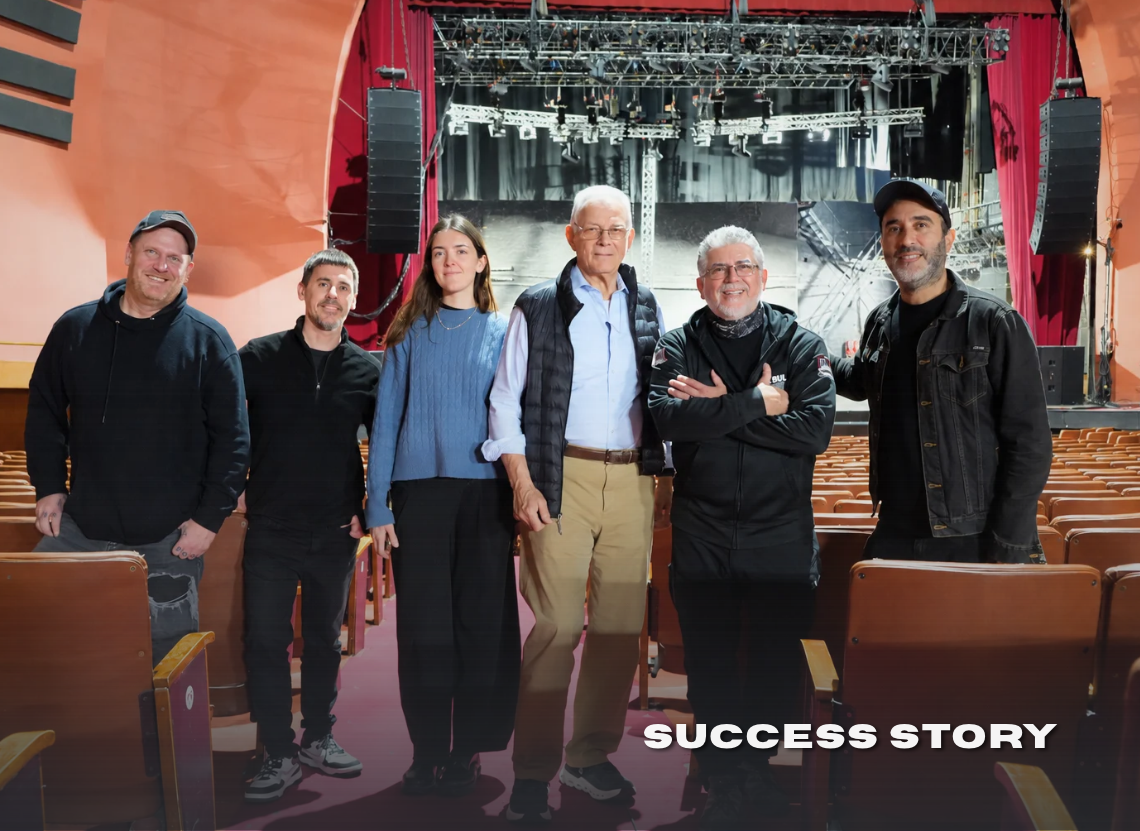
Argentina – Renewing the sound system of one of Argentina’s most iconic theaters involved much more than replacing technology. The project developed at Teatro Gran Rex brought together JBL Professional, Todomusica S.A. and the venue’s technical team around a precise objective: to achieve consistent coverage from the first row to the last seat of the Super Pullman.
Three-dimensional modeling, structural constraints, measurements at multiple positions and calibration taken down to the finest detail defined a project in which technology had to adapt to a building with almost nine decades of history.
There are buildings that force you to listen before intervening. And at Teatro Gran Rex, in Buenos Aires, that statement takes on a literal meaning. Its architecture, its different levels, balconies and surfaces are part of the identity of a venue approaching nine decades of history, but they also present very particular conditions when the challenge is to distribute sound uniformly among thousands of spectators.
That is why, when the time came to renew its audio system, the question was not simply what equipment to install.
There was another, much more important one: how to ensure that someone sitting close to the stage and another person seated in the last rows of the Super Pullman would receive the most consistent sound experience possible?
Raúl González, Senior Specialist, Audio Applications & Support Group – US & Canada at JBL, sums it up in a much simpler way: “That favoritism should not exist. If you paid to go to the show, everyone should hear.”
That premise shaped a project involving the Teatro Gran Rex technical team, Todomusica as JBL’s local distributor and integrator, and specialized support from the brand from the earliest design stages through final calibration.
The result is a new system based on the VTX family, specifically designed around the theater’s actual characteristics and adjusted to respond to a program in which very different musical and theatrical productions can coexist.
But the story also contains a return to the beginning.
JBL returns to Gran Rex
The decision to renew the system began within the theater itself. Daniel Itelman, managing partner and project lead on behalf of Gran Rex, participated in the search for brands and models, the economic analysis and ultimately the completion of the purchase.
The previous system was still working and continued to be accepted on production riders. “The system we had had already completed a cycle. But we decided to purchase a more current sound system, with new technology,” explains Itelman.
The choice of JBL, however, also had a historical component.
In 1991, Ángel Itelman, Daniel’s father, had purchased a JBL system to install permanently at Gran Rex. Until then, systems would come and go depending on the productions, a dynamic that not only occupied space but also generated wear both on the equipment and on the venue itself.
The permanent installation also made it possible to recover seats that until then had remained unavailable because of systems placed on the floor.
“I have a very nice romance with JBL,” Daniel acknowledges. “I chose this brand because it works well, because it is equipment requested in riders, because there is good support in Argentina and because, in terms of price-quality, I felt it was what suited me best.”
And this time Ángel was also there to listen to it, at the age of 90.
For Leonardo Paonessa, JBL product specialist for Todomusica S.A. in Argentina, participating in that renewal also had a particular meaning.
“The first place I was taken to by the Music School to see what a large-scale sound system was like was Teatro Gran Rex. And 20 years later I participated in the design development and installation of that theater. So it was like: ‘Well, I made it. Here I am where I always wanted to be.’”
And before choosing the loudspeakers, the building had to be understood.
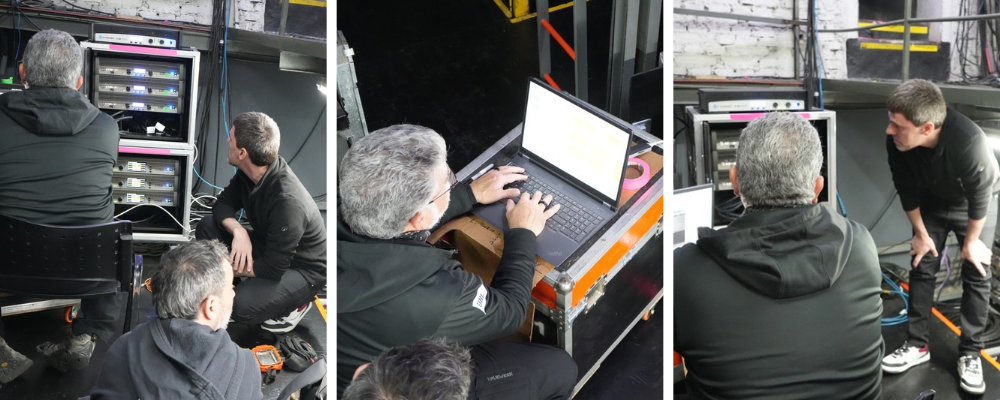
González already knew Gran Rex: he had worked there in 1999 and maintained a professional and also personal relationship with the space. For this renewal, he initially returned to survey it and begin developing a three-dimensional model that would make it possible to study different alternatives.
The objective was not to start from assumptions. “Half of all the time we spent was measuring the room and making different designs based on what was measured,” he acknowledges.
The architectural plans were a reference, but not an absolute truth. In a historic building, actual dimensions may differ from the available documentation, and small variations become important when they determine the angle and coverage of a system.
González’s philosophy is unequivocal: “I love going there and actually measuring it. What the building says is the truth.”
The team spent several days taking measurements. During that process, they even discovered a particularity that is difficult to notice at first glance: the geometry of the room is not completely symmetrical with respect to the stage.
Paonessa recalls that they repeated the plan several times because they initially questioned what the measurements were showing. That survey later became a three-dimensional model on which different configurations began to be studied.
Venue Synthesis: designing before deciding
For this stage, JBL’s Venue Synthesis was used, the brand’s three-dimensional acoustic simulation tool, which allows the space to be modeled and the acoustic and mechanical behavior of the system to be predicted before installation. In the case of Gran Rex, the model reproduced its different levels and made it possible to study how the arrays would reach the orchestra, Pullman and Super Pullman.
The graphics developed during the project show the theater’s complete geometry in section and the different projection lines of the systems toward the audience. But Venue Synthesis was not used simply to represent an installation that had already been decided. It was part of the process used to determine what that installation should be.
González developed different alternatives: configurations with different numbers of main loudspeakers, delay systems, under-balcony and front fills. Each proposal made it possible to analyze not only coverage, but also the necessary size of the system, its actual mounting possibilities and the resources involved.
An initial option contemplated 14 modules in the main arrays and did without delay systems. But acoustic simulation was only part of the equation. They had to look upward.
When the building also decides
Gran Rex does not offer absolute freedom to determine where and how a system can be suspended.
The existing infrastructure conditions the rigging points, the number of available motors, the permissible weight and the physical location of the arrays.
“You can make a design in a vacuum and say: I want 15 boxes, I want them with two motors and at this height. And you get to the theater and they say: ‘No, that doesn’t exist. You can’t hang that here, it doesn’t fit or the weight is too much,’” González explains.
The solution had to start from what the building legitimately allowed to be installed.
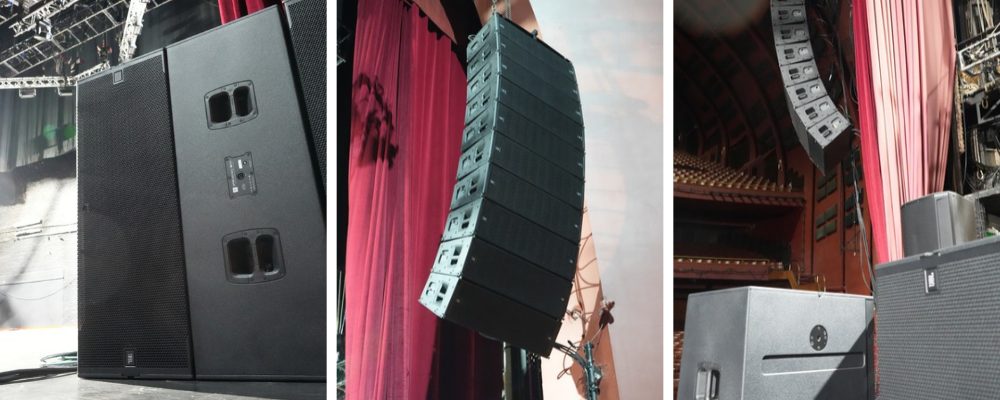
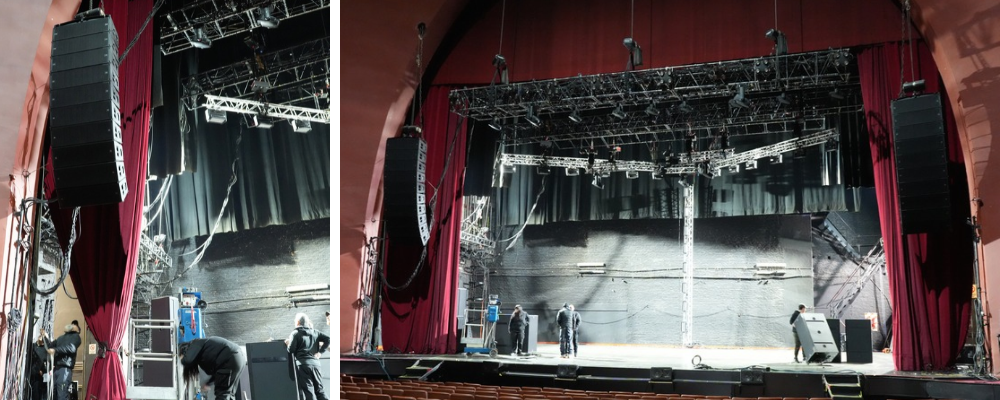
The alternative ultimately chosen was the second: ten VTX A12 boxes per side as the main system, complemented by VTX A8 delay systems.
The process demonstrates an important difference between simulating and designing. And along that journey, local support acquired a decisive importance.
From JBL to Gran Rex: the role of Todomusica S.A.
Todomusica accompanied the process locally across different areas: technical evaluation together with the theater, development of alternatives, supply, commercial conditions and on-site support during implementation.
“There were many parts that come together, not only the brand, but also the local support. That has a lot to do with it,” González points out.
Paonessa worked directly on the project and on the design of the technical infrastructure. The final system documentation bears his signature and details the distribution and wiring of each of its components.
From the theater, Itelman recalls that the process began with several meetings with Todomusica to evaluate which configuration best responded to each need. “We were mapping out which system yes, which system no; this one suits you, this one doesn’t suit you, instead of this I offer you this. Always talking about JBL, but different models for different needs.”
The definition process extended over several months: “The truth is that the support we received from both Todomusica and JBL, with Raúl at the helm, was very good,” Daniel points out.
The project thus brought together three levels of knowledge: the needs and experience of the Gran Rex team, Todomusica’s local implementation capabilities, and JBL’s specialized tools and support.
A system built by zones
The final configuration uses ten VTX A12 per side as the main PA.
To extend coverage toward Pullman, VTX A8 were incorporated, while the lower end of the system is completed by VTX B28 in left and right cardioid configuration.
González describes the relationship between A12 and A8 as that of “father and son”: two acoustically related models that make it possible to maintain sonic coherence when moving from the main system to the delay zones.
At the edge of the stage, JBL AC26 function as front fills, while other cabinets of the same model cover the under-balcony positions.
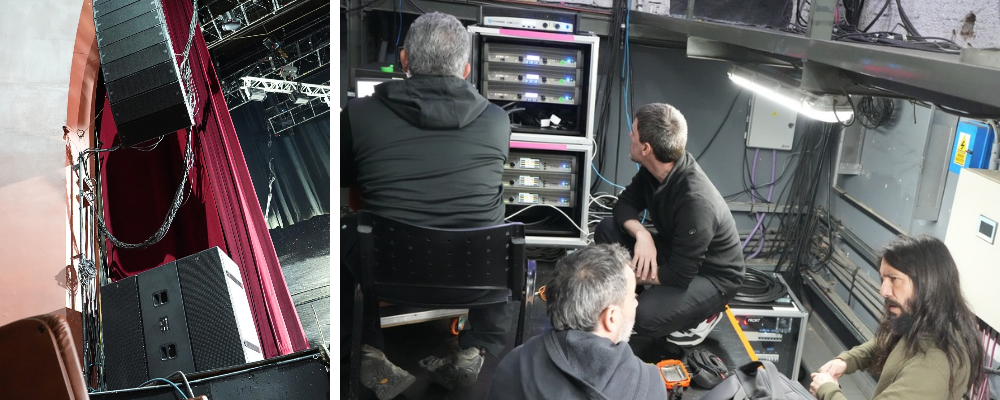
Amplification is based on Crown I-Tech, with network control. The stage also incorporates JBL VTX M22 monitors, while the sidefill system uses solutions from the SRX family.
The next challenge is to ensure that, once suspended, the physical system actually reproduces that design. At Gran Rex, this verification was taken down to differences of tenths of a degree.
Once the arrays were mounted, the team used lasers to verify the direction of each cabinet and digital inclinometers to check the resulting angles.
In one of the checks, for example, the model indicated 12.3 positive degrees for one position and the physical measurement was 12.5. In another, the reference was -38.7 degrees and the installed result was -38.5. The difference was minimal. But it was not ignored.
“You can make whatever design you want and then mount it one way and not verify that what was installed is what was designed. Then there is no correlation,” González warns.
For Paonessa, that experience ultimately reinforced a lesson that can be applied to any installation. He had heard the theater’s previous system, heard the new system once installed and then heard it again after the adjustments carried out with González: “Many times you say: ‘Well, there’s a degree of difference, leave it like that, I want to go home, I’m tired.’ The perseverance to reach perfection, to 0.1 degrees, makes the difference. And in this case it demonstrated that there was a difference.”
Going into millimetric detail during installation and calibration stopped being simply a theoretical matter: the result could be heard.
Getting a system to geometrically cover a room is only part of the job. Then comes the acoustics of the building itself.
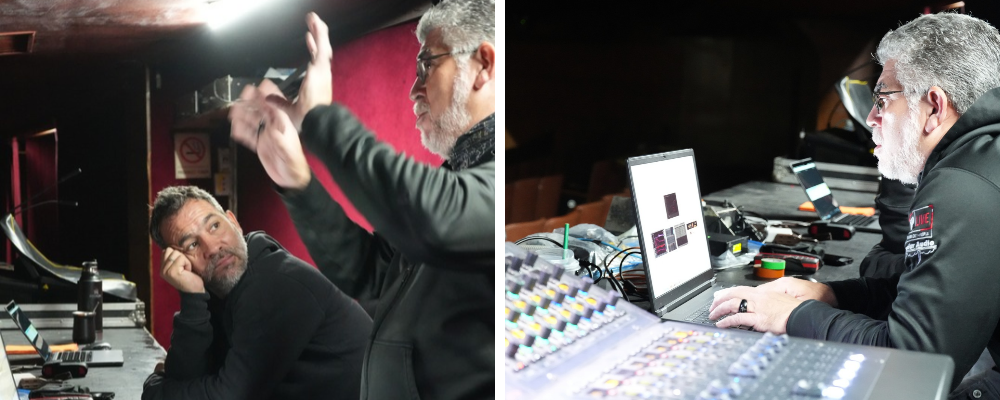
González began with something seemingly elementary: walking through the theater and clapping. “I really like clapping to hear the natural echo of the room and see where the potential problems are.”
The observation may seem simple compared with the software, measurement microphones and processing available, but it responds to an idea that runs throughout his methodology: “You cannot defeat the acoustics of the room.” Gran Rex has several particularly demanding areas. González points to low-frequency buildup in the Super Pullman and also around the FOH engineer’s position. There are also lateral surfaces capable of generating significant reflections if they receive too much energy from the system.
Another factor is the presence of the audience. An empty room does not respond acoustically in the same way as a full theater, so the calibration had to account for the fact that what appeared correct during adjustment would maintain its balance when thousands of people occupied the seats.
The challenge was to find coverage without unnecessarily feeding problematic surfaces. First coverage. Then equalization.
Paonessa summarizes the process as a full day of measurements at five points in the room, including front, middle, rear and upper positions. Based on those samples, an average was generated and the response was worked on to bring the behavior of the different zones closer together.
González insists that this order is fundamental. “There is no way to get the entire audience to hear the same way if the coverage is not correct. You have to start there.”
Only after verifying curvatures, angles and orientation does what he defines as “technical equalization” begin: measuring multiple positions, analyzing the average and adjusting the system based on that data.
The measurements showed, among other aspects, an excess of energy in the low-midrange area capable of affecting voice definition. Processing made it possible to clean up and balance that response, seeking more linear behavior across the audience area.
Operation and control are carried out through Performance Manager, which allows the JBL/Crown system to be configured, synchronized, optimized and monitored. In addition, designs created in Venue Synthesis can be integrated with Performance Manager, connecting the simulation work with system configuration.
But for González, graphics never represent the final step; after the computer comes listening to those who know the room.
Once measurement-based equalization is completed, a second stage begins that González calls “personal equalization.”
That is where the people who work daily at Gran Rex come in: “I depend heavily on them because they have been there much longer than I have. Once I do that part of my work, we move on to what I call personal equalization: the people who live here with the system, who practically sleep in the theater, what do they think?”
That is when decisions appear that no longer depend exclusively on a curve: “These are things that go beyond simply what the computer and the analysis tell you. You are already entering more subjective areas. You have to trust and depend on the people who are there, who know the place.”
The procedure synthesizes two dimensions of the project: technological precision and human experience. Venue Synthesis allows prediction. Microphones allow measurement. Performance Manager allows configuration and control.
But in the end, someone has to listen.
The mix position is also part of the audience
One of the specific objectives was to improve coverage at the FOH position.
“If where the engineer is located it sounds dull or lacks presence, that operator will EQ in a way that normalizes for where they are operating. That means that for everyone else in the front it can be a strident or very bright sound,” González reflects.
The new angling managed to deliver more direct energy from the main arrays toward that area. The result was significant enough that, during one of the subsequent tests, the under-balcony systems could remain switched off without the FOH listening area losing the necessary coverage.
For Paonessa, this is where the effect of those tenth-of-a-degree corrections became especially evident.
From Row 1 to the Super Pullman
All that process converges on an objective that can be explained without graphics or measurements.
Consistency. “The big difference is that all listeners, from the first to the middle, the back and the top, hear a very similar average,” Paonessa emphasizes.
That does not mean that every seat has exactly the same level. Physical proximity to the stage continues to exist. What is sought is to reduce the differences that make certain locations receive a clearly inferior experience compared with others.
González checked it again during one of the first shows performed with the new system. There were spectators seated even in the last rows of the Pullman.
For him, that image summarizes the purpose of the project.
A system for a theater that changes every night
The theater hosts musical productions from different genres and formats, as well as other types of shows. Therefore, the renewal could not be conceived around a single style. “The system is faithful to whatever you put through it,” Raúl states.
During adjustment, he used very different material —rock, Latin music, reggaeton and classical music— to check its behavior. In his evaluation, one of the strengths sought was particularly important for a venue of this type: vocal clarity.
Itelman highlights that the new generation of technology requires less amplification to handle an equivalent number of boxes and reduces physical space, cabling and racks. Added to this is the possibility of keeping the system connected and monitored over a network.
But he immediately returns to the point he considers the priority: “Audio quality is paramount. It is a very good system, but when it is adjusted as it should be adjusted, for me it is an unbeatable system.”
And he defines the result from the same perspective as González: “The first thing was for the coverage to reach from row 1 to the last row, to the last corner of the theater, with the same clarity. That is what we did with Raúl: adapt and angle the boxes so that this would happen. And the truth is that it is happening.”
That intersection between theater, distributor and manufacturer is one of the least visible keys to the installation. A permanent system does not end when it is switched on for the first time. It begins there.
A return that looks ahead
In 1991, Ángel Itelman made a decision that changed Gran Rex’s sound infrastructure: installing a permanent JBL system in the theater.
Thirty-five years later, he was there waiting to hear another generation of JBL occupy that space.
But the final purpose remains surprisingly simple. For the theater to work better. For the engineer to be able to make decisions while listening to a reliable reference. For an artist to find infrastructure prepared to receive different productions. And for the location of a seat not to determine whether someone will or will not be able to fully enjoy what happens on stage.
In a project shaped by three-dimensional models, digital processing, networks and high-precision measurements, González reaffirms all that work in one sentence: “If you paid to go to the show, everyone should hear.”
In the new Teatro Gran Rex system, that idea ceased to be merely a design objective. It became the criterion against which every decision was measured.


