
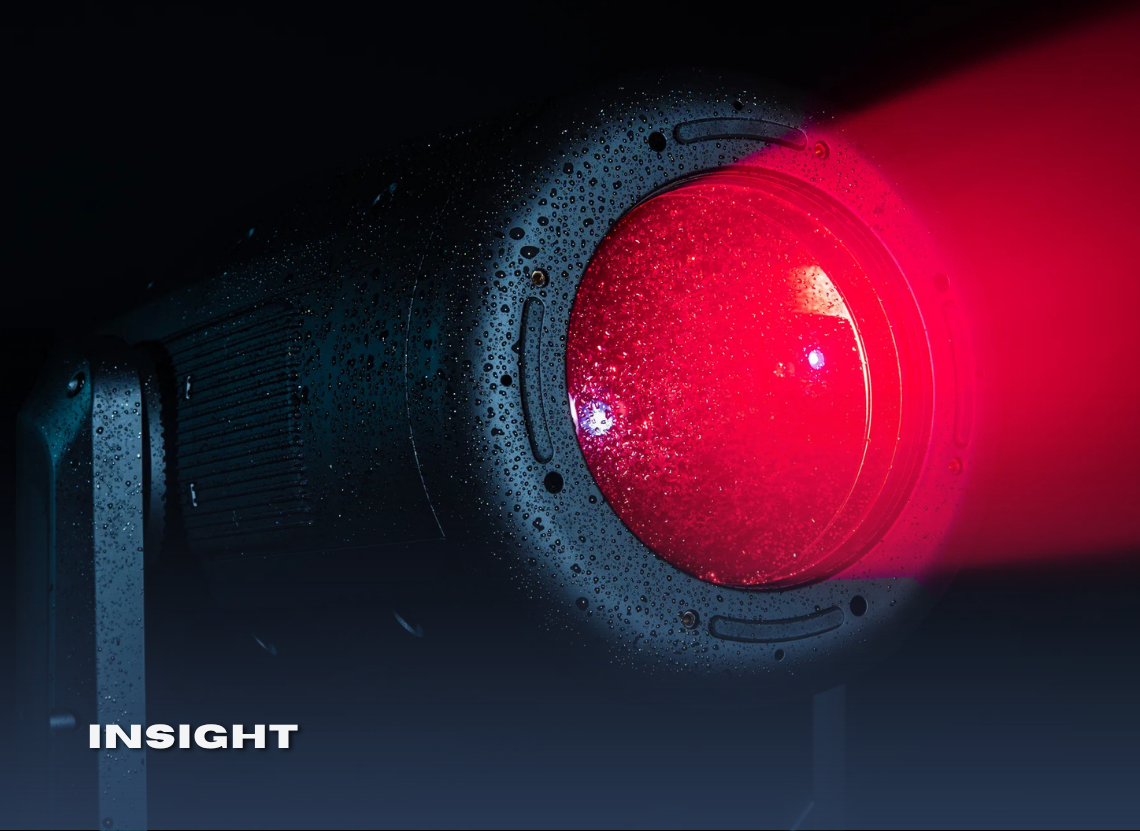
The PARAGON series from Elation proposes a new way of understanding the professional luminaire: rather than simply adding features, it integrates power, light quality, versatility, quiet operation, and ease of maintenance into a single platform. With technologies such as TruTone, interchangeable lenses, and Ultra Dimming, PARAGON seeks to reduce the compromises that have historically constrained designers and rental companies, shifting the conversation from “what can a luminaire do?” toward a much more relevant question: how much more can a single fixture do for a production?
For years, the evolution of professional moving lights was marked by a fairly predictable race: more power, more effects, greater zoom range, more functions, and, increasingly, protection for outdoor use. Elation’s PARAGON series proposes something different.
It is not simply about adding more features to a moving head. The real idea behind PARAGON seems to lie elsewhere: reducing the number of compromises that have historically forced designers and rental companies to choose between power, light quality, versatility, weight, noise, environmental protection, and ease of maintenance.
And this is where the technology developed by Elation begins to acquire a dimension that goes beyond specifications.
To understand what PARAGON really means and where this platform is heading, LATAM STAGE spoke with Abraham Levit, Director of ADJ Group Mexico, whose experience and leadership in the market help put these innovations into context and understand their potential beyond the technical specifications.
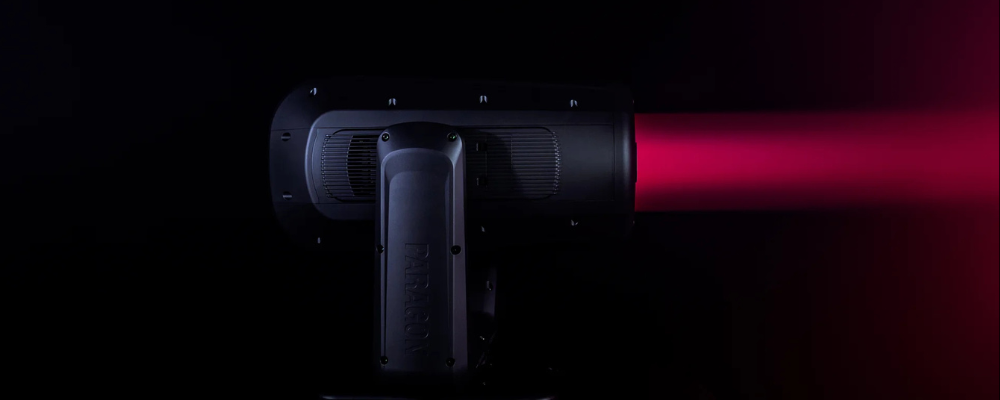
The problem was not having more features
A superficial look might lead us to define PARAGON as an extremely comprehensive luminaire. Technically, it is.
The family consists of three models: PARAGON S, PARAGON M, and PARAGON LT, with power ratings ranging from 550 W to 1300 W and outputs reaching approximately 50,000 lumens in the LT model.
But listing those figures does not explain why Elation decided to develop a platform of this kind. The interesting point lies in the integration.
PARAGON combines profile, wash, and beam capabilities through an interchangeable lens system; incorporates a variable-CRI white LED engine; mixes CMY; adds CTO, gobos, animation, prisms, frost, iris, and framing; offers quiet operation and IP54 protection; and, at the same time, maintains a relatively compact construction designed with servicing in mind.
In other words, the innovation is not necessarily in each individual function, but in the way all those functions coexist within a single luminaire.
This change in approach is significant. Because the professional market no longer simply needs luminaires capable of doing many things. It needs luminaires capable of doing those things well and, above all, capable of doing so without creating new production problems.
TruTone: tackling one of the historical compromises of LED
One of the central elements of PARAGON is TruTone, Elation’s variable-CRI technology.
The concept addresses a familiar contradiction in professional lighting: as higher color reproduction is sought, part of the available intensity is normally sacrificed.
PARAGON proposes to resolve that tension within the LED engine itself. The system uses different white LED arrays and allows the balance between performance and color fidelity to be dynamically adjusted, taking CRI from approximately 70 to 93.
This means that the same luminaire can prioritize power when a scene requires impact and, at another moment, shift toward more accurate color reproduction when the work requires fidelity in skin tones, scenery, or costumes.
The conceptual difference is important. We are not simply talking about a luminaire with “high CRI.” We are talking about a light source whose color behavior can become a creative and operational decision during the show. And this is probably one of the keys to understanding PARAGON.
The luminaire stops being a passive element that the designer selects before beginning the work and instead offers greater adaptability during operation.
Versatility that makes sense
The concept of an interchangeable lens may seem simple, but it has an important consequence.
PARAGON can be configured as a profile, PC, or Fresnel using interchangeable accessories. The system automatically recognizes the installed optic and adapts its operation.
In production terms, this can mean something much more concrete than a technological demonstration. It means fewer different fixtures are needed to handle the same production.
A rental company can use part of its inventory as profiles for one production, modify the configuration for a second application, and reuse the same luminaires as washes in another.
The value, then, lies in asset utilization. A luminaire that can take on different functions can reduce the need to maintain separate inventories for each application. And when talking about rental companies, that flexibility has an economic dimension that a technical specification sheet can hardly show.
For example, PARAGON S offers functions that solve everyday production problems. That is an important indicator. True versatility is not about having more buttons. It is about needing fewer compromises.
IP54: a decision that also speaks to strategy
Another interesting aspect is the choice of an IP54 rating instead of IP65. At first glance, it could be interpreted as a limitation. However, both PARAGON’s characteristics and independent evaluations point toward a different interpretation.
The platform was designed to provide sufficient protection for shows and temporary outdoor applications, without turning the luminaire into an excessively heavy or complex unit to maintain.
Internal access, HEPA filtration, and the ability to perform servicing tasks without having to put the unit through a specialized resealing process again are all part of the same philosophy.
Here we find an idea that runs through the entire PARAGON design: the engineering does not appear to pursue the maximum possible specification in every category, but rather the most useful balance for the professional user.
In that sense, IP54 is not necessarily “less” than IP65. For certain applications, it may simply be more appropriate. And this distinction is important to understanding PARAGON’s positioning.
Less weight is also more technology
Weight reduction is another element that can go unnoticed when compared with output figures.
PARAGON S weighs around 23 kg, while the M is approximately 32 kg and the LT 44 kg.
For a luminaire with these characteristics, weight is not a minor detail. In theater, it means less load on structures and positions that are difficult to access. In touring, it means less weight being transported. In rental, it means easier handling and potentially less strain on crews.
It is important to highlight PARAGON’s construction design, internal accessibility, and the details related to maintenance.
This allows us to identify another of Elation’s decisions: innovation is not only about what the luminaire does when it is switched on, but also about what happens when it needs to be transported, installed, configured, cleaned, or repaired. For a professional company, that time is also technology.
Silence is no longer exclusive to theater
Quiet operation is another aspect that deserves to be considered separately from the list of specifications.
Traditionally, extremely quiet luminaires were associated mainly with theater, opera, studios, and broadcast. But that boundary is shifting.
Corporate events, audiovisual productions, hybrid concerts, and shows incorporating cameras and streaming increasingly require greater control over noise as well.
PARAGON incorporates different ventilation modes, including a dedicated theater mode, while the new Ultra Dimming firmware takes that philosophy one step further.
The update incorporates a high-precision LED control system with a refresh rate of up to 25 kHz, seeking to combine smoothness at low intensity levels with camera-friendly performance.
This reveals another important shift: the contemporary luminaire no longer has to respond only to the human eye. It also has to respond to the camera. And that difference is changing the design of professional equipment.
Ultra Dimming: evolution after the hardware
There is something particularly interesting about the evolution of PARAGON: Elation did not present the platform as a finished and immutable product.
Development continued through firmware. Ultra Dimming is a good example. The company uses software to improve hardware behavior and refine aspects that directly affect the user’s perception: intensity transitions, low levels, camera performance, and quiet operation.
This raises a broader question about the future of professional lighting. Will we continue buying luminaires as finished products, or will we begin to consider them technological platforms that evolve throughout their useful life?
PARAGON clearly seems to be moving toward the second option.
From the hybrid luminaire to the platform concept
For years, the hybrid concept was sold as a value proposition: a luminaire capable of performing several functions and therefore capable of replacing different fixtures.
But hybrids also acquired a reputation: doing many things, although not necessarily at the level of a specialized luminaire. PARAGON attempts to challenge that equation.
Elation’s proposition does not appear to be simply “a fixture that does everything,” but rather a platform that seeks to maintain professional performance in each of its configurations.
Profile when precision is required. Fresnel when coverage is needed. PC when a different beam behavior is required. Higher CRI when color reproduction is a priority. Greater output when intensity dominates the scene.
And all of this within a single architecture. That is perhaps where the true innovation of PARAGON emerges.
What does this mean for Latin America?
This question is particularly relevant. The technology may be extraordinary, but its true value emerges when it finds a market capable of taking advantage of it.
For a region such as Latin America, where rental company inventories must respond to an enormous diversity of productions — concerts, festivals, theater, television, corporate events, institutional events, and touring shows — the ability to use a single platform for different applications can take on particular importance.
This is where the perspective of Abraham Levit, Director of ADJ Group Mexico, can provide a particularly valuable reading.
Rather than analyzing PARAGON solely through its features, his experience makes it possible to put into perspective issues such as the evolution of customer demands, the importance of versatility in professional inventories, the relationship between technology and return on investment, and, especially, which characteristics are beginning to become decisive for the Latin American market.
Because the question is no longer simply whether a luminaire can do more. The question is: how much more can a company do with the same inventory?
The real leap is not in the lumens
PARAGON enters the market with figures that attract attention: up to 50,000 lumens, variable CRI, a wide zoom range, multiple effects systems, interchangeable lenses, IP54, a high refresh rate, quiet operation, and a construction designed with servicing in mind.
But reducing PARAGON to that list would mean missing what is most interesting.
The technological leap lies in the relationship between those characteristics. More versatility without sacrificing precision. More power without turning the fixture into an unmanageable unit. More protection without making it unnecessarily complex to maintain. Greater color fidelity without abandoning performance. More functions without turning operation into an exercise in compromise.
Elation seems to have understood that the next generation of professional luminaires will not necessarily be the one with the most spectacular specification.
It will be the one that manages to solve more real problems with fewer compromises.
And this is where PARAGON takes on another dimension. It is not simply a new family of moving heads.
It is a statement about where professional lighting can evolve: more adaptable, more intelligent luminaires, more aware of the production environment and, above all, designed around the way professionals actually work.
The question that remains open is not whether PARAGON can replace certain luminaires. It is much more interesting: Is it beginning to change the way we think about what a professional luminaire should be?
Credits
Cover Photo: LATAM STAGE.
Inside Photos: LATAM STAGE.
The journalistic production, research, writing, editorial approach, and editing of this content are original works by LATAM STAGE and are protected by copyright.
No part of this content may be reproduced, copied, distributed, adapted, or published, in whole or in part, in any medium or format, without the prior written authorization of LATAM STAGE.


