
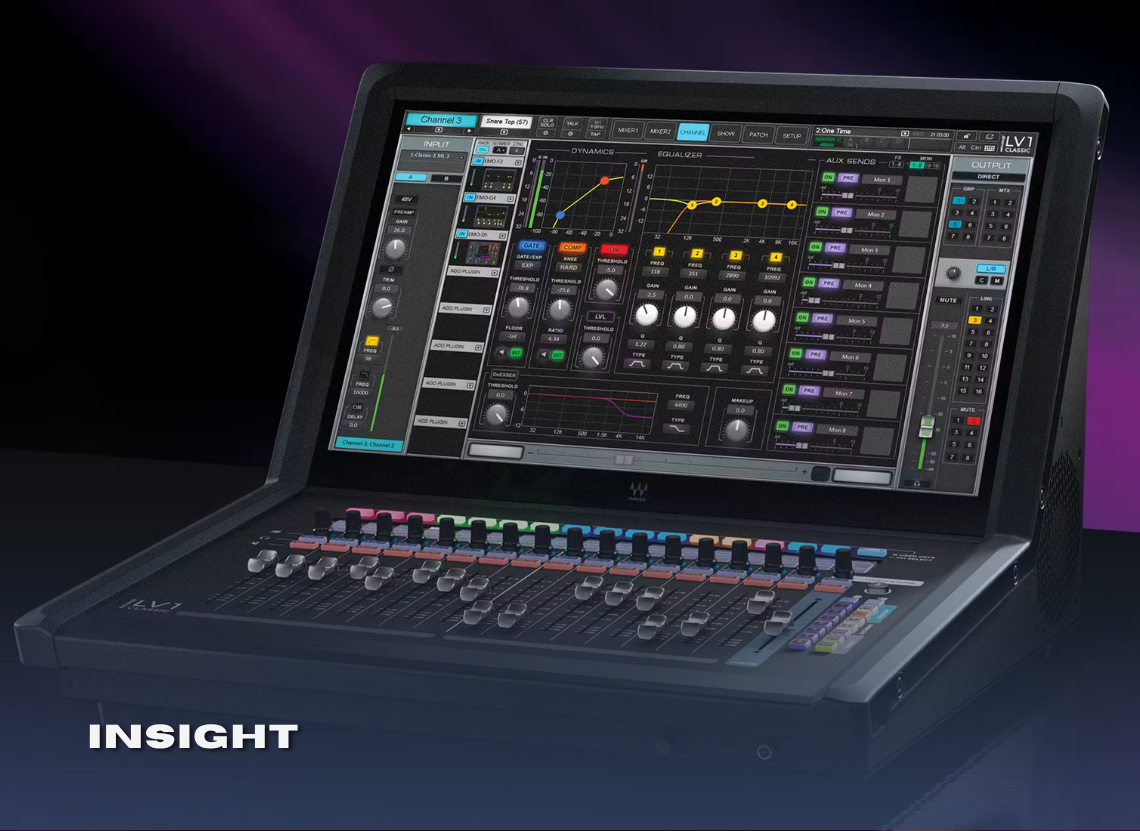
Waves brings a philosophy born in the studio to live sound: processing, mixing, control, and expansion within a single ecosystem. With the eMotion LV1 Classic, that idea arrives in a compact, transportable format designed to grow without forcing the user to change platforms.
For years, Waves built its reputation around an idea that transformed audio production: bringing highly sophisticated processing tools to a software-based platform. Its plugins became part of the everyday language of studios, broadcast, and live sound. But there was a particularity in its mixing proposition: eMotion LV1 was, until now, essentially a platform that each user had to build.
The logic was powerful. Users could choose the computer, DSP servers, input and output interfaces, control surfaces, and other components to build a customized LV1 system. That flexibility was precisely one of its greatest strengths. But it also implied a barrier: technical knowledge, configuration, compatibility, and, above all, the responsibility of integrating a system that is critical to a live show.
The eMotion LV1 Classic changes that equation. Waves took the LV1 engine, its SoundGrid architecture, its processing tools, and its software-based mixing philosophy, and brought them to a physical console conceived as a complete system. The result is a platform that combines a professional control surface, multitouch display, DSP processing, inputs and outputs, network connectivity, and a Waves processing library within a single unit weighing just 17.2 kg.
And that is, probably, the true importance of this product.
The change is not only in the console
The professional audio industry is accustomed to thinking of digital consoles as closed platforms: a certain number of channels, buses, processing, and inputs and outputs are purchased, and evolution depends largely on a new generation of hardware.
LV1 Classic proposes a different logic. Its architecture allows users to start with 64 mono/stereo channels and 44 buses, and subsequently expand the system through software to 80 stereo channels — 160 inputs — and 52 buses. The upgrade does not require replacing the console.
This changes the relationship between investment and growth. A rental company can start with a given configuration and expand its capabilities as its clients’ demands increase. An engineer can acquire a platform that meets their needs today and tomorrow support larger-scale projects. And a production can add processing or I/O without completely rebuilding its system.
In other words, the hardware is no longer the limit to the system’s evolution.
Understanding the technology from the market
To understand what this philosophy represents in the Latin American market, LATAM STAGE spoke with Luis Duque, CEO of Wholestage, Waves distributor for Mexico, who helps us put the concept behind the eMotion LV1 Classic into context.
From this perspective, the importance of LV1 Classic is not only about the number of channels or the number of plugins available. The central point is integration.
Waves brings together on a single platform elements that traditionally could be found separately: console, processing, DSP, networking, remote control, stageboxes, and production tools.
And that makes it possible to think of the console not as an isolated piece of equipment, but as the center of an ecosystem.
A console with studio DNA
One of the characteristics that differentiates LV1 Classic is that its processing philosophy does not simply attempt to reproduce the traditional concept of a digital console.
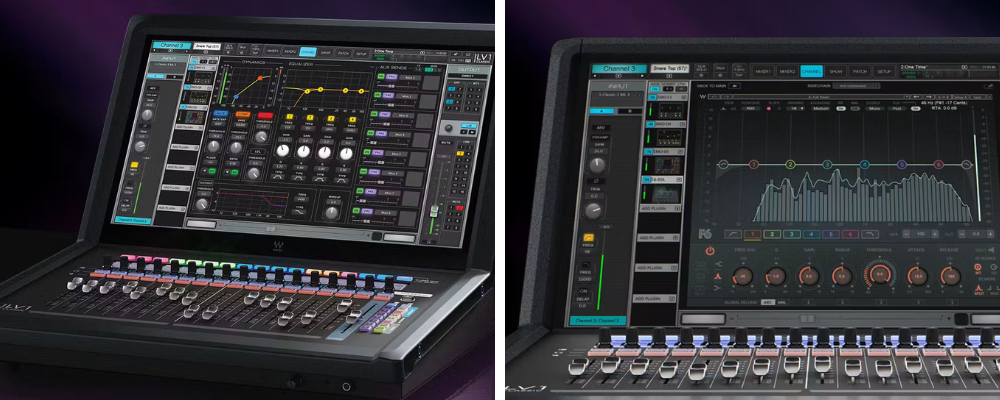
In LV1, each channel features a processing rack with up to eight slots, and processors can be freely organized. There is no obligation to accept a fixed processing chain. A plugin can be used on any channel or bus where it is needed.
This may seem like a workflow issue, but in reality it is much more important.
An engineer coming from the studio world finds a familiar logic in LV1: select a processor, insert it, modify its position within the chain, and build the sound according to the needs of each source.
But now that philosophy is transferred to the stage. F6 Dynamic EQ, Waves Tune Real-Time, X-FDBK, PSE, R-Comp, H-Delay, Renaissance Reverb, Doubler, GTR3, Magma Tube, and other tools are part of an ecosystem that can be expanded to more than 160 plugins geared toward live sound.
The difference is that processing ceases to be an external element and becomes an integral part of the console.
Processing as part of the instrument
Here another of the points that make LV1 Classic a particularly interesting proposition emerges.
Waves did not design this console simply to “mix.” It designed it to process the show.
Tone correction, dynamics, feedback control, bleed reduction between microphones, real-time vocal tuning, effects, creative processing, and monitoring tools are all part of the same architecture.
Even functions that traditionally required additional equipment can be incorporated through software. This is the case with eMo IEM, which allows certain monitor outputs to be converted into an immersive in-ear mixing system, or Dugan Speech, which integrates gain automation for up to 64 microphones into the LV1 workflow.
This opens a particularly interesting door for theaters, corporate events, churches, festivals, and productions where the number of microphones and the need for automatic control can grow rapidly.
SoundGrid: the piece that makes the idea possible
To truly understand LV1 Classic, it is necessary to look beyond the control surface.
The conceptual heart of the system is SoundGrid, Waves’ network architecture for transporting audio and distributing processing with very low latency.
The console can be connected to IONIC stageboxes, additional DSP servers, and expansion devices, as well as integrated with Dante and MADI environments through specific interfaces. It is also possible to connect multiple LV1 systems to share I/O between FOH, monitor, and broadcast positions.
This is particularly relevant because it transforms LV1 Classic into a modular platform even though its physical format is all-in-one.
The paradox is interesting: it is an integrated console that preserves the modular philosophy of LV1.
If a production needs more inputs, I/O can be added. If it needs more processing, SoundGrid servers can be added. If it needs more control surface, another bank of faders can be added. If it needs Dante or MADI, the corresponding devices can be incorporated. The system grows around the console.
Power that fits in a suitcase
In a market where productions travel more and more and logistics costs carry increasing weight, size is also a technological variable.
LV1 Classic measures approximately 560 × 402 × 561 mm and weighs 17.2 kg. That relationship between capability and size is one of its most compelling arguments. Waves even positions it as a console compact enough to be transported on commercial flights with suitable packaging.
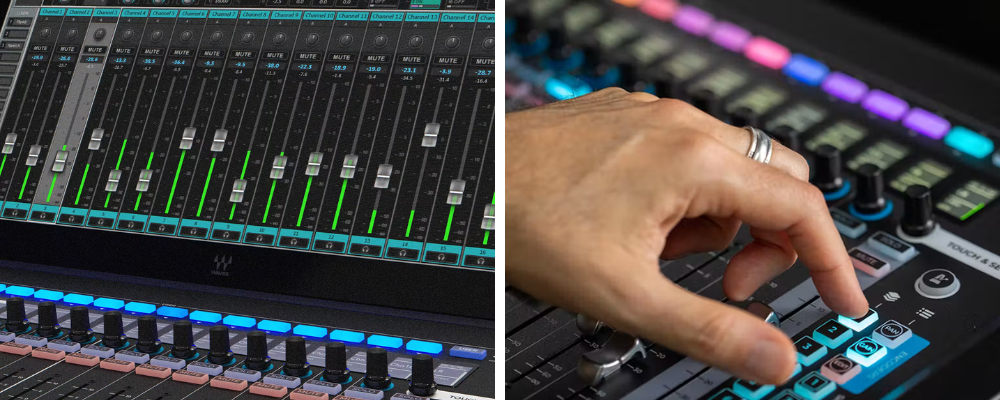
But what matters is not simply that it is small. It is that it does not seem small in terms of architecture. The surface incorporates a 21.5-inch multitouch display with up to 1000 nits of brightness and 17 100 mm motorized faders, in addition to encoders, LCD displays, and dedicated controls.
The screen allows users to work with an enormous number of parameters without multiplying the physical size of the console. At the same time, physical faders maintain the tactile relationship that live engineers continue to demand.
It is a combination of software flexibility and the physical response of hardware.
Two worlds that finally meet
Perhaps one of the most interesting aspects of LV1 Classic is that it eliminates a boundary that remained quite clearly defined for years.
On one side was the world of live consoles: physical surfaces, faders, buses, scenes, and integrated processing.
On the other was the studio world: plugins, processing chains, automation, recall, creative tools, and enormous freedom to design the sound.
LV1 Classic attempts to unite both worlds.
And it does so from a platform that can also store up to 1000 scenes, offers Recall Safe and Scope Filters, incorporates DCAs, mute groups, multiple outputs per channel with delay alignment, and allows recording of up to 16 tracks directly to USB or up to 128 channels through an external computer.
The result is a console that does not only think about the moment of mixing, but about the entire workflow.
The console also leaves the console
Another element that reveals Waves’ philosophy is remote control.
MixTwin allows users to replicate system control from an iPad; MyFOH allows levels, panning, and sends to be managed from different points in the venue; and MyMon allows musicians themselves to control their monitor mixes.
This is particularly relevant in productions where the console is no longer necessarily the only place from which decisions are made.
The FOH engineer can be at their position. The monitor technician can work from the stage. And the musician can have direct control over their mix.
The console moves from being a mixing surface to becoming a distributed production interface.
The real differentiator: not being locked into the hardware
There is a phrase that can summarize much of the LV1 Classic philosophy: the console does not end where the hardware ends.
The user can start with the included resources and subsequently add I/O, processing, plugins, control, immersive monitoring, or new capabilities.
The current version of the system can even expand LV1 to 80 stereo channels, 160 inputs, and 52 buses through a software upgrade.
This possibility is particularly relevant at a time when the industry is seeking smarter investments and systems capable of keeping pace with technological changes without forcing users to replace all their equipment.
In that sense, LV1 Classic does not simply propose buying a console. It proposes buying a platform that can evolve.
Is it truly revolutionary?
The word “revolutionary” is often overused in the industry. A console does not become revolutionary simply because it has many channels, a large screen, or a huge number of plugins.
In the case of LV1 Classic, the argument is different.
The innovation lies in having transformed a historically modular, software-based architecture into an integrated, physical, and transportable product, without abandoning the expansion possibilities that made LV1 attractive from its beginnings.
In other words: Waves did not eliminate modularity; it made it optional.
For those who need simplicity, there is a console ready to work. For those who need to grow, there is SoundGrid. For those who need more processing, there are additional servers. For those who need more inputs and outputs, there are stageboxes and converters. For those who need more channels, there is software expansion. For those who need more surface, faders can be added.
And for those who need a different mixing experience, there is the entire universe of Waves processing.
That concept can be especially valuable for a Latin American market where versatility, mobility, and the ability for a single system to handle different types of work carry increasing weight.
A new way of thinking about a console
The eMotion LV1 Classic arrives at a time when live sound is moving away from thinking in terms of individual pieces of equipment and beginning to think in terms of ecosystems.
The console, stagebox, DSP server, network, plugins, monitoring, remote control, and recording no longer have to be separate worlds.
Waves puts them under a single architecture. And that is probably the greatest value of LV1 Classic: it does not attempt to compete solely by having more channels or more processing. It attempts to change the way we understand what a digital console should be.
A console can be hardware. It can be software. It can be a network. It can be a processing server. It can be a production tool.
And it can be all of those things at the same time. The eMotion LV1 Classic is precisely the physical embodiment of that idea.
Maximum power. Compact format. And a platform that can continue growing after it has left the box.
Credits
Cover Photo: WAVES
Inside Photos: WAVES
The journalistic production, research, writing, editorial approach, and editing of this content are original works by LATAM STAGE and are protected by copyright.
No part of this content may be reproduced, copied, distributed, adapted, or published, in whole or in part, in any medium or format, without the prior written authorization of LATAM STAGE.


