
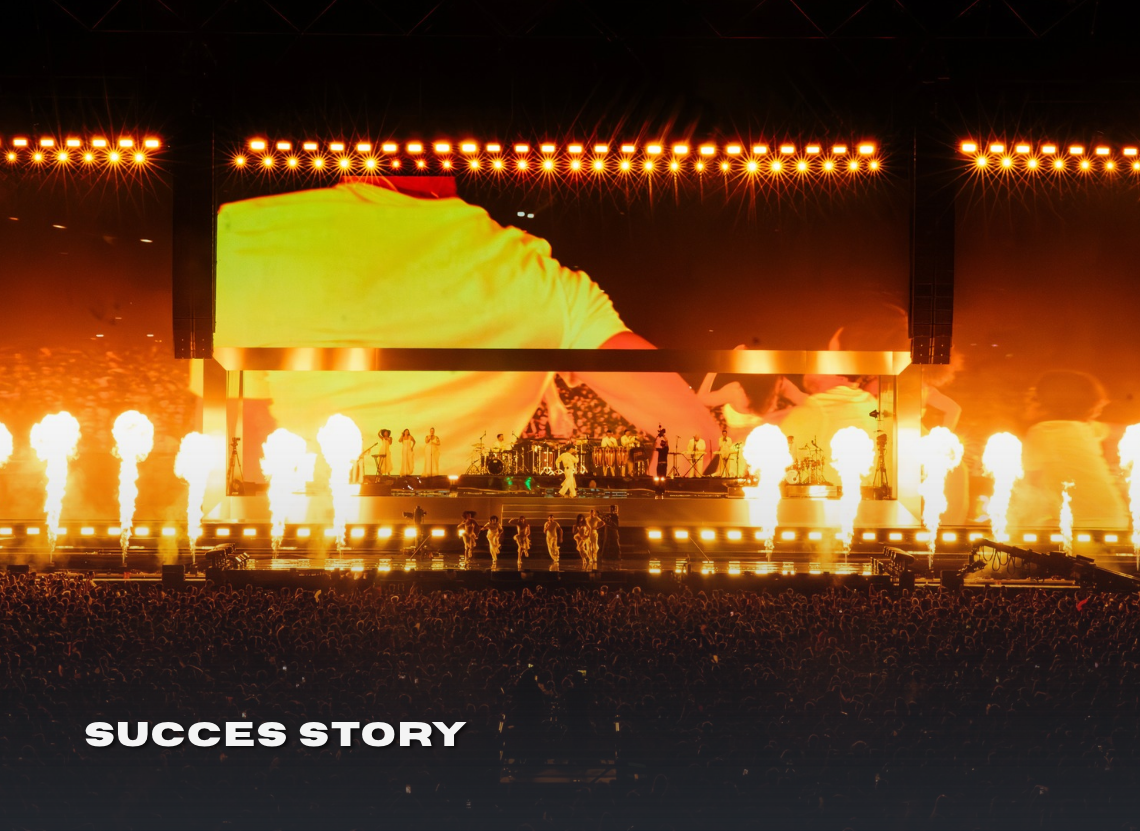
Argentina – Designing a stadium show involves much more than deciding what will happen on stage. For YOK Studios, every project begins with an idea that moves through floor plans, 3D models, previsualization, lighting, video, set design and programming before becoming a show. Mauro Pujia, Félix Sainz and Peter Ehrlich explain how MA Lighting fits into this process, supporting the studio from the earliest design decisions through to the execution of large-scale productions.
YOK Studios defines its work around a simple yet far-reaching idea: creating a language through design. This perspective helps explain why its projects can span stadium concerts, festivals, fashion, dance and other forms of live entertainment without being associated exclusively with a single discipline.
Founded in Buenos Aires by designers and directors Mauro Pujia and Félix Sainz, and later joined by producer Peter Ehrlich, the studio has built its own identity in just a few years while expanding its work into international projects.
Their individual paths are different, although they converge on one point: none of them sees a show through the lens of a single tool.
Félix began in the technical department at Fuerza Bruta, where he also trained to take on lighting duties. He later studied film and focused on cinematography, while his career moved toward show direction and design. Mauro entered production at a very young age and found his first specialization in lighting. At 20, he moved to Europe, studied at the Accademia del Teatro alla Scala in Milan, and continued developing his skills in lighting, drafting and design before working in Spain and Los Angeles.
When they met professionally, they shared a concern that would ultimately define the studio: thinking about a show through design rather than through an isolated discipline.
“I wouldn’t classify myself as a lighting designer as such, but rather as a director,” Félix explains when describing his career.
This way of understanding their work also explains the role MA Lighting plays within YOK. The platform does not appear only when it is time to program the fixtures. It is part of a workflow that begins much earlier and aims to preserve information and creative intent as the project moves from one stage to the next.
From two individual paths to a shared methodology
The professional relationship between Mauro and Félix began before YOK formally established its identity as a studio. During 2022, they worked together on different projects, and the following year their collaboration intensified until it became an almost daily working relationship.
For Félix, one of the turning points came in 2023, when several projects confirmed that they were both moving in the same creative direction. Mauro describes it as the moment when an ambition that had previously been individual began to become visible to the industry as well: they were no longer being brought in solely for a specific specialty, but to design.
Peter’s arrival further expanded that structure. From the general production side, his role brings another perspective to the projects: turning creative proposals into processes that can be sustained within the real-world conditions of production.
This complementarity is particularly important because YOK does not work from a fixed formula.
“Someone brings an idea, and we develop it together. Mau brings an idea, or I bring an idea, and we keep building on it,” Félix explains.
Throughout this process, renders, documentation and previsualization are not simply presentation materials. They are part of building the show, allowing an idea to be discussed, refined and ultimately transferred to the technical system that will execute it.
MA Lighting long before reaching the console
For Mauro, MA Lighting is essential precisely because of what happens before the show is programmed.
YOK follows a detailed methodology during the design phase. Floor plans, patch information, 3D models and cue points are all part of an information structure developed in the studio, which must subsequently continue through to programming.
“It’s a control system that gives us a great deal of peace of mind, because there are many processes we carry out before we get to programming the show, including offline,” he explains.
This is especially important for the studio. If a considerable part of the project has already been developed, starting again from scratch when the programmer comes on board would make little sense.
“We have a very methodical and meticulous workflow here at the studio. There are many specific elements within that larger area that are transferred directly to the console, from patch information to 3D models. We use cue points extensively to mark cues, and that also transfers very smoothly to MA.”
The platform thus serves as a bridge between two stages that YOK considers part of the same process: designing and programming.
A house that was never meant to be a house
The work carried out for Rels B offers a concrete example of this methodology.
YOK’s relationship with the artist was already well established. The studio had worked on his previous tour and subsequently participated in different stages of a new phase in his career. When development began on the Madrid stadium show, the starting point was not a technical plot but an idea from the artist himself.
Rels B wanted a house. He even made an initial sketch, but for Mauro and Félix, the question was not how to literally build that house on stage. The interesting part was understanding what he wanted it to express.
The artist’s new material presented a more introspective and personal perspective. The house therefore became a way to convey intimacy, closeness and a connection with the audience that had to be maintained even within the scale of a stadium.
“We started stripping away the literal interpretation, in a good way, and asking ourselves: ‘What do we have left if we want people to feel as though they’re in a little house without actually putting a little house there?’” Mauro recalls.
That exercise ultimately shaped a large part of the stage design.
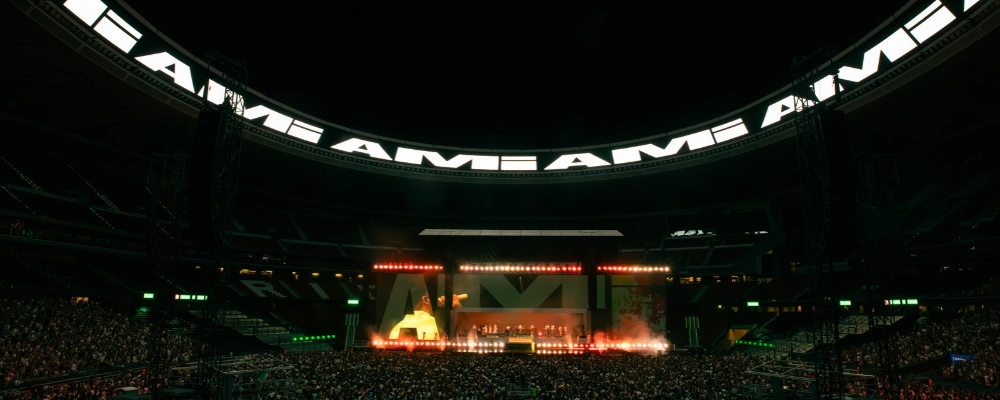
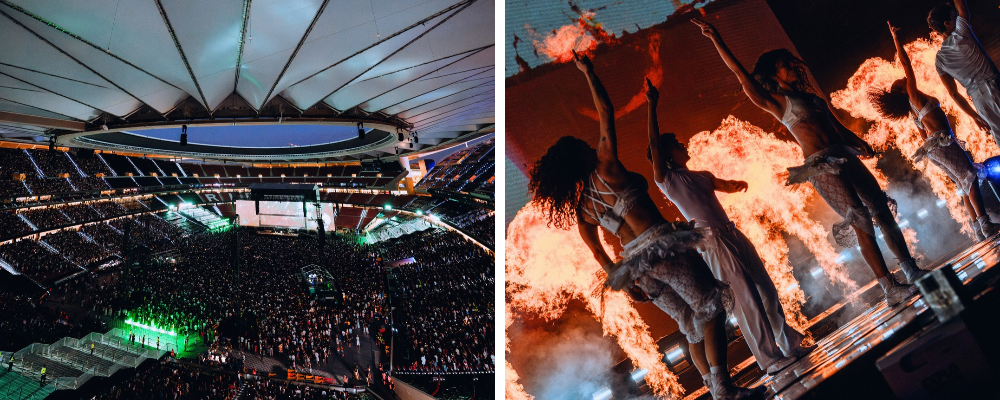
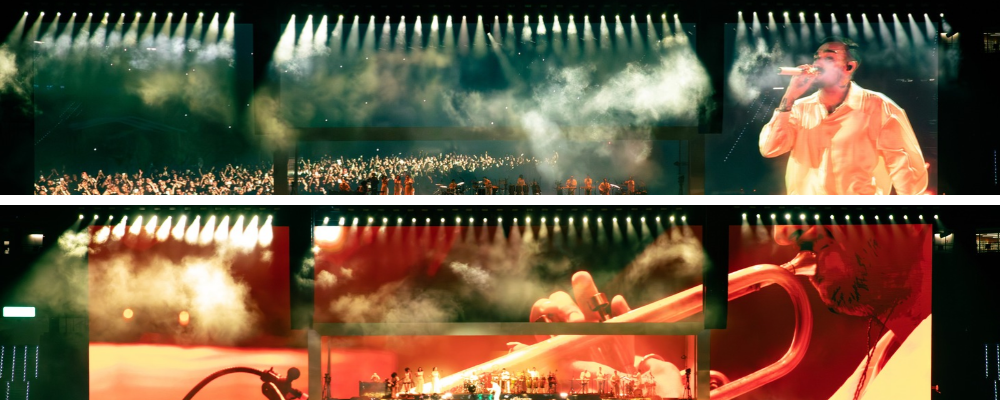
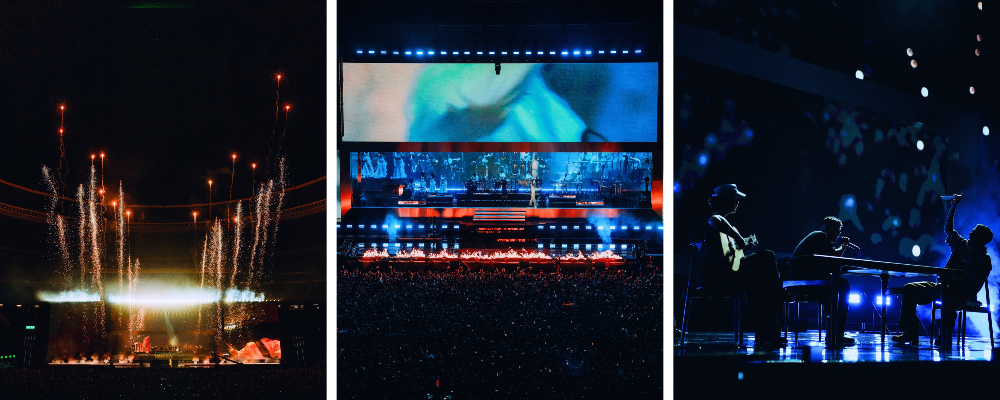
Closeness would not be created by means of a long runway extending through the audience. Instead, the stage was conceived as a large box, with different layers capable of transforming, and a screen approximately 50 meters wide by 15 meters high that could amplify the artist’s presence and his connection with spectators in the stadium’s different sections.
For this production, YOK Studios took on production design, including lighting, set design and stage design. The team included Campitx for CAD development, G. C. Gironelli for the studio’s production coordination and management, Vilardell Lighting for lighting direction, programming and operation, and Esteve999 as lighting assistant.
The resulting working structure brought together the studio’s creative vision and specialized professionals capable of turning that proposal into a technically achievable show.
Scaling up an idea without losing it
The stadium show was not conceived as a completely separate project from the work YOK had previously developed around Rels B’s new material.
An earlier listening session for the album had helped establish part of the visual language. Some elements could be transferred directly; others needed to be reinterpreted as the scale changed.
Mauro offers a particularly clear example from the lighting design. During that listening session, they had used a large overhead softbox with a strong visual presence. Reproducing that solution literally in the stadium would not have made the same sense, but they wanted to preserve the quality of a full, solid and even overhead light that was central to the concept.
“In the stadium, that softbox lost its meaning for many reasons, not only technical and production-related ones, but creative ones as well. We needed to preserve that full, solid overhead lighting in a particular area. So suddenly, it ended up becoming a ceiling with 60 or 80 strobes.”
The example neatly summarizes YOK’s approach: transferring a design does not mean copying its elements. It means identifying what made them meaningful and finding another way to achieve the same effect when the space, scale or technical conditions change.
The stage designed for Madrid incorporated multiple moving layers. At the proscenium was a screen the team called the “plug,” which could move up and down and visually close off the large screen behind it. Beyond that were lighting sections, a moving curtain, additional lighting structures, scenic elements resembling wooden walls, and another screen at the back.
Each element played a role in different scenes. The intention was also to avoid making the stage box excessively deep. The elements had to remain relatively close to the proscenium so that spectators viewing the stage from different angles could perceive its depth and transformations without losing sight of the back of the stage.
But compressing so many layers created another problem.
“All these sections and all these motors need to be spaced apart. There was a risk of things colliding and not ending up in the right place. So the technical team, rigging and everyone involved had to rack their brains over it: if I move something 30 centimeters here, something at the back moves 25.”
Félix identifies this millimeter-by-millimeter adjustment as one of the project’s major technical challenges. It was compounded by the tight load-in schedules typical of a stadium production and the need to coordinate set elements with automation.
With so many interdependent variables in a production, arriving at the venue with as many decisions as possible already worked out is no longer simply an advantage. It becomes part of what makes the project feasible.
From floor plans to the programmer
This is where the advance workflow Mauro describes takes on another dimension. By the time the programming specialists come on board, YOK already has a substantial amount of information prepared for the transition to MA.
According to Mauro, transferring files and data helps “clear the way” for both the studio and the programmer.
But this preparation is not intended to restrict the person taking over the project. Quite the opposite: the aim is to provide a solid foundation that allows them to contribute their experience, judgment and creativity.
One of the ideas that comes up repeatedly when listening to Mauro and Félix is the value they place on collective work.
Mauro explains it through a football analogy: if the programmer has been brought in to play a particular position, part of the studio’s job is to give them the conditions they need to perform in that role for as much of the match as possible.
“We like to hire people who are not just programmers, but who feel that their contribution goes beyond programming.”
Preparing the information properly therefore has an additional benefit: it frees the specialist from tasks that can be handled in advance, allowing them to spend more time on the work they were brought in to do.
For the Rels B stadium show, Vilardell Lighting took charge of lighting direction, programming and operation, with Esteve999 as lighting assistant. Their involvement represents precisely the stage at which YOK’s design must find its final expression in the control system and on stage.
The team knew the programmer’s track record through colleagues and understood that the scale of the show demanded someone capable of meeting particularly high expectations.
“It’s a stadium; it’s enormous. We want you to shine. Give that person everything: the best boots, the best jersey, so they can play without worrying. Because the reality is that these are projects where expectations and the bar are extremely high.”
Within this framework, MA provides the shared environment where all the previous preparation comes together with the programmer’s specific work.
Félix’s relationship with the platform offers another perspective on the same process. Unlike Mauro, who has experience programming from an earlier stage in his career, Félix does not come from that background. His path has been more closely connected to direction, design and working alongside specialists capable of turning his ideas into lighting behavior.
However, one thing has remained constant.
“MA has always been the tool that has accompanied me throughout this entire process. From day one, I have never used another tool.”
His choice of words is significant. For him, the platform does not replace the programmer or turn the designer into an operator. It provides the space where the two can meet.
“My role has always been to work alongside artists who, in my view, are very talented, as well as programmers and operators who have supported me in developing an idea. Not simply to execute that idea, but to contribute to it.”
He adds: “Always through MA as a tool and as the core.”
Peter observes the process from a different position. As a producer, he is not involved in programming in the same way, but he is involved in making it possible for the ideas developed by the studio to reach the stage.
From this perspective, he highlights how YOK has evolved by incorporating tools and expertise that make it possible to anticipate the final result with increasing precision.
Previsualization serves a dual purpose here. Internally, it allows decisions to be evaluated before the constraints of the load-in come into play. For the client, it helps answer a much simpler but equally decisive question: what will it look like?
Peter specifically highlights the team’s ability to bring what is presented in advance closer to what ultimately happens in the show.
This level of predictability does not eliminate the unexpected challenges inherent in live production, but it does mean that a substantial part of the show has been assessed before entering the stadium.
For Peter, this capability is part of the workflow that clients value and that helps build continuity in working relationships.
When the design travels
YOK’s international growth added another reason to systematize this process.
Mauro identifies the arrival of projects outside Argentina as one of the studio’s major leaps forward. Expansion meant working with new teams and collaborators in other markets, while ensuring that the creative direction retained a recognizable identity.
In this context, an organized workflow allows the project to move forward without depending entirely on the same people always occupying every role.
Documentation, previsualization and the transfer to MA provide a shared structure: when a programmer joins the project, they receive work in which many decisions have already been articulated and can continue developing them within the system.
This is especially relevant for a studio that sees collaboration as part of its identity. Bringing in new talent should not mean losing the language of the design; it should allow other perspectives to become part of a shared creative foundation.
MA Lighting occupies a central place in YOK’s methodology. Floor plans, models, previsualization, patch information, cues and programming form a continuous process that accompanies the project from an abstract idea through to execution.
MA does not enter the process when the console is switched on. It is there earlier, when the show still exists in plans, models and conversations; it continues when that information reaches the people who will program it, and remains there when the design finally leaves the screen and takes over the stage.
For a studio seeking to create a language through design, that continuity is essential: allowing an idea to pass through the entire process without getting lost along the way.
Production credits — Rels B, Madrid stadium
YOK Studios
• Production design (lighting, set design and stage): @yokstudios
• Studio CAD design: @campitx
• Studio production management and coordination: @gcgironelli
• Lighting direction, programming and operation: @vilardell_lighting
• Lighting assistance: @esteve999
Project creative and production team
• Creative direction: @skinnyflakk, @heyyysanti, @pogo.creative.co
• Show direction: @ardihla
• Show direction assistant: @juan.zorraquin
• Musical direction: @omaralcaide
• Content direction: @outerview, @daturover, @moreradebes
• Art direction: @isadellc
• Styling: @michaelorigados
• Choreography direction: @soffmae
• Production direction: @brianselleipro, @menosquecero
• Production management: @brianselleipro, @ordezkaezina
• Production coordination: @cler.millan
• Technical production: @brianselleipro, @matirodriguez_rmrr
• Show caller: @elmarcelsolecasas
• Show caller assistants: @xavibuxeda, @albavicky__
• Stage manager: @manuusanon
• Tour manager: @rubensziontifik
• Video content programming and operation: @jldpaula
• CCTV video direction: @purafurgo_ivan
• Steadicam camera operation: @j.rubio95
• Lighting crew chief: @unaibarriorey
• P.A. operation: @xavi_lek
• Monitor operation: @aitor_gzlez_aguinaga
• Multitrack operation: @andresyuma.flp
Service companies
@smartfussion, @inlights_ar, @pascualinestructures, @twincamprointernational, @discomfa, @kaosstage, @call_and_play, @therollingstage, @tricolorproducciones, @tarsrigging.
Cover Photo: LATAM STAGE
Inside Photos: LATAM STAGE
The journalistic production, research, writing, editorial approach, and editing of this content are original works by LATAM STAGE and are protected by copyright.
No part of this content may be reproduced, copied, distributed, adapted, or published, in whole or in part, in any medium or format, without the prior written authorization of LATAM STAGE.


