
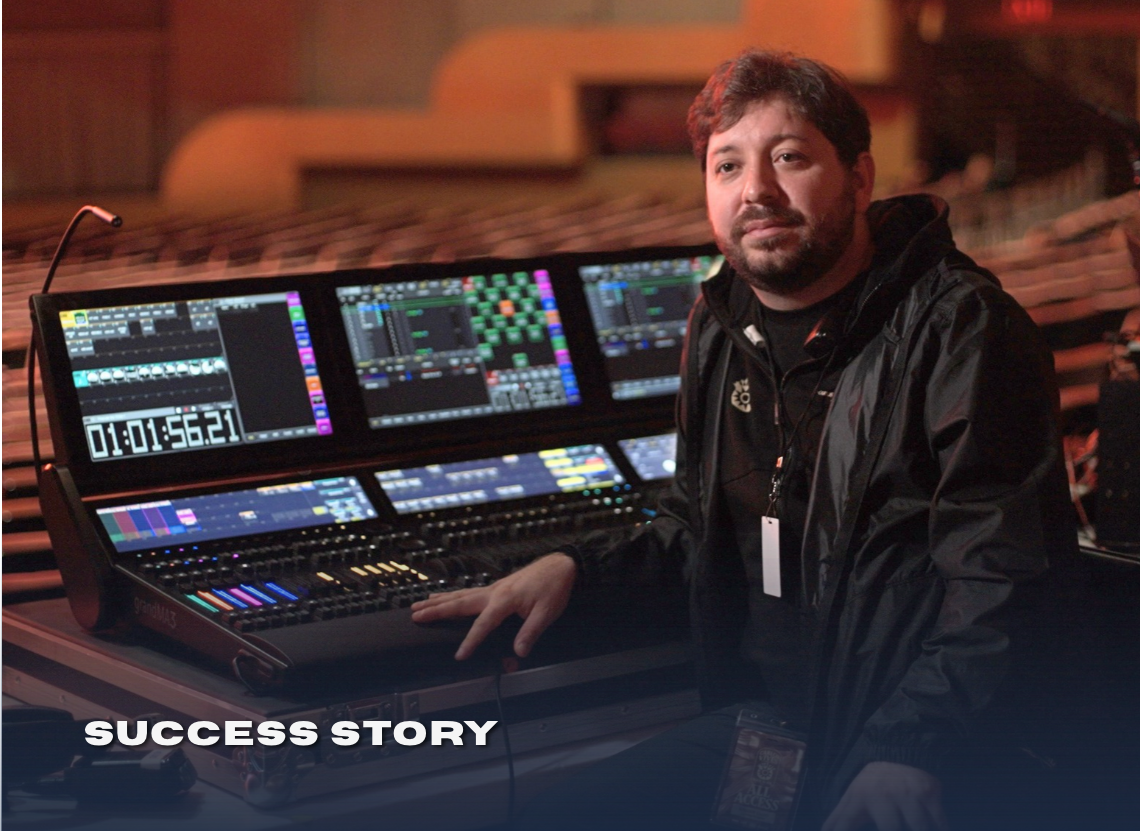
Colombia – Carlos Vives’ Tour Al Sol proposes a journey through more than three decades of music following the path of the sun. Behind that idea, William Gallo built a design in which lighting, video, tracking and audio work together to accompany the artist without competing with him. A concept that found in Wholestage a technology partner capable of bringing together solutions from MA Lighting, zactrack and L-Acoustics, along with the support needed to turn each idea into a real production tool.
There is a phrase that William Gallo repeats when he talks about the “Al Sol” Tour and that, to a great extent, explains the entire design: the light should accompany and not compete.
The idea takes on particular significance at a time when major tours are often measured in square meters of screens, number of fixtures and dimensions of their structures. For the Colombian designer, Carlos Vives’ lighting director for several years, the starting point was precisely the opposite: to build a large-scale show without allowing technology to displace what should truly occupy center stage: Carlos Vives, La Provincia and music deeply connected to Colombian identity.
The concept was in dialogue with the very nature of the Tour Al Sol, a tour celebrating more than three decades of his career and proposing a musical journey through different moments of the day. For Gallo, that idea became the starting point for an entire visual language.
From film to lighting
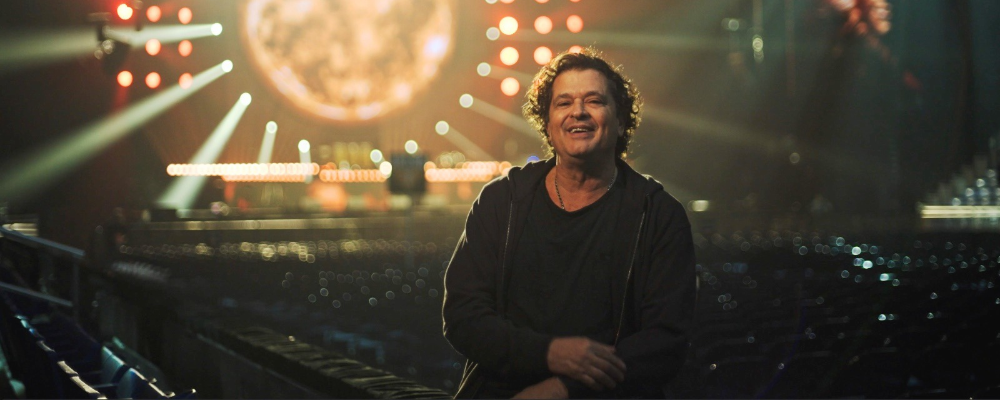
Before reaching the biggest stages, William Gallo imagined his career behind a screen. He studied film and television with the intention of working in post-production, attracted by editing, visual creation and photography. A class devoted to studio techniques began to change that path when he came into contact with lighting fixtures, color temperatures and the construction of environments.
At the same time, he was working at an events company where he began to become involved with lighting consoles, theatre and stage productions. Over time, those two worlds ended up coming together.
His audiovisual training never disappeared. Today it remains present in the way he designs, thinking not only about what the audience sees in front of the stage, but also about what passes through a lens.
“That knowledge of lenses, cameras, light and photography has helped me tremendously. It has helped me create atmospheres and make the photography I apply to my shows have meaning and criteria.”
A project with Colombian singer-songwriter Santiago Cruz ultimately shaped that path. Working in theatres, he found a territory where he could explore intensities and atmospheres with greater subtlety, until he recognized his own language. Years later came Carlos Vives, with whom he began working toward the end of the pandemic and with whom he has already shared several tours.
Following the path of the sun
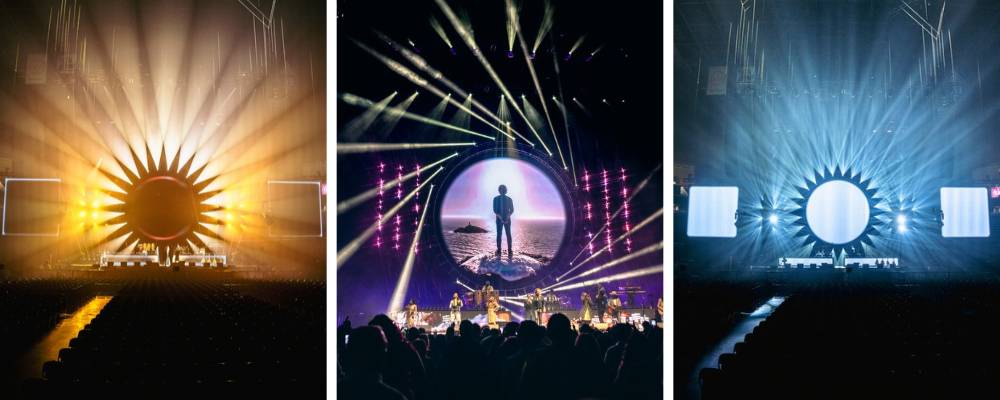
The first indication came from Vives himself: the concept had to be the sun.
The reference was Santa Marta, on Colombia’s Caribbean coast, its sunrises and sunsets and the artist’s relationship with that landscape. But turning that idea into a stage took time.
Gallo recalls developing between 17 and 18 proposals. There were screens, video floors and different configurations until the team decided to stop and return to the beginning. Instead of continuing to add elements, they began by building the emotional curve of the show.
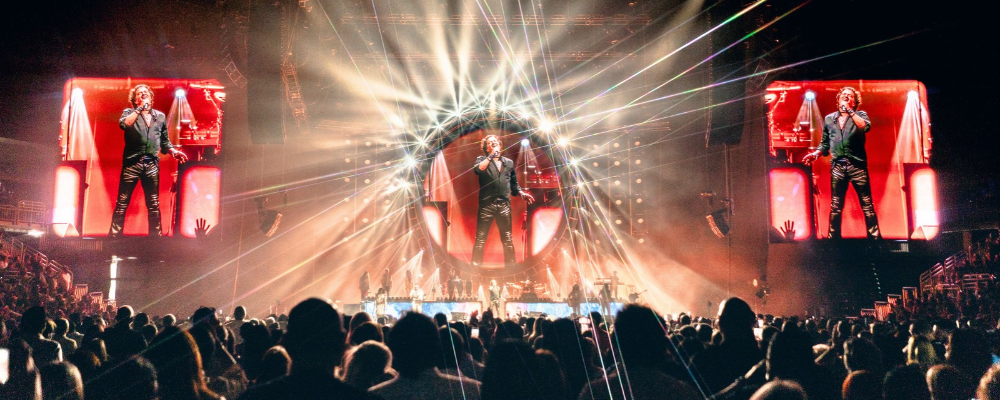
The setlist was organized into four acts: sunrise, midday, sunset and night. From there, lighting, video and music could share the same journey, with color temperature as the common thread.
“We started working on the setlist and the show by acts. The first act is sunrise, the second is midday, the third is sunset and the fourth is night. The common thread was going to be color.”
Gallo’s cinematic background naturally reappeared: if the light changes throughout the day, the stage should do the same. The tones of sunrise could not be the same as those of midday, while sunset had to emotionally lead toward a night understood as another stage within the same cycle.
The music followed that structure. The classic vallenato songs and songs associated with Colombia’s warmer regions found their place during the moments of greatest solar intensity. The design thus stopped being a succession of illuminated songs and became a journey.
Fewer elements, greater intention.
Once the narrative was defined, the stage emerged.
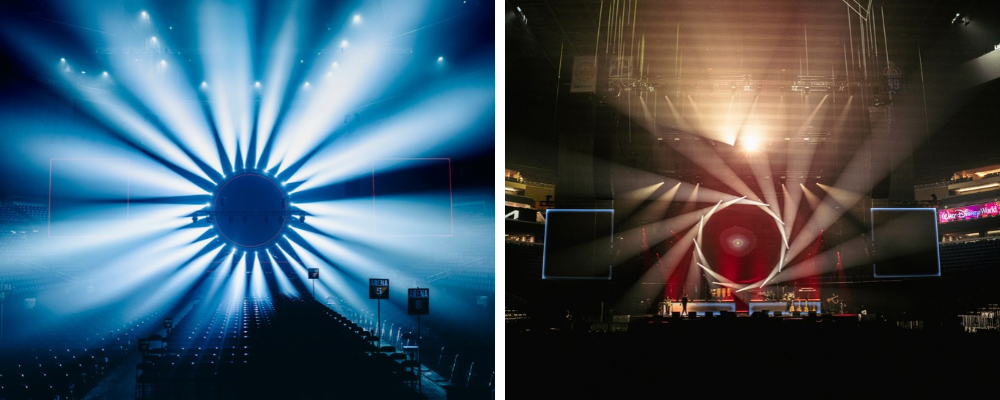
The sun had to be physically present, and a large circular structure ultimately became its main visual element. Around it, the decision was to reduce: less screen, fewer fixtures, simple risers, a carefully designed floor and a closed-circuit video system with a strong photographic direction. Lasers, effects and pyrotechnics were added when the music required the scale to be expanded.
Spectacle was not supposed to come from accumulation. “Why have 500 lights and not 40? Why have 600 meters of screen and not 100? We really wanted to focus on keeping the attention on Carlos and La Provincia.”
With fewer elements, every tool had to justify its presence. And there was another difficulty: the concept had to survive an international tour.
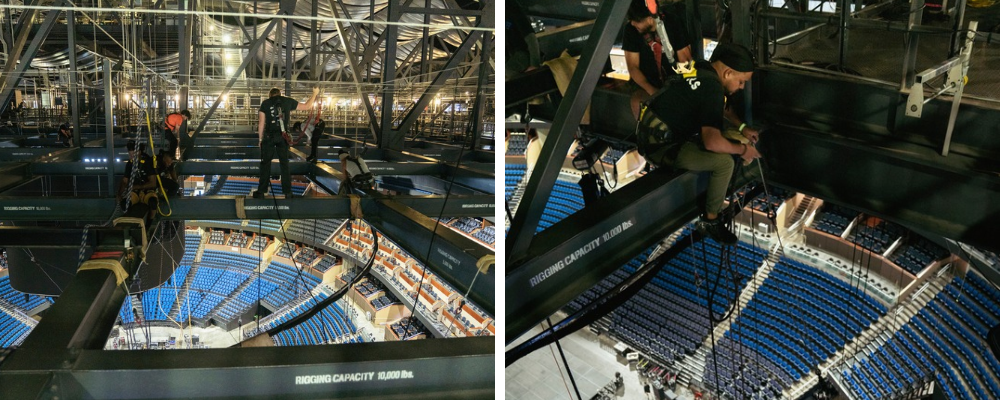
Transporting a large circular structure between countries was not practical, mainly because of its volume. The solution was to develop a concept capable of being rebuilt locally, maintaining its proportions and allowing the programming to be transferred to fixtures installed in unusual vertical positions.
The internal directive was clear: “The circle always goes.” There were venues where implementing it was particularly complex. In Seattle, for example, actual conditions forced the team to review assumptions made during pre-production. At the same time, the setup times required that the structure could be operational within extremely tight schedules.
The first shows served to refine the process until it became a reproducible methodology. Something similar had to happen with the programming: changing cities could not mean rebuilding the show from scratch.
MA Lighting as the brain of the show
William Gallo has been working with MA Lighting since approximately 2012. On Tour Al Sol, he operates a grandMA3 full-size as the main console and a grandMA3 light as backup, within a programming structure built almost entirely around timecode.
Lighting, movements and different actions are executed according to an automated structure that allows precision to be maintained night after night. During the show, Gallo maintains direct intervention mainly over the intensities of the key light for cameras.
“The only way for us to achieve the consistency we have is timecode. There is no other way.”
The platform also plays a fundamental role in dealing with changes in venues and equipment. Gallo highlights tools such as Recipes, presets stored in Fixture Type, Phasers, offsets and XYZ programming, which allow him to quickly adapt the show’s behavior.
During the United States and Canada leg, traveling with a stable configuration, he could resolve much of the position adjustment from a single preset. When the design has to be reproduced with different equipment, Recipes makes it easier to transfer its logic without redoing each programming element.
For Gallo, the ability to create his own macros and plugins adds even more flexibility. But grandMA3 is not limited to controlling fixtures: within Tour Al Sol, it functions as one of the points from which different areas of the show begin to connect.
When Carlos’ position transforms the scene
The integration of zactrack added another dimension to the project. Carlos Vives wears a tracker and his position can become information for different systems. Video receives data, fixtures react and different visual elements can respond to his movement.
In “La Foto de los Dos,” for example, as Vives moves across the stage, lights, visuals and particles are progressively activated to accompany the nostalgic character of the song.
The team even experimented with the digital sun’s eyes so that they would follow the artist. The function worked technically and was used in several shows, but certain positions generated a visual result that did not fully convince them. They decided to temporarily remove it and continue developing it.
The experience summarizes a fundamental idea of the project: the fact that something is technically possible does not necessarily mean it should remain on stage. Undoubtedly, technology is subordinate to the concept.
A network to connect the show
The interaction between departments turned the network infrastructure into one of the tour’s most important technical challenges.
Lighting sends DMX to platforms such as Notch and TouchDesigner, while the position information generated by zactrack is shared with video and audio. Gallo spent several weeks structuring an architecture capable of handling different protocols reliably.
The system relies on fiber and detailed documentation of IP addresses, connections and information flows. Even the workflow during setup depends on this integration: zactrack must be calibrated before other departments can properly access its data.
“The most complex thing on this tour is having a very robust network that speaks all the protocols without something failing. We have a bible with absolutely everything marked and a very robust fiber system precisely for that.”
It is precisely at this point that Wholestage stops being understood merely as a technology supplier.
Wholestage, within and behind the ecosystem
The relationship between William Gallo and Wholestage goes back around six or seven years and became particularly strong after his joining Carlos Vives’ team.
With Luis Duque and Jonathan del Villar, CEO and CTO of Wholestage respectively, that relationship grew around a specific dynamic: present an idea, analyze what is needed and find a way to test it.
When Gallo expressed his interest in exploring zactrack, a few days later he already had access to the system and the support needed to begin working with it.
“With Luis, things don’t remain a project. Everything gets executed; we talk about it and it happens.”
That same logic extended to MA Lighting and the rest of the tools used by the team. Wholestage provided access to equipment, a laboratory, training and specialized support.
Gallo also highlights the assistance of technicians such as Moisés Aguilar and Juan Daniel, who are available when questions arise during development or in the middle of production.
For him, that is the true differentiator. “I think the best thing about Wholestage isn’t the equipment. It’s their technical support, their human support.”
More than simply making different technologies available to the project, Wholestage thus became a partner in exploring how to use and connect them within a production that continually seeks to take them toward new applications.
“Tour Al Sol” extends that integration into sound with L-Acoustics solutions, including L Series and the L-ISA immersive environment, within the technology ecosystem supported by Wholestage.
Gallo does not intervene in the specific decisions regarding sound design, but from lighting there is an important point of connection: the systems share information. Position data generated by tracking can travel to audio via PSN, integrating into the same infrastructure that connects lighting and video.
Thus, MA Lighting, zactrack and L-Acoustics stop functioning as independent universes. Each contributes a different layer, while Wholestage provides the technological support that allows them to be integrated into a single production.
An image that also tells the story
Although “Tour Al Sol” was not conceived as a streaming broadcast, the closed-circuit system plays a fundamental role in the audience experience.
That work was developed together with Sergio Rodríguez, Carlos Vives’ audiovisual director, and Gonzalo, responsible for visuals. Cameras, lenses, color temperature and photographic treatment were studied to ensure that stage and image shared the same intention.
One of the greatest creative challenges was maintaining that continuity. During programming, there is always the temptation to add a color or effect because it works visually, but “Tour Al Sol” required respecting the desaturated palette and chromatic curve established during pre-production.
The design had rules, and maintaining them was part of its identity.
And designing also means knowing how to read the artist. Carlos Vives actively participates in the creative process and can introduce changes even during soundcheck. He does not always do so using technical terms: he may ask for sadness, mystery or for the light to behave like a drizzle.
Gallo’s job is therefore to translate sensations. On one occasion, Vives asked for it to look as though it were raining on stage. Gallo responded by combining gobos and intensity effects. The artist’s response was immediate: “It was exactly what I imagined.”
After several years of working together, knowing those references is as important as mastering a console.
“Beyond the deep knowledge I may have of the console, you have to know how to read what he wants.”
That understanding is also connected to the culture behind the songs. For Gallo, working with Carlos Vives requires understanding vallenato, the Colombian Caribbean and the meaning that certain compositions have for different generations.
A way of creating.
Translating that universe into lighting requires something no platform can automate.
Gallo describes it as a combination of technique and sensitivity. Knowing how to program allows him to solve much of the work, but it does not determine what color a song needs, when a scene should breathe or when it is better for a fixture to remain still.
He sums it up in one phrase: “Taste cannot be programmed.”
And perhaps that is also the explanation for why “Tour Al Sol” chose to move in the opposite direction from accumulation. The possibilities of grandMA3, zactrack, interactive video, networks and immersive audio allow increasingly complex scenes to be built; the creative challenge remains deciding when to use them.
For Wholestage, the tour demonstrates in practice the value of an ecosystem that does not end with MA Lighting, zactrack or L-Acoustics, but also includes the knowledge, experimentation and support necessary for those technologies to interact with one another.
For William Gallo, however, the final measure remains in front of the stage.
After dozens of productions a year, a show can become routine for those working behind the scenes. For someone in the audience, it may be the first concert of their life, or even the last. That is why Gallo often stays at front of house, watching how people leave.
There is a moment that summarizes that perspective. When Vives performs “El Caballito,” Gallo sees adults who knew the song when they were children and who now sing it alongside their own children. He himself remembers seeing it on television when he was eight or ten years old and, decades later, finding himself designing the lighting for the artist he once watched from a screen.
In “Tour Al Sol,” that memory coexists with tracking, timecode, fiber, interactive video and immersive audio. Wholestage provides the ecosystem that makes it possible to bring ideas to the stage; William Gallo uses those tools to build a journey in which technology finds its true place when it stops competing with the music and begins to accompany it.
Credits
Cover Photo: William Gallo
Inside Photos: William Gallo
The journalistic production, research, writing, editorial approach, and editing of this content are original works by LATAM STAGE and are protected by copyright.
No part of this content may be reproduced, copied, distributed, adapted, or published, in whole or in part, in any medium or format, without the prior written authorization of LATAM STAGE.


