
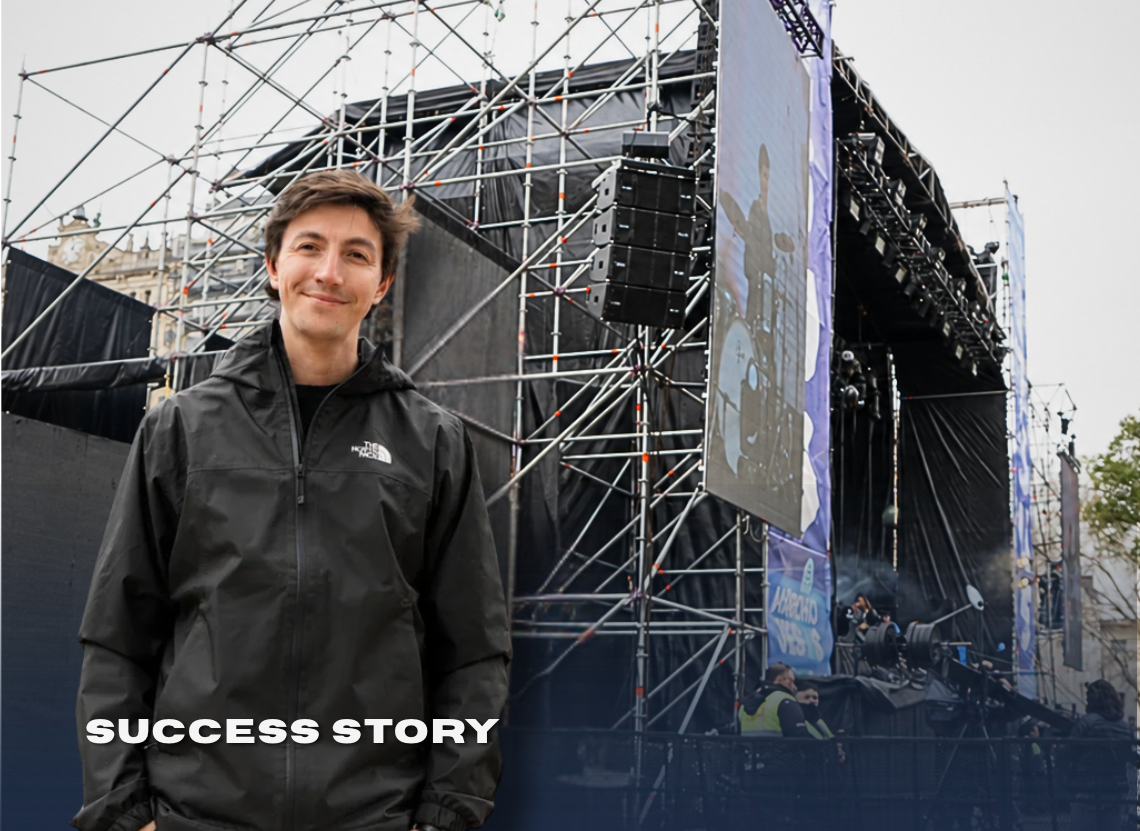
Argentina – Sonorizing a large-scale gathering at Plaza Congreso required power, reach, and clarity in a complex urban environment. CAIO found the answer in dBTechnologies, with Todomúsica as its technology partner in a deployment designed to deliver sound uniformly across the entire venue.
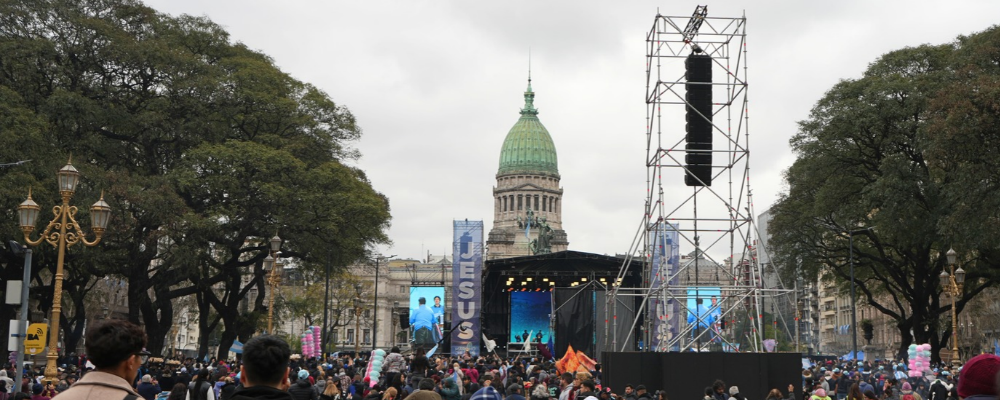
Plaza Congreso presented a setting that was as expansive as it was complex. Throughout the site, the presence of buildings, trees, monuments, and different obstacles affected sound propagation, while the system had to deliver the same clarity both to those in the front rows and to audiences in the most distant areas.
For CAIO, the company responsible for providing sound reinforcement for the Christian Marcho por Jesús gathering held on Monday, August 17, in Buenos Aires, the objective was clear from the beginning: to build a coverage system capable of reaching the entire area without losing uniformity.
With more than four decades in the industry, the company took on a production in which speech played a central role, but had to coexist with a live band and an area approximately 250 meters long. The system therefore needed to combine sound pressure, range, frequency response, and intelligibility within an acoustically complex environment.
Juan Francisco Olivares, CAIO’s Services Manager, summarizes the objective with a phrase that seems simple but defines much of the work carried out: “The main challenge is for everyone to hear evenly. And then, for it to be loud enough to meet the client’s actual needs.”
To achieve this, CAIO once again placed its trust in dBTechnologies, a brand it has worked with since 2022 and around which it has progressively built an inventory prepared for large-scale productions. Behind this evolution is Todomúsica, dBTechnologies distributor and CAIO’s technology partner for years, supporting both the company’s investments and the systems’ technical support.
250 meters where power had to remain uniform
The design started from a specific need: to cover the entire area without concentrating all the sound pressure around the stage.
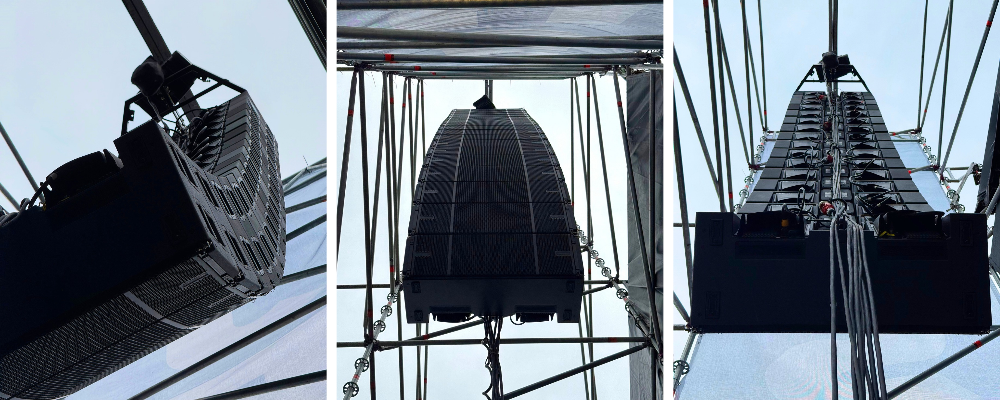
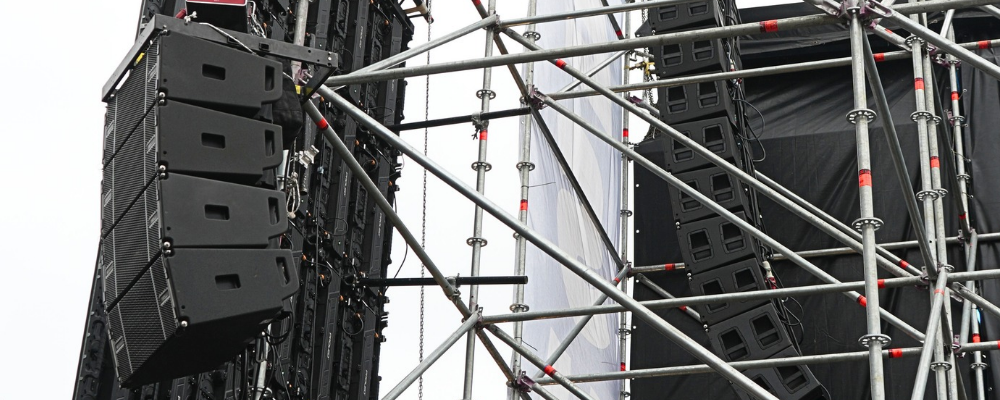
CAIO deployed 18 VIO L212 loudspeakers per side as the main system, flown approximately 13 meters high. Four VIO L212 units were added as frontfills, designed to cover the area immediately in front of the stage.
To extend the system horizontally, four VIO L1610 units per side were used as outfills, while a delay system consisting of 12 VIO L1610 units extended coverage toward the most distant areas of the venue.
The number of enclosures was only part of the solution. Their distribution and height were equally important.
In a space with these characteristics, lowering the system would have concentrated too much energy in the first audience areas and limited its ability to project toward the more distant zones.
“The height allows you to reach farther, which is what we particularly needed for this event,” explains Olivares. Even with only four frontfill units, the central area immediately in front of the stage was properly covered.
The goal was not simply for people to hear the event from the opposite end of the square. The challenge was to preserve the greatest possible uniformity throughout the entire distance. The power was available; the task was to distribute it.
A square that also becomes part of the system
Plaza Congreso introduced conditions that do not exist in a conventional open field.
Buildings along its sides, large trees, monuments, and other structures inevitably interfered with sound propagation. Each element could generate losses, reflections, or changes in system behavior.
CAIO had previously worked at the same location with a configuration of 12 boxes per side, but this production presented a different scale. The objective this time was to properly extend coverage and reach the Avenida de Mayo area with a consistent level.
“The solution therefore combined the reach of the main arrays with strategically positioned reinforcement systems. Instead of requiring the main system to solve the entire distance on its own, outfills and delays allowed the coverage to follow the audience as it moved farther away from the stage. In a production of this scale, having more sound pressure does not automatically solve the problem if that energy cannot be distributed in a controlled manner. And that was precisely one of the central points of the design,” emphasizes Juan.
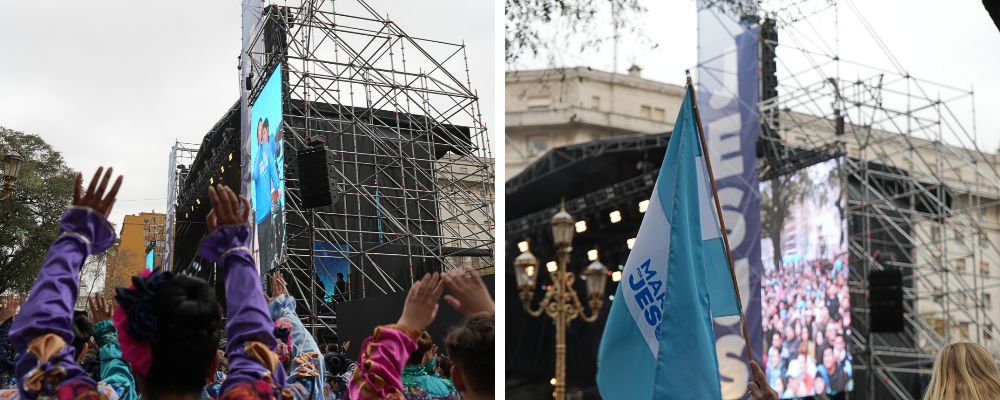
Speech had to reach the audience as clearly as the music
The content of the event imposed another condition. The preaching required a level of clarity that would allow the spoken word to be properly understood throughout the venue. But the same system also had to immediately respond to the demands of a live band.
Those two needs determined much of the technical selection. “dBTechnologies allows us to achieve excellent intelligibility during the preaching, in this case with the pastors, while also providing a great frequency response for the entire band,” comments Olivares.
The system was therefore not designed exclusively for speech, nor was it focused solely on the sound pressure required for music. It had to maintain definition when the spoken message occupied center stage and respond with breadth when the band came into play.
According to Juan, “That versatility is one of the reasons why dBTechnologies systems have progressively become part of our operation.”
An active system designed to grow into larger productions
CAIO’s relationship with dBTechnologies began to take shape in July 2022, when the company was looking to make the transition to a larger-format system that could support the growth of its productions, particularly outdoors.
CAIO already had a commercial relationship with Todomúsica, and the process even included a visit to the factory in Italy together with the distributor to learn more about the brand’s solutions firsthand.
At that time, one of the decisions was to move toward an active platform. For the company, having integrated amplification and processing made it possible to simplify part of the infrastructure required to deploy large-format systems and was particularly functional in dealing with the logistical demands of outdoor productions.
The first major addition was the VIO L212. In addition to its performance, CAIO found in the system a balance between power, dimensions, and weight that matched the needs of an operation beginning to take on increasingly larger projects.
“The weight of the enclosure is key because it weighs almost nothing compared with what a box of that size can weigh. In every way, we were always interested in the product, and we also liked the brand,” recalls Olivares.
The investment, however, did not stop with that first purchase. As new productions emerged, CAIO expanded its inventory according to specific needs, progressively building an ecosystem that could be configured in different ways depending on the project.
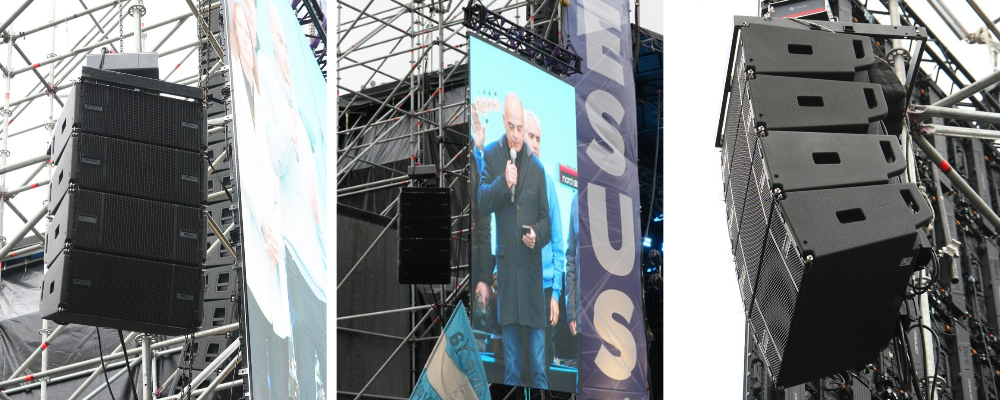
VIO L212 and VIO L1610: two scales within the same ecosystem
As productions grew, the need for a more compact solution emerged. The addition of the VIO L1610 expanded the possibilities of the inventory and made it possible to combine both families according to the characteristics of each application.
At Plaza Congreso, this complementarity was clearly demonstrated. The VIO L212 carried the main system, while the more compact VIO L1610 format proved particularly suitable for the outfills and delay.
Olivares acknowledges that either of the two models could have been used for some of those positions, but they opted for the L1610 because its dimensions allowed them to address those requirements more compactly while maintaining performance close to that of the larger system. He also recognizes a difference in low-frequency response between the two, with greater presence from the L212.
This combination reflects the logic with which CAIO developed its dBTechnologies inventory: not simply adding boxes to have greater quantities, but incorporating formats that make it possible to build scalable systems and assign each solution to the function where it is most efficient.
At Plaza de los Dos Congresos, this strategy allowed the L212 to be used where reach and response were priorities, while the L1610 extended coverage in positions where a more compact format offered operational advantages.
Knowing what is happening 250 meters away
The physical extent of the deployment made it equally important to know what was happening within the system.
For Juan Francisco, one of the tools supporting his operation with dBTechnologies is Aurora Net: “The system also allows us to see live what is happening to or within each enclosure. And that gives us greater control when we are live,” Olivares says.
In a configuration distributed across approximately 250 meters, this monitoring takes on an especially concrete meaning. The ability to observe the system’s status from a central position provides information that allows the team to react to any eventuality without relying exclusively on physical checks of equipment located at different points throughout the venue.
The system’s performance has also generated reactions from those who are not yet familiar with the platform. “The few people who don’t know it are surprised by how it actually sounds,” says Olivares.
An inventory that grew alongside the projects
Plaza Congreso was not the first large-scale production in which CAIO put this evolution to the test.
The addition of the VIO L1610 was precisely related to the need to expand the inventory in response to increasingly larger projects. Olivares recalls the Copa Libertadores final held at River Plate Stadium as one of those turning points, when the scale of the deployment led the company to add new units rather than relying exclusively on rented equipment.
The decision was part of a strategy that would continue in the following years: building an inventory capable of adapting to different scales and configurations.
Another example came with the Supercross World Championship held at the Oscar and Juan Gálvez Autodrome, where CAIO deployed 64 VIO L212 loudspeakers. There, the technical scenario was completely different: in addition to covering a large area, the system had to perform in an environment affected by the high sound levels generated by the motorcycles.
These are different applications, but they demonstrate the same evolution. From a stadium to a racetrack or an urban square, the company continued expanding its dBTechnologies ecosystem so it could be reorganized according to the demands of each production.
Plaza Congreso once again put that strategy into practice: L212 and L1610 did not operate as independent systems, but as components of an inventory progressively built to scale.
Todomúsica, a technology partner behind the growth
Throughout this journey, Todomúsica’s role goes beyond equipment supply. CAIO was already a customer of the company before it began working with dBTechnologies. When the time came to look for a system that would allow the company to take a new step forward, that existing relationship also became the bridge to the brand.
The visit to Italy was part of that initial process, but the relationship continued afterward through technical support and day-to-day assistance.
“The truth is that, with Todomúsica, we have had a friendship for many years. Whenever there was an issue, they responded immediately. If we have had to change something, they change it without any problem. We are always very satisfied with them, especially with Eliseo Ciciniello, Sales Manager at Todomúsica. Every time we have needed him, he has always responded immediately, regardless of the time or our needs,” says Olivares.
Power to keep growing
The result at Plaza Congreso confirmed that evolution. After the event, the feedback received was positive and opened conversations for future projects. The focus is already on expanding the inventory again, but the objective is more specific than simply having more boxes: to have a true dBTechnologies ecosystem.
After more than 40 years in the industry, CAIO continues to build the capacity to take on increasingly larger projects.
With dBTechnologies as its sound platform, the challenge was not simply to make a square sound: it was to ensure that, from the front rows to the most distant areas, distance would not become a barrier to hearing clearly.
Credits
Cover Photo: LATAM STAGE
Inside Photos: LATAM STAGE
The journalistic production, research, writing, editorial approach, and editing of this content are original works by LATAM STAGE and are protected by copyright.
No part of this content may be reproduced, copied, distributed, adapted, or published, in whole or in part, in any medium or format, without the prior written authorization of LATAM STAGE.


