
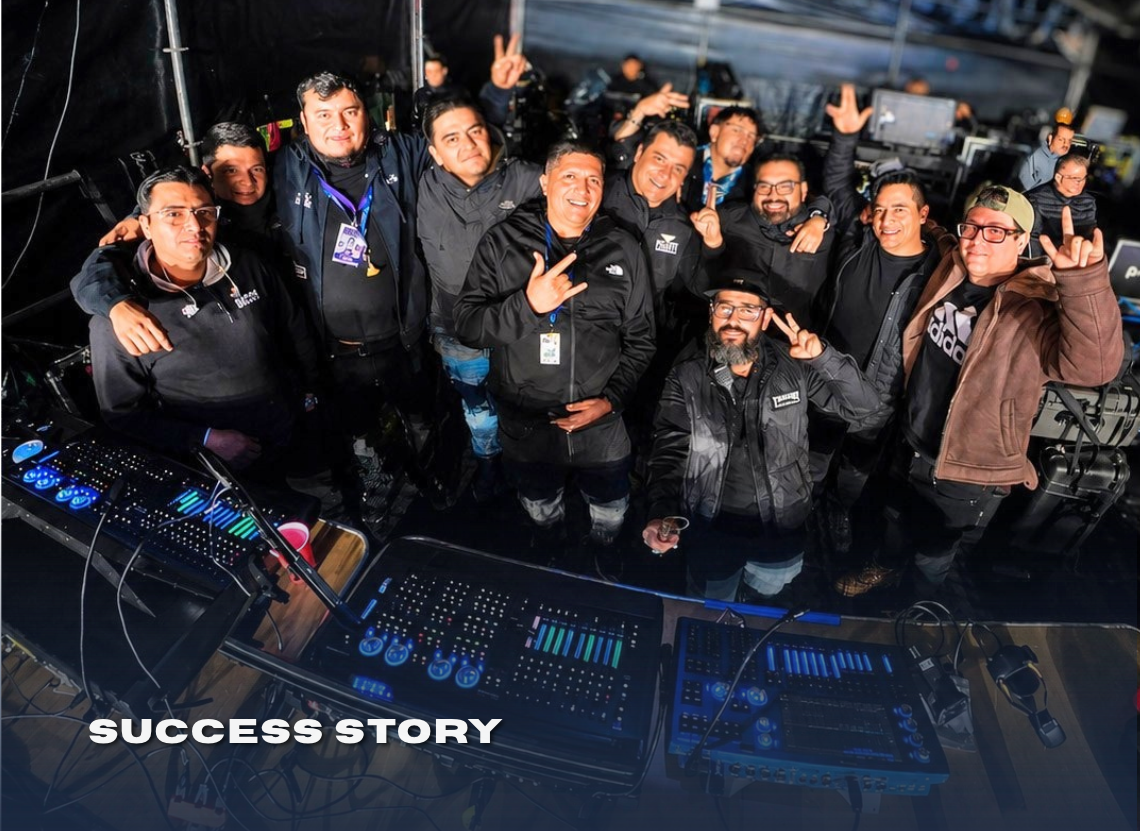
Mexico – Six lighting professionals, a production for 64,000 people, and a way of working in which decisions no longer belonged to a single person. For José Madero’s show at Estadio GNP, the HexaLighting collective built a collaborative workflow in which design, programming and operation moved forward as parts of the same process. At the center of the system, a ChamSys architecture headed by an MQ500+ made it possible to bring that collective dynamic to the control of a large-scale production.
A stadium forces you to think differently. The dimensions change, the amount of equipment increases, and every decision made during the design process ends up multiplying when the time comes to turn it into a show in front of tens of thousands of people.
For José Madero’s show at Estadio GNP in Mexico City, the challenge also took on a particular characteristic: behind the design and programming there would not be a single perspective, but rather a group of professionals accustomed to occupying different positions within the industry and willing, this time, to build the project together.
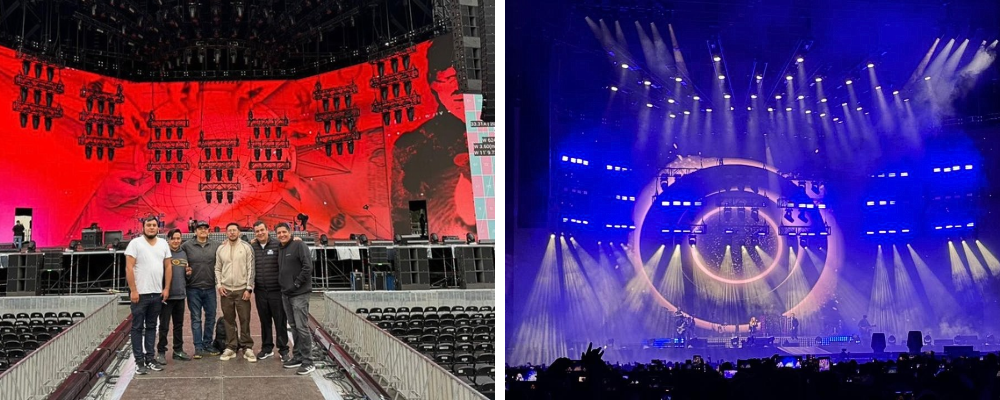
Thus, what initially could have represented the responsibility of taking a show to stadium scale also became an opportunity to consolidate HexaLighting, a collective made up of six professionals who decided to share tasks, knowledge and responsibilities around a common goal.
The control platform had to respond to that same logic. ChamSys, with an MQ500+ as the main console, an MQ250 as backup and MQ70 units assigned to different functions, became a central part of a workflow designed so that technological complexity would not interfere with the team’s dynamics.
Six perspectives to build the same show
HexaLighting was not created specifically for this concert. The idea of bringing together experiences and knowledge had already been circulating among its members, some of whom knew each other and had shared different professional experiences. But it was the scale of José Madero’s project that ultimately turned that conversation into a concrete way of working.
Diego Reyes, who entered the industry as a stagehand in 2007 and later developed as a lighting technician and programmer, summarizes the spirit with which they took on the project: “Our idea for the collective is to take all the knowledge we have, put it together to deliver a quality product and a show that belongs in the big leagues.”
The decision meant abandoning a logic based on individual protagonism. Each member could contribute from the area in which they had the most experience and, at the same time, submit their decisions to the perspective of five other professionals.
Delher López, with 25 years in the industry and experience also in film and television, describes it from that standpoint of complementarity: “Each one of us has something to add. Some of us have more experience in certain areas and we combine all of those. I think adding, more than talent, means adding professionalism and experience, so that each of those experiences produces a single result.”
Responsibilities were distributed according to those strengths. Marcos Rubio led the work developed in the studio; Edgar Loredo was in charge of production and the initial development of the concept; Ignacio González worked especially on the Vectorworks plans and supported programming; Delher López contributed through technical consulting and visualization; Uriel Pérez worked on hardware, positions and programming; while Diego Reyes and Alfredo “Tacho” Reséndiz Reyes participated in the programming work.
Rather than dividing the project into compartments, the intention was to build a system in which the different specialties could review one another. A design had to be visually powerful, but also understandable to whoever would later have to install it, connect it, program it and operate it.
When video and lighting had to speak the same language
The creative starting point came from the artist himself. José Madero outlined what he expected from the show at a general level, especially regarding the importance the visual content should have, and from there left the development in the hands of the team.
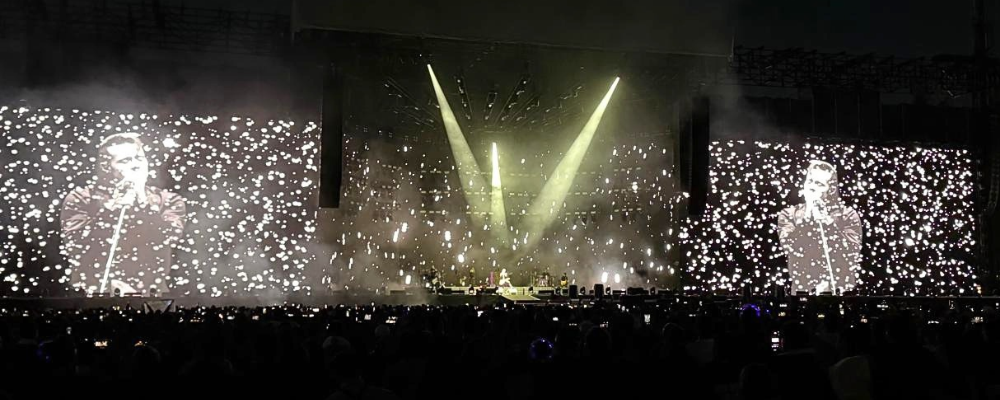
“He wanted a video theme that would rise above everything, but that would match the lighting theme. So that the screen would not be seen on its own and the lighting separately, as two different concepts,” explains Edgar Loredo.
The concept began to take shape in the visualizer, through different tests and designs that evolved through the exchange among the members of the collective.
The scale of Estadio GNP turned that integration into one of the major challenges. In front of approximately 64,000 people, it was not enough to build two visually striking systems: video and lighting had to be perceived as parts of the same image.
For Delher, his experience in film and television provided precisely another way of observing that relationship. His work also focused on temperatures, cameras, screens and contrast, seeking to ensure that the impact of the design did not ultimately relegate the artist within the visual composition.
Loredo considers the challenge from the perspective of the sheer scale of the setup: “Because of the dimensions and the amount of equipment, it becomes a challenge. There are too many video panels, too many fixtures, and getting all of that together and programmed is a significant challenge.”
The show also incorporated a change of language toward the end of the runway, where an acoustic set of seven songs was developed, functioning as a break from the visual scale that predominated throughout the rest of the show.
Designing also for what cannot be controlled
The advance planning inevitably encountered new variables upon arrival at the stadium. One of them was wind. Part of the design included structures with variable-speed motors that had to move near the screens. The air currents inherent to an open-air venue required distances to be reviewed during setup to guarantee safe operation.
Ignacio recalls that it was necessary to work together with the riggers and modify positions: some structures had to be moved approximately 50 centimeters from their planned positions to avoid risks during their movements.
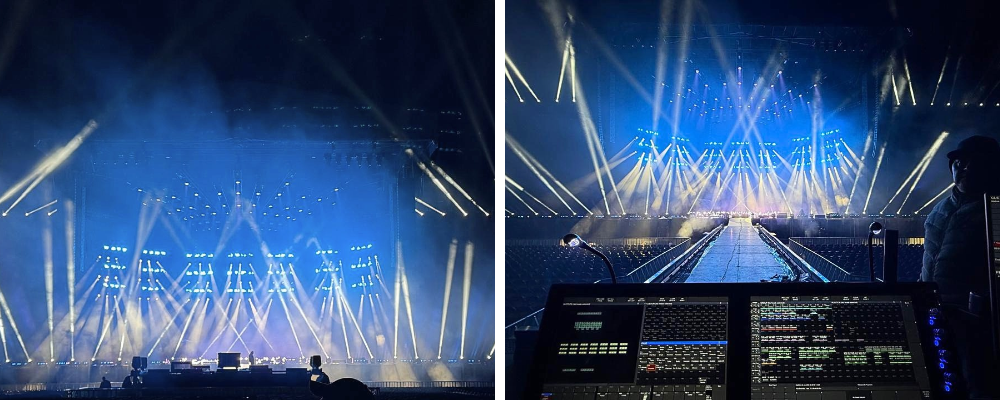
Wind also affected another essential element for the perception of the design: haze. Achieving the necessary density to make the lighting visible without saturating the space or interfering with the video required finding a balance in a stadium where air currents were constant.
For Marcos Rubio, this was one of the challenges that could only truly be resolved on site. The goal was to achieve the atmosphere necessary for the lighting without creating a mass of smoke that would ultimately take attention away from the artist or the visual content.
The first confirmation that months of decisions were working came when the first song began to run. “From the moment the first song ran, when the intro started, from there it was like everyone said: we’re here, we did it, and it’s running,” recalls Rubio.
Loredo had another reference point: finally seeing the capture of the show and observing how the systems behaved together. “When I was able to see on video what was happening, that was when I said: we’re achieving it, because there is a perfect match between lighting and video.”
ChamSys at the center of the workflow
The scale of the show required a control architecture capable of handling both the amount of information and the distribution of tasks established by HexaLighting.
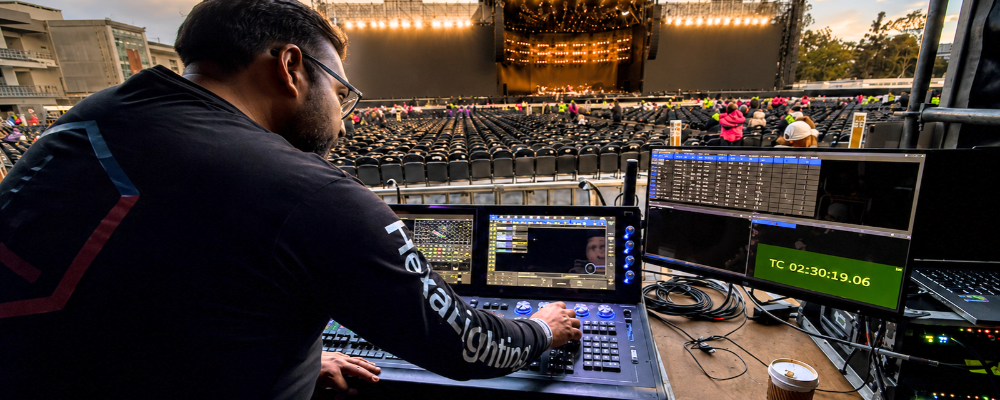
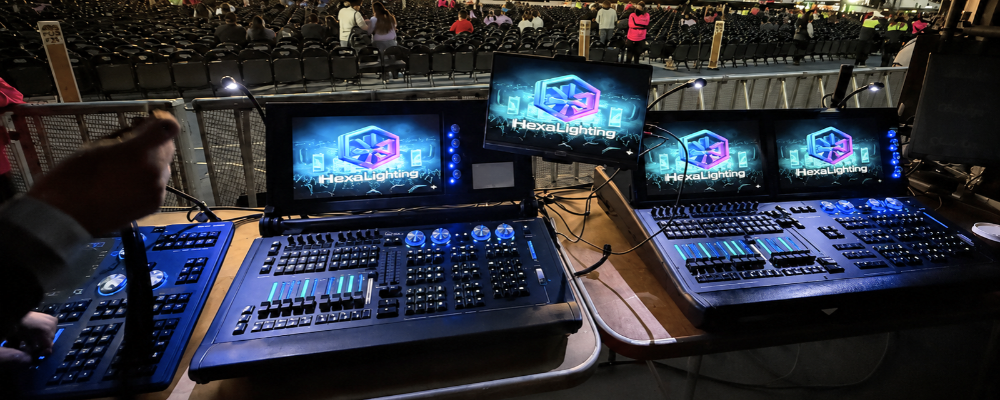
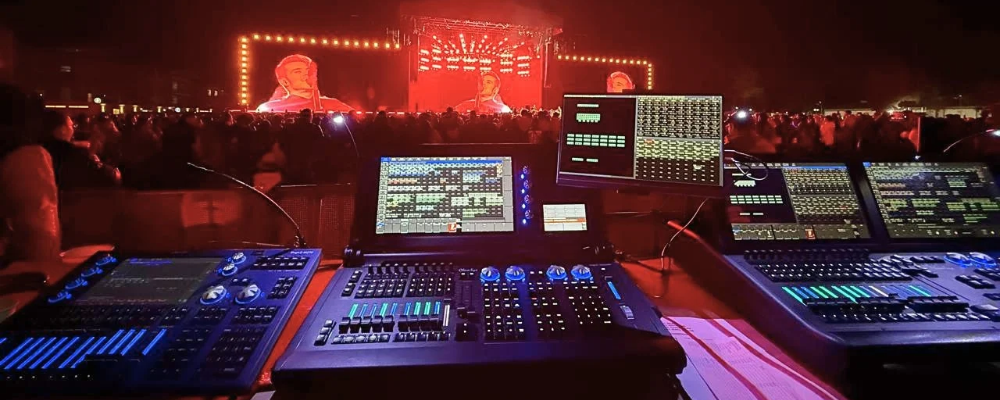
The system was built around a ChamSys MQ500+ as the main console, from which Marcos Rubio ran the show. An MQ250 served as backup, while an MQ70 was used for the tracking system and another control position was dedicated to haze and effects management. The signal was managed over the network, integrating the different functions into the workflow.
The programming previously developed in the studio thus found continuity upon arrival at the stadium. Visualization, plans and files prepared during the preceding weeks made it possible to transfer much of that structure to the final system, although the actual scale of the venue subsequently required adjustments. Synchronization through SMPTE/timecode was added to this workflow to coordinate the programmed sequences with the development of the show.
For Rubio, one of the main advantages during programming was the speed with which he could move from an idea to its execution.
“For me, it is the practicality with which you generate an effect and the very fast, uncomplicated way in which you do it. It is very comfortable, very practical, very fast, and there are several ways to do it,” he comments.
That last point proved particularly useful for a collective made up of programmers with different experiences and methods. ChamSys did not impose a single path for building an action: each person could use the logic that best suited their way of working and achieve the desired result. In a project based precisely on combining different ways of thinking, that flexibility made it possible to preserve each operator’s individual dynamic within the same programming environment.
Ignacio González found that same philosophy while working from an MQ70. After nearly two decades working in lighting and progressively specializing in consoles, he particularly highlights the ability to resolve different needs directly from the platform.
“The same console gives you the power to open quite a few universes, and you don’t depend on another device,” he points out.
In a production of this scale, reducing unnecessary steps and maintaining an accessible operating logic was not simply a matter of convenience. It was part of the efficiency required so that different areas could move forward without wasting time dealing with complexities added by the control system itself.
Different consoles, the same operating logic
Uriel Pérez, with more than 22 years of professional experience, participated in hardware, position programming and subsequently in the control associated with onstage smoke. From that role, one of the aspects he highlights is simplicity: “Regarding the network, creating a communication network from FOH to the stage is very simple. It is not that complex to create the network. The configuration was very fast,” he explains.
The management of the effects also maintained a logic similar to that used for other devices, working primarily with fan levels and smoke output.
Alfredo “Tacho” Reséndiz Reyes joined the project with around two decades in the industry and previous direct experience with ChamSys. Approximately one year earlier, he had purchased an MQ250 after being introduced to the platform through recommendations from other colleagues and getting to know it in greater depth.
“From the moment I saw the 250, I fell in love with it. I started using it and I liked many things, especially the practicality; you can do many things very quickly,” he acknowledges.
His experience also reflects something that ran through the entire project: each member arrived with different habits, backgrounds and ways of solving a show. The goal of HexaLighting was not to standardize those experiences, but to find a platform and a workflow that would allow them to take advantage of them.
Support as part of the system
The technical architecture also presented challenges before reaching the stadium. One of them was ensuring that the different models worked correctly within the planned configuration and that the main and backup consoles could handle the dimensions of the system.
Alberto García, from ChamSys technical support, accompanied that process from the initial preparation, working with the team on configurations and libraries and resolving the needs that emerged as programming progressed. One of the central points was bringing both the MQ500+ and the MQ250 to a 128-universe configuration and correctly establishing the relationship between them so that the second could assume its backup role within the planned architecture.
That support continued throughout the programming sessions and through to the execution of the show.
“The main thing for the brand is that operators and programmers are as comfortable as possible with the console, both in programming and operation, and that during the execution of the show they do not encounter any setbacks,” Alberto assures.
From the other side, Rubio turns that idea of support into something much more concrete. During preparation, questions could arise at any time, even during long overnight studio sessions.
As he recalls, Alberto personally stayed with them until late hours to resolve questions, configurations and libraries. “If I’m asked to recommend something, I will always say: look at the support,” he states.
In a project built around six different ways of working, that support took on particular importance. It was not only about making sure the hardware worked, but about ensuring that those responsible for programming and operating it could focus on the show.
A collective that works as one
When the show ended, the result belonged exclusively neither to the design, nor to the programming, nor to a console. It was the consequence of having managed to make those parts work together.
Feedback also came from the stage. Loredo recalls the musicians being particularly enthusiastic and José Madero following the process in his own way: initially presenting his ideas and then allowing the team to develop the show, becoming involved again whenever he found an element that needed to be reviewed.
For HexaLighting, however, the experience left something that went beyond that particular night.
Working among six professionals meant constantly exposing themselves to other ways of solving the same problems. Diego Reyes considers this part of the growth generated by the project: “Having all six of us helps us grow professionally as well, because maybe I have an idea of how things are done and then I see five different ways of working. That also helps me grow a lot professionally and individually.”
In an industry where technology is constantly advancing, that ability to exchange knowledge became for them a tool as important as any of those used during the show.
The experience was also not conceived as an isolated meeting around José Madero’s show. For its members, HexaLighting was created with the intention of continuing to develop projects together, bringing that combination of specialties to new productions and adapting the collective’s dynamic to whatever challenges arise. In that sense, Estadio GNP also served as a first demonstration of how far that way of working could go when facing a large-scale production.
And the project demonstrated that this philosophy could be sustained as the scale increased. The ChamSys architecture supported the process from programming through operation, distributed functions among different consoles and provided the team with a platform from which to execute a show built precisely from the combination of different experiences.
Edgar Loredo perhaps offers the most precise definition of what happened behind the scenes: “This group does not preach collectivity and does not preach being a collective: it does it and functions as a collective. There is total respect for everyone’s opinion and work.”
At Estadio GNP, that way of working faced its first major test. Six professionals, one shared direction, and a ChamSys ecosystem capable of supporting a workflow in which technology had to do exactly the same thing as the people: integrate, communicate and function as part of a whole.
Credits
Cover Photo: LATAM STAGE
Inside Photos: Hexalighting – LATAM STAGE
The journalistic production, research, writing, editorial approach, and editing of this content are original works by LATAM STAGE and are protected by copyright.
No part of this content may be reproduced, copied, distributed, adapted, or published, in whole or in part, in any medium or format, without the prior written authorization of LATAM STAGE.


