
UK – “If you look at things with a pencil and paper in your hand, you are going to see far more,” advised David Hockney. The legendary artist and theatrical set designer had a point. Even in this era of sophisticated AI technology, committing an idea to paper and pencil endows it with greater depth, compelling us to view it in a different, often more nuanced way.
Such was the case with Will Thomas, a lighting designer who was “lucky — or old — enough” to be taught how to draw plans and elevations to scale at art college back in the early 90’s. Thomas puts this talent to good use, often sketching designs by hand before making them come alive on his ChamSys console.
He did this for a Mastery Presents show at Church of St. John at Hackney in March headlined by Rock & Roll Hall of Famer Alessandro Cortini, who earned his spurs as the keyboardist for Nine Inch Nails.
“If you are doing a massive rig with multiple heads and complicated staging then of course it makes sense to take a different path, but if you want to communicate an idea on a smaller show quickly, being able to accurately draw a visualization of what you plan to do is really important in my view,” he said. “The other thing I have found to be really important is that actually handing a piece of paper to the client and also to the crew gives everyone a greater sense of ownership.”
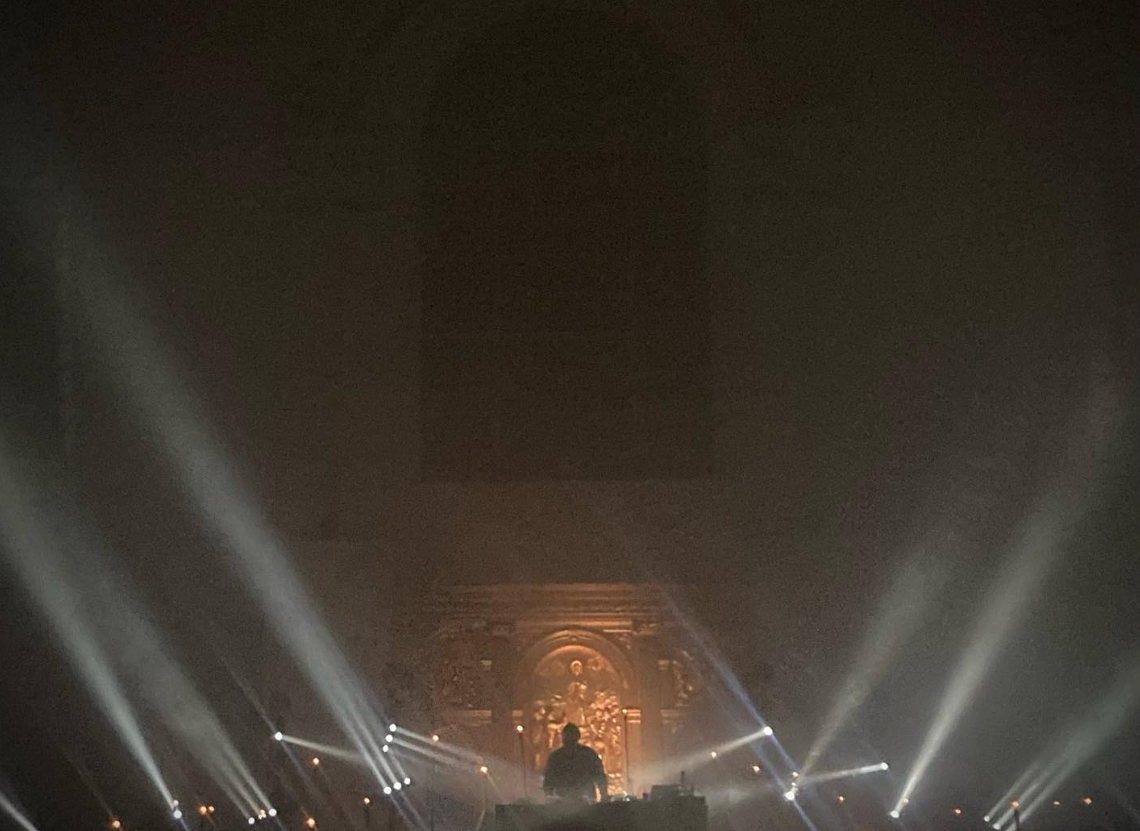
Thomas’s design as he sketched it and ran it on his ChamSys MagicQ MQ70 Compact Console was an artful creation that deftly relied on subtle lighting nuances from his 30-fixture kit to play off the architectural fixtures of this iconic church, whilst also reflecting the music of different artists on stage.
“Happily, my client, Bianca Mayhew at Mastery Presents had a very clear idea of how the evening should be presented,” said Thomas. “Each position of every fixture was purposeful and reacted something they’d mentioned. However, speaking with her – in the actual space – and with the performers as they set up, I was able to glean from them that the improvised nature of each performance meant. It was then up to me to be present and use my console and the lighting design to react to the music that they played in that moment and not rely on preprogrammed looks or effects.”
“For this particular show the final layout changed from the drawing, and we added an extra two tank traps and stands because the client wanted to have the risers covered with a neat black drape,” He continued. “The lower fixtures would have been lost behind it so we moved them out on to the additional stands. The only inconvenience to me was a quick regroup of fixtures on desk. This sort of adaptability and willingness to change is important to me and is valued by the client.”
Thomas evoked powerful moods during the event, not only through his evocative color mixes, but also by my mixing light and darkness. He explained how the nature of the venue allowed him to control dark space on stage. “The joy/challenge of working in a space like St. John’s Hackney is that it lacks any dark space when you are setting up, so you get to determine where darkness is,” he said.
“Incrementally revealing the building gave a much greater and gentler dynamic than I would have achieved if everything was lit up at the beginning of the night. Once the performances began, I split the floor wash group into odds and evens — and by selectively using the zoom, I was able to separately illuminate the golden alter-piece and backlight the performers.”
Thomas’ MagicQ MQ70 Compact Console aided him in achieving this vision. For example, to reflect the overall mood of this show, he used tungsten 40W lamps on microphone stands. His console made it easy for him to shift/copy these, add a third fader to them, change the direction of the chase. Additionally, using his ChamSys console he was able to randomize or bounce the chase live.
“Although this was a very small lighting rig, being able to make sub-groups of fixtures easily meant I could use different parts of the rig to create different shapes,” said Thomas. “For example, the lower set of Rogue FxB’s pointing up and the higher set focused down at the performer. I love having a start centre stage position for the heads and then being able to easily record a new position for each performer and update it live. This is important when there are multiple acts on stage, and it was too light to focus them precisely when they sound checked earlier.”
“ChamSys allows me to do this –and it is really important when there are multiple acts on stage and it was too light earlier during soundcheck to focus precisely. My MagicQ MQ70’s Shift-to-Access and Fine Pan Tilt are essential in allowing me to create these defined focuses without the audience really noticing the position changes.”
There was more than responsive and flexible equipment involved in helping Thomas create this evocative design. He also gives credit to Paul Jarvis from Copper Red Design who worked with him on the project and to Colour Sound Experiment show supplied the gear. Together they helped transform a creative vision that began with a sketch and ended with a deeply moving lighting design.


