
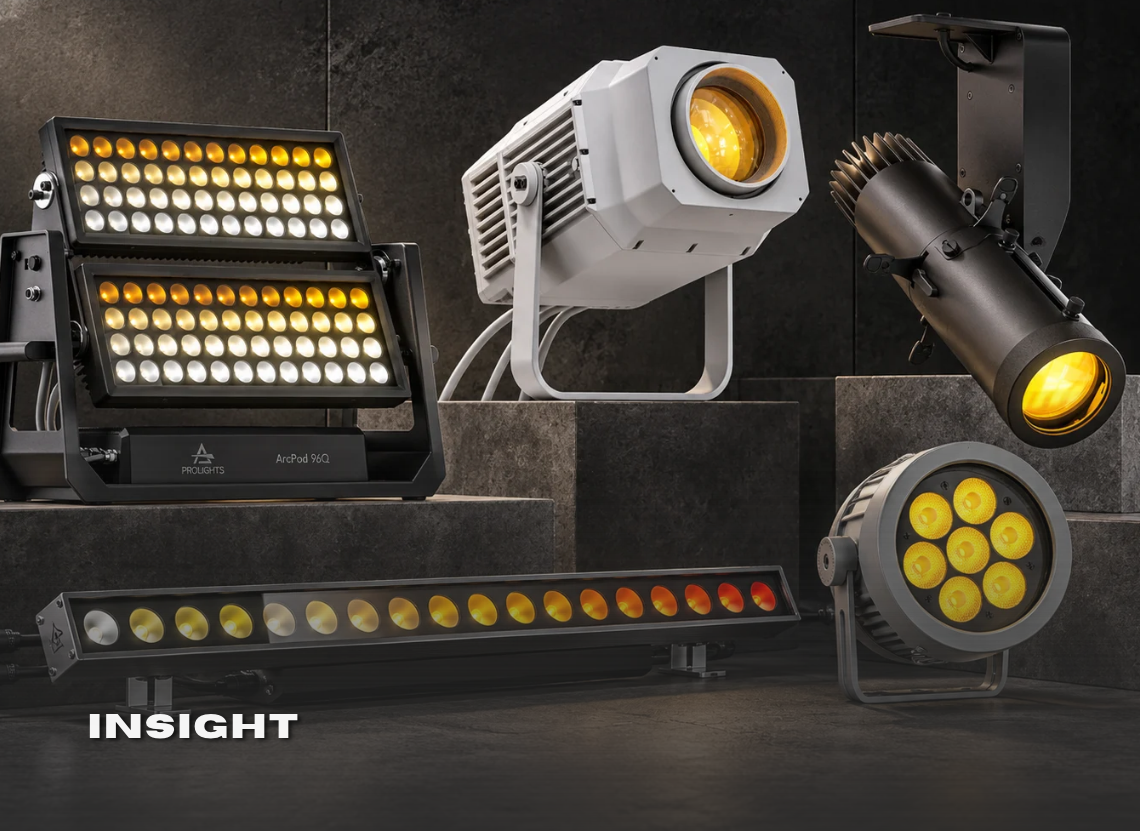
Argentina – From façades and urban spaces to museums, galleries, and corporate buildings, architectural lighting requires specific tools for each challenge. Maximiliano Moreno, product specialist at NASH Ingeniería, explains how PROLIGHTS architectural solutions can address different projects through a combination of precision, light quality, and versatility.
Architectural lighting is no longer simply a resource for making a building visible at night. Today, it forms part of the identity of spaces, helps highlight heritage, enhances contemporary architecture, and creates visual experiences capable of transforming the way people perceive an environment.
However, for Maximiliano Moreno, product specialist at NASH Ingeniería, one of the main challenges remains understanding that there is no single formula for lighting architecture.
“Architectural lighting is often discussed as if it were a single category, but in reality we are talking about very different needs. Lighting an entire façade is not the same as highlighting an ornamental detail, enhancing a work of art, or projecting an image onto a building. Each objective requires specific tools.”
The first step: understanding what we want to show
Before talking about fixtures, optics, or control protocols, Moreno believes there is one fundamental question: what do we want to highlight?
The answer will determine not only the type of fixture to use, but also the way the light interacts with the architecture.
“The first question should never be which fixture to buy. The first question should be what we want to show. From there, we can define output, distribution, color temperature, color rendering, and the type of tool best suited to achieve the desired result.”
This philosophy guides the development of PROLIGHTS’ architectural range and NASH’s work as the brand’s representative, with different product families designed to address specific applications and scales.
When architecture is the protagonist
There are projects where the main objective is to reveal the building in its full dimension. Façades, galleries, cultural spaces, and institutional buildings require working with surfaces, volumes, and materials, while also adapting to the distances, dimensions, and specific conditions of each installation.
For these applications, ArcPod 96Q is one of the solutions within the PROLIGHTS architectural range, expanding the possibilities for outdoor projects where performance and coverage are part of the design considerations.
“When we want to illuminate a façade or a large surface, uniformity is key. The visitor should perceive the architecture, not the points of light.”
When a project requires following structural lines, emphasizing geometries, or creating dynamic scenes across the architecture itself, linear solutions such as ArcShine M18FC come into play.
“Linear lighting makes it possible to work with the building’s own architectural language. It can follow contours, highlight volumes, and create very elegant visual effects without altering the architectural identity of the space.”
When details shape identity
In many projects, the true architectural value is not found in the building as a whole, but in its details.
Columns, sculptures, moldings, ornamental elements, and structural components may require more precise and directional lighting. In these cases, the relationship between the point from which the light is projected, the area to be highlighted, and control over the light takes on greater importance.
For these types of applications, PROLIGHTS offers ArcSpot SFC as an alternative designed for accent lighting on specific architectural elements.
“Accent lighting allows us to direct the eye. Very often, it is these small details that shape the personality of a space and help create a much richer visual reading.”
In this way, ArcPod 96Q, ArcShine M18FC, and ArcSpot SFC address different scales and objectives within the same project: working across surfaces, following the linear language of a structure, or focusing attention on specific elements.
When light must respect a work of art
There are environments where light quality is even more important than output.
Museums, galleries, exhibition spaces, and premium retail environments require accurate color rendering to ensure that colors, materials, and textures can be appreciated correctly.
Within this category, EclDisplay CCFC stands out as a solution developed for applications where visual fidelity is essential.
“When we illuminate a work of art, a historical piece, or an exhibit, we are not simply trying to make it visible. We want it to look exactly as it was conceived. That is where light quality becomes critical.”
Complementing this offering is DisplayCob TRWDFC, a tool designed for exhibition, retail, and hospitality applications, where the visual perception of the product or illuminated object forms part of the experience.
“Exhibition lighting has very particular characteristics. The light has to complement the object, enhance it, and respect it at the same time. These are applications where every detail matters.”
When architecture also communicates
Architectural lighting is no longer limited to highlighting buildings. In many projects, it also becomes a medium for communication.
Hotels, shopping centers, cultural institutions, corporate buildings, and urban spaces increasingly use projection to convey messages, reinforce visual identity, or create immersive experiences.
This is where the PROLIGHTS Mosaico range comes into play, a family of gobo projectors designed to project images, textures, patterns, and graphic elements onto different architectural surfaces.
“Architectural projection opens up enormous possibilities because it allows us to transform a space without physically altering it. It can be used to communicate, provide signage, or create visual experiences in a highly flexible and creative way.”
Technology at the service of design
For Moreno, the growth of architectural lighting is not only driven by technological evolution, but also by a greater understanding of the role light plays within architecture.
“Today, we have much more precise tools than we did a few years ago. This allows us to select exactly the right solution for each need and achieve much more efficient and controlled results.”
ArcPod 96Q, ArcShine M18FC, ArcSpot SFC, EclDisplay CCFC, DisplayCob TRWDFC, and Mosaico address different applications, but share the same logic: providing designers with different tools so that each choice begins with what the space itself requires.
With the arrival of these solutions in the Argentine market, NASH Ingeniería expands its ability to support projects where light does more than illuminate: it also helps define the identity of spaces.
Because, ultimately, architectural lighting is not simply about making a structure visible, but about revealing what makes it unique.


