
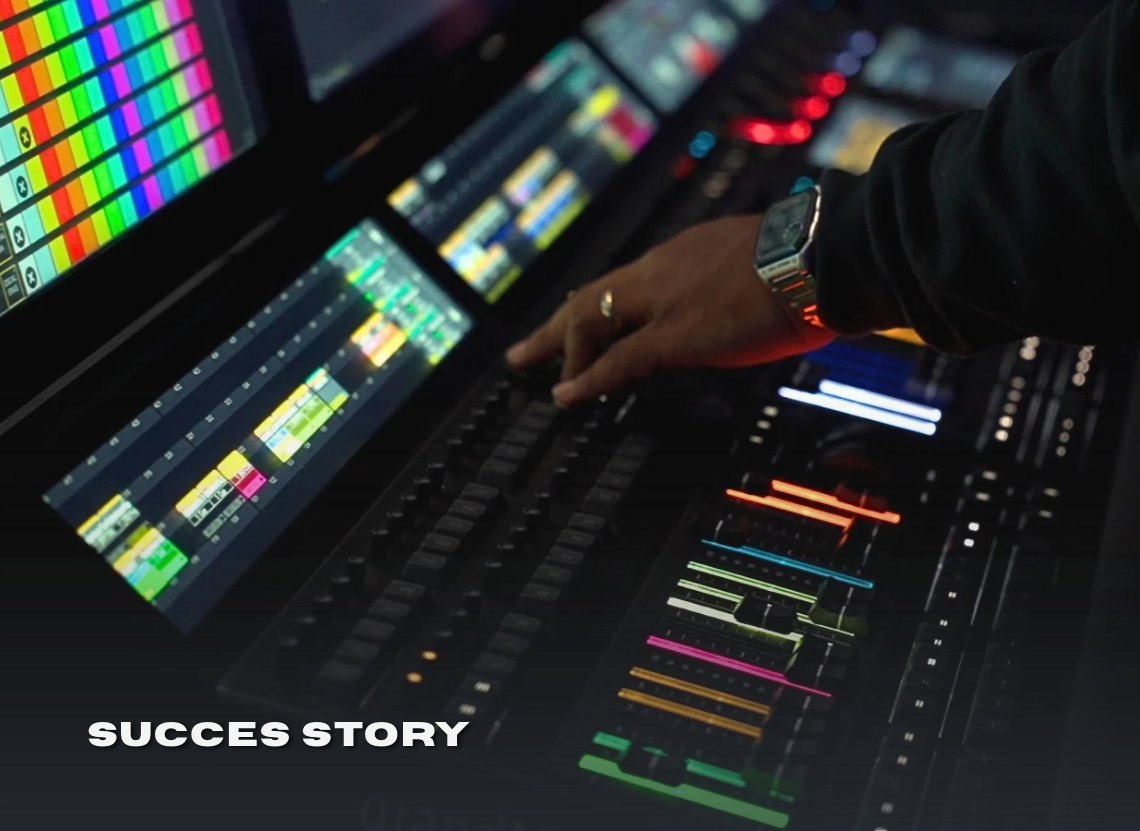
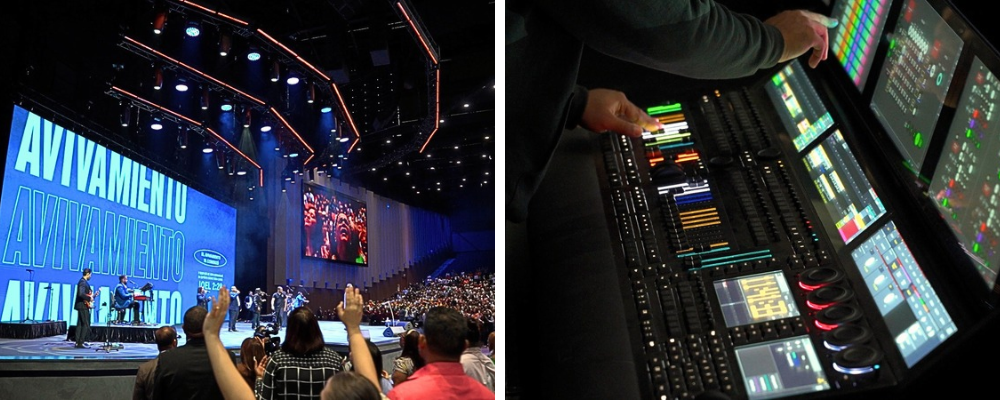
In Santo Domingo, Dominican Republic, a project developed over more than a decade has resulted in one of the Caribbean’s largest auditoriums for houses of worship. Featuring lighting design by Paulinho Lebrão, system integration by Sound Video Live, and technology supplied by WHOLESTAGE, Monte de Dios brings together large-scale audio, lighting, control and broadcast solutions. Jonathan del Villar, CTO of WHOLESTAGE, explains how a relationship that began with consulting and training evolved into one of the region’s most ambitious audiovisual installations.
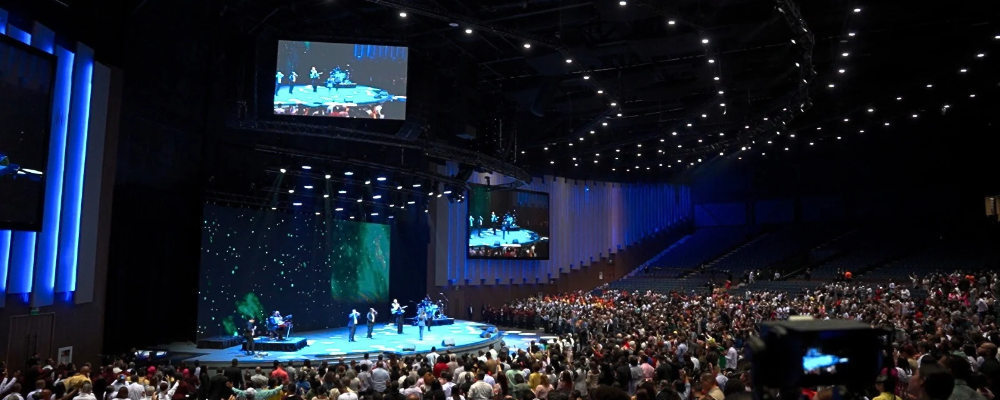
Dominican Republic – Nearly 15 meters above the ground, the first suspended structures of Monte de Dios’s new auditorium begin to take shape. There is still considerable distance from there to the ceiling. The height gives a sense of the scale of a venue built from the ground up to accommodate 8,000 people and host productions with requirements comparable to those of major international stages.
In Santo Domingo, Dominican Republic, the church inaugurated the main space of a campus that will continue to incorporate new facilities. The project took more than ten years to develop and brings together an audio, lighting, control, rigging and broadcast infrastructure designed to serve both religious services and large-scale musical productions.
Behind this installation lies a history of technical decisions, planning and collaboration among different specialists. WHOLESTAGE participated as a distributor and technology supplier, supporting the institution from an early stage. Lighting design was handled by Paulinho Lebrão, while Dominican company Sound Video Live was responsible for system integration.
For Jonathan del Villar, Chief Technical Officer (CTO) of WHOLESTAGE, the scale of the project also helps illustrate the particular challenges of developing installations of this magnitude in the Latin American market.
“These projects take time,” he says. He explains that although an auditorium for thousands of people can generate great expectations, bringing it to life requires much more than selecting equipment and having a budget.
Monte de Dios represents precisely that journey: a vision defined from the outset, an investment built progressively, and an infrastructure in which every discipline had to meet the same level of demand.
A vision that took shape over more than a decade
Before the new auditorium opened, Monte de Dios held its activities in a space for approximately 1,500 people, where it sometimes conducted as many as six Sunday services to accommodate attendance.
Building the new venue represented a considerable change in scale. However, the institution was not starting with an improvised idea.
Its leaders had visited major churches in the United States, Australia and other international markets, studying their facilities and the resources used to create experiences combining music, audiovisual production and the participation of thousands of people.
“They knew what level they wanted their project to reach, as well as the level of detail and quality they expected,” Jonathan recalls.
The clarity of that vision also shaped the relationship with WHOLESTAGE. The company did not arrive to introduce needs the client had not identified, but to help evaluate technologies, compare alternatives and make appropriate decisions for an installation that would need to remain operational for many years.
Jonathan had known about the initiative even before joining WHOLESTAGE. The commercial and technical relationship began to take shape around 2020, when audio became the first point of contact.
“There is always one discipline that acts as the key to entering these projects. In this case, it was audio.”
L-Acoustics solutions opened that initial conversation, which later expanded to lighting and control.
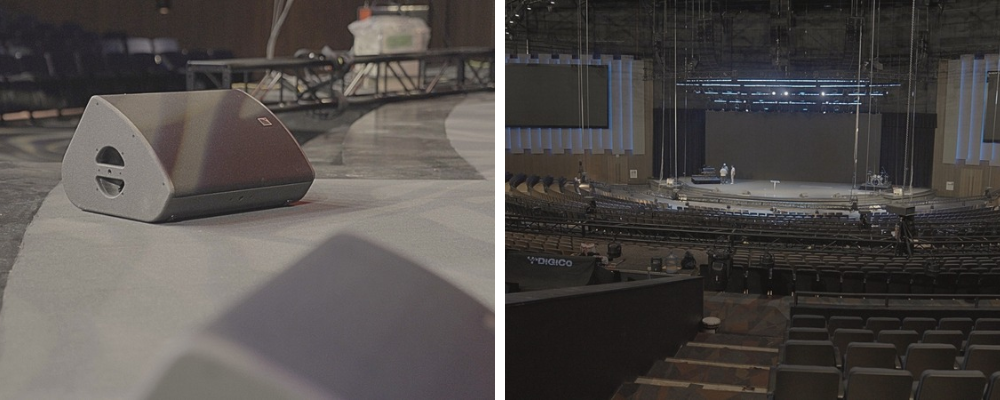
The scale of the building presented particular challenges for sound distribution. The systems had to cover an enormous auditorium, with suspension structures positioned at great heights and a configuration specifically designed for the space.
The audio equipment also includes DiGiCo Quantum Series consoles, within an infrastructure prepared for musical productions and high-level operations.
But technology selection was not determined by technical specifications alone.
“The church market is a little particular because selling into it requires a great deal of consulting—in other words, consultative selling, if you want to call it that,” Jonathan explains.
At Monte de Dios, brands carried considerable weight, especially because the institution’s leaders were familiar with internationally recognized installations. However, they also wanted to evaluate the available solutions firsthand.
Jonathan recalls traveling to Frankfurt with one of the church’s executives to visit manufacturers and explore different lighting fixtures. Although Paulinho Lebrão’s design already included certain Ayrton fixtures, the institution wanted to test their performance and understand the advantages of each alternative.
“They wanted the freedom to choose the offer or product that best suited their needs.”
This process reveals another aspect of the project: despite its magnitude, Monte de Dios approached its investments carefully. Every decision had to address a specific need and be supported by sound technical reasoning.
From a command wing to a grandMA3 full-size
The evolution of the lighting control system is one of the clearest examples of how the relationship developed.
MA Lighting is an established reference in the touring world, but Jonathan believes its presence in houses of worship follows a different dynamic.
“MA is the benchmark, but while it is the benchmark in touring, it is not necessarily the default benchmark for churches. One does not guarantee the other.”
In this segment, decisions also depend on operators’ experience, how easily new tools can be adopted, and the availability of assistance when difficulties arise.
That is why Monte de Dios’s first introduction to grandMA3 did not involve a large-format console.
WHOLESTAGE began by inviting the technical team to take part in training activities through WHOLESTAGE Academy.
Jonathan recalls those early training sessions in the period following the pandemic, when masks were still being worn and the church’s staff was beginning to familiarize itself with the platform.
“We invited them to the courses at WHOLESTAGE Academy to show them what MA3 is.”
The first purchase was a grandMA3 onPC command wing, intended for the previous venue. It was a relatively small solution for the institution’s activities, but it allowed the team to start working with the platform, learn how it operated and assess its possibilities in practice.
The experience continued after the purchase. Questions arose about operation, maintenance needs and situations typical of the early stages of the grandMA3 software’s development.
WHOLESTAGE supported that process, providing technical assistance and helping the team become more self-sufficient.
By the time the lighting control system for the new auditorium had to be selected, the institution already knew the platform and had incorporated its tools into day-to-day operations.
“They fell in love with MA because they took the courses and had the opportunity to use a small product. Then they changed venues and moved from a command wing to a full-size.”
Moving to a grandMA3 full-size was a significant step, but not an isolated decision. It represented the continuation of an experience that had begun years earlier.
Jonathan considers it particularly interesting that an institution capable of building an 8,000-seat auditorium did not choose the largest console from the outset.
The investment was gradual because its leaders wanted to understand the technology and verify that it met their needs.
“They need a point of reference and different kinds of tools when making a purchase. It is not simply a matter of having the money and being able to afford it.”
The story also shows how training can create opportunities for technologies traditionally associated with major entertainment productions, expanding their presence in other market segments.
Lighting for the stage, the audience and the cameras
Monte de Dios’s new auditorium had to deliver a high-level visual experience while also meeting the demands of television production.
The institution made a substantial investment in broadcast infrastructure, with resources that allow its activities to be recorded and transmitted through its own audiovisual production system.
This meant that the lighting had to work simultaneously for the audience in the venue and for the cameras.
“It cannot be just any fixture,” Jonathan says, explaining the project’s requirements.
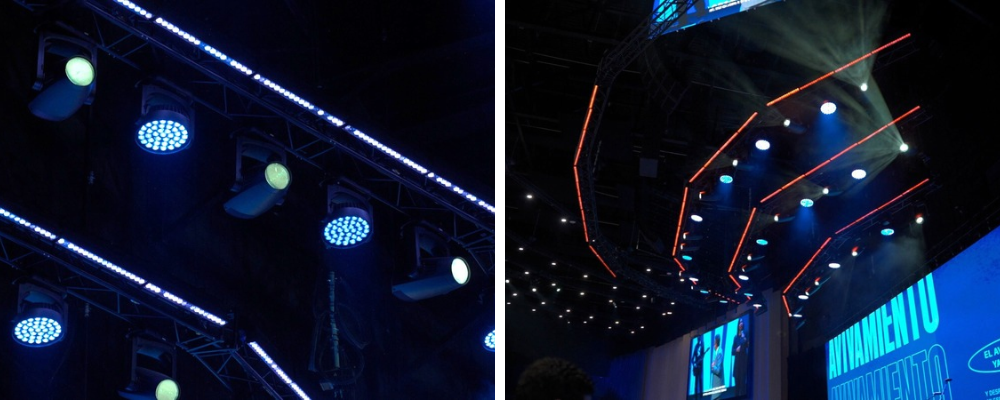
Paulinho Lebrão’s design includes a system capable of lighting both the stage and the areas occupied by the audience.
The goal was to control the venue’s atmosphere during the different moments of each service, using lighting as part of the overall experience.
“They want complete control at all times, including over the audience areas and the people in attendance. They may want to shape the mood or create different moments during the service.”
One of the most distinctive elements of the design is a starry sky installed above the audience.
According to Jonathan’s estimate, it consists of more than 400 PAR-type fixtures, each independently addressed. This configuration makes it possible to create compositions across a considerable surface area and requires the management of a large number of control channels.
The system works alongside motorized structures and automated rigging elements, which allow positions to be changed and certain stage configurations to be adapted.
On stage, the building’s distances and dimensions required high-performance fixtures.
Among the selected equipment are Ayrton Huracán Wash fixtures, used to provide front lighting. Jonathan estimates that approximately 24 units were installed in this position.
“We are using Huracán Wash, which belongs to Ayrton’s Series 9 and is perhaps one of the largest products we offer within the Ayrton portfolio.”
The power and coverage of these fixtures are particularly relevant in a space where front and side lighting must reach great distances while maintaining suitable conditions for the cameras. “Just imagine it—the venue is massive, and you need very good front and side lighting.”
The design also reflects an ambition that goes beyond the church’s regular services. Monte de Dios was conceived to host established Christian artists from around the world, including shows that form part of major tours.
Its leaders wanted an infrastructure comprehensive enough to adapt to different productions without constantly depending on additional equipment rentals.
“Their vision is: I can do whatever I need to do here without having to bring anything in from somewhere else,” del Villar emphasizes.
That decision influenced the selection of consoles, lighting fixtures, audio systems and video resources, all designed to meet professional production demands.
A connected infrastructure and the work of Sound Video Live
One of Monte de Dios’s most notable technical features is the architecture used to distribute lighting control.
According to Jonathan, the installation manages approximately 80 to 90 universes through sACN (Streaming ACN), using a network infrastructure that does away with conventional DMX lines.
“The venue does not have a single DMX cable. Everything is handled through Streaming ACN. Everything is networked—absolutely everything.”
The architecture incorporates switches, VLANs and a data network that allows communication among the various devices distributed throughout the auditorium.
The installed Ayrton fixtures support network-based control protocols, making it easier to integrate them into this infrastructure.
For Jonathan, this configuration reflects an important evolution in the way large lighting systems are developed.
“Fixtures are becoming increasingly capable of connecting,” he explains, noting that current technologies make it possible to design installations in which digital communication plays a central role.
The volume of information and the number of connected devices required meticulous planning, particularly given the building’s dimensions and the distribution of equipment across elevated structures.
Integration was carried out by Sound Video Live, a Dominican company with nearly twenty years of experience in the local market.
Its work included the technical execution of a highly complex installation, in which cabling, rack organization, connections and system mounting all had to meet operational and maintenance requirements.
Jonathan particularly highlights the quality of that work. “You will see the photos of the racks, the terminations and how all the rigging turned out. Everything has been taken to the highest level, with excellence as the benchmark.”
Cable organization, connection labeling and the quality of the terminations are aspects that normally remain out of public view but are essential to the operation of a permanent installation.
The project also highlights the importance of distinguishing the responsibilities of the different participants. WHOLESTAGE supplied technology and provided consulting, training and support; Paulinho Lebrão was responsible for lighting design; and Sound Video Live handled integration.
Jonathan believes this collaboration is essential to developing large-scale projects in the region. “A highly respected integrator, a highly respected designer, a client with the budget and the determination to do things properly, and, of course, us bringing the technology and providing the consultative sales component.”
The experience also reinforces WHOLESTAGE’s operating model as a regional distributor, based on collaboration with integrators and specialized companies that execute projects in their respective markets.
“We provide the technology, the education and the support,” Jonathan del Villar says.
For the company, having a network of professionals capable of developing installations of this magnitude creates opportunities to expand technology implementation across Central America, the Caribbean and other Latin American markets.
A regional benchmark that continues to grow
Although the main auditorium is already operational, Monte de Dios still has further stages to develop.
The campus includes other spaces, and the installed infrastructure retains opportunities for expansion in certain areas.
Jonathan notes that the audio system already has a very high level of equipment, while the lighting control system could incorporate additional redundancy resources and other expansions according to future needs.
There are also discussions about the architectural lighting of the venue’s façade.
The possibilities being considered include MA Lighting control solutions and architectural lighting products associated with WHOLESTAGE’s portfolio, including SGM options.
The intention would be to take advantage of a control architecture compatible with the existing network infrastructure, although this stage is still under consideration.
For Jonathan, the project provides a particularly valuable reference in a segment where professional audiovisual technology is playing an increasingly prominent role.
The combination of a large-scale installation, a client with clearly defined objectives, and the participation of international and local specialists demonstrates the opportunities available in this market.
It also illustrates how applications for tools traditionally associated with major tours are evolving.
MA Lighting, for example, is part of a permanent installation here that must support regular activities, television productions and shows of different kinds.
Monte de Dios’s story is significant because of this combination of scales: a project that began taking shape more than ten years ago, an initial experience with a grandMA3 onPC command wing, and an evolution toward an 8,000-seat auditorium equipped with a grandMA3 full-size, Ayrton fixtures, professional audio solutions and extensive digital infrastructure.
For WHOLESTAGE, the experience confirms the importance of working alongside specialized designers and integrators and of developing relationships that continue beyond equipment delivery.
Jonathan sums it up in a reflection that runs throughout the project: “The people who teach you, support you and stand by you are very important.”
At Monte de Dios, this combination of knowledge, technology and collaboration helped support a long-term vision and turn it into one of the Caribbean’s most prominent audiovisual projects in its segment.
Monte de Dios demonstrates that major audiovisual projects are built not only with first-class technology, but also with a clear vision, well-founded decisions and relationships that can be sustained over time. The journey from an initial control console to an 8,000-seat auditorium equipped for international-scale productions reflects a transformation that goes far beyond the size of the venue. In a market where excellence requires much more than financial investment, the experience of WHOLESTAGE, MA Lighting, Ayrton and Sound Video Live confirms that the real difference lies not only in the technology installed, but also in the knowledge, support and ability to turn a vision into reality.
Credits
Cover Photo: LATAM STAGE
Inside Photos: LATAM STAGE
The journalistic production, research, writing, editorial approach, and editing of this content are original works by LATAM STAGE and are protected by copyright.
No part of this content may be reproduced, copied, distributed, adapted, or published, in whole or in part, in any medium or format, without the prior written authorization of LATAM STAGE.


