
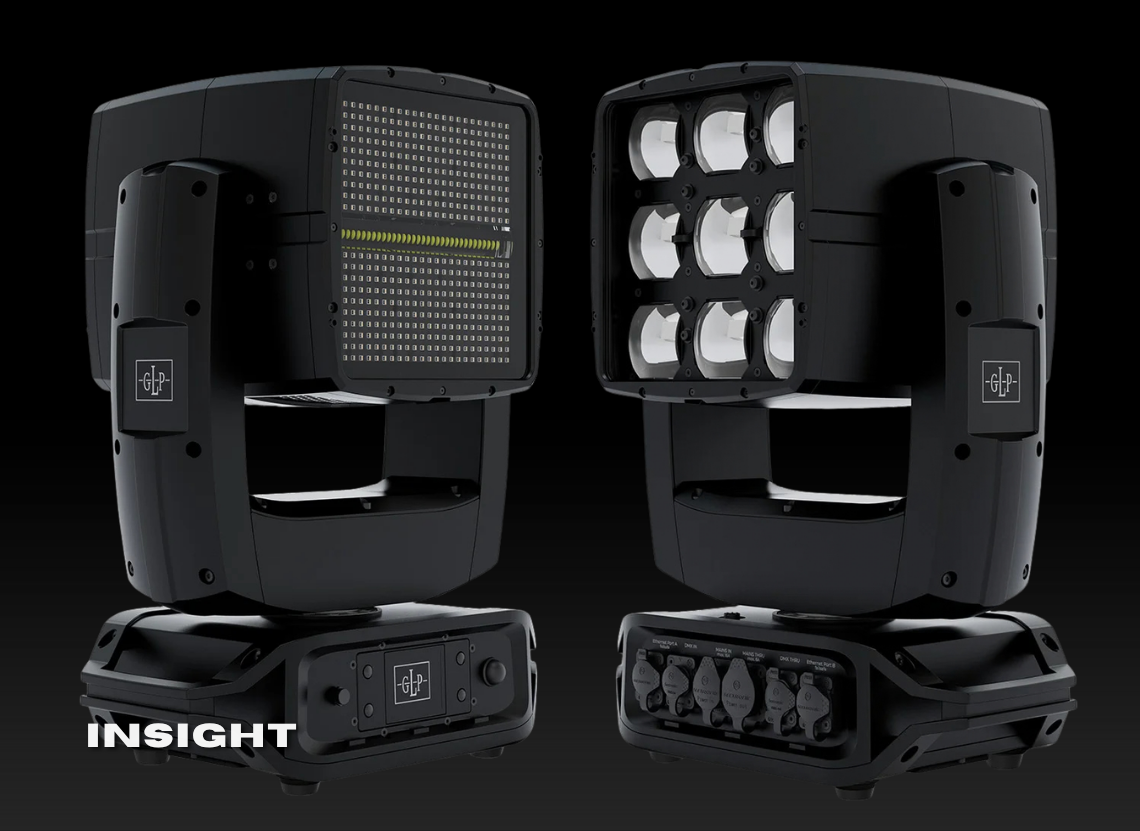
Germany – GLP is once again challenging the true meaning of innovation in professional lighting. With a vision that combines engineering, creativity and a deep understanding of the needs of contemporary lighting design, the German company continues to develop tools that support those seeking to take their visual concepts beyond the conventional. TWYN represents a new expression of this philosophy and reinforces GLP’s position as one of the leading technology partners for lighting designers.
There are manufacturers that develop lighting fixtures, and there are companies that try to anticipate what lighting will look like in the future. GLP clearly belongs to the second group. Under the leadership of Udo Künzler, the company’s founder and CEO, and Mark Ravenhill, Director responsible for commercial development and marketing, the German company has built an identity around a principle that is becoming increasingly important to lighting designers: innovation is not just about making a more powerful fixture, but about creating new possibilities for imagining, designing and building a show.
That philosophy is once again on display with TWYN, a fixture that does not try to fit into traditional categories but instead proposes a different way of understanding them.
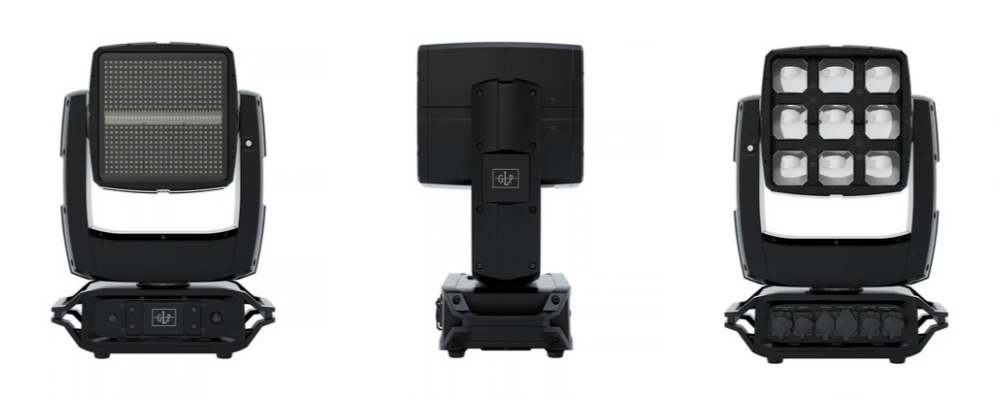
TWYN brings together two independent lighting systems in a single moving head: on one side, an RGBL wash based on a 3×3 matrix with nine 40 W LEDs and a zoom range of 4° to 53°; on the other, a hybrid strobe system inspired by the JDC Burst 1, with 36 high-intensity white LEDs and 480 RGBW LEDs arranged in segments. In practical terms, GLP has taken some of the most recognizable capabilities of Creos and JDC Burst 1 and turned them into a single moving tool.
But TWYN’s real value lies not only in the combination of these technologies. It lies in what happens when both sides begin working simultaneously.
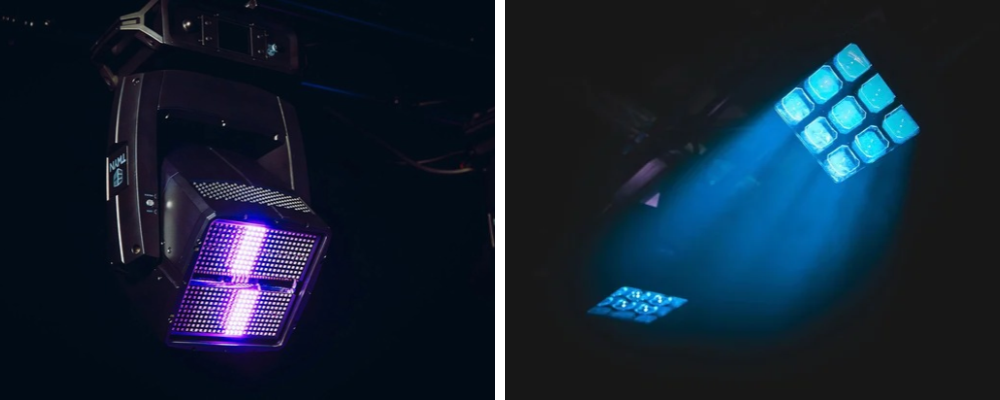
While one side can operate as a beam or strobe, the other can illuminate a surface, a backdrop, a structure or any scenic element. The result is a new dimension of depth and movement that makes it possible to create different visual layers from a single position within the rig.
This is where one of the concepts that best explains GLP’s philosophy comes into play: doing more with less.
For a designer, reducing the number of fixtures does not necessarily mean reducing creativity. It can mean exactly the opposite. Fewer fixtures can translate into less space occupied on truss, lower weight, less logistical complexity, shorter setup times and a more efficient investment, without sacrificing visual possibilities. At just 16 kilos, TWYN can be a particularly interesting tool for tours, clubs, smaller productions and projects where every kilo, every position and every transport item has a real impact.
GLP understands that contemporary lighting design can no longer be evaluated solely in terms of light output. It is also necessary to consider a tool’s ability to integrate, adapt and multiply its possibilities within a system.
That is why TWYN maintains a pixel and segmentation structure that is fully compatible with Creos and JDC Burst 1. Designers already working with these fixtures can extend their designs without disrupting the system’s visual coherence. Mapping structures can continue from one fixture to another, creating continuity that goes far beyond simple technical compatibility.
This way of thinking is also reflected in color technology. The iQ.Gamut system maintains stable colors and intensities at defined white points, combining high-quality pastels with saturated primary colors calibrated to match Creos and the X5 series.
For the designer, this has a tangible consequence: technology stops being an obstacle and becomes an extension of their creative language. And that appears to be one of GLP’s greatest strengths.
The German company has built a distinctive relationship with the most creative and demanding lighting designers because it understands that they are not simply looking for a fixture that produces light. They are looking for tools capable of supporting an idea.
A fixture can have more power. It can have more functions. It can incorporate more technology. But when those capabilities are designed around the real needs of the people creating shows, they stop being technical features and become creative possibilities. TWYN is a good example of that transformation.
Its continuous 360° pan and tilt movement, its ability to operate indoors and outdoors in temporary installations thanks to its IP65 protection, its DMX, RDM, Art-Net, sACN and iQ.Mesh protocols, its wireless update capabilities and its design aimed at simplifying transport and setup demonstrate that GLP is not thinking only about what happens when the fixture is switched on.
It is thinking about everything that happens before, during and after the show. And that detail is fundamental.
True innovation in professional lighting does not end onstage. It is also found in logistics, setup, maintenance, available space, the weight a structure must support, the speed with which equipment can be installed and dismantled and, especially, the possibility of using a single tool to meet different needs.
TWYN brings this vision together in a lightweight fixture that offers two sides, two systems in a single unit.
But above all, it raises a question that GLP is once again putting on the table: how much more can a designer do when technology stops imposing limits and starts expanding their imagination?
A company that thinks like a designer
The development of TWYN also helps explain why GLP has established such a distinctive position in professional lighting.
Under Udo Künzler’s leadership, with Mark Ravenhill driving commercial development, GLP has built a culture in which innovation does not seem to be driven solely by a race to incorporate technology, but by a constant search for new answers for the professionals behind every production.
This connection with the designer is possibly one of the company’s greatest assets.
GLP does not seem to ask only what a fixture can do. The more interesting question is what a designer can do with it. The difference may seem small, but it completely changes the outcome.
When a company designs exclusively with the product in mind, it produces a product. When it designs with the people who will use that product to create experiences in mind, it can build a tool.
And that is precisely what makes GLP more than just a manufacturer.
Its fixtures are part of the creative language of designers working on stages, tours, festivals, television, clubs, installations and major international productions. They are tools that make it possible to build volume, depth, movement, texture and visual architecture.
TWYN takes that philosophy one step further. It does not try to be just another wash. Nor just another strobe. It does not need to choose a single identity. It can be both. It can work forward and backward. It can generate light on a surface while creating effects in the air. It can integrate with existing GLP fixtures and expand an existing design.
And it can do so while simultaneously reducing the amount of equipment required. That is innovation applied to design.
When technology understands creativity
The evolution of professional lighting is leading designers toward increasingly complex systems, where fixtures, video, content, mapping, pixels and movement are all part of the same visual architecture.
In this context, the tools that endure will not necessarily be those with the most features on a technical specification sheet. They will be those capable of integrating naturally into this new language.
GLP appears to have understood this transformation. TWYN is not just a new fixture. It is a statement about how the concept of a professional lighting device can evolve: becoming more versatile, more efficient, more integrated and, fundamentally, more open to creativity.
Because when a fixture makes it possible to do more, occupy less space, reduce weight, simplify logistics and, at the same time, open up new visual possibilities, it becomes more than just part of the equipment.
It becomes a design tool. And perhaps that is where GLP’s true significance lies. The company does not try to tell designers how they should light. It gives them new possibilities so they can do it.
In a market where technology advances at an extraordinary pace, that difference is enormous. Because the future of professional lighting will depend not only on who can manufacture the most advanced fixture, but on who can build the tools that allow designers to imagine what does not yet exist.
GLP has been working in that direction for years. TWYN is further proof of that. Two sides. One fixture. Infinite possibilities.
The history of professional lighting is also written by companies that dared to change the rules, and GLP has carved out its own place in that history. Its ability to turn technological innovation into practical tools for creativity, its ongoing contribution to the evolution of design and its close relationship with the professionals redefining the language of light have gone beyond product development to become a genuine influence within the industry. That is why talking about GLP means more than talking about lighting fixtures: it means talking about a company that has helped transform the way we understand, design and experience professional lighting, and that, through its innovation, vision and contribution, has earned a place among the most important companies in the history of this industry.
When innovation serves creativity, technology stops being simply technology. It becomes a language.


