
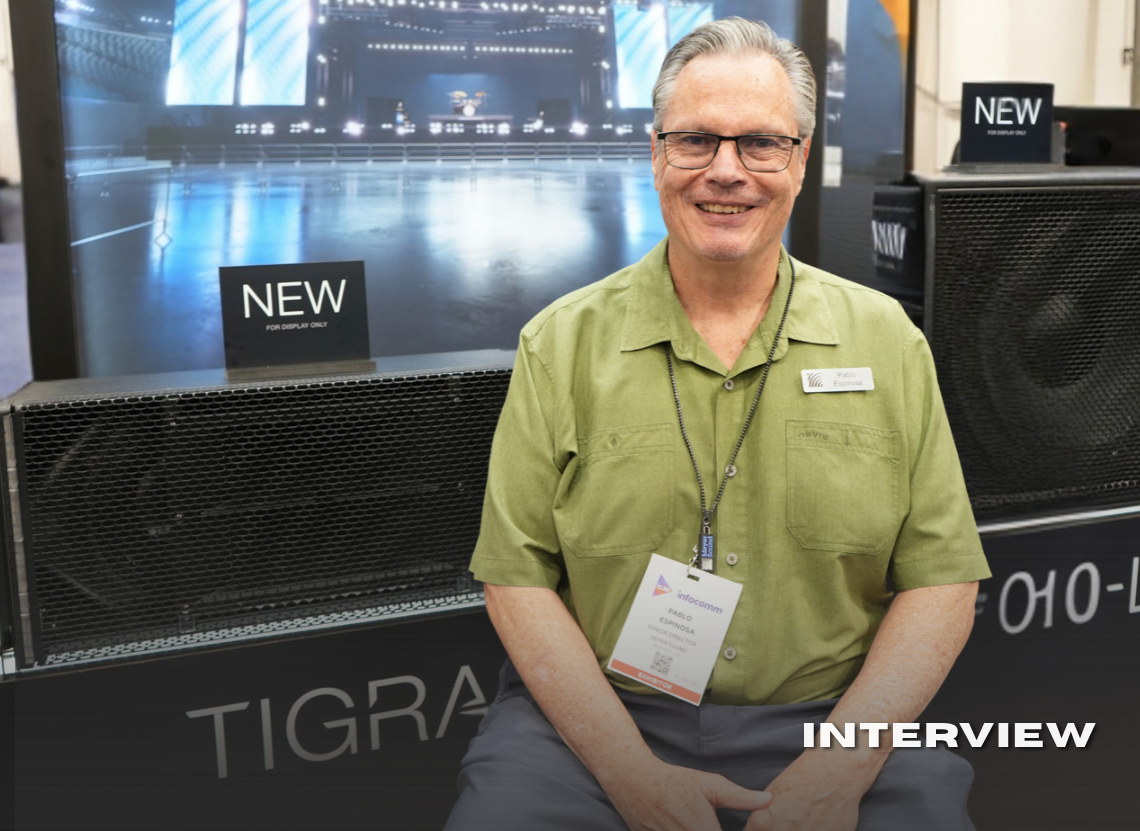
Listening to users before designing, developing each component as part of a system, and maintaining quality, consistency and reliability as engineering principles. Pablo Espinosa, Senior Director of Transducers & Technical Services at Meyer Sound, explains a philosophy that has guided the company for nearly five decades and finds one of its most recent examples in TIGRA.
In an industry accustomed to talking about power, coverage, processing and performance, Pablo Espinosa proposes starting much earlier. Before design. Before defining components. Even before thinking about a new product.
For Meyer Sound, the starting point is listening.
“We are very fortunate to have highly relevant clients in the industry, and when we listen to our clients and learn about the problems they are trying to solve, that is when we begin the creative process of developing our new systems.”
Espinosa, Director of Component Development and Director of Technical Services at Meyer Sound, takes this idea directly into the realm of engineering. Rather than developing a solution first and then looking for where to apply it, he explains, the process often begins with a specific need coming from those who use the systems in real-world situations: “Many of these systems have already been sold because they are required by our clients.”
It is a dynamic that requires finding a constant balance.
A system must be versatile, but it must also be optimized for specific applications; it must respond to different scenarios without losing reliability, consistency or the ability to operate within a larger ecosystem.
From PANTHER to TIGRA
TIGRA clearly illustrates this approach.
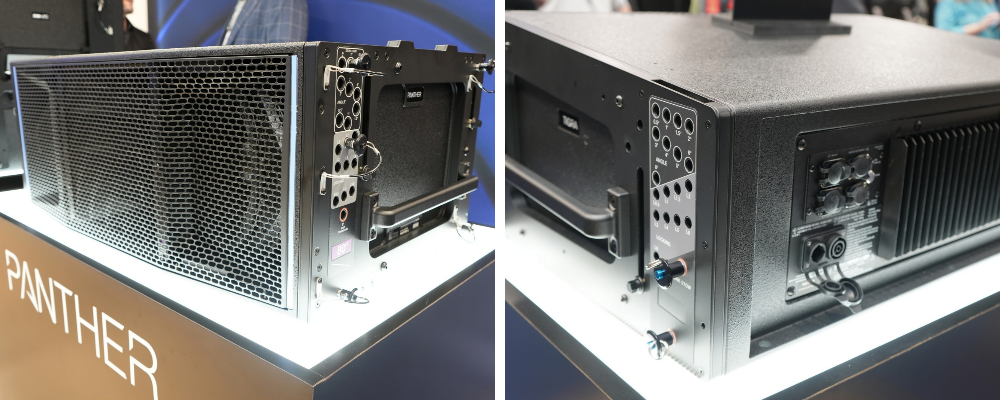
When Meyer Sound introduced PANTHER, the system was designed especially for large-scale productions and tours. Espinosa mentions applications with artists such as Metallica, Ed Sheeran and Michael Bublé.
Over time, feedback from users themselves began to reveal another need: “They needed a slightly smaller system, something more compact and lighter.”
The request had two dimensions. On the one hand, they needed a solution capable of complementing PANTHER at large events as a downfill, outfill or frontfill. On the other, they needed a system that could operate independently in theaters, arenas and venues where PANTHER might be oversized.
TIGRA emerged from this scenario, not simply as a smaller version of another system, but as a response to applications requiring a different scale without abandoning Meyer Sound’s design principles.
Self-powered technology is part of that equation. For Espinosa: “This allows us to maintain reliability and predictability, but it also makes the system scalable because it does not depend on an external relationship between the number of cabinets and the amplification. We are always thinking about how the system needs to be highly versatile and scalable.”
But this versatility cannot be achieved by sacrificing other variables: “In our design process, we are always looking for optimization. Obviously, versatility is one of those factors, along with reliability and the ability to work as a system.”
Finding that balance is part of the challenge because not all users prioritize the same things. Some projects may require certain features to take precedence over others, but for Pablo, that does not mean the remaining aspects can be overlooked: “Different clients have different needs, and for some, one aspect is very important, while for others, another aspect is very important. So we cannot leave any of these aspects behind.”
Thinking about the complete system
For Meyer Sound, a product should not function as an isolated component.
TIGRA must be able to integrate with PANTHER, but also work alongside other elements of the Meyer Sound ecosystem. He mentions its compatibility with the 1800, 2100, X80 and X40 loudspeakers as part of a philosophy that aims to allow different solutions to work together without creating additional complexity for those designing or using the system.
This approach, he explains, did not begin with TIGRA: “Since the company’s inception, the mindset John Meyer has always had—and one of his contributions to the industry—is not to think in terms of components, woofers, drivers, amplifiers or cabinets, but rather to think about a complete system.”
To achieve this, Meyer Sound develops and controls the technologies that make up its systems. Amplification, drivers and other components are not conceived independently and then brought together, but designed from the outset with consideration for how they will interact with one another: “Because the only way to optimize something is to know exactly how it will be used, how it will work and how it will interact with the other components in the system.”
This idea leads to one of the most emphatic statements of the conversation: “We don’t make cabinets; we actually make complete systems.”
From centralized to distributed processing
Thinking of a product as a system also makes it possible to look at where the technology is heading.
Pablo Espinosa identifies a clear trend toward digital transport, digital control and processing. In TIGRA, this evolution is represented by GEN-1, Galaxy Extended Network: “Instead of using centralized processing, we are now distributing processing to each of the system’s components, to each cabinet in the line arrays. This is not just a feature incorporated into a product. It is part of a change that will continue to develop. This trend will continue, and what is new today will become essential in the future.”
This perspective is also connected to Meyer Sound’s history. Technologies that are now a regular part of professional audio began decades ago as developments that changed the way systems were conceived.
The responsibility of meeting expectations
Innovating for decades also creates another consequence: expectations.
For Espinosa, working with users who have an in-depth understanding of technology and operate in some of the industry’s most demanding environments brings an additional responsibility: “Our clients always expect the best quality, the best reliability and the best development. We not only have to meet their expectations, but exceed them to ensure that our most demanding clients are not just satisfied, but truly happy.”
When asked to sum up Meyer Sound’s philosophy in a single word, Espinosa resists. One word is not enough.
He talks about quality, but not only in terms of manufacturing or components. He talks about audio quality, consistency, reliability and predictability. And he inevitably returns to integration.
“When a client buys a Meyer loudspeaker, they know exactly what to expect, and we make sure they receive exactly that. All the components, the different cabinets, the software—everything has to work as a system and give our clients the tools they need to do their jobs properly.”
This way of working is directly connected to Meyer Sound’s track record and to a vision that has been sustained for nearly 50 years.
This working philosophy is reflected in the way decisions are made: listening to a need, turning it into an engineering problem and working through every variable until the answer is found.
TIGRA is one of those answers today. It will certainly not be the last.


