
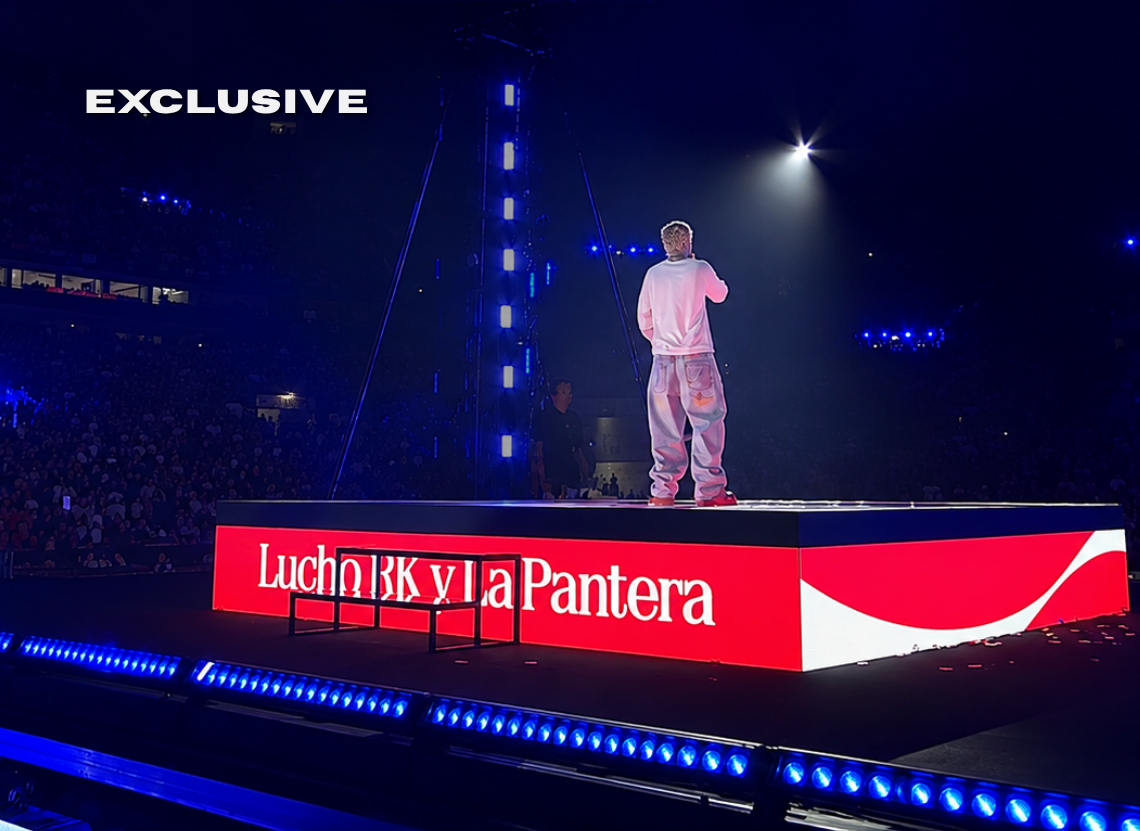
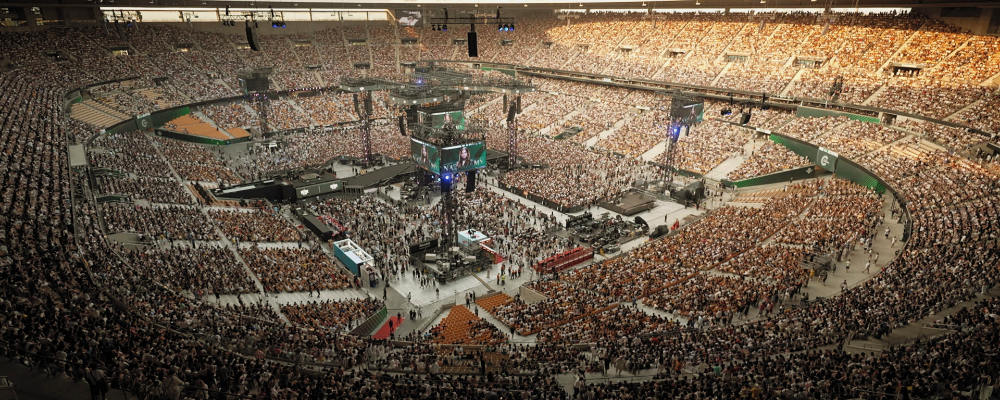
Designing lighting for a 360° stadium, with nearly 1,500 fixtures, dozens of cameras, and more than eight hours of broadcasting requires every tool to have a clear function. At La Velada del Año VI, Toni Llobet integrated GLP impression X4 Bar 20 fixtures into the mobile stage used for the musical performances, taking advantage of their movement, pixel control, and versatility to handle everything from front lighting for the artists to scenic lighting.
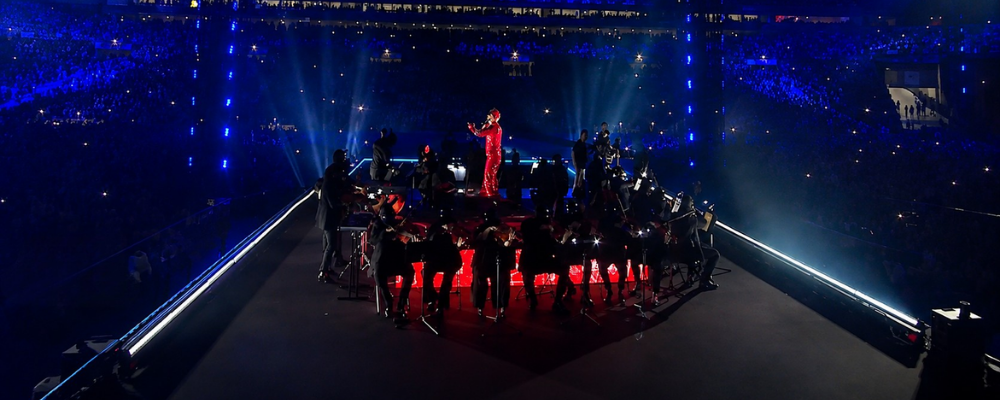
The scale of La Velada del Año VI could easily lead to a discussion about numbers. A stadium, around 80,000 spectators, nearly 1,500 fixtures, and a multi-camera production that requires virtually every angle to be considered. But for Toni Llobet, responsible for the lighting design, the complexity was not only about how much equipment to use, but about ensuring that every element made sense within a show that had to run for more than eight hours and be seen from every direction.
“It’s a 360° show, with a ring in the middle and 80,000 people around it,” Llobet explains. That condition influenced virtually every design decision. “It’s very difficult to keep everyone happy, to make sure everyone receives the same lighting inputs, and that it also looks good on camera.”
Within that enormous system, there was one area with particularly specific requirements: the mobile stage used for the musical performances.
The structure could move and be positioned beneath one of the screens, while also functioning as part of the access tunnel. There, Llobet incorporated GLP impression X4 Bar 20 fixtures with a specific premise: to have a light capable of physically accompanying that movement while also providing different resources throughout the show.
A light that had to travel with the stage
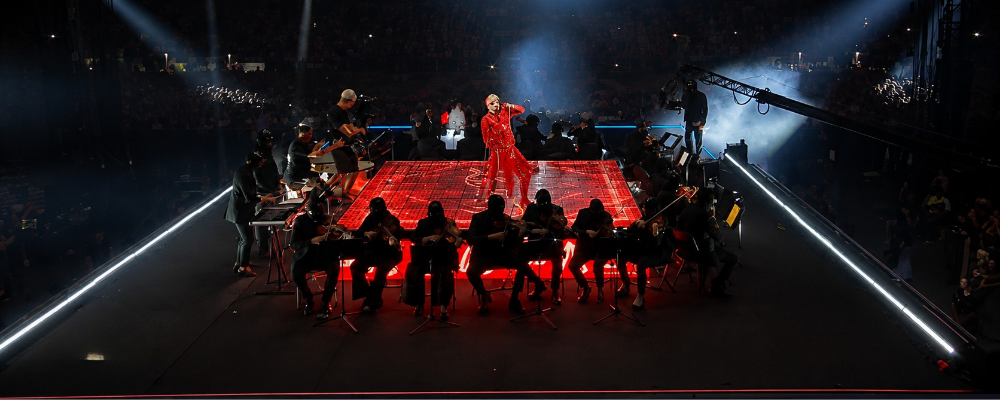
The position of the X4 Bar 20 fixtures was not accidental. Llobet distributed them in front of and behind the stage to respond to the 360° nature of the show and generate low-positioned footlight-style front lighting on the artists.
“The ones up here are front lights. They provide lighting coverage for the entire stage. It’s the only light that travels on top. When it’s moving, I don’t have any other light besides this one to provide the front lighting,” he explains.
This is where one of the interesting aspects of the application emerges: the fixture was not intended solely as a visual element within the structure, but as a tool directly linked to its operation.
As the stage changed position, the X4 Bar 20 fixtures remained integrated into it, maintaining a front light source that accompanied the movement while preserving coverage over those occupying the platform.
The architecture of the impression X4 Bar 20 is particularly well suited to this approach. The fixture incorporates 20 individually controllable 15 W RGBW LEDs, a motorized zoom from 7° to 50°, and 210° tilt, combining the possibilities of an LED bar with the movement of an automated fixture.
From the artist to the scenery
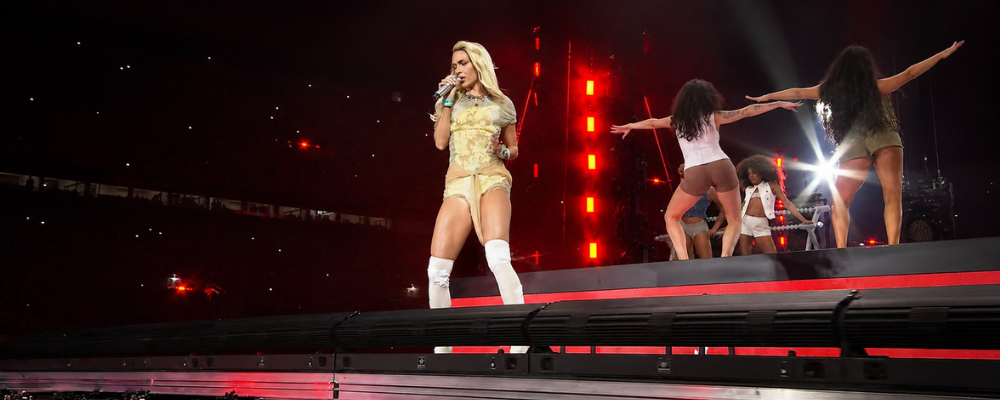
Other X4 Bar 20 fixtures were incorporated at floor level within the scenic concept developed by Brau, the team responsible for the scenic design and with whom Llobet works closely.
In that position, their function changed. “Down below, to light the curtain, to light the scenery. We also had some pixel effects and some tilt effects,” the designer explains.
The same family of fixtures could therefore work across two different layers of the image: on the one hand, providing light on people; on the other, becoming a tool to transform the background and add color and movement to the scenery.
Individual control of the X4 Bar 20’s 20 RGBW pixels expanded that second possibility. Instead of necessarily operating as a single surface of color, the bar could become a graphic element, generating sequences and effects across its pixels. Its zoom range also made it possible to modify the behavior of the beam, from a narrow output to considerably wider coverage.
But behind those technical possibilities was a much broader need that Llobet repeatedly mentions when explaining different areas of the project: every fixture had to provide more than one resource.
The reason was simple. La Velada is not a conventional concert with a fixed setlist and a predictable sequence of songs. Fights, participant entrances, musical performances, and different entertainment segments coexist within a broadcast that this year lasted approximately eight and a half hours.
That changes the way the tools are considered.
Llobet summarizes it during the interview when discussing other hybrid fixtures used in the project: he needs “fixtures that give me more than one option per fixture.” The use of the X4 Bar 20 on the mobile stage follows that same logic.
Designing for the stadium and also for the camera
The coexistence of the live show and broadcast runs through all of Llobet’s work on La Velada.
“I really start with the stadium, with what people see live,” he explains. From there, it is important to review “all the camera fields” and cover each of those perspectives.
That dialogue between lighting and camera is directly connected to his own background. Before establishing himself as a lighting designer, Llobet studied cinematography and developed both disciplines in parallel. Today, he acknowledges that this combination is particularly useful in multi-camera productions such as those associated with Ibai Llanos.
“In the end, what I always say is that what I love is making art with technology. If you give me a piece of paper, a canvas, and a brush, everything is horrible. All my art comes through technology,” he summarizes.
At La Velada, that technology must also survive an enormous scale and a particularly dynamic format.
More possibilities within the same tool
The X4 Bar 20 was conceived precisely around an unconventional combination: a linear LED bar that can also behave like a moving light.
Its 20 RGBW sources can be controlled individually, while the tilt movement makes it possible to physically change the direction in which the line of light operates. Added to this is the motorized zoom, which expands the coverage possibilities without requiring the fixture’s position to be changed.
Within the context proposed by Llobet, these features do not appear as isolated specifications. They translate into the possibility of using the fixtures for front lighting, changing their behavior when the stage reaches another position, working on scenic elements, and adding pixel effects when the narrative of the show allows it.
That versatility is particularly valuable in a design where space, structural loads, and budget also influence every decision.
During each fight, the lighting must remain stable and avoid stimuli that could distract the participants. Between fights, during entrances or musical performances, the language changes completely and the system regains movement, color, pixels, and effects.
The X4 Bar 20 fixtures found their place precisely within that second dimension, occupying a specific role within a system of nearly 1,500 fixtures, but their function summarizes much of the logic with which Toni Llobet built La Velada del Año VI: tools capable of adapting, changing roles, and continuing to perform when the show, the stage, or the camera requires attention to shift elsewhere.
Cover Photo: La Velada del Año IV – Youtube @ibai
Inside Photos: La Velada del Año IV – Youtube @ibai
The journalistic production, research, writing, editorial approach, and editing of this content are original works by LATAM STAGE and are protected by copyright. No part of this content may be reproduced, copied, distributed, adapted, or published, in whole or in part, in any medium or format, without the prior written authorization of LATAM STAGE.


