
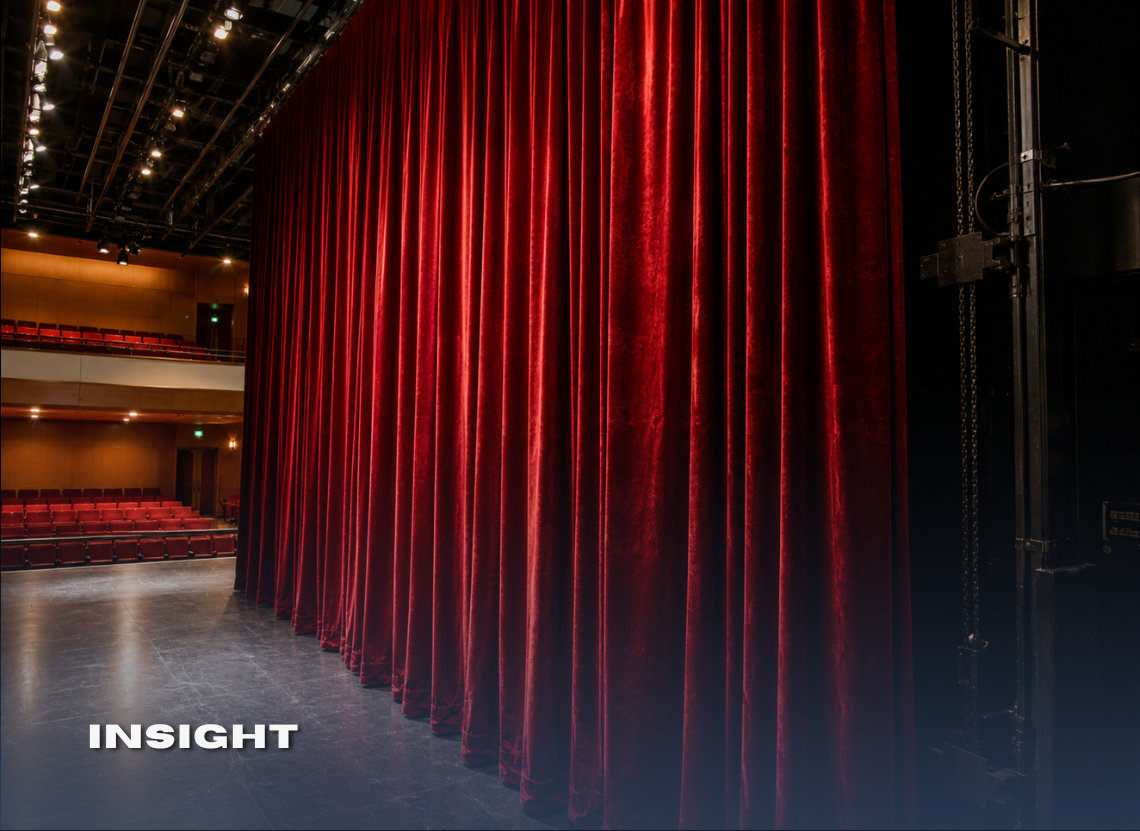
From the function it will serve to fabric weight, opacity, fullness, acoustics, movement system and safety requirements, choosing a stage curtain involves much more than defining dimensions and color. Together with NASH Ingeniería, we review some of the main factors that should be considered before specifying a solution.
A curtain is one of the most recognizable elements of a stage, but behind its appearance lies a series of technical decisions that often remain invisible to the audience.
Main curtains, legs, borders, backdrops and masking systems serve different functions. While some form part of the visual identity of the venue, others must conceal equipment and technical areas, control sightlines, minimize reflections or contribute to the acoustic behavior of the space.
Therefore, the first question should not be what fabric to use, but what function the curtain will serve within the stage.
Every stage presents different needs
In masking systems, for example, performance in response to light is fundamental. Legs and borders visually define the stage space and conceal technical areas from the audience, which is why materials with a high capacity for light absorption and low reflection are commonly used.
The right textile choice can help control unwanted ambient light, reduce reflections within the stage area and keep certain technical areas out of sight. Depending on the material and its construction, it can also contribute to the acoustic behavior of the venue.
But there is no single fabric suitable for every application.
Weight, composition, density and finish influence how a curtain hangs, how long it lasts, how it interacts with lighting and what its acoustic performance will be.
This does not mean that a heavier fabric is necessarily the best choice. Weight should respond to the objective and specific conditions of each project.
“One of the mistakes is to begin the selection by thinking only about color or dimensions. We first need to understand what function the curtain will serve, where it will be installed, how it will move and what conditions the space presents. From there, we can begin defining the appropriate fabric and system,” explains Maximiliano Moreno, NASH Ingeniería product specialist.
A 10-meter stage does not necessarily need 10 meters of fabric
Another fundamental variable is fullness. The visible width of the curtain and the actual amount of fabric used to make it are not necessarily the same. Folds require additional material and, in addition to modifying the aesthetics, they can increase opacity and the absorption of light and sound.
As a reference, a finished curtain 10 meters wide with 50% fullness requires approximately 15 meters of fabric at its developed width. With 100% fullness, the amount increases to 20 meters.
Therefore, simply taking the width and height of the opening is not enough to correctly calculate a solution.
The fullness percentage must also be related to the fabric, height, desired visual appearance and function. In very tall curtains, it may also be necessary to carefully evaluate this percentage in order to maintain the visual appearance of the folds throughout the entire drop.
What happens with sound?
Stage textiles also interact with acoustics.
Heavy and porous materials can contribute to absorbing sound energy and reducing reverberation. This is why there are curtains specifically developed for acoustic applications.
But the objective may be exactly the opposite.
If there are loudspeakers or other audio systems behind the curtain, acoustically transparent textiles may be required, whose structure allows the equipment to be visually concealed while seeking to minimize its interference with sound propagation.
The question remains the same: what does that curtain need to do within the system?
“The fabric cannot be separated from the movement. When a curtain needs to open and close, the selection is no longer exclusively about textiles. Its total weight, dimensions and construction become part of a system that includes tracks, carriers, suspension elements and, depending on the project, manual or motorized operation.”
The type of opening must also be defined. A main curtain can be split at the center and travel toward both sides or be gathered toward a single side, among other configurations.
For NASH, which specializes in stage consulting, design and installation of stage machinery systems and projects, analyzing these elements as an integrated solution helps prevent an apparently simple decision from later conditioning stage operation.
“The curtain should not be considered separately from what will support and move it. When we know the dimensions, final weight, frequency of use and type of opening required by the project, we can size the complete system. Choosing the curtain first and solving how to move it afterward can lead to oversizing, limitations or modifications that could have been avoided from the beginning.”
Safety is also part of the specification
In public-use spaces, the material’s behavior in response to fire is another fundamental aspect.
“There are FR (Flame Retardant) textiles, whose resistance to flame propagation comes from treatments applied to the material, and IFR (Inherently Flame Retardant) synthetic textiles, manufactured with fibers that incorporate this characteristic. IFR materials can also offer advantages for certain touring applications or installations subject to frequent setups, depending on the specific composition and characteristics of the textile.”
However, the required certification must be evaluated according to the regulations applicable in each country and venue. There are international standards such as NFPA 701 for evaluating flame propagation in certain textiles and films, but its specific application depends on the regulations and authorities corresponding to the location where the installation will take place.
Therefore, rather than simply looking for the word “flame retardant,” it is necessary to verify which certification the material has and what the project specifically requires.
A solution begins long before the curtain is installed. Function, dimensions, fabric, weight, opacity, reflection, acoustics, fullness, safety and movement are all part of the same decision.
And this is probably where the main difference lies between simply selecting a fabric and designing a stage solution.
“The visual experience ultimately perceived by the audience begins long before the curtain opens: with a proper understanding of the space, how it operates and all the technical variables that will need to coexist behind the stage.”
A perspective that summarizes NASH’s approach: understanding the curtain not as an isolated element, but as part of a stage system in which every technical decision influences the final result.
Credits
Cover Photo: LATAM STAGE
Inside Photos: LATAM STAGE
The journalistic production, research, writing, editorial approach, and editing of this content are original works by LATAM STAGE and are protected by copyright.
No part of this content may be reproduced, copied, distributed, adapted, or published, in whole or in part, in any medium or format, without the prior written authorization of LATAM STAGE.


