
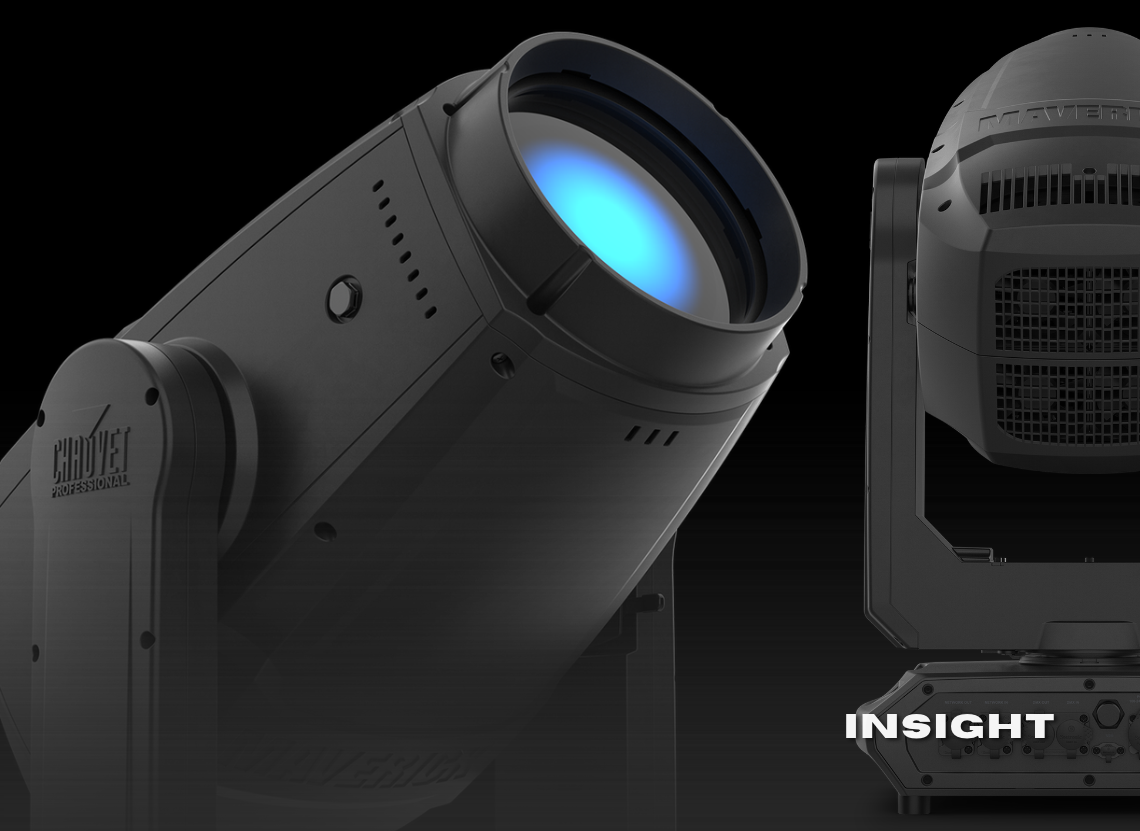
USA – In productions where the boundary between show, audiovisual content and immersive experience is becoming increasingly blurred, lighting design faces new challenges. In this context, CHAUVET Professional puts forward the Maverick Storm 3 Profile as a solution that focuses on something essential: giving designers greater freedom to turn a creative intention into a concrete solution.
Lighting design evolves alongside increasingly demanding productions. Stages no longer have such clearly defined boundaries, audiovisual content requires greater precision, and working conditions can change radically from one show to another. In this context, designers need tools capable of responding to different challenges without compromising creativity, control or the quality of the result.
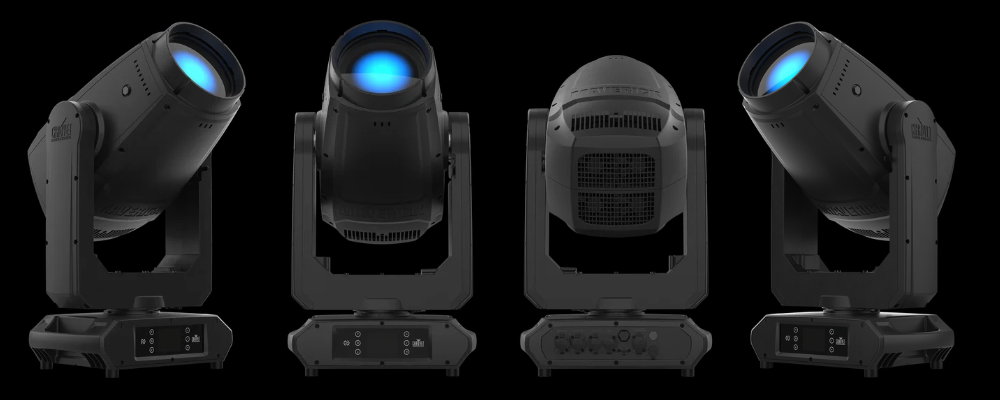
CHAUVET Professional’s Maverick Storm 3 Profile represents a technological response to this reality. It is not simply a high-output LED luminaire with IP65 protection. Its proposal combines light output, optical precision, effects versatility, color resources and integration capabilities that make it possible to address a wide variety of applications. Above all, it puts a set of tools at the designer’s disposal to bring ideas to life with greater freedom.
Creativity needs tools that do not impose limits
One of the main needs of a lighting designer is to be able to adapt the same tool to different situations. In one production, they may need a narrow, defined beam to highlight a specific element; in another, broad coverage to create atmospheres or illuminate large surfaces.
The Maverick Storm 3 Profile offers an optical zoom of 3.4° to 56.7°, a range that allows it to move from a concentrated beam to considerably wider coverage. This versatility reduces limitations that may arise when working with different distances, stage dimensions and visual concepts.
Its 620 W, 7500 K LED source is accompanied by an optical system designed to deliver high levels of intensity. The manufacturer’s photometric measurements record up to 34,500 lumens at an intermediate zoom position, while in Full Spot it reaches an illuminance of 165,664 lux at five meters. These figures provide an understanding of the luminaire’s potential, although final performance depends on the zoom position and the configuration used.
For the designer, this combination means having a tool capable of addressing different needs within the same production, without the choice between output and flexibility necessarily becoming a limitation.
Optical precision to bring an idea to life
Power alone does not define the quality of a luminaire. In professional design, being able to control exactly where the light reaches and how it behaves is just as important as its intensity.
In this regard, the Maverick Storm 3 Profile incorporates a four-blade framing system with full rotation, allowing the beam to be precisely shaped and defined. This feature is particularly valuable when a specific area needs to be illuminated, spill light onto unwanted elements needs to be avoided, or defined shapes need to be created on stage.
These capabilities are complemented by two gobo wheels—one rotating and interchangeable and another static—along with a five-facet prism, iris and frost. The combination expands the possibilities for creating textures, effects and different light behaviors, from defined projections to softer and more diffuse atmospheres.
The CMY color system, accompanied by CTO and a dedicated color wheel, provides another level of control. It is not simply about having a broad color palette, but about being able to work with transitions and adjustments that respond to the aesthetic requirements of each design.
The difference lies in control. The more possibilities a designer has to define the shape, color, intensity and behavior of the light, the greater their ability to translate a creative intention into a concrete result.
IP65 a new freedom to work outdoors
Today’s productions take place in increasingly diverse environments. Festivals, concerts, corporate events and outdoor shows require equipment prepared to operate under environmental conditions that can change throughout the day.
The Maverick Storm 3 Profile’s IP65 rating expands its potential use outdoors and in environments exposed to dust and water. This protection makes it possible to incorporate the luminaire into designs where weather conditions represent an important variable, without having to restrict its use exclusively to indoor spaces.
An interesting detail is the inclusion of SunShield, a system designed to protect the optical components from direct sunlight when the luminaire is switched off. It is a solution that addresses a specific situation in outdoor work and demonstrates how the development of a professional luminaire must also consider what happens outside the moment when it is turned on.
Ultimately, environmental protection is not merely a construction feature. It is a factor that expands the scenarios in which designers can work and plan their concepts.
When light also has to respond to cameras
The relationship between lighting and audiovisual production is becoming increasingly close. Shows are recorded, broadcast and distributed across multiple platforms, introducing additional demands on luminaires.
A light that works correctly to the naked eye can exhibit unwanted behavior in front of certain cameras. This is why PWM frequency control becomes particularly relevant.
The Maverick Storm 3 Profile offers different frequency options, including 600, 1,500, 2,000 and 65,000 Hz. The latter option is intended for applications that require appropriate performance in productions using high-speed cameras, where flicker can become a visible problem.
Its CRI filter also deserves attention, allowing color reproduction to be prioritized when color fidelity is critical. The manufacturer’s photometric measurements record a CRI of 91.1 with this filter, with an output of 23,539 lumens at an intermediate zoom position.
This is where a fundamental issue emerges: the designer does not always need the maximum amount of light. In certain situations, more accurate color reproduction can be far more important than having the highest possible light output. Being able to choose between different operating priorities is part of the versatility that professional productions demand today.
A powerful tool must also integrate into the workflow
A luminaire’s technology does not end with its light source or optical capabilities. It must also facilitate the work of the professionals who install, configure and operate it.
The Maverick Storm 3 Profile incorporates compatibility with DMX, RDM, W-DMX, Art-Net and sACN, making it easier to integrate into different control architectures. NFC configuration, operating presets and the ability to synchronize settings between fixtures help simplify preparation and commissioning tasks.
It also includes a battery-backed display, a USB connection for software updates and an Ethernet data transfer system designed to maintain signal continuity under certain connection conditions.
Another aspect worth considering is acoustic performance. In the test report carried out by the University of Salford’s acoustics laboratory, the unit recorded 64.8 dBA of sound power in Full mode and 54 dBA in Eco, TV25 and TV35 modes. These results, obtained under the specific conditions of the test, show that there are operating alternatives to adapt the unit’s behavior to environments where fan noise can be a relevant factor.
These are details that may not be part of a luminaire’s first visual impression, but they become important when working on complex productions where every component must integrate reliably into the overall system.
Technology makes sense when it expands creative possibilities
CHAUVET Professional’s Maverick Storm 3 Profile brings together features that respond to several of the current demands of lighting design: output, precision, optical versatility, color control, outdoor adaptability and compatibility with different production environments.
However, its true value should not be measured solely by its lumens, effects or IP65 certification. The relevant question is what a designer can do with all these tools and how they can help them better address the challenges of each project.
In an industry where productions demand increasingly sophisticated technical and creative resources, having equipment capable of adapting to different scenarios is no longer a luxury but a professional necessity.
Because, ultimately, the most valuable technology is not necessarily the technology that incorporates the most functions, but the technology that allows an idea to go further, with greater precision and without imposing unnecessary limits on the person behind the design.
Credits
Cover Photo: LATAM STAGE
Inside Photos: LATAM STAGE
The journalistic production, research, writing, editorial approach, and editing of this content are original works by LATAM STAGE and are protected by copyright.
No part of this content may be reproduced, copied, distributed, adapted, or published, in whole or in part, in any medium or format, without the prior written authorization of LATAM STAGE.


