
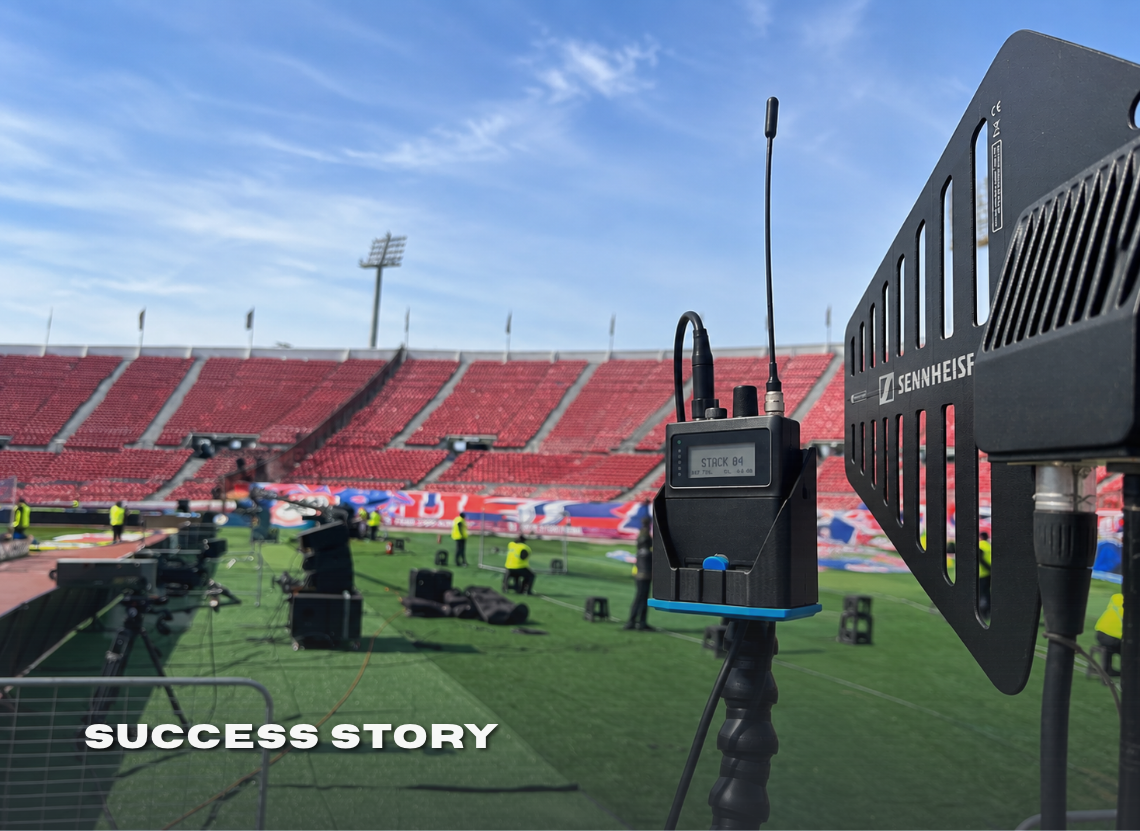
Chile – A Red Bull activation held as part of the Chilean Superclásico became an unconventional technical challenge for Chino Santana Refuerzo Sonoro. With just a few days to prepare, Mauricio “Chino” Santana and the Sennheiser team brought Spectera into a different application: distributing audio wirelessly to 12 points around the stadium, extending coverage to the stadium roof, and responding to new requirements that emerged during the event.
Five days before the Superclásico, Mauricio “Chino” Santana received a call that would turn into one of the most demanding tests he had carried out with Spectera up to that point. He had to handle the audio for a Red Bull activation at Chile’s National Stadium, initially planned to accompany a musical performance and cover specific areas of the venue.
Santana’s experience working in that stadium quickly made him realize that, with the stands full, limited coverage could become a problem. His proposal was to expand the setup to 12 sound points distributed around the field, each with its corresponding sound reinforcement system.
That scale also created the opportunity he had been waiting for months: to use Sennheiser Spectera beyond its usual microphone and in-ear applications and make it part of the wireless audio distribution to each of those points.
“When this opportunity came up, that was the first thing I thought of,” Santana recalls. Until then, he had worked with Spectera primarily in in-ear and microphone applications. The National Stadium would be the first opportunity to test another of the possibilities he had envisioned since discovering the technology.
Twelve sound points, without running audio cables
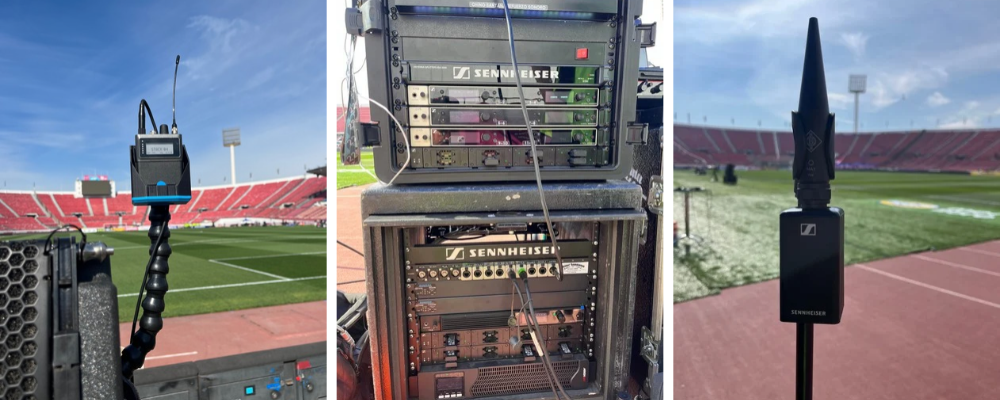
The idea was as simple to explain as it was unconventional to implement: use Spectera bodypacks to wirelessly deliver the signal to the systems distributed around the field.
Javier Liberón, Sennheiser Technical Support in Chile, explains that Spectera allows the bodypack’s headphone output configuration to be modified to operate as a balanced output. This made it possible to place one unit at each stack and feed the amplification system from there.
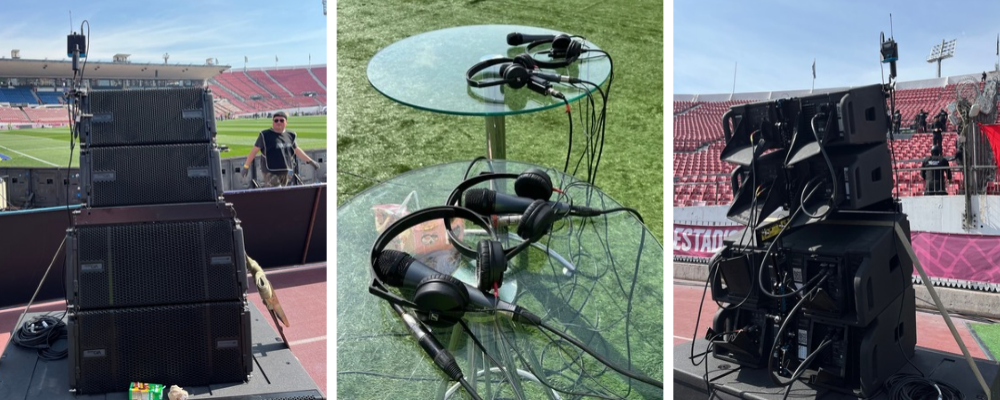
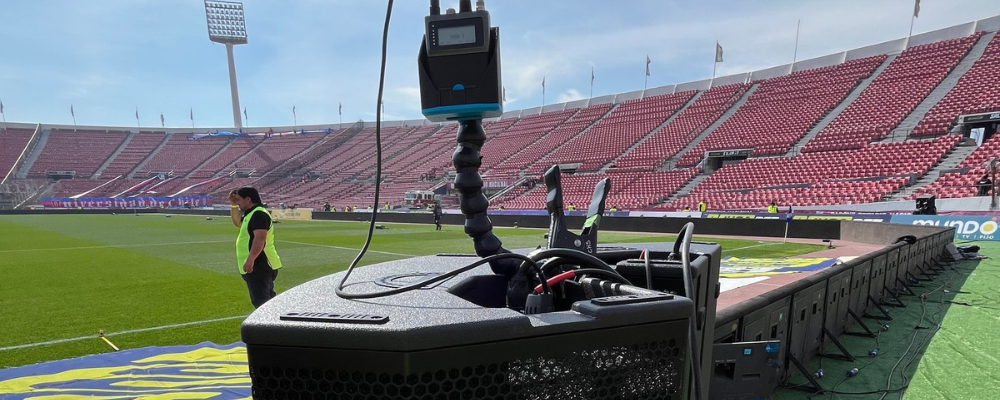
The field was covered by six stacks on each side, twelve points in total. Instead of running audio lines to each location, the signal arrived wirelessly through Spectera.
The difference was particularly significant for Santana, who had been accustomed to working in large venues long before current digital technologies made this type of deployment easier.
“In the 1990s, doing something like this was a challenge because of the amount of information that had to travel through all the cables and the number of cables that had to be run. It was incredible.”
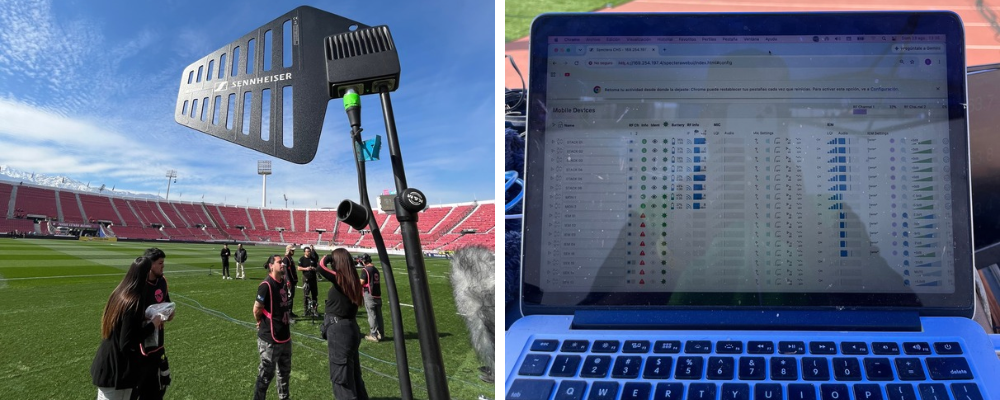
This time, the approach was completely different: power at each position, antennas to establish coverage, and bodypacks to receive the signal.
Santana sums it up even more clearly: “In the end, we only ran power cables: 12 power points around the stadium. Everything else was wireless.”
For Chino Santana Refuerzo Sonoro, this change did not simply mean reducing the amount of cabling. It made it possible to conceive of the field as a series of sound points that could receive a signal without having to build extensive analog infrastructure around them.
Measuring before making sound
Distributing the signal was only one part of the job. The twelve points had to operate as a coherent system in front of stands covering a large area.
Santana explains that the team carried out microphone measurements at three positions in the stands, using that information to adjust the response and achieve greater uniformity in the high frequencies. Based on those measurements, the corresponding PA system presets were also selected before replicating the configuration across the different points.
In this way, wireless distribution through Spectera solved the problem of transporting the signal, while the measurement and calibration work addressed how that signal should behave once reproduced throughout the stadium.
And just when it seemed that this would be the project’s main test, a second challenge emerged.
From the field to the roof of the National Stadium
The Red Bull activation added a new element to the proposal: taking the three artists to the stadium roof for another performance.
This change completely altered the technical setup. The system operating around the field now had to extend its coverage several dozen meters upward.
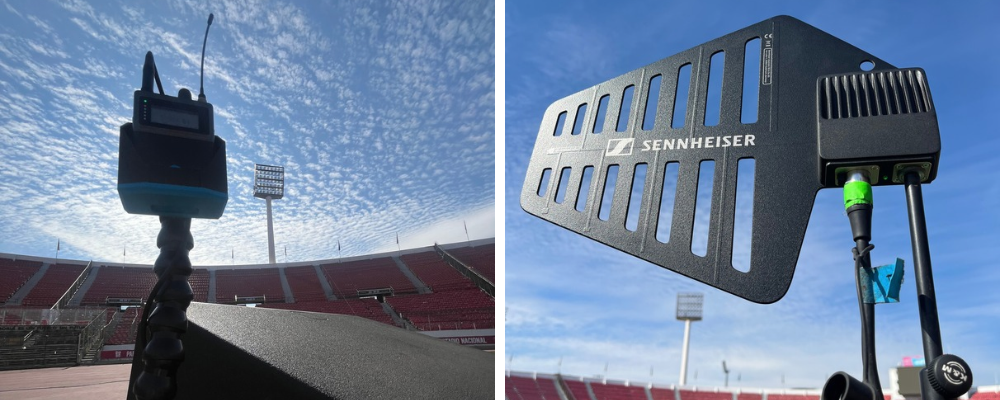
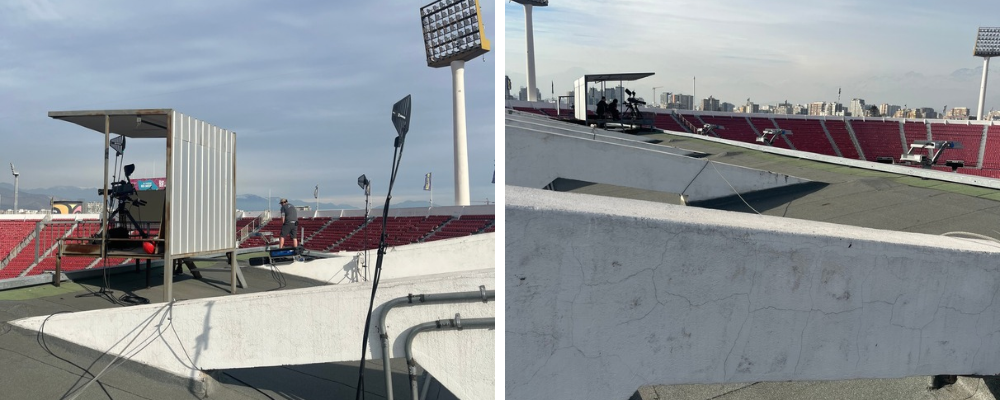
By then, Javier Liberón was already working directly on the project alongside Santana: “The available configuration included a Spectera Base Station and four antennas, so we had to find a way to distribute them to cover both areas simultaneously. Spectera’s architecture offered a fundamental advantage: its antennas connect via network cable, allowing them to be positioned a long distance from the base station without requiring long coaxial cable runs.”
The solution was to run network cable to the upper part of the stadium and install a Spectera antenna there for the in-ears. Since the team did not yet have Spectera handheld transmitters at that point, the vocals were handled using Sennheiser EW-DX, with a receiver and its corresponding antennas installed at the top.
The necessary connection for a stagebox from the Midas console was also brought up to that location.
In physical terms, a situation that could have required considerable infrastructure was ultimately resolved with two network cables and power running to the roof.
The other three Spectera antennas remained distributed around the field, providing coverage for the sound points installed around the playing area.
“Chino would set up his stacks and bring in the power, but we handled the audio wirelessly with Spectera,” Liberón explains.
The roof itself, which Javier estimates to be approximately 40 or 50 meters high, thus became an extension of the infrastructure deployed below.
From the show to the match: the infrastructure kept growing
The project changed once again after the activation was underway.
What had begun as a solution for the pre-show and halftime ended up being used until the final whistle. The system’s performance led to an expansion of its role, and another requirement emerged: players and referees needed to hear the audio associated with VAR.
The solution once again relied on the infrastructure already in place. Since power was distributed around the field and Spectera coverage was available, monitors were added at these new listening points, and the wireless system was again used to transport the signal.
Santana confirms that even the audio intended for VAR had ended up integrated into the solution using Spectera. His response was emphatic: “Yes, exactly.”
The addition of these new points further demonstrated the flexibility the infrastructure had acquired. “Since power was distributed throughout the stadium, in the end all we had to do was add a couple of Spectera units and that was it. There were the monitors. It was that simple,” he summarizes.
For Liberón, much of this flexibility comes from a different approach to wireless infrastructure.
Spectera is a bidirectional ecosystem that allows transmission and reception to be combined within a single platform. From an RF perspective, Javier points to another important difference: Spectera can operate over a single wideband RF carrier, concentrating a considerable number of channels within the same environment.
“It provides 32 inputs and 32 outputs, in a single rack unit, over a single RF carrier,” he notes.
For someone who also regularly works in radio frequency coordination, spectral efficiency carries particular weight. Liberón recalls participating in events such as Lollapalooza, where they coordinated around 1,400 frequencies. In situations with that level of density, reducing the spectrum required to manage multiple signals can significantly change the planning process.
But at the National Stadium, another feature proved particularly useful: the ability to extend the antennas using Ethernet.
“With conventional systems,” Javier explains, “increasing the distance between the receiver and the antenna using coaxial cable means having to account for the losses introduced by the cable run itself. With Spectera, the network cable connection makes it possible to position the antennas at considerable distances from the Base Station. In this project, that allowed us to reach the roof and distribute coverage across the field without having to move the entire RF system.”
Line of sight matters too
Working wirelessly did not eliminate the need to pay attention to the physical location of each component.
During operation, the team raised the bodypacks used at the sound points on small supports to maintain a good line of sight to the antennas.
It was a simple but effective adjustment. “The only assistance we provided was to raise the bodypack […] simply to establish line of sight with the antenna, and that was the solution to prevent it from losing the link,” Liberón explains.
His assessment after the event was positive, both in terms of audio quality and the system’s low latency, the distances achieved and its performance throughout the operation.
For Santana, who was using Spectera for the first time under this type of demanding conditions, the experience ultimately broadened his own perception of what he could do with the platform.
From a phone call to a stadium in five days
The scale of the project contrasts with the time available to prepare it.
Santana was contacted approximately five days before the event. Conversations related to the production began three days before, and two days before the event Javier was already involved in resolving the technical requirements.
“Everything came together in four or five days,” he recalls. Paradoxically, the technical idea had been waiting much longer.
Ever since incorporating Spectera, Santana had wanted to find a situation that would allow him to explore the system beyond its usual applications. That is why, when the project came up, the possibility of using it to distribute signals to different points throughout the stadium emerged almost immediately.
The short timeframe meant moving quickly from idea to implementation.
The result generated positive feedback from the client, the audience and other professionals present. Santana particularly remembers the interest shown by the technical team involved in the broadcast, who approached him after discovering how they were using Spectera to distribute audio throughout the stadium, an application they had never seen implemented in that way.
The following day, he also received messages of thanks and recognition for the work carried out.
The project also left a less visible but important lesson for future implementations.
The more infrastructure relies on networks, switches and digital devices, the greater the attention required to ensure continuity of the power supply.
And for Santana, that was one of the practical lessons learned from the experience: protecting the infrastructure against potential power outages.
“What I would say is that the power must never go out. That is fundamental,” he points out. He clarifies that this is not a limitation specific to Spectera, but rather applies to the entire digital chain and the switches that are part of the system.
The conclusion for future configurations is straightforward: incorporate adequate power backup for these critical components.
For Javier Liberón, the transition to systems such as Spectera involves something deeper than learning to operate a new device: “It means changing part of the way audio technicians have traditionally worked. The analog environment established a very direct physical relationship over decades: one signal, one cable, one connector. Digitalization and audio over IP introduce networks, addressing, protocols and new ways of managing signals. Mainly, you have to change the way you think a little.”
Spectera can integrate with digital infrastructures through Dante and MADI, and this convergence also requires expanding technical knowledge.
The support role therefore takes on another dimension. It is not limited to stepping in when a problem arises; it involves accompanying companies and technicians as they incorporate new ways of designing their systems.
Liberón has been working with Spectera since its first implementations in Chile and took part in its use at the Viña Festival. Since then, he has supported different rental companies as they incorporated the platform and new firmware and software versions, as well as components within the ecosystem, became available.
Chile as a testing ground for new applications
Sebastián Álvarez, from Sennheiser, views this process from a broader perspective.
For him, introducing new technology always involves overcoming a certain initial resistance: changing familiar procedures, testing different configurations and demonstrating that a change can simplify tasks that have historically been handled in other ways.
“The willingness to try, to take risks, to do new things and test new technology has put us in a really good position today in Chile when it comes to our technology. In Chile and throughout the region,” he comments.
The evolution of the ecosystem itself continues to expand these possibilities. During the interview, Álvarez highlights the addition of the handheld transmitter as a component that makes it possible to progressively complete the Spectera offering, integrating in-ears and microphones within a single platform.
For Chino Santana Refuerzo Sonoro, this growth also opens up applications that go beyond large stadiums.
Santana is already exploring Spectera in productions involving musicians and orchestras, where performers move through spaces far removed from the traditional stage.
A stadium turned into a testing ground
The Red Bull event began as a job that came in with barely a few days’ notice and ended up becoming a real test of how far a wireless infrastructure could be taken.
Twelve sound points around the field. Three antennas distributed across the playing area. A fourth extending coverage to the roof. In-ears dozens of meters above ground. New listening points during the match. And a single Spectera Base Station at the center of that architecture.
“It was an incredibly exciting job because the two projects that have accompanied me recently came together,” Santana says. “The final result was wonderful.”
Perhaps that is the most interesting aspect of this case. Spectera did not arrive at the National Stadium simply to replace a cable with a wireless connection.
The system made it possible to rethink how audio could travel within a space of those dimensions.
What happened at Chile’s National Stadium leads to a conclusion that goes beyond the results of a Red Bull activation. When technology is combined with experience, creativity and the willingness to explore new paths, the limits of a solution are no longer defined by its traditional applications.
Spectera demonstrated that its potential does not end with microphone transmission or personal monitoring systems. It can become a tool for rethinking audio distribution, simplifying infrastructure and responding to needs that arise even after a project is already underway. In just five days, Chino Santana and the Sennheiser team turned an idea into a concrete implementation, using an entire stadium as a testing ground. And perhaps that is the true value of this experience: it was not simply about delivering audio wirelessly to twelve points in a stadium, but about demonstrating that there are still new ways to think about, design and operate professional audio systems.
Credits
Cover Photo: LATAM STAGE
Inside Photos: LATAM STAGE
The journalistic production, research, writing, editorial approach, and editing of this content are original works by LATAM STAGE and are protected by copyright.
No part of this content may be reproduced, copied, distributed, adapted, or published, in whole or in part, in any medium or format, without the prior written authorization of LATAM STAGE.


