
Consoles, controllers, and nodes are all part of the same philosophy: creating flexible, distributed systems designed to grow alongside every project. NASH Ingeniería explains why LIGHTSHARK’s true potential goes far beyond a control surface.
For years, talking about lighting control meant talking exclusively about a console. The larger the production, the more important the control surface seemed to be. However, the evolution of networks, communication protocols, and integration requirements has transformed that logic.
Today, professional control no longer depends solely on a console, but on ecosystems capable of distributing information, expanding universes, operating remotely, and adapting to increasingly complex installations.
That is precisely the philosophy behind LIGHTSHARK.
“The most interesting thing about LIGHTSHARK is that it was not conceived as a standalone console. It is a complete platform where each component fulfills a specific function, allowing users to build the system they truly need without oversizing resources,” explains Maximiliano Moreno, Product Specialist at NASH Ingeniería, the brand’s distributor in Argentina.
The Starting Point: LS1
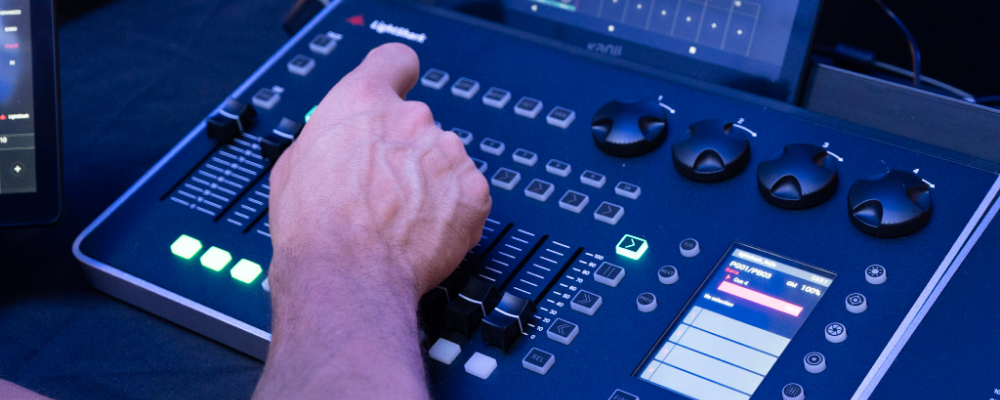
For many users, the gateway into the LIGHTSHARK universe is the LS1.
Its intuitive design, native integration with mobile devices, and ease of programming have made it an attractive tool for both experienced operators and new users.
“The LS1 offers a very user-friendly learning curve without sacrificing professional capabilities. This allows an operator to get up and running quickly while still having enough tools for complex projects.”
But according to Moreno, the real strength emerges when the console is integrated with the rest of the ecosystem.
When Control No Longer Depends on a Physical Surface
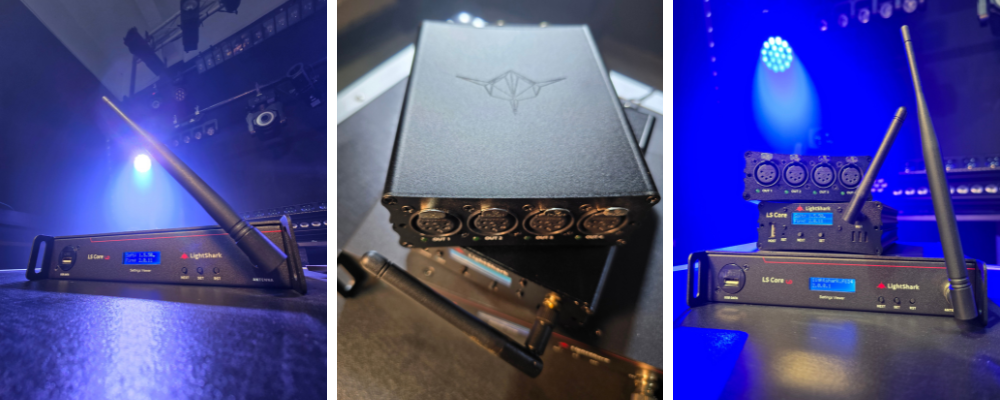
One of LIGHTSHARK’s most innovative concepts is the LS CORE.
This device houses the system’s processing engine and allows lighting control from computers, tablets, or mobile devices through a web interface.
“There are many projects where a physical console is not necessarily required. Theaters, churches, cultural centers, or permanent installations can operate perfectly using an LS CORE as the heart of the system.”
This philosophy provides enormous flexibility for integrators and users seeking to optimize space, infrastructure, and costs.
LS CORE IO: Intelligent Integration
The natural evolution of this concept is the LS CORE IO.
In addition to incorporating all the capabilities of the LS CORE, it adds inputs and outputs that allow interaction with other automation and control systems.
“The LS CORE IO greatly expands integration possibilities. It allows lighting to communicate with sensors, external triggers, and automated systems. This opens very interesting opportunities for permanent installations.”
Its application is especially useful in environments where lighting needs to respond to different events or operating conditions.
Nodes: The Invisible Infrastructure
If consoles and controllers are the brain of the system, nodes are the tools that distribute information wherever it is needed. Within the LIGHTSHARK ecosystem, solutions include:
⚡ LS NODE 1
⚡ LS NODE 2
⚡ LS NODE 4
Each allows network protocols such as Art-Net and sACN to be converted into physical DMX outputs, simplifying universe distribution within a project.
“Users often focus only on the console, but nodes are fundamental. They reduce cabling, optimize installations, and bring control exactly where it is needed.”
An Ecosystem That Adapts to Every Project
One of the platform’s greatest advantages is its scalability. A small theater can start with an LS1 as its primary system. A church can manage its entire operation using an LS CORE. A cultural center can incorporate multiple nodes to distribute universes across different areas. And a complex installation can integrate an LS CORE IO alongside external automation systems.
“There is no single correct configuration. LIGHTSHARK allows users to build solutions tailored to each need. That flexibility is one of the aspects most valued by users.”
The Future of Control Is Connectivity
The global trend points toward increasingly connected, scalable, and distributed systems.
In this context, platforms such as LIGHTSHARK represent a natural evolution of the traditional concept of lighting control.
“The industry is moving toward smarter and more flexible infrastructures. LIGHTSHARK fits perfectly into that trend because it allows users to grow progressively without needing to replace the entire system as project requirements evolve.”
More than a console, more than a node, and more than a controller, LIGHTSHARK proposes a different way of understanding control: an open, scalable platform designed to support the evolution of every installation, from the simplest projects to the most complex infrastructures.


