
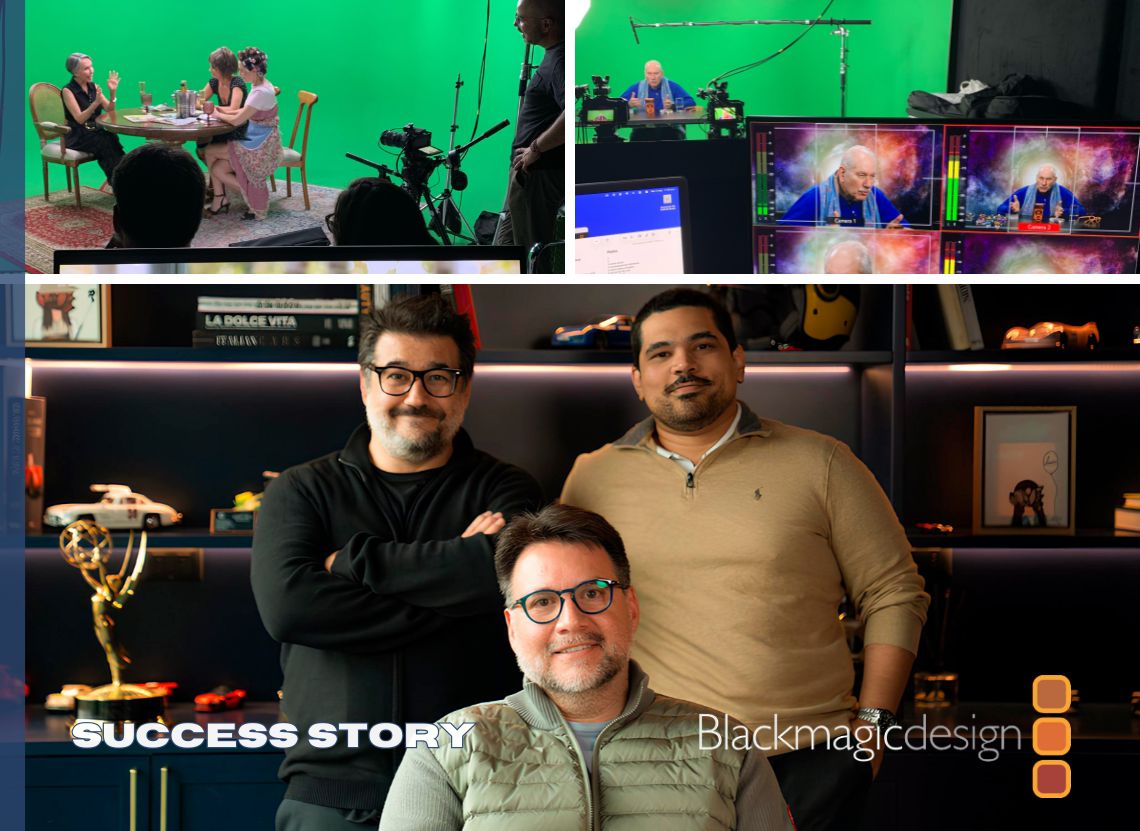
From its own studio in Chile, MIRAI MEDIA developed a methodology that combines cinematic language, broadcast standards, and production for digital platforms. Throughout this process, the Blackmagic Design ecosystem became a key ally in building a flexible, efficient workflow prepared to bring new ways of storytelling to life.
Chile – What began as a project focused on creating educational courses eventually evolved into an audiovisual studio with a clear vision: bringing cinematic language and broadcast standards to digital content.
From Chile, MIRAI MEDIA built a complete workflow based on the Blackmagic Design ecosystem, combining multicamera production, advanced chroma keying, real-time editing, and a methodology inspired by cinema to develop hybrid formats that have now made the leap to broadcast television.
At a time when much of today’s digital content is produced with immediacy, fast formats, and minimal structures, MIRAI MEDIA chose to take the opposite path.
The Chilean production company was founded just two years ago, but from the very beginning it had a very clear idea: to elevate the visual and narrative standards of digital content using tools and methodologies much closer to cinema and television than to the traditional social media ecosystem.
“We realized there was a level of technological maturity that made it possible to create very high-quality productions at much more accessible costs than a few years ago. Blackmagic Design, in particular, opened the door for mid-sized studios to produce at broadcast standards,” explains Benjamin Ferrer, CEO of MIRAI MEDIA.
Interestingly, the project’s origins were not initially linked to entertainment. Everything started with the production of courses related to mental health, where an interest in audiovisual production and creative control of content first emerged.
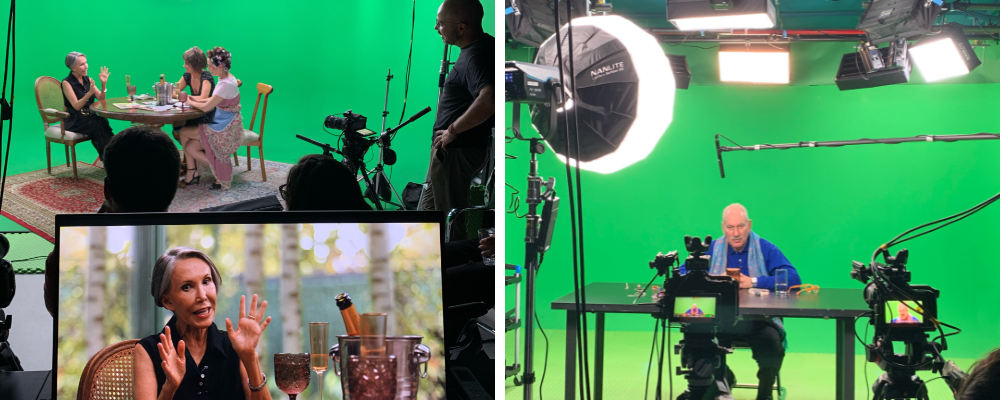
“We started by producing courses, and our reference was always MasterClass. We watched that content and thought: this looks like cinema, it looks like television. So we started asking ourselves what was behind that aesthetic,” Ferrer recalls.
The search quickly led the team to the Blackmagic Design ecosystem. After analyzing different options available on the market, testing workflows, and comparing costs, they reached a conclusion that would ultimately define the future of the studio.
“We didn’t want the problems to be technical. We wanted them to be creative. We needed a robust, proven, and flexible ecosystem. In the end, we returned to our initial impulse, which was Blackmagic Design,” he says.
A dedicated studio to experiment, learn, and create
Unlike many production companies that are created solely to provide services, MIRAI MEDIA built its studio as a space to explore new ideas, develop original formats, and experiment with different audiovisual languages.
The infrastructure quickly became a competitive advantage.
“We have the ability to review every stage of the process. If something isn’t working, we correct it on the fly. We don’t wait until the end to discover a problem,” says Antonino Ballestrazzi, Executive Director of MIRAI MEDIA.
Having full control over the creative process allows the team to oversee every step, from the initial script to final delivery.
“Having our own studio allows us to constantly experiment. We test cameras, lighting, textures, editing, new technologies, and new workflows. We are learning all the time,” he adds.
This philosophy also directly impacts the way they develop content.
While much of today’s digital production prioritizes speed above everything else, MIRAI MEDIA decided to adopt a methodology much closer to filmmaking.
Projects go through scripting, visual planning, cinematography, editing, and narrative review processes before reaching the final product.
“We don’t create content thinking only about social media. We apply work processes that are normally associated with cinema. There is visual construction, staging, and a narrative that continues to develop even during the editing stage.”
For the team, mistakes are also a fundamental part of the creative process.
“We are very perfectionist, but we also place a great deal of value on mistakes. Having our own studio allows us to experiment, make mistakes, go back, and improve. That’s something that doesn’t always happen when you work within much more rigid structures,” he adds.
Blackmagic Design as the operational core of the workflow
Behind this creative pursuit is a carefully designed technological structure.
MIRAI MEDIA built a fully integrated production workflow around Pocket Cinema Camera 6K Pro cameras, the ATEM Mini Extreme ISO G2, HyperDeck Studio HD Plus, DaVinci Resolve Studio, Ultimatte 12 HD, and virtual production tools.
The choice was not based solely on image quality.
“What we were looking for was an ecosystem that worked as a whole. We didn’t want to spend our time solving compatibility issues between equipment or software. We wanted to focus on creating,” explains Ferrer.
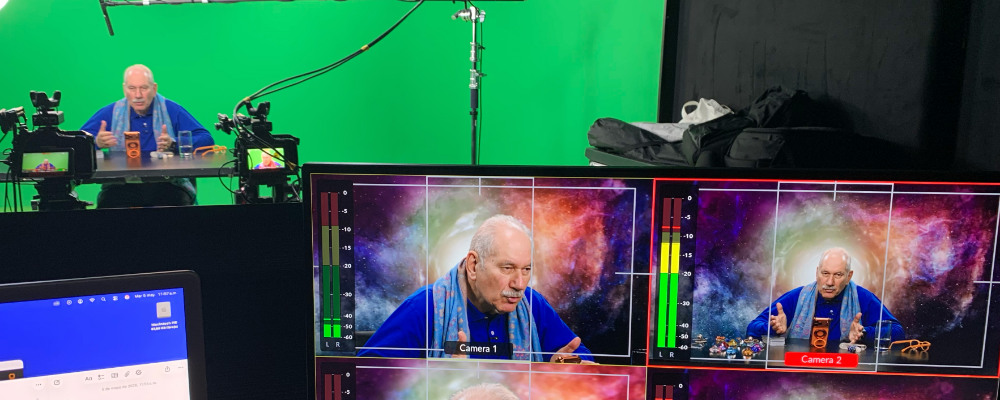
One of the elements that ultimately tipped the balance was the performance of the Ultimatte 12 HD in chroma key work.
“We tested practically every possible solution. When we arrived at Ultimatte 12 HD, the difference was enormous. That’s when we realized this was the right path,” he recalls.
From that point on, the team also began exploring virtual environments and Unreal Engine integration.
“Once we saw what we could do with Ultimatte 12 HD, we said: that’s it, now we’re ready,” he comments.
But perhaps one of the aspects most valued by the studio is the operational efficiency generated by the complete ecosystem.
“With DaVinci Resolve Studio and the entire Blackmagic Design workflow, we can be recording while the footage is already being edited. What we shoot in the morning can be worked on by the editors while we continue filming in the afternoon,” notes Ballestrazzi.
The presence of the ATEM Mini Extreme ISO G2 is key within that framework.
“We specifically chose the ISO version because it allows us to record all cameras simultaneously and maintain multiple backups of the material. We have backups from the cameras, the HyperDeck Studio HD Plus, and the ATEM Mini Extreme ISO G2.”
The integration between devices also makes it possible to automatically generate proxies, distribute them among different collaborators, and dramatically accelerate production times.
“This has allowed us to work with editors in different geographic locations at the same time. Not every platform offers that level of flexibility,” he adds.
When digital content reached broadcast television
Originally, MIRAI MEDIA intended to develop content exclusively for digital platforms.
However, the growth of some of its projects ended up creating an unexpected opportunity.
According to Luis Malavé, Commercial Director of MIRAI MEDIA: “We were surprised to discover that content initially designed for digital platforms could also work perfectly on broadcast television.”
What seemed like an alternative path ended up becoming a true test for the entire workflow built around Blackmagic Design.
“Our real test came when we reached broadcast television with broadcast technical standards. When they reviewed our materials, they were surprised because we fully met all the technical requirements.”
For the team, that moment confirmed that the technological decision had been the right one.
“Quality remains the main differentiator. When you do things properly, content finds its place regardless of the platform,” he says.
Today, MIRAI MEDIA continues exploring new formats related to fiction, documentary, hybrid production, artificial intelligence, and television, while maintaining the same philosophy that gave birth to the studio.
“We are entering a stage where technology is freeing up more and more space for creativity,” Ferrer concludes. “And that excites us tremendously because it allows us to experiment, discover, and build content that simply wasn’t possible before.”
The story of MIRAI MEDIA demonstrates how the Blackmagic Design ecosystem is enabling independent studios to develop productions with visual standards that, only a few years ago, were reserved for large television and film operations. In this scenario, technology ceases to be a barrier and becomes a tool at the service of ideas.


