
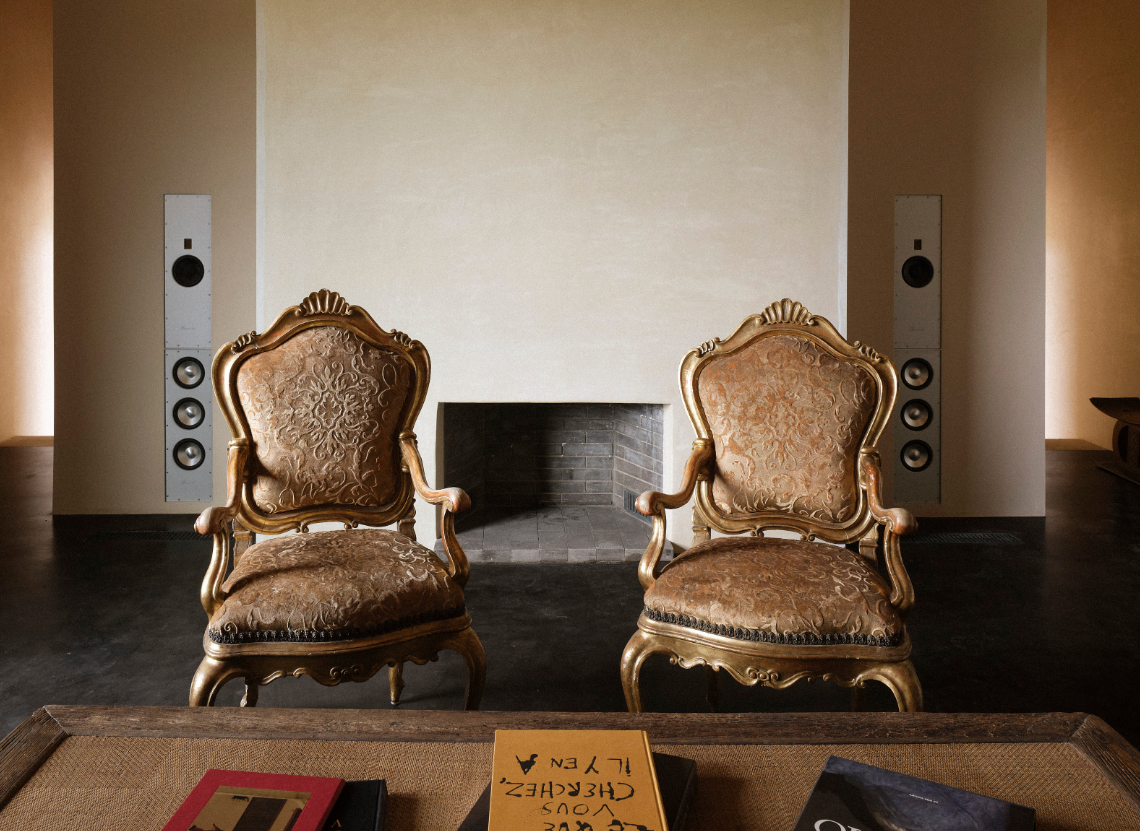
France –Domaine de la Cavalerie, a discreet sanctuary dating to the 12th century, nestled within the foothills of Provence’s Luberon National Park, and one of France’s most extraordinary private estates available to rent, opens the second house on its property this spring, with a dedicated listening salon designed by international acoustic and AV technology consulting firm WSDG. The new 4-bedroom house, known as ‘La Bergerie’, occupies a 17th-century farmhouse which has undergone a gut renovation, and whose living room doubles as a state of the art salon, delivering a professionally engineered listening environment that honours both the heritage of the 12th-century Templar commandery and the vision of its owners.
Originally restored by legendary couturier Emanuel Ungaro as his personal retreat for creativity and renewal, the estate has been lovingly reimagined since 2019 by his daughter Cosima Ungaro and her husband Austin Feilders through their Paris-based creative studio CONCEPT.
“We were working on a very family-oriented scale of creating something that brings together great people and has the power to transform them,” says Austin Feilders, Co-owner, Domaine de la Cavalerie. “It’s been really nice having the support from John [Storyk, WSDG’s Founding Partner] and the WSDG team. These kinds of collaborations make for great spaces and great experiences for people.”
“From the very first conversations with Austin and Cosima, it was clear that this project was something truly special,” recalls Storyk. “The depth of their connection to this place — to its history, its textures, its spirit — was palpable, and that kind of direct contact with a client is exactly what allows us to do our best work. When someone can articulate not just what they want a space to look like, but how they want it to feel, how they want people to be moved by it, that gives us everything we need to translate that vision into reality. What struck me about Austin and Cosima was their sensitivity to the land, the heritage of the building, and to the human experience of being inside it. Our job became about honouring that sensitivity through sound.”
The project commenced in mid-October 2024, with WSDG providing comprehensive acoustic modelling, simulation, and electro-acoustical systems design. Members of the WSDG team who were involved included Amin Nehmeh [Project Engineer], who carried out the acoustic modelling and simulations of the room, identifying acoustical pressure areas and optimising loudspeaker placement within the space, Joshua Morris [Senior Partner, Co-CEO] who helped coordinate the aesthetic elements, and Dirk Noy [Senior Partner, Co-CEO], who oversaw the overall project.
Throughout the design process, WSDG collaborated closely with the team to ensure the acoustic surfaces and elements complemented the heritage character of the 17th-century building. The architects chose oak shutters to maintain the wood aesthetic, while WSDG recommended that the shutters be fitted with microabsorbers and structured art pieces to serve as natural diffusers on the sidewalls, breaking up reflections without resorting to obvious acoustic treatment. The entire ceiling as well as the loudspeaker walls are outfitted with BASWA Phon, an acoustical plaster specifically manufactured in the precise color of the existing lime plaster and sand walls.
“We were able to turn the architecture itself into the acoustic solution,” Morris recalls. “The floors, the oak shutters, the perforated dark wood door panels, the acoustical ceiling, the art — every element was doing double duty, contributing to the room’s performance without ever looking like acoustic treatment. That kind of integration requires constant dialogue between the acoustic and architectural teams throughout the design process, and the collaboration here made it possible to achieve exactly that.”
WSDG also recommended inclining the window glass panes to divert reflections away from the listening position, a suggestion successfully implemented by the architects. The result is a room that achieves optimal reverberation times and reflection control in accordance with professional standards for listening rooms, while remaining entirely in keeping with the estate’s sense of place.
“This space will be a very private, intimate space, but it will leave people changed and sensitive to something that they felt there,” adds Feilders. “We’re really excited about the collective effort that everyone put into it.”
For the audio system in La Bergerie, WSDG recommended the brand-new Burmester 232 Classic Line Integrated Amplifier, paired with InWall S wall-mounted Air Motion Transformer loudspeakers and additional matching woofers. This handcrafted sound system built around Air Motion Transformer technology, normally reserved for Porsche interiors and exclusive private residences, has transformed the living room into a space that invites deep listening, intimate live performance, and creative experimentation.
“What brought us together is the fact that we were all seeking an approach of perfection. Perfection in architecture, experience, design and acoustic performance,” says Dina Hoenge, Burmester. “What WSDG did was create a perfect canvas – they wanted to give the people that visit this place an exceptional experience of listening to music, so the sound system is completely integrated into the architecture.”
“From the outset, we knew the audio system had to be something special both in performance and in character, and so Burmester was the natural choice,” says Noy. “Their products are handmade in Berlin, with only around 2,000 units built in total, which speaks to an extraordinary level of craftsmanship and exclusivity that felt entirely in keeping with what Cosima and Austin were creating at La Cavalerie. But beyond the prestige, it was about what the speakers could actually deliver in the room. That alignment between the quality of the product and the spirit of the space is exactly what we look for when specifying a system, and with Burmester, it was a perfect fit.”
The acoustic treatment strategy addresses three key frequency ranges. For low-frequency control, WSDG designed a 30cm deep Helmholtz absorber positioned behind a large painting at the rear of the room, using a perforated wood construction that maintains the aesthetic integrity of the space. Broadband absorption is provided by a multilayered BASWA Phon acoustical plaster system, seamlessly colour-matched to appear as normal plaster on walls and areas adjacent to the chimney. The window shutters incorporate a micro-perforated wood finish, making them acoustically active elements that contribute to the room’s overall performance while preserving the wood aesthetic.
“What I find most satisfying looking back is how naturally the acoustic solutions fit into the space,” says Nehmeh. “Concealing a Helmholtz absorber behind a painting, using a plaster system that looks no different from the ancient walls around it, making the window shutters acoustically active — none of these feel like workarounds. When a brief demands that level of discretion, it pushes you to think more carefully about every surface in the room, and I think the results here speak for themselves.”
“Working within a 17th-century farmhouse, on a property established in the 12th-century, in the heart of a UNESCO biosphere reserve, is not something you take lightly,” adds Storyk. “There is a profound responsibility that comes with adding anything to a structure like that, and equally, a profound joy. Every decision had to earn its place. That challenge is what makes this kind of project so deeply rewarding for our team.”
“I knew that learning from someone like John was a huge opportunity,” Feilders continues. “And I was thrilled to be connected to him through Victor Lévy-Lasne who started Rue Boyer, a project that WSDG worked on that has gone on to become one of the most important recording spaces in Paris. When I got in touch, John immediately wanted to work with us. I told him what we wanted to do as far as creating a space whereby people could have an extremely sensorial experience of listening to music. Meeting inspiring people who teach you new things can help you grow, and John allowed us to take this project and grow it into something that we couldn’t have ever imagined without him.”
The listening salon, which will officially open this spring along with an open-air wellness space, La Source, serves as a sanctuary within the sanctuary: a dedicated space for musical inspiration and critical listening that complements the estate’s broader mission of nurturing creativity. Artists and musicians who book the property will have access to this professionally designed acoustic environment – a world-class facility befitting one of the most iconic retreats in the south of France.
For Ungaro and Feilders, the listening salon is deeply personal. The estate’s experience is built around four pillars — food, nature, wellness, and sound — values the Ungaro family has long lived by at La Cavalerie. Sound, in particular, carries a special weight. Cosima’s father Emanuel was passionate about music; classical pieces were a constant presence throughout the home, and he hosted piano concerts in the estate’s chapel. The space is, in many ways, a realisation of that dream, and the cultivation of music as a living, breathing part of life at La Cavalerie is something Cosima is determined to carry forward.
“What we achieved at Domaine de la Cavalerie is a testament to what becomes possible when everyone around the table shares the same commitment to a vision,” Storyk concludes. “We worked closely with CONCEPT and the wider team to ensure that every acoustic and technological element served Austin’s and Cosima’s ultimate dream for this space: a sanctuary where artists can encounter music at its most pure, in a place that has been shaped by centuries of human creativity. That is a rare privilege, and one I am enormously proud of.


