
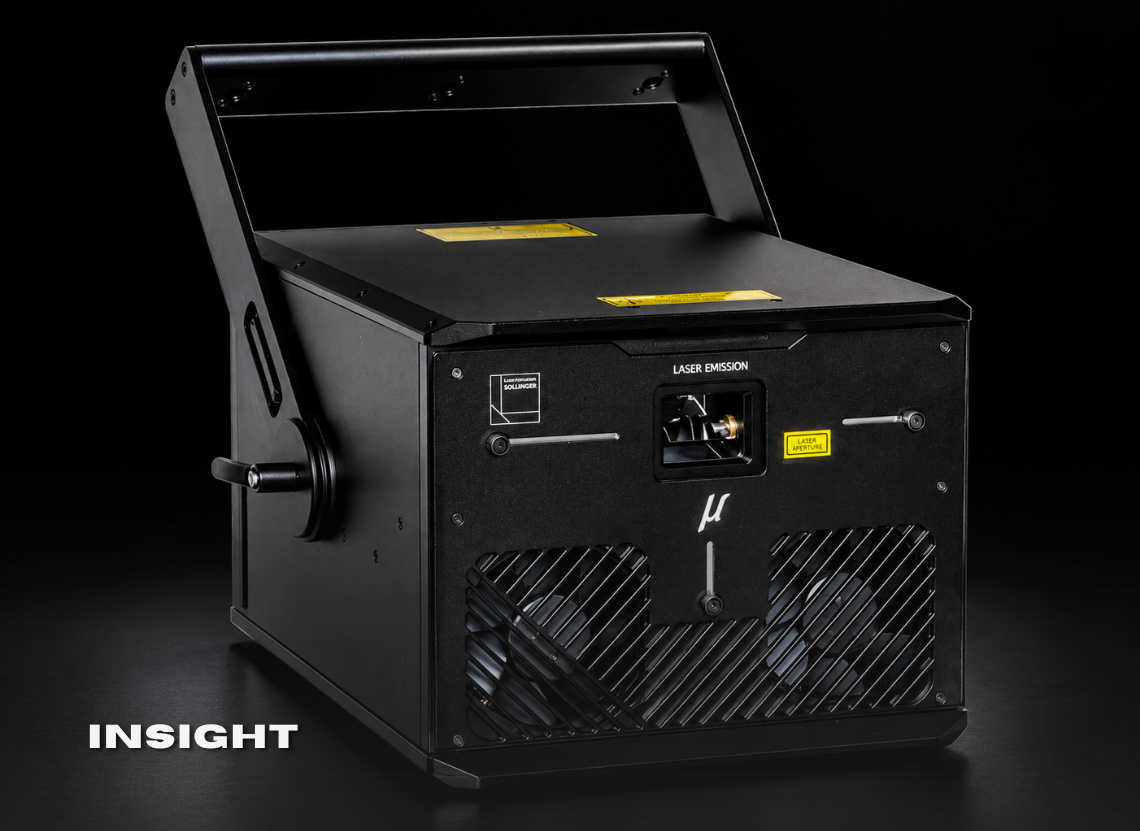
In entertainment technology, there is a rule that for years seemed difficult to break: more power means more size, more weight, and greater complexity. The new UNREAL 120 by LaserAnimation Sollinger arrives precisely to challenge that equation.
With 120 W of guaranteed optical power and weighing just 15.5 kg, the RGB projector is presented as a solution that seeks to bring high laser power to a much more compact, portable, and easier-to-install format. Its housing measures just 34.5 x 28.1 x 22.3 cm and features IP65 certification, characteristics that place it in a particularly interesting category for touring, large events, permanent installations, and outdoor applications.
But reducing the size of a piece of equipment is not, by itself, an innovation. The real question is what happens when that reduction does not require sacrificing power, control, safety, or reliability.
120 watts that change logistics
The most striking fact about the UNREAL 120 is obvious: 120 W in 15.5 kg. But its importance is not only in the figure. It is in everything that this relationship can change around the equipment.
A high-power system that weighs significantly less is easier to transport, rig, dismantle, and redistribute. It can also reduce rigging complexity and facilitate production decisions that were previously constrained by the weight and volume of the projectors.
In other words, power stops being merely a technical specification and begins to become a production design tool.
This becomes even more relevant in large spaces. When the goal is to cover enormous distances, stadiums, or outdoor spaces, having a 120 W source that can be handled and positioned with logistics much closer to that of a compact piece of equipment changes the operational possibilities.
And this is where one of the most interesting concepts of the UNREAL 120 appears: making a technology traditionally associated with large and heavy systems capable of being integrated into a much more agile workflow.
It is not just about power
The UNREAL 120 uses RSL Gen. 4 RGB laser modules — 637 nm red, 525 nm green, and 455 nm blue, developed and manufactured by LaserAnimation Sollinger in Berlin. The system offers a guaranteed optical power of 120 W, with a minimum specification of 110 W, a 10 mm beam, and 0.8 mrad divergence. The scanners reach 38 kpps at 8°, with a maximum angle of 48°.
But the product also shows where the concept of a “laser projector” is evolving. The UNREAL 120 incorporates FB4, can operate as a stand-alone player, and supports Art-Net. In addition, the LA.toolbox platform allows parameters such as color selection and the configuration of the LAS LAN Disable Button to be managed. There is also the possibility of incorporating AVB as an upgrade.
This means that the equipment is not designed as an isolated box that simply receives a signal and projects light. It is part of a network, a control system, and a production architecture.

One cable, many functions
There is another aspect that deserves special attention: the integration of control and safety. In a professional laser installation, safety cannot be an element added at the end of the process. It is part of the system design.
The UNREAL incorporates a scanfail safety circuit, an adjustable three-position physical beam blocker, key switch, interlock, and emission LEDs on both the front and rear. It also allows the LAS LAN Disable Button to be integrated and certain functions to be managed from LA.toolbox.
But from the user’s perspective, what is interesting is how these functions are integrated within the network infrastructure.
The ability to carry control, operation, and safety information over the same network makes it possible to simplify certain installations and, especially, to have a much clearer view of what is happening with the equipment.
And this is where an important difference from the traditional view of laser appears: the operator no longer has only a projector; they have information about the system.
From LA.toolbox, it is possible to view operating and temperature parameters, providing a level of monitoring that is especially valuable when working with multiple units.
The outdoors is no longer a limitation
The other characteristic that considerably expands the UNREAL 120’s field of application is its IP65 construction. The equipment is designed to operate outdoors, with a specified ambient temperature range between -10 °C and +40 °C. To manage these conditions, it incorporates a large heatsink, Peltier elements for active heating and cooling, and high-performance temperature-controlled fans.
Once again, the key is not an isolated feature. 120 W + 15.5 kg + IP65 + network control + thermal management + integrated safety build a different proposition. It is the combination that is interesting.
A new relationship between power and practicality
Perhaps this is why the UNREAL 120 deserves to be observed beyond its technical specifications. The entertainment industry has spent years seeking more power, more reach, more brightness, and greater impact. But it is also seeking exactly the opposite: lighter equipment, easier to transport, faster to install, and simpler to integrate.
The challenge has always been to achieve both things at the same time. The UNREAL 120 appears to take this contradiction as a design starting point.
It is not simply trying to manufacture a more powerful laser. It is trying to make that power easier to use. And that difference is important.
Because in a real production, technology is not measured only by what it can do when it is operating. It is also measured by how much it costs to transport it, how long it takes to install it, how many people it requires, how it integrates with the existing system, what information it provides to the operator, and what happens when conditions stop being ideal.
From that perspective, the 15.5 kg of the UNREAL 120 may ultimately be just as important as its 120 W.
When the laser starts behaving like a production tool
The nomination of the UNREAL 120 for the PLASA Awards for Innovation 2026 is particularly significant in this context. PLASA included it among the products selected for its Innovation Gallery and specifically highlights its power-to-weight ratio, as well as its compact format, integrated control, and ability to handle professional applications.
Beyond the award’s outcome, the nomination helps place the product within a broader conversation: what does innovation mean today in entertainment technology? And perhaps the answer is not always to add more features.
Sometimes innovation consists of taking something that for years seemed inevitable — in this case, the weight and complexity associated with high laser power — and asking whether it really has to remain that way. LaserAnimation Sollinger appears to have asked precisely that question. And the UNREAL 120 is, for now, one of its most compelling answers.
Credits
Cover Photo: LATAM STAGE
Inside Photos: LATAM STAGE
The journalistic production, research, writing, editorial approach, and editing of this content are original works by LATAM STAGE and are protected by copyright.
No part of this content may be reproduced, copied, distributed, adapted, or published, in whole or in part, in any medium or format, without the prior written authorization of LATAM STAGE.


