
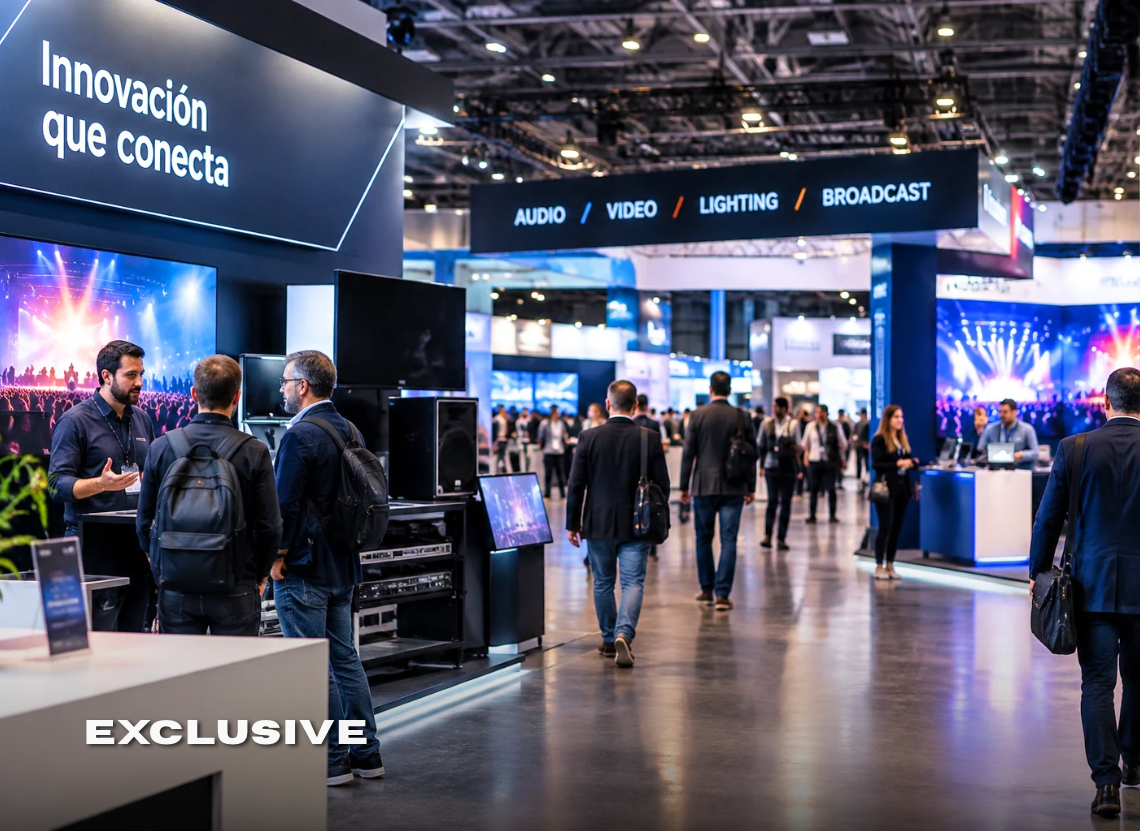
Rising costs, changing information-consumption habits, and the difficulty of demonstrating commercial results are forcing trade shows to rethink their value proposition. Bringing brands and visitors together is no longer enough: the challenge is to become indispensable to the industry once again.
For decades, trade shows were at the heart of business in the audiovisual, broadcast, and live entertainment industries. They were where manufacturers presented their latest innovations, distributors discovered new opportunities, professionals exchanged knowledge, and buyers established relationships that could shape the future of their companies.
However, this model faces new challenges. Across different segments of the industry, organizers must answer increasingly difficult questions: How can they maintain visitor interest? How can they convince manufacturers that their investment remains worthwhile? And how can they prevent an exhibition from losing relevance in the face of other alternatives for presenting products, generating contacts, and developing business?
The problem does not stem from a single cause. It is the result of a deeper market transformation in which costs, digitalization, new commercial priorities, and participants’ expectations are redefining the role of in-person gatherings.
The Cost of Participation Under Scrutiny
For a manufacturer, participating in an international trade show represents a considerable investment. In addition to booth rental, expenses include booth design and construction, equipment transportation, insurance, airfare, accommodation, technical and sales staff expenses, refreshments, networking dinners, and evening parties.
There is also a less visible but equally important cost: the time teams spend preparing for the exhibition, meeting visitors, and following up afterward.
In a context where companies must optimize their budgets, participation in a trade show can no longer be justified solely by tradition, visibility, or brand positioning. Sales managers need to identify concrete opportunities, establish relevant contacts, and evaluate the results generated by every dollar invested.
When those results are not evident, decisions begin to change. Some companies reduce the size of their booths; others limit the number of staff they send, share spaces with their distributors, or replace their physical presence with more targeted commercial initiatives.
In other cases, the decision is simply not to participate.
Information No Longer Depends on Exhibition Halls
Another decisive change is the speed at which new developments circulate.
Product launches that once relied on trade shows as their primary presentation platform can now reach global audiences through digital platforms, virtual demonstrations, live streams, and specialized campaigns.
An innovation can reach thousands of professionals long before an exhibition opens. This forces organizers to reconsider what additional value they offer compared with the possibility of accessing information from anywhere.
The answer does not necessarily lie in competing with digital channels, but in offering what they cannot fully replicate: the opportunity to test technologies, compare solutions under real-world conditions, speak directly with specialists, and build trusted business relationships.
The in-person experience retains a distinctive value. The question is whether each trade show’s offering succeeds in making the most of it.
More Visitors Do Not Always Mean More Business
The number of registrations remains one of the most widely used indicators for communicating an exhibition’s results. However, attendance figures do not always reflect its ability to generate business opportunities.
For an exhibitor, not all visitors represent the same value. A decision-making executive, a distributor looking to add new brands to its portfolio, or an integrator preparing a large-scale project have different needs from those of a student, a technician seeking training, or a professional attending primarily for the conferences.
This does not mean the latter groups are unimportant. Training, technical updates, and professional exchange are also part of a trade show’s value. However, the offering must address the objectives of different audiences while providing exhibitors with a visitor base aligned with their commercial interests.
The challenge, therefore, is to move from an approach centered on counting attendees to one that makes it possible to understand who they are, what they are looking for, and what opportunities arise from their participation.
The quality of contacts, meetings held, projects identified, and subsequent commercial follow-up can provide far more useful information than an isolated attendance figure.
The Loss of Exhibitors Can Become a Vicious Circle
When a company decides that the results do not justify the cost, its withdrawal may seem like an individual decision. However, when the phenomenon is repeated, its consequences affect the entire event.
A reduction in booth numbers can mean fewer product launches, less ambitious demonstrations, and a less diverse commercial offering. This can diminish visitor interest, especially among those traveling from other cities or countries expecting to discover the sector’s leading innovations.
If the event becomes less attractive, the remaining exhibitors may also question their investment. A vicious circle then emerges: reduced commercial investment can diminish an exhibition’s appeal, while a declining ability to attract visitors can, in turn, weaken brand participation.
There is also a strategic effect. The absence of relevant manufacturers can influence the decisions of distributors, buyers, and professionals who consider meeting them at the event essential.
Nevertheless, a reduction in the number of exhibitors does not always mean a loss of quality. A smaller exhibition can be more commercially efficient if it brings together the right participants, facilitates relevant meetings, and improves the experience of attendees. The key is to distinguish between a contraction resulting from a more focused offering and one reflecting a sustained loss of appeal.
An Industry That No Longer Recognizes the Same Boundaries
Technological transformation is also changing the way professionals choose where to update their knowledge.
Broadcast is converging with streaming, cloud production, and artificial intelligence. Professional audio is increasingly integrated with IP networks, software, and control platforms. Stage lighting is connected with video, automation, immersive experiences, and new forms of show production.
In this environment, traditional boundaries between specialties are becoming less rigid. Professionals seek solutions for their projects regardless of the historical category to which those solutions belong.
Trade shows that maintain an overly fragmented structure or an offering focused exclusively on their original specialty may miss opportunities to connect with these emerging needs.
The challenge is not to cover every sector, but to identify the areas that are converging and build an experience that is relevant to the people working in them.
From Renting Square Meters to Generating Value
The future of professional trade shows will depend, to a large extent, on their ability to evolve from a model centered on selling exhibition space to one that prioritizes participant results.
This means developing pre-arranged meeting programs, facilitating connections between manufacturers and buyers, attracting professionals with decision-making authority, and generating technical content that addresses specific market challenges.
It also means listening to those who decide not to return. Companies that withdraw from an exhibition can provide essential insights into costs, organization, visitor profiles, and the business opportunities they failed to find.
The relationship with the industry should not be limited to the days of the event, either. An active professional community throughout the year, supported by specialized content, technical meetings, and business networking tools, can extend a trade show’s reach and strengthen its relevance.
In this process, specialized media plays a strategic role. Journalistic coverage, interviews, product analysis, and digital distribution can extend the lifespan of product launches and multiply opportunities to reach audiences who were not necessarily present at the exhibition.
Relevance Is No Longer Inherited: It Must Be Proven
Trade shows continue to offer an advantage that is difficult to replace: bringing manufacturers, distributors, integrators, professionals, and buyers with shared interests, challenges, and opportunities together in one place.
Few trade shows manage to transcend their role as product showcases and become true industry benchmarks. The difference lies in understanding where the market is heading, anticipating its needs, and building an offering capable of bringing together innovation, knowledge, business, and a professional community. In an environment where participation requires increasingly greater investment and visitors are more selective about how they spend their time, leading the way means offering concrete reasons to attend. A long track record and more square meters are no longer enough: value must be created and the event’s relevance demonstrated, edition after edition.
One outstanding example is Integrated Systems Europe (ISE), which has established itself as one of the world’s leading reference points for the audiovisual and systems integration industries. Its strength lies in connecting sectors that are increasingly converging: audiovisual technology, enterprise collaboration, education, entertainment, smart buildings, and artificial intelligence. This breadth, combined with product launches, demonstrations, training, and networking opportunities, expands its appeal beyond any single specialty and attracts manufacturers, integrators, distributors, consultants, and end users.
The results support this strategy. In 2026, ISE reached a record 92,176 unique attendees, brought together 1,751 exhibitors — 323 of them participating for the first time — and occupied 101,000 m² of exhibition space. Attendance grew by 8% compared with 2025, demonstrating that a trade show can continue to expand when it combines international scale, technological diversity, and an offering aligned with market developments.
ISE is not simply a successful event: it is an example of how a trade show can evolve alongside its industry and become a platform where innovation, knowledge, and business opportunities converge. Its main lesson is clear: the future of trade shows does not depend on preserving the traditional model, but on having the vision needed to transform it.
Today, ISE is where everyone wants to be. Some trade shows remain benchmarks in their own countries but have lost much of their international character. Track record, prestige, and history no longer guarantee attendance on their own. Every edition must demonstrate why it deserves the time, budget, and attention of an industry with more channels than ever to access information, build relationships, and do business.
The challenge is not simply to recover visitors or add exhibitors. It is to build an offering that creates value for both, facilitates concrete opportunities, and turns the in-person experience into a genuine advantage.
Because a trade show does not lose relevance simply when it attracts fewer visitors. It loses relevance when it stops being the place where the industry finds what it needs to move forward.
Credits
Cover Photo: LATAM STAGE
Inside Photos: LATAM STAGE
The journalistic production, research, writing, editorial approach, and editing of this content are original works by LATAM STAGE and are protected by copyright.
No part of this content may be reproduced, copied, distributed, adapted, or published, in whole or in part, in any medium or format, without the prior written authorization of LATAM STAGE.


