
UK – Berlioz has famously described his signature sound as what would happen “if Matisse made house music.” Like the French master, who altered the course of early 20th Century art by upended rules about using colors, Jasper Attlee (aka “Berlioz”) is fearless when it comes to defying expectations. Boldly breaking rules about genres, the British DJ-producer is creating music that can best be described as “Jazz House,” combining, as it does, the warm improv and acoustic qualities of jazz with the 4/4 rhythm and beats of downtempo deep house.
Such music calls for a production and lighting design that is equally maverick — and that is precisely what Liam Griffiths, the team at The Vision Factory, and lighting op-programmer James Taylor have provided for Berlioz’s six-week multi-country tour.
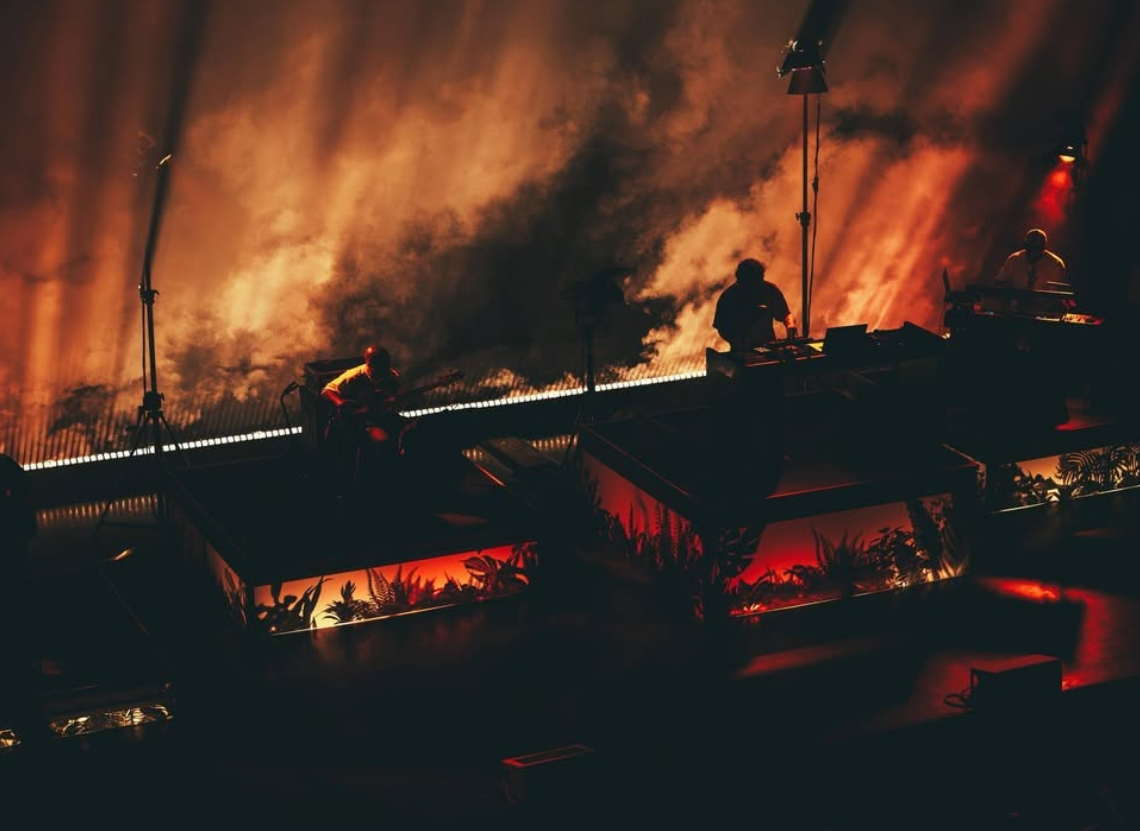
A fierce, independent vision runs through this design like a hot wire. To begin with, there is the bold use of dark space, which at times covers most of the stage, giving rise to an intensely unsettling feeling, especially when set against the show’s monochromatic color schemes, and the foliage scenic pieces on the risers.
“By keeping the majority of the stage in negative space, every beam and silhouette becomes intentional and readable,” explained Griffiths. “The performers then become graphic shapes rather than fully lit figures, which suited the tone of the set. This also gave the foliage risers something to play against. The plant silhouettes only read because they’re backlit against black.”
Adding to the intensity of the shadowy scene is the line of 20 CHAUVET Professional COLORado PXL Bar 16 motorized battens, which like the rest of the rig is supplied by Coloursound Experiment. A principal light source for the show, the PXL units are key to the backlighting and to creating the redolent monochromatic glow that lights the stage.
“Sticking to a single hue per look — the deep reds and ambers, for example – keeps everything visually cohesive and lets contrast and intensity do the storytelling instead of colour change,” said Griffiths, who then described how light angles help him achieve his vision:
“Lighting from below and behind rather than the traditional front/top wash is about reversing the usual visual logic instead of light falling onto the artists. In this design, it feels like light is rising up through and around the performers, almost like they’re emerging out of the ground. It also lets the vertical beams double as a graphic architecture across the whole rig. Those long red shafts cutting up through the haze became a structural element as well.”
Creating “structural elements” from the ground up, it is as if The Vision Factory team was building an entire world within the stage, which, as it turns out, is an ideal space for a groundbreaking pioneer, who, in the tradition of Matisse, is transcending rules in pursuit of an artistic vision.


