
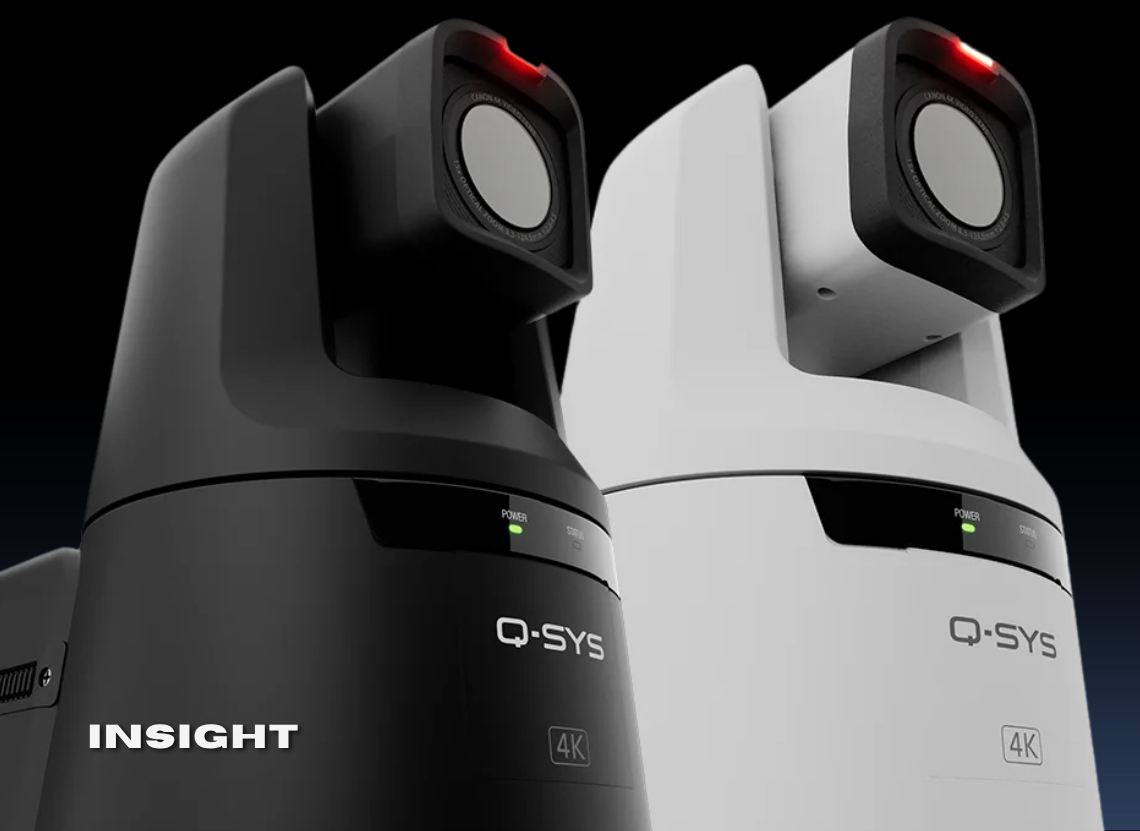
Fixed AV installations are moving toward increasingly flexible, scalable systems prepared to respond to different environments and integration needs. In this context, Todomúsica, Q-SYS distributor for the Argentine market, focuses on the NC-Pro15x to explore its features, possibilities, and the concept behind its development, sharing a perspective that helps understand the scope of this solution and its place within the evolution of professional AV.
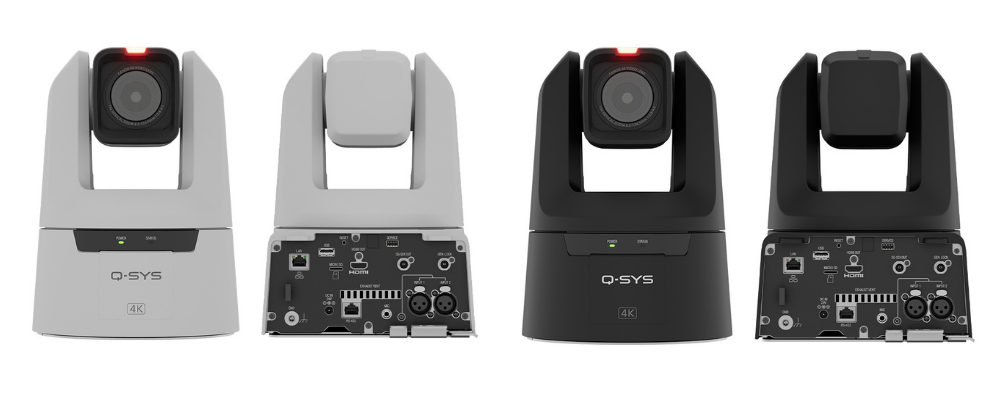
In fixed installations, incorporating a professional camera should not mean adding another layer of complexity. The NC-Pro15x, developed by Canon for Q-SYS, introduces a different architecture: broadcast-quality video, PTZ, power, control, and IP distribution integrated within an AV platform. The result is a camera designed not only to capture an image, but to become part of a system that can grow, be automated, and evolve.
For years, incorporating a professional camera into a fixed installation meant thinking of the camera as an element independent from the rest of the system. The model was selected, positions were defined, cabling was resolved, outputs were connected to a matrix or distribution system and, finally, some type of control mechanism was incorporated.
That model still works. But the evolution of AV installations is changing the question. It is no longer simply a matter of asking which camera offers the best image, the greatest zoom, or the most precise PTZ movement. The question is becoming a different one: how does that camera integrate into an infrastructure that must operate, scale, and evolve for years?
And this is where the Q-SYS NC-Pro15x comes in, a network PTZ camera developed by Canon for Q-SYS that combines professional production capabilities with an architecture specifically designed for network-based AV installations. And that combination is probably its most important characteristic.
The camera as part of the infrastructure
The NC-Pro15x was not conceived simply as a camera that can connect to a network. Its true differentiator is that it is a native device within the Q-SYS ecosystem.
This means that the camera can be discovered, controlled, monitored, updated, and managed from the platform itself. Its signal can be routed within the network without necessarily relying on a conventional video matrix, and it can be integrated with Q-SYS control and automation tools.
The difference may seem subtle, but architecturally it is enormous. A traditional camera is a device that delivers a signal. A camera integrated within an AV platform can become an active element of the experience.
It can respond to system events, integrate with presets, become part of an automation, be associated with different audio or video sources, and participate in an operating logic designed specifically for the space. In other words, the camera stops being merely a capture point and becomes a node within the infrastructure.
One cable. A much greater impact
One of the most attractive concepts of the NC-Pro15x for fixed installations is the use of PoE+. A single network cable can carry power, video, and control data.
At first glance, this may seem simply like an installation advantage. But in a permanent project, simplifying cabling has much more significant consequences.
Fewer connections mean fewer elements to install, document, and maintain. They also enable a cleaner architecture and make it easier to add new cameras in the future.
In addition, the camera can deliver its signals over IP while simultaneously providing HDMI and 3G-SDI outputs. This allows the NC-Pro15x to adapt to different architectures and coexist with existing infrastructures.
This is a particularly relevant feature for installations that are not entirely IP-based from the outset but need to evolve toward a network infrastructure.
The network as a matrix
This is where one of the most interesting concepts behind the Q-SYS approach emerges. In a conventional architecture, as the number of cameras increases, so does the need to manage signals, inputs, outputs, matrices, extenders, and distribution points.
In a network-based architecture, the approach changes. The camera signal can travel through the IP infrastructure and be routed within the Q-SYS ecosystem wherever it is needed. This makes it possible to think about the system from a much more scalable perspective.
The consequence is important for a fixed installation: adding a camera does not necessarily mean redesigning the entire video system. This can be especially valuable in universities, auditoriums, convention centers, corporate spaces, houses of worship, hospitality, and other environments where needs may grow over time.
An installation that begins with two cameras may need four or six in the future. A room initially designed for videoconferencing may later become a space for production, streaming, or content creation. The infrastructure is no longer static.
Broadcast quality where there used to be a conference camera
Integration, however, would not make much sense if it required sacrificing image quality. The NC-Pro15x addresses this point with an architecture clearly oriented toward production applications.
Its 1-inch 4K UHD CMOS sensor, combined with 15x optical zoom, Dual Pixel Autofocus, and Canon image processing, makes it possible to capture images with a level of quality superior to that of conventional conference cameras.
The optical system offers a horizontal field of view of approximately 73° at wide angle, while PTZ movement reaches ±170° horizontally and from -30° to +90° vertically. It also incorporates a built-in ND filter and tally light.
These are features that bring the concept of a fixed-installation camera closer to the language of professional production. And that is another relevant change.
A corporate room, university auditorium, or house of worship no longer has to use a lower-quality camera simply because its primary function is not broadcast.
Today, those same spaces produce content, broadcast events, host hybrid presentations, create online training, and receive remote participants. The boundary between corporate AV and content production is becoming increasingly blurred.
Automation: the real leap
However, it is probably in control where the NC-Pro15x best demonstrates the value of belonging to Q-SYS.
As a native device within the platform, it can take advantage of the Q-SYS Control Engine to create automated experiences.
This makes it possible to imagine a room where the camera does not need to be permanently operated by a person. A microphone can determine who is speaking, while the system can select a camera. The camera can automatically move to a preset, the system can change the routing, and the display can show the corresponding source.
And all of this can happen without the user having to understand how the system technically works.
This logic is especially important in fixed installations because the goal is not simply to have advanced technology, but to make the technology disappear behind the experience.
The more sophisticated a permanent system is, the less it should depend on someone knowing every one of its components in order to operate it.
A camera designed for installations that need to evolve
There is also an economic and operational reason to consider this type of architecture.
A fixed installation does not end when the event is over. By definition, it has to continue operating for years. This means that the value of a solution does not depend exclusively on its initial capabilities. It also depends on its ability to be maintained, updated, expanded, and integrated with new technologies.
A software- and network-based platform has a structural advantage in that regard: it can evolve without necessarily requiring the entire infrastructure to be replaced.
The NC-Pro15x is part of that philosophy. The camera can work with IP, HDMI, and SDI; it can integrate with Q-SYS; it can use NDI | HX2; it can be powered via PoE+ and can become part of control and automation systems.
It does not force a choice between a traditional architecture and a completely new architecture. It can act as a bridge between the two.
Canon + Q-SYS: two specialties converge
It is also significant that the NC-Pro15x was developed by Canon for Q-SYS.
On one hand, Canon brings expertise in optics, sensors, autofocus, and image processing. On the other, Q-SYS brings a software-based platform architecture encompassing networking, control, audio, video, and management.
The combination responds to an increasingly evident need in the AV market: image quality and technological infrastructure can no longer be considered separately.
A camera may deliver an extraordinary image, but if it requires a complex infrastructure to operate, that quality comes with an operational cost.
Likewise, a platform may be extremely efficient from a networking standpoint, but lose value if the image does not meet new production demands.
The NC-Pro15x seeks to address both needs within a single solution.
Why is it necessary for the fixed installation market?
The answer is not simply that it is a new PTZ camera.
The fixed installation market is changing. Spaces that once needed only audio and a display now require videoconferencing, streaming, content production, automation, centralized control, and signal distribution.
At the same time, those systems must be easy for the end user to operate and flexible enough to adapt to needs that do not yet exist.
In this scenario, continuing to add independent devices can ultimately create an infrastructure that becomes increasingly difficult to manage. The alternative is to think of the system as a platform. And that is the real importance of the NC-Pro15x.
It does not simply propose capturing better images. It proposes making the camera part of an AV architecture capable of distributing, controlling, automating, and scaling that image.
For a temporary production, that difference may be convenient. For an installation that will have to operate every day for the next five, ten, or fifteen years, it can be decisive.
When Todomúsica shared its experience with Q-SYS and gave us access to the technical information that made it possible to develop this analysis, we were able to understand that the future of AV installations does not seem to lie in having more devices. It seems to lie in getting all of them to work as a single system.
Credits
Cover Photo: LATAM STAGE
Inside Photos: LATAM STAGE
The journalistic production, research, writing, editorial approach, and editing of this content are original works by LATAM STAGE and are protected by copyright.
No part of this content may be reproduced, copied, distributed, adapted, or published, in whole or in part, in any medium or format, without the prior written authorization of LATAM STAGE.


