
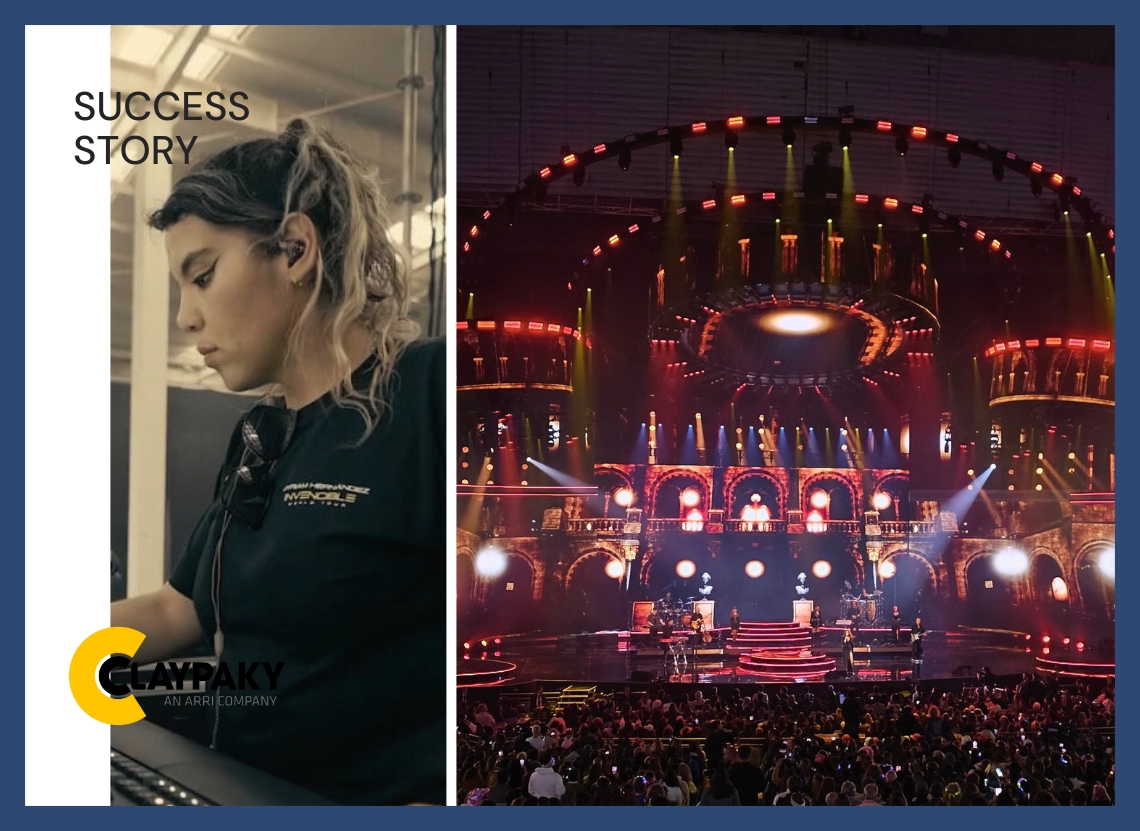
At 32, Marcela Pacheco Ibarra has established herself as one of Chile’s most promising lighting designers.
Born in Santiago on November 24, 1992, her story with light began much earlier than many imagine.
“I started 18 years ago, when I was a production assistant at Icardi Producciones, my family’s production company,” she recalls. “From that position, I witnessed the creation of massive events and memorable lighting interventions in the country: from the Copa América to the Bicentennial, including iconic lighting projects like that of the Costanera Center tower.”
But there was one encounter that marked a before and after. “It was where I met the best lighting designer, in my opinion, and the greatest mentor I could have had: Toni Amorós,” she says with admiration. “He saw my interest and taught me everything he could before he died of cancer.”
Although her training focused on certifications and courses from specialized brands, the real learning came from the field. “The rest came from my teacher and experience. In the end, there’s no better school than learning by doing,” she asserts with conviction.
Her first step on stage was no small feat. In 2017, she debuted as a lighting designer at a live show by El Bloque 8, a renowned cumbia band with whom she continues to work to this day, leading the artistic and audiovisual direction. “I was a replacement at that time. While I had the technical knowledge, the live show is a different story.” However, the experience was more than positive. “The lighting designer who worked on me, Luis ‘Garoto’ Quiroz, helped me with everything I needed to make everything perfect.”
Beyond the technical aspects, Marcela sees lighting as an art with its own soul. “I think one of the things I love most about light is that it can be used to express oneself,” she says.
For her, light is much more than a stage resource: it’s a tool for direct communication between the artist and their audience. “I see it as an incredibly important instrument within the setting of a show. We can communicate and express ourselves with pulses, changes in color, or position, and thus give each show a different meaning depending on what the artist wants to convey.”
Like any artist, Marcela also finds inspiration in the work of others.
Although she admits to admiring many colleagues, there is one figure who stands out among her role models: Krizia Vélez, renowned lighting designer for Bad Bunny.
“Her handling and elegant interpretation of the themes in the shows is of a high level, worthy of being considered among good shows.”
Although each lighting designer develops their own style, Marcela is characterized by her versatility and openness to new ways of working. “I like to know a little about everything,” she says confidently. And while she acknowledges that everyone has their own techniques that are more comfortable for them, in her case, what prevails is the constant pursuit of knowledge. This flexibility is part of her hallmark, and also what allows her to fluidly adapt to different types of shows and artists.
The path in the industry hasn’t always been easy, especially for a woman in a historically masculinized field. “Although it hasn’t been easy for women in my country, I think it’s changing,” she states with a mix of realism and hope.
“There are still issues of sexism, where people think we may not have the same strength, skills, or knowledge, but the present is already showing a shift: It’s becoming known that there are indeed women, and very good ones, doing lighting.”
For Marcela, the role of women is key not only technically but also symbolically. “They are responsible for opening the career path to more women, for raising awareness of this beautiful profession, for showing that it’s not just for men.”
From the road to the big show.
But beyond the technical challenges, Marcela also reflects on her personal journey, the one that led her to such an iconic venue as Viña del Mar, where her childhood dreams came true.
Designing the lighting for the Viña del Mar International Song Festival was a turning point in her career. “It was a very learning experience. I’d be lying if I told you everything was perfect, because it wasn’t,” she sincerely acknowledges, but adds with a smile: “I learned a lot and met wonderful people, which in the end is what counts most. They say, ‘It’s worthless if it’s not hard.’”
And while the technical challenge was great, so was the emotional component.
Being behind the show of one of Chile’s most iconic artists, Myriam Hernández, added a special burden. “Myriam is a very important person to me, a great help in my professional development, and for whom I am very grateful. I admire her deeply. She is very caring and affectionate; I love being able to share her experiences, to share with someone as good as her.”
That spirit also extends to her team: “They are tremendous professionals and people.”
For Marcela, working with them was more than a project: it was an unforgettable human experience. “In this staff, I found the four best friends music could have given me: Pablo Martínez (drummer), Andrés Acevedo (sound engineer), Alexander Cares, and Cristóbal Contreras (roadies).”
The night Myriam Hernández received the Platinum Seagull Award is etched in the collective memory as a historic moment for Chilean music.
For Marcela, it was also a deeply personal moment. “The impact and emotion of seeing that moment is priceless. I cried and screamed for Myriam because she completely deserved it, and what a greater honor than to be there and participate in such an important moment in the career of an artist and their team.”
And it was much more than lights, shots, or synchronization: it was being part of a story that touched the hearts of thousands, and that crowned years of shared effort and passion.
Lighting Viña del Mar entailed many challenges, but it also became a turning point in her career.
One of the biggest challenges was having to familiarize herself almost from scratch with the MA3 software in the middle of the design and programming process. “The pressure of the situation and the technical problems that arose the night before the show lengthened everything. What had to be resolved in three technical tests turned into a 25-hour day.”
However, she didn’t face the challenge alone. Marcela highlights the constant support of the MA Lighting team: “Luis Martínez helped me by sending personalized videos with answers to my questions. At Quinta Vergara, I had the assistance of LEC and the constant technical support of the MA team. They never let me down.”
Still feeling excited, she sees this project as a turning point. “Having done Viña del Mar has a very positive impact. It sets a foundation for continued improvement. It sets a higher standard for work. Okay, you did Viña… now you have to keep learning and working hard,” she affirms.
And the challenges don’t stop. Her next big goal is just around the corner: Myriam Hernández will perform at the National Stadium, becoming the first Chilean woman to do so. “It’s the largest and most significant venue in the country. It will be a historic milestone, and I’m honored to be able to accompany her again.”
Furthermore, she continues to focus on the growth of her personal project: BlindLights, the lighting design company she founded with her partner, Javier Ramos. “We provide comprehensive management services for complete artistic events and shows. It’s a dream that grows with every step.”
Technology that enhances artistic vision.
And in the midst of this unique experience in Viña del Mar, Claypaky technology played a key role, supporting her designs and allowing her to take lighting to a level never before achieved.
Marcela’s work with the Italian company’s luminaires has a long-standing relationship. From her first steps in the industry, she has worked with the brand, fully trusting its capabilities and performance.
“Claypaky has been with me since the beginning of my career, even though I was new to lighting, as my family’s company worked extensively with their products in our country, which led me to work with them from the beginning.”
“Today, I remain a loyal fan of Claypaky, as my lighting projects are 100% composed of their products,” says Marcela, highlighting the importance of this brand in her professional development.
For the iconic show in Viña del Mar, although she didn’t have the opportunity to personally choose the luminaires, she trusted them. The quality offered by the technical ride, which mostly featured fixtures from the brand based in the Italian city of Bergamo.
“This gave me the confidence that I was working with reliable technology, and experience has shown me that their products always meet expectations in shows of this magnitude,” explains Marcela.
Marcela has a clear idea of her favorite models within Claypaky’s wide range of products, standing out both for their technical performance and the creative possibilities they offer.
“My all-time favorite will be the Mythos 2,” she says with conviction. “The optics on that machine are wonderful; it has an impressive light quality. Also, the Stormy, which I affectionately call ‘the little storm,’ is another of my favorite models. I love how it can generate such powerful and dramatic effects.”
However, in the context of Viña del Mar, Marcela worked with a model that quickly won her heart: the Tambora bars. “In Viña del Mar, I had to work with the Tambora bars, which automatically became one of my current favorites. The definition of the LEDs gives the impression of having many more lights installed. It gives you the possibility “It’s a great opportunity to create color bases with more movement, and the fact that they have tilt makes it a completely dynamic bar,” she explains.
Working with Claypaky products offers Marcela great confidence in the execution of her shows, which becomes a key advantage for her projects. Marcela explains: “They have a complete color range and fine-tuned parameters, which makes the execution of some presets, such as movements and shutters, elegant and successful. In addition, one of the most important points is the stability they offer during setup, especially in difficult conditions. They are machines that withstand both cold and heat, which makes the entire process much easier.”
According to Marcela, Claypaky fixtures are essential for making her designs come to life just as she imagines them. “They are reliable to design and execute, not to mention the number of things they allow you to do. The versatility of their products gives me the freedom to create unique atmospheres without worrying about technical aspects. The effects I can achieve with them are key to bringing my vision for each show to life.”
Marcela’s relationship with Mauricio Brando, Business Development Manager for Claypaky’s Latin American region, or Mauro as she affectionately calls him, is one of great respect and admiration. “Mauro is an incredible person; we’ve known each other for many years,” Marcela says fondly. “He’s always been very committed to his clients and to lighting designers in general. I like that he brings the brand closer to its users, that he listens to them and helps them.” He’s a friendly professional, which is essential for being able to work effectively.”
In addition to his professional support, Mauricio Brando has been a great source of emotional support for Marcela at key moments. “We happened to be in a different country, where he stopped by to say hello to me at the venue and see the setup,” she recalls. “On the day of the show, he sent me a very nice message, which gave me confidence and helped me calm my nerves a bit.”
Marcela has a very clear vision for the brand’s future, which she views with great optimism and confidence. “For me, Claypaky is a pioneering company in lighting,” she states firmly. “They’re always looking for new technologies to improve and surpass their own machines, which keeps them at the forefront. They are an excellent companion for any lighting designer, whether experienced or beginner, as they provide security and minimize the risks of setup and execution.”
Marcela’s confidence in Claypaky products is as strong as her hope for continued innovation, providing tools that make lighting designers’ work easier. “I hope they continue to innovate in the field and continue providing tools that allow us to work comfortably.”
“Honestly, it’s one of my greatest complements,” she says. “There are machines that are essential in my designs, like the Mythos and the Stormy, which I know have incredible potential and what I can achieve with them. I know they’re capable of faithfully translating the colors, textures, and effects I want to achieve.”
“In short, I’m convinced that with Claypaky, I can translate the crazy ideas I come up with when designing and programming a show,” she concludes with a smile, reaffirming her deep confidence in the brand and its technology.
Looking back, Marcela can’t help but think of the young woman who dreamed of lighting big stages.
“I would tell that 14-year-old Marcela that, although the road will be difficult, all the effort, difficulties, and rejections are worth it. Dreams do come true; you just have to work for them,” she shares with emotion.
Today, that teenager has become an established lighting designer, capable of illuminating the most iconic stages of Latin music.
And although the path remains challenging, she knows that each step brings her closer to her dreams, always with passion, perseverance, and a light that never stops shining.


