
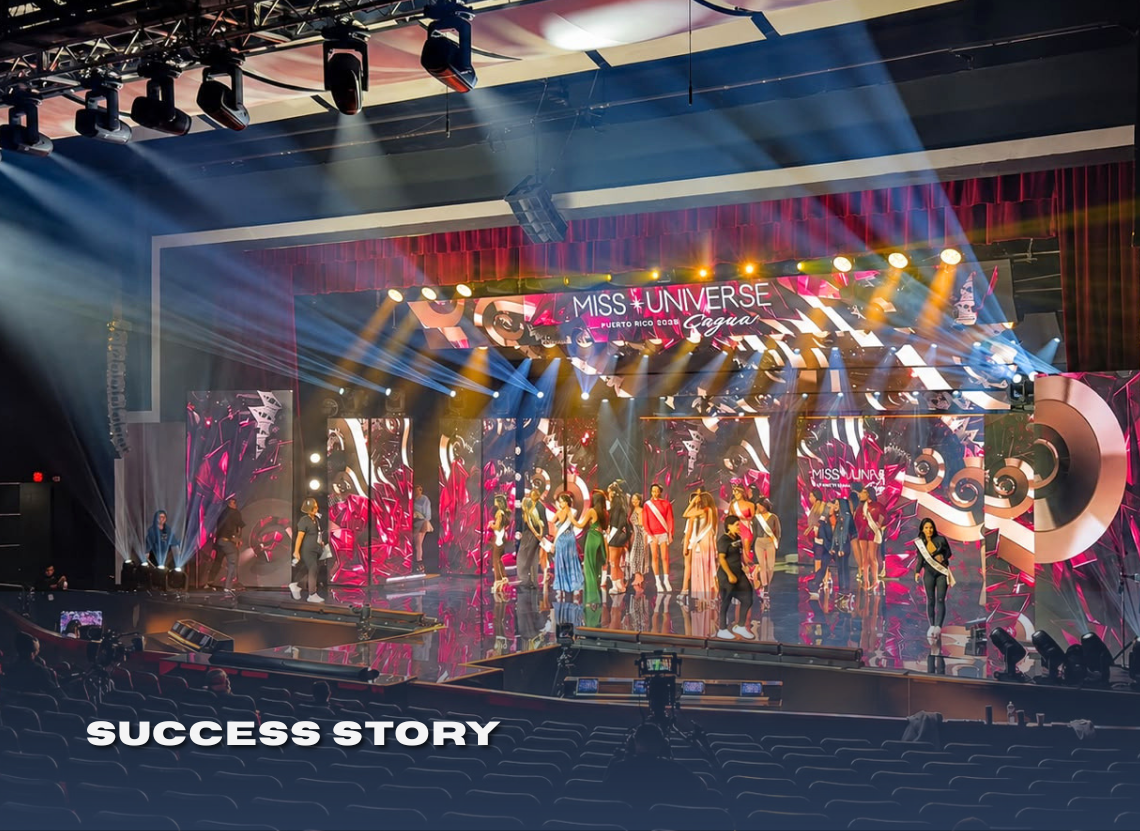
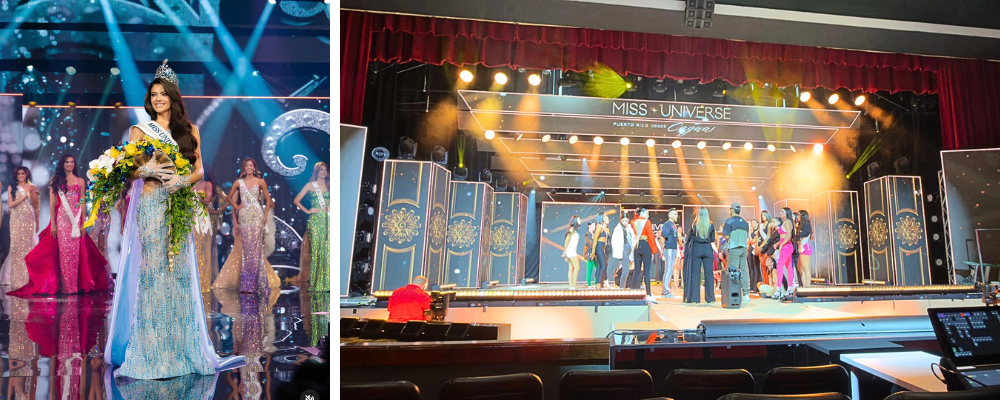
Puerto Rico – A venue change forced the redesign of a project that was already underway. Lower height, weight restrictions, and a much smaller space turned the 2026 edition of Miss Universe Puerto Rico into a particular challenge for Musique Xpress. Under the design of Eduardo Avilés, the company found in CHAUVET Professional solutions the versatility needed to build a production capable of responding simultaneously to the demands of television, the language of theater, and the energy of live entertainment.
There are projects where the challenge begins with an idea, and others where that idea must confront a space that seems determined to impose limits.
For Eduardo Avilés, one of the owners of Musique Xpress and responsible for the technical and lighting design of Miss Universe Puerto Rico 2026, it was the latter. After almost eight years working on the pageant, the new edition began taking shape under familiar parameters, until a venue change forced him to reconsider practically everything he had envisioned.
The stage would this time be the Centro de Bellas Artes de Caguas. A smaller theater, with a maximum height of barely six meters, significant load restrictions on its battens, and complex logistics for bringing equipment up to the second floor. The available scale had changed, but not the expectations of a production destined to be seen both within and beyond Puerto Rico.
The challenge did not end in the venue. The television broadcast and its international streaming distribution multiplied the exposure of the design, turning every lighting decision into part of an image intended to transcend Puerto Rico’s borders.
For Avilés, that meant finding a new way to reach the same objective.
“Every year is a challenge because we strive to make every setup different from the previous one, but also much better technically, visually, and in terms of content. You know that when the competition begins, everyone’s eyes are on that television program.”
A relationship built in front of the cameras
Musique Xpress has been part of Puerto Rico’s entertainment industry for 39 years. With a track record spanning concerts, theater, festivals, and, increasingly, corporate events, the company has now concentrated much of its operation on professional lighting and LED screens.
Avilés shares the company’s management with Enrique Núñez, but his relationship with projects also involves design. In Miss Universe Puerto Rico, that relationship has grown stronger over almost eight years and has even spanned different television stages of the pageant.
It is this continuity that made it possible to build a direct working dynamic with Aníbal Fernández, director and producer of the event for WAPA Television. The starting point is usually the same: review what happened the previous year, analyze what can be improved, and from there, find a new identity.
Creative freedom comes with a fundamental condition. Miss Universe Puerto Rico is, above all, a production designed for television.
“Aníbal always meets with me first. We talk about what happened in the previous competition, about the changes and improvements, but he gives me the opportunity to take care of the design. He tells me: you are the one who knows, you have to bring me something fresh, something new, but we have to continue with the goal that television is always television.”
This balance between renewal and continuity would be particularly important in 2026.
A design that had to adapt to a new stage
The project had initially begun to take shape with another venue in mind. When the move to the Centro de Bellas Artes de Caguas was confirmed, the change introduced new technical conditions that forced Musique Xpress to review much of the original concept and find other ways to take advantage of the venue’s possibilities.
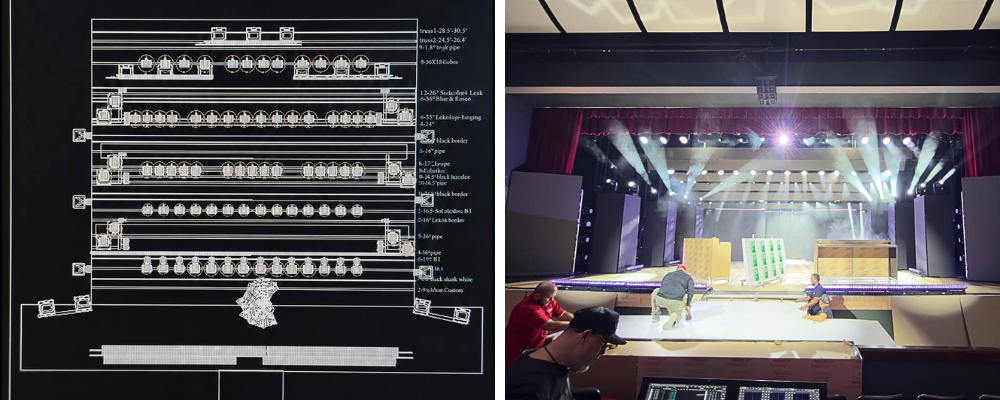
The considerations went beyond dimensions. Some positions could support loads of up to 500 pounds, while the electrical battens allowed approximately 1,500, and the available height also affected the size of the LED screens and the distribution of suspended equipment. Rather than reducing the proposal, Avilés used these conditions as a starting point to reorganize the design.
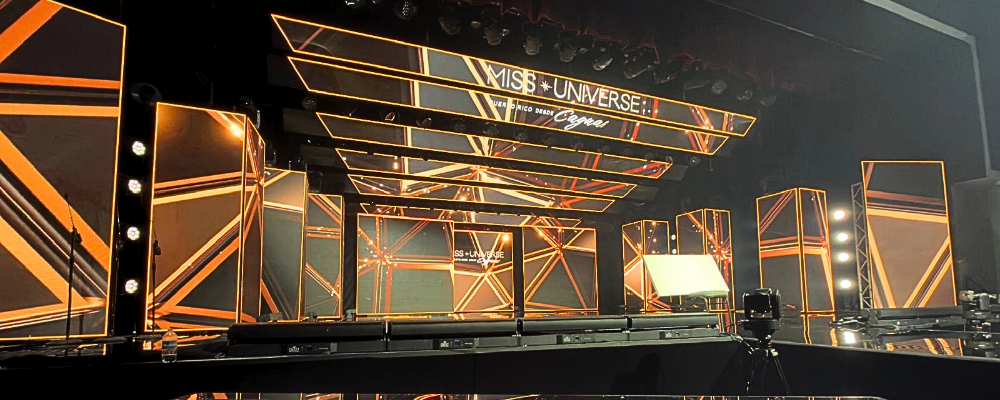
The background screens were resized, and the LED surfaces themselves became part of the visual construction of the scenic ceiling. From there, every available position was studied to integrate CHAUVET Professional fixtures according to a specific function within the production.
“I am not someone who likes to eliminate. What I do is keep rearranging things, looking for ways for the lighting designer and programmer to achieve what we want and make the most of the programming.”
The process thus became an exercise in precision in which every fixture had to justify its place. With specific height and load parameters, power alone was no longer enough: versatility, dimensions, functions, and the ability to solve different needs from a single position became decisive factors.
And it was precisely there that CHAUVET Professional acquired a central role, providing Musique Xpress with the tools needed to preserve the original intention of the design while responding to the technical characteristics of the new stage.
One family for three languages.
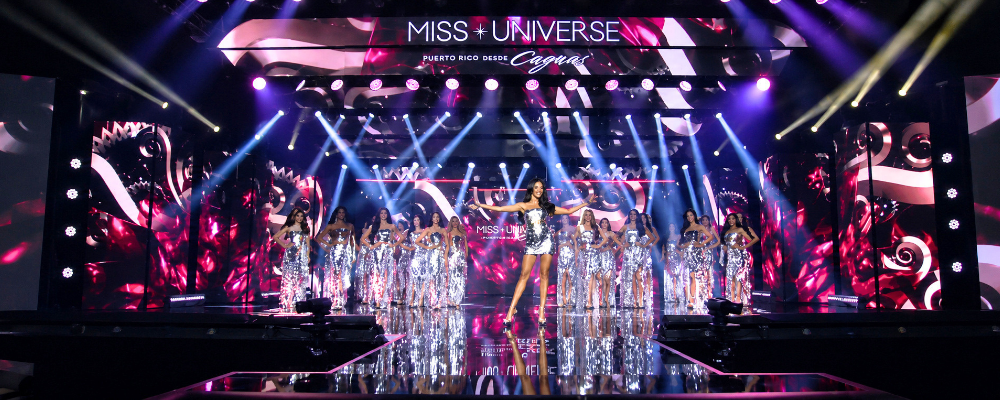
Miss Universe Puerto Rico presents an unusual combination. The light must respond to the precision of a television broadcast, preserve the depth inherent to a theatrical stage, and completely change its language when the musical segments begin.
Avilés summarizes this equation in an apparently simple proportion: 50% white light and 50% color.
In practice, achieving this involves much more: “Faces must retain natural reproduction. Dresses need volume and texture. Contestants must move without crossing areas where exposure changes abruptly. Cameras have to maintain continuity from different angles, and just a few seconds later, the stage must be able to transform itself to accompany a musical number.”
Musique Xpress’s response was to build the system around different solutions from the CHAUVET Professional family, avoiding the combination of numerous platforms that had characterized some previous productions.
“Today Chauvet has given us the possibility of not having to use other fixtures, because we can now achieve everything we need with their brand.”
The decision also brought consistency to the programming process. For José Oyola, responsible for translating Avilés’ concept and the direction team’s instructions to the console, working within a single family allowed him to focus on the creative result and maintain consistent behavior among the different tools in the rig. According to Aviles, “Current designs and technical requirements increasingly tend to focus on families of fixtures capable of assuming multiple functions, especially profiles and beams, reducing the need to build systems from numerous types of equipment.”
Maverick and the construction of television lighting.
A fundamental part of the system consisted of 36 Maverick Profile fixtures, distributed from the front positions to the intermediate and rear trusses. The theater’s limited space even required the creation of an additional approximately 50-foot rigging structure to bring part of the front lighting closer. Several Profiles were placed on it, allowing more suitable camera angles than those provided by the venue’s original positions.
“It is a fixture our technicians have loved because we can get an incredible variety out of it, especially for television. I can use its elements to work with white light, combine it with theater, and at the same time have the show side because we also have musicals within the competition.”
The Maverick Storm fixtures completed this architecture from other perspectives. Some units were distributed across the upper structures of the side screens while the remainder were placed on the floor, adding beams and movement to scenes where the show temporarily needed to move away from the neutrality of television.
Without a doubt, having powerful beams whose size could be controlled was particularly useful during the musical numbers.
COLORado Pixel Bar: when the weight limit changes the design
Structural restrictions came into play again when it was time to install the COLORado Pixel Bars.
The project initially called for 22 units, but the available weight capacity forced the quantity to be reduced to 12. Instead of interpreting the change as a loss, Avilés redistributed six on each side, working from low positions associated with the screen structures.
The function of these bars went beyond effects. In a production where wardrobe and movement occupy a central role, Avilés found in them a tool to add dimension from the sides and work on the garments without compromising the skin reproduction required by the cameras.
“They help me fill in the contestants’ clothing and give it that touch of brightness when we use RGB mixed with white. It highlights the clothing a little more without losing the idea that it shouldn’t look too overexposed.”
A single position thus solved completely different needs.
ÉPIX Strip and Color STRIKE, details that complete the scene.
ÉPIX Strip solutions were incorporated with another function within the design. They were used on the LED screens to accentuate their contours and prevent the video surfaces from appearing visually isolated from the rest of the lighting. Light thus became a transitional element between content, scenery, and stage.
“I like using the ÉPIX to accentuate details. Without a doubt, an indispensable tool in these formats.”
The design also incorporated six Color STRIKE fixtures, expanding the possibilities for the highest-energy moments of the show.
The combination of tools, however, was not driven by a search for quantity. Avilés insists on a philosophy that runs throughout his work: no fixture should occupy a position simply because there is space to place it. Every fixture must fulfill a function within the scene.
Designing by looking through a camera
The construction of the design did not end when the fixtures were hung.
For Avilés, the real adjustment begins in front of the monitors. “During testing, Musique Xpress works with live cameras and models or dancers on stage to reproduce the conditions the broadcast will encounter. At least three main shots — front and sides — are evaluated individually before analyzing the complete image.”
The procedure makes it possible to correct differences between cameras, lenses, and exposure settings that could go unnoticed when observing the stage solely from the audience area.
In a beauty pageant, this precision becomes even more important. “When they tell you beauty, it is beauty. There can be theater, there can be a musical, but people want to see that woman’s face. I work the white light independently with each camera and then bring them all together to see the overall content.”
The reduced height of Bellas Artes de Caguas added another difficulty. The proximity between fixtures and performers required carefully managing intensities from the console to avoid excessive levels and preserve the natural appearance sought by the direction team.
The result was particularly evident in the continuity between cameras. An international member of the team who followed the broadcast from the mobile unit specifically highlighted the absence of perceptible lighting variations when moving from one scene or shot to another.
For Avilés, it was confirmation that the coverage achieved within such a limited space was working as it had been conceived.
Programming an idea, not just fixtures.
José Oyola’s task began long before building cues. Avilés works with his programmers by first explaining the general concept and the function he expects from each position. From there, the programming must interpret both his proposal and the needs outlined by Fernández from the direction team.
“The director wants everything to be different, to have its own effect, its own color, its own life. He often says that every number or every section of the program has to have a different life. And the consistency of the Chauvet fixtures ended up favoring that process.”
Avilés points out that the experience also convinced Oyola to continue using this line of fixtures in future productions, appreciating the ability to address different needs with fewer fixture families without limiting creativity.
When the limitations disappear from the screen.
When the cameras began broadcasting Miss Universe Puerto Rico 2026, the restrictions that had shaped the design for months were no longer visible.
Those watching the program did not need to know that the screens had to be reduced, that some positions could not support the initially planned weight, or that dozens of fixtures had been redistributed to find a place inside a theater barely six meters high.
They needed to see a show. And they needed to see it with the same visual scale expected from one of Puerto Rico’s most important television productions.
“We were able to achieve our objective. With a much smaller and more complicated theater for the setup, we achieved what we wanted: perfect lighting for television, but at the same time theater and show. We were able to master all three foundations.”
The response went beyond the team itself. According to Avilés, the international CEO of Miss Universe was impressed with the setup, while the event’s production management highlighted the result achieved.
For Musique Xpress, the experience also reinforced a way of approaching its upcoming projects. After years of working with more heterogeneous configurations, the breadth of tools available from Chauvet made it possible to build a system in which each family assumed a different function without breaking the overall coherence of the design.
And the challenge does not end here. The production has already confirmed that it will continue working at the same venue over the coming years. For Avilés, that means returning to the challenge, now with a much deeper understanding of its possibilities and with an additional difficulty: the next design cannot simply repeat what worked.
“If it was so beautiful, someone might ask why not use it the same way, but the audience wants to see something new every year.”
Miss Universe Puerto Rico 2026 thus left a different reference point for Musique Xpress. Not because it managed to impose a large design on a small space, but because it demonstrated how much a project can change when every element is used with a specific intention.
Credits
Cover Photo: Musique Xpress
Inside Photos: Musique Xpress
The journalistic production, research, writing, editorial approach, and editing of this content are original works by LATAM STAGE and are protected by copyright.
No part of this content may be reproduced, copied, distributed, adapted, or published, in whole or in part, in any medium or format, without the prior written authorization of LATAM STAGE.


