
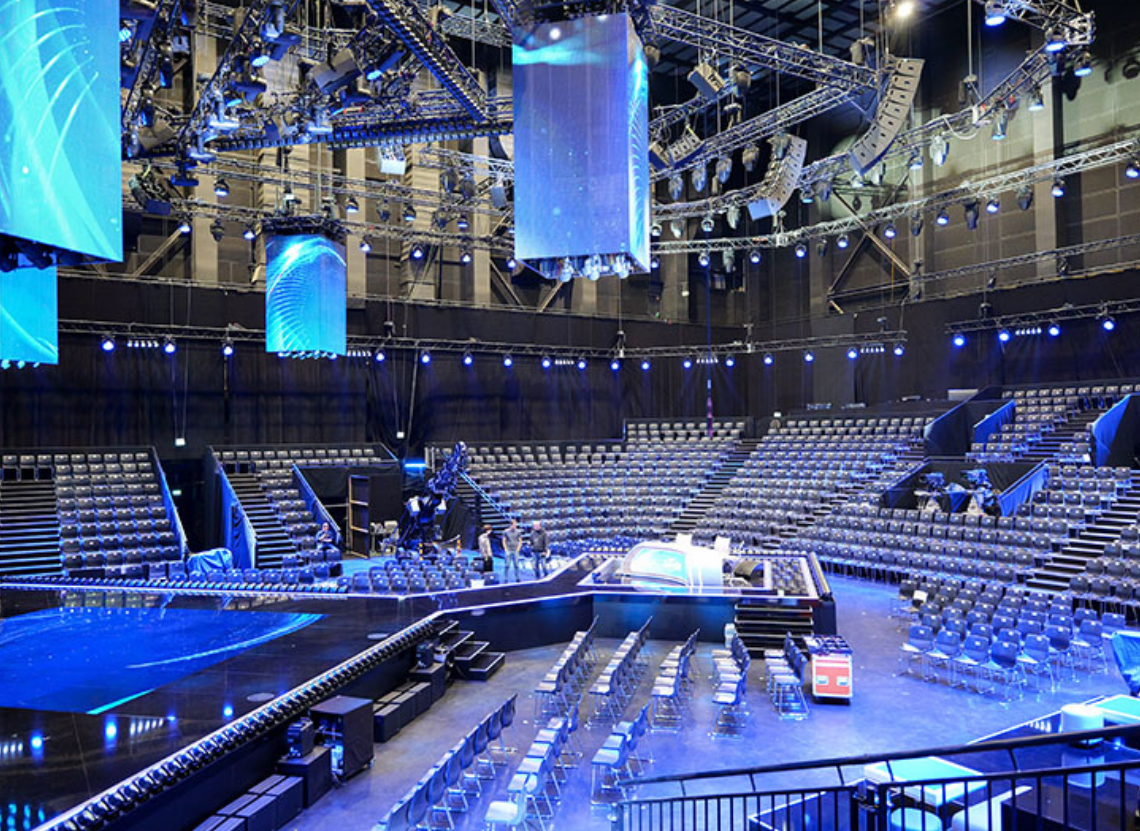
Germany – MMC Studios, one of Germany’s leading television production facilities, has implemented a sound reinforcement system based on the dBTechnologies VIO Series to meet the demands of a live television production held at the Coloneum in Cologne. The challenge was to deliver premium audio quality for an audience of more than 1,300 people while complying with the strict visual requirements of a televised broadcast.
The production took place in a studio with a seating capacity of 1,315 and featured several simultaneous audio scenarios, including a live band, wireless headset and handheld microphones, as well as judges’ microphones that remained open for much of the show. In addition, the production required that all loudspeakers remain completely out of the cameras’ field of view, eliminating the use of floor-mounted subwoofers or stage monitors.
To meet these requirements, dBTechnologies worked closely with MMC Studios to develop a fully flown sound reinforcement system built around the VIO platform. The objective was to provide consistent coverage throughout the venue while satisfying the needs of both the live audience and the broadcast production.
“On a TV production, we’re dealing with several constraints at once – sightlines, acoustic shadowing, the separation of broadcast feed and house PA, and above all, a high gain-before-feedback with permanently open microphones,” explains Jochen Gotzen, Technical Director at dBTechnologies.
Jens Szczygieleski, from Atlive and responsible for the system implementation, highlighted one of the project’s key advantages: “The consistent tonal character running right through the VIO series was the decisive advantage here: we could freely combine different system types without introducing any tonal discontinuities, and we flew the entire rig to keep the floor clear and take the equipment out of shot.”
The system components were supplied through the VIO Rental Network. The main coverage was handled by 24 VIO L1610 line array modules deployed in three arrays. Audience seating areas and perimeter zones were covered by 26 VIO L1608 modules arranged in six additional arrays. The system was complemented by four VIO X310 point-source loudspeakers and four VIO X205 units used as delay systems. On stage, six VIO W12 loudspeakers provided monitoring.
Before installation, the entire system was modeled in EASE Focus by MMC Studios’ Martin Antulov and Marius Dimke. The simulations made it possible to optimize coverage, SPL distribution and frequency response for every section of the venue before load-in.
“Our aim was to give every visitor a consistently high-quality sonic experience, wherever they were seated. Thanks to careful system planning and the capabilities of EASE Focus, we were able to tailor the sound reinforcement precisely to the venue before load-in. It’s always rewarding to see the work done in simulation later reflected in such homogeneous, transparent reproduction,” say Antulov and Dimke.
One of the most challenging aspects of the project was the low-frequency design. Since floor-mounted subwoofers were not an option, the team installed a centrally flown cluster consisting of eight VIO S118 subwoofers. Arranged in an arc, the configuration allowed low-frequency energy to be directed precisely toward the audience while adapting its performance to different seating areas.
“The subs are our zero,” says Gotzen. “We defined the flown sub cluster as the acoustic reference and time- and phase-aligned every other system to it. With the right crossover, the whole system sits in phase. The result is noticeably better localisation and a considerably higher gain-before-feedback – exactly what you need with permanently open judges’ microphones and a lively house.”
System integration also played a major role in achieving a seamless listening experience.
“Every loudspeaker is on the network, each has its own DSP, and the phase response across the VIO family is identical,” adds Szczygieleski. “That makes the transitions between the main system, stalls, delays and outfills extremely clean – for the studio audience, the impression is of a single, unified source, even though a large number of systems are working in the room.”
From the front-of-house position, the results also received high praise from the engineering team at MMC Studios.
“As FOH engineers, what we value most about this system is the combination of control and consistency. On a live TV show in particular, where there’s no second chance, it gives us the assurance that the system performs exactly as planned,” emphasize Martin Antulov and Marius Dimke.
The installation demonstrates how careful planning, acoustic simulation and the right system configuration can successfully overcome the demanding challenges of a live television production. By combining precise engineering with a fully integrated loudspeaker design, the project delivered a consistent audio experience for both the studio audience and the broadcast.
Photo @ dBTechnologies


