
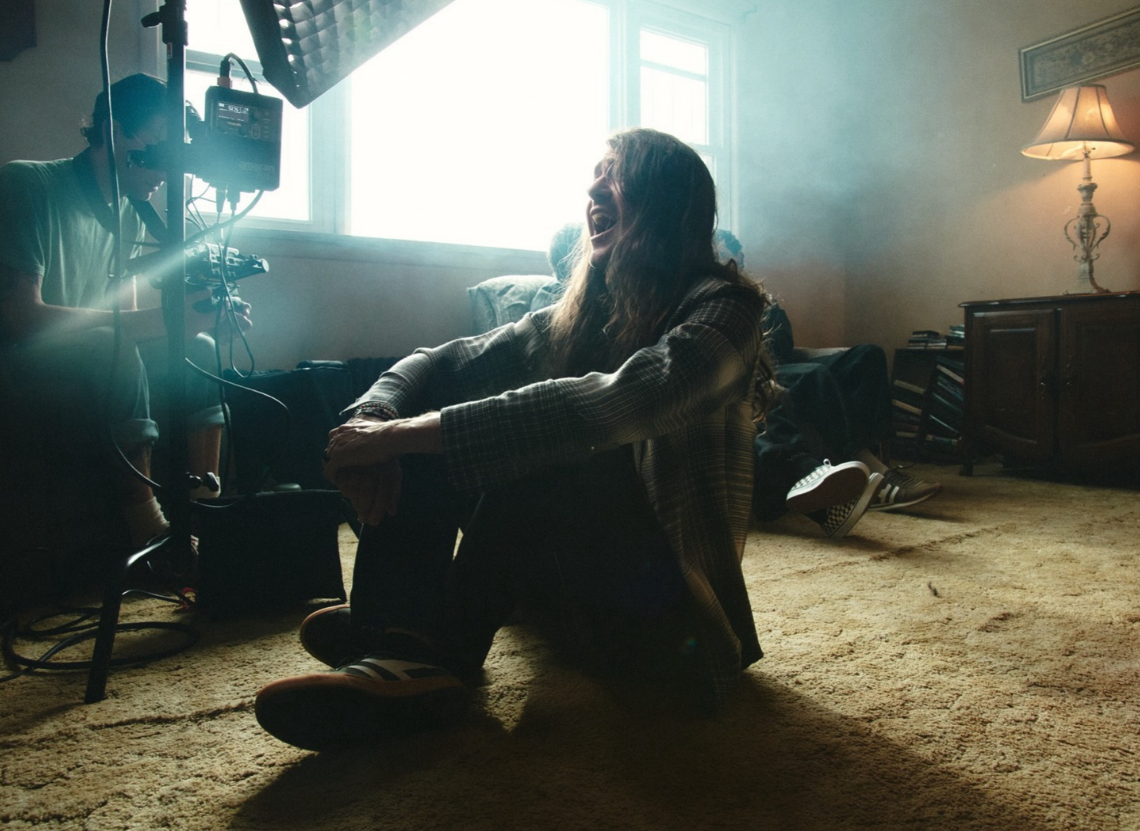
USA – Blackmagic Design today announced that Mayday Parade’s “Weekend Music” music video was shot with the Blackmagic PYXIS 12K digital film camera by DP Kris Khunachak. Director and Colorist Benjamin Lieber color graded the project in DaVinci Resolve Studio editing, photo editing, color grading, visual effects (VFX) and audio post production software.
“For ‘Weekend Music,’ we wanted to achieve a blend of two main aesthetics: a black and white ‘home video’ style of what feels like the memory of an idyllic romantic couple, and an in color, more present day look for the band’s performance, both in the very same home. Separated by look but connected by place,” began Khunachak.
For lenses, Khunachak treated a cine modded Helios 44-2 58mm f/2 vintage lens as his home base for the narrative B roll, and he supplemented the band’s performance coverage with a set of DZOFilm Arles Prime lenses when different focal lengths were needed.
“The Helios lens paired with the PYXIS gave us this surreal, otherworldly vintage but new feeling unlike any other. It unlocked a lot of doors for us creatively both on set and in post,” noted Lieber.
Khunachak detailed capturing the band’s performance during an especially memorable setup. “We shot multiple takes on sticks while I got to whip pan the camera almost in 360 degrees to land on different members of the band in different rooms of the house. I obviously had rolling shutter in mind going into tackling that setup, and knowing that I could swap the PYXIS 12K to its 8K or 4K capture modes without compromising on quality or framing to manage rolling shutter performance, gave me the confidence to execute the sequence without worry,” he said.
Khunachak added: “The PYXIS sensor’s strong dynamic range gave us, and specifically our one man band G&E Lorenzo Graziano, a lot of leeway on set to let the bright natural daylight, blended with our own exterior lighting, do its thing while we lit the interiors with more nimble, low wattage fixtures. We still captured the highlights and shadows we wanted and were able to move faster with less gear.”
Khunachak also commented on the PYXIS 12K’s image richness, which allowed Lieber to achieve the exact looks he wanted for the “two worlds” approach in post with DaVinci Resolve Studio.
“Grading Blackmagic RAW in general is always such a pleasure, as its flexibility and read speeds make adjusting in real time a breeze. It just works. And the color space of Blackmagic RAW and the PYXIS really lend nicely to film emulation approaches, which we love,” said Lieber.
As a musician turned videographer, Khunachak reflected on his journey: “I got my start shooting social media for my music friends. I kept my nose to the grindstone for years, learning everything I could, accumulating different tools of the trade, and eventually meeting and working with other creatives in my region like Ben. In time, the idea of shooting and color grading raw video became more appealing as I wanted more control over my image and to introduce myself to a more intentional workflow. Enter the Pocket Cinema Camera 4K, my first real cinema camera.”
“We now work with the PYXIS 12K and URSA Cine 12K LF, which rise to the needs of the larger and more demanding projects that we take on,” Khunachak concluded. “After seeing firsthand what that sensor is capable of, we both knew that this was the sensor we wanted to help capture the world that Mayday Parade was building for a unique multiple album release plan. We were blown away by the dynamic range, detail and scale of the image, especially in full 3:2 open gate. It made even intimate closeups feel like they had more scale and gravitas. And I appreciate the power of that sensor in a smaller, more manageable body for the mini crew jobs that Ben and I often find ourselves in.”


