
Amaia Montero’s return to La Oreja de Van Gogh represented far more than just another tour. After nearly two decades, the reunion of the band’s original lineup required creating a visual identity capable of supporting that emotion without competing with it. Built around ChamSys, an entirely white stage design, projection instead of LED screens, and a concept in which lighting, video, and space function as a single visual language, Maxi Gilbert embraced an uncommon idea in today’s large-scale productions: bringing the spotlight back to the artist.
Some productions are built around an LED screen. Others begin with a massive stage structure or a new piece of technology. In the case of Amaia Montero’s return to La Oreja de Van Gogh, the story began with a much simpler question.
How do you create a show where the stage supports the emotion without becoming the main character?
That question summarizes much of Maxi Gilbert’s career. The Argentine lighting designer, based in Madrid for more than two decades, founder of the Museum of Light and one of the leading figures in Ibero-American stage design, has developed a philosophy in which lighting, scenography and technology never seek to overshadow the artist, but rather to enhance the story being told. Built over more than thirty years of experience, that vision now shapes the highly anticipated return of La Oreja de Van Gogh.
For Gilbert, the answer began to take shape several months before the first rehearsal.
“When the news broke, it was everywhere. It was one of those tours every designer dreams of doing. It was also something personal from a generational point of view because I had worked with the band years ago, and meeting them again at this moment was very special,” Gilbert recalls.
The project began to take shape in November 2025. The only initial premise came directly from Amaia Montero herself: she wanted the show to emerge from a completely white stage. From that starting point, Gilbert began working alongside Susana Martínez Allende, who was responsible for the visual content and collaborated on the scenic design, developing a concept in which every element spoke the same language.
“We wanted to move completely away from the rock-and-roll stage aesthetic we see today. We weren’t trying to make the design stand out; we wanted to create a space where Amaia would truly be the focal point. The rest of the band had to support her, not compete with her,” he explains.
The decision seemed simple, but it meant going completely against many of today’s industry trends.
While most major tours build their visual identity around huge LED screens, black stage structures and increasingly spectacular effects, Gilbert deliberately chose the opposite direction.
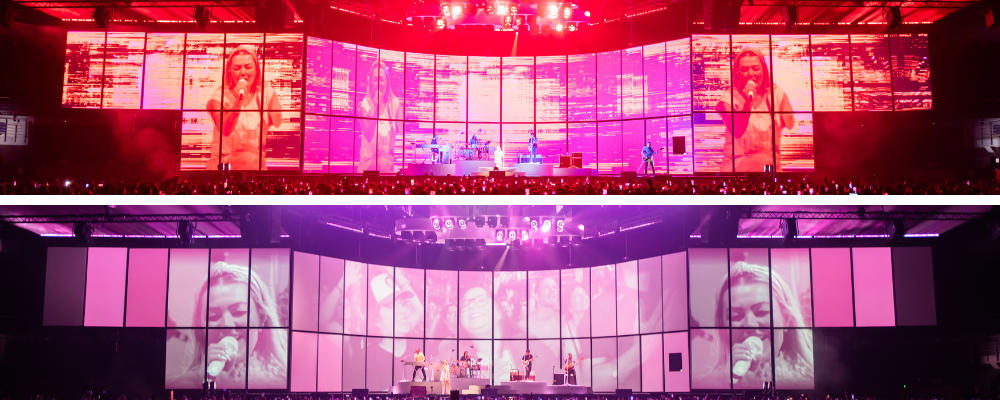
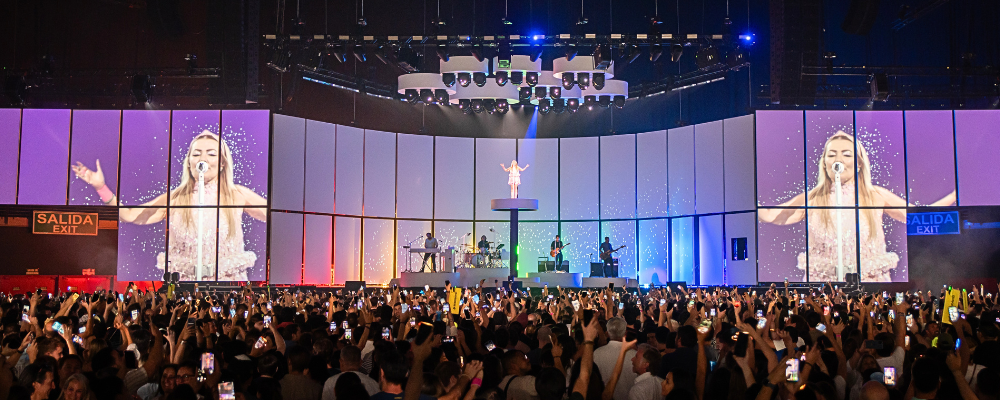
“We didn’t want to work with LED screens. The entire show is based on projection over white scenic frames. It was a risky design because today almost everyone works with LED, but we felt that wasn’t the essence we were looking for,” he says.
A Way of Understanding the Stage That Began Many Years Ago
Although this concept ultimately materialized in La Oreja de Van Gogh’s return, Gilbert acknowledges that this way of thinking about stage design began much earlier.
Back when he was still living in Argentina, he discovered through magazines that a concert could be built with the same narrative depth as a theatrical production.
“I remember seeing the stage design for Bicicleta by Serú Girán in Pelo and Humor magazines, created by Renata Schussheim. That was when I realized music could perfectly coexist with the language of theater and opera. Without realizing it, I think that was one of the moments that led me to dedicate my life to stage design,” he recalls.
Years later, another influence helped solidify that vision.
“I always remember the emotion with which Sandro Pujía described how he conceived the fourteen Canción Animal concerts by Soda Stereo at the Gran Rex Theatre, using completely white trapezoidal structures and building the entire visual narrative by mixing colors across those white surfaces. That way of using white as a creative canvas has stayed with me ever since.”
Those influences naturally found their way into this new production.
The stage recaptures the simplicity of the classic television sets where major bands performed during the 1960s, but reinterprets it through a contemporary aesthetic inspired by the Space Age movement and the boutiques designed by André Courrèges in Paris.
The entire space was conceived as one vast white surface capable of being transformed solely through light.
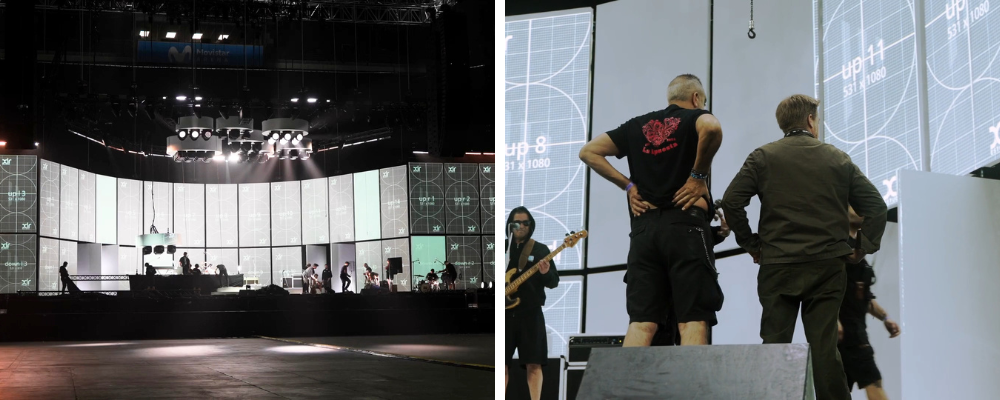
The scenography consists of 43 scenic frames, 14 of which rotate 360 degrees, continuously transforming the audience’s perception of the stage through reflections, shadows and projections.
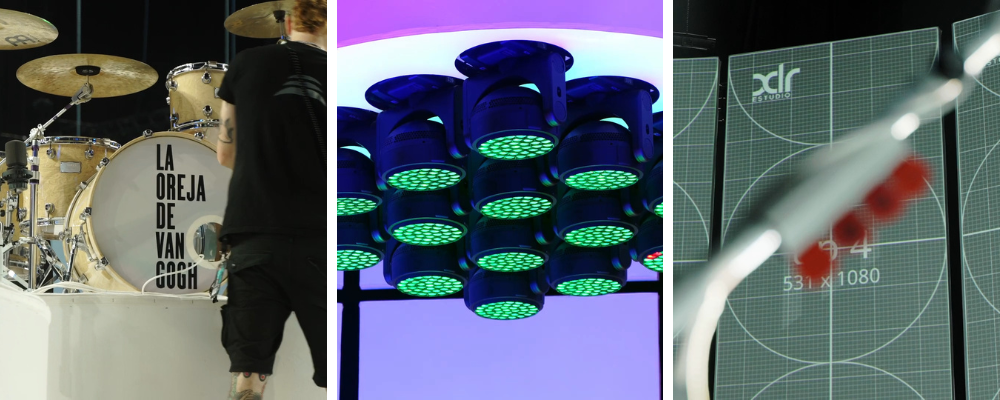
Even the distinctive circular structures known as tulipas were designed to fulfill a much greater purpose than simple decoration.
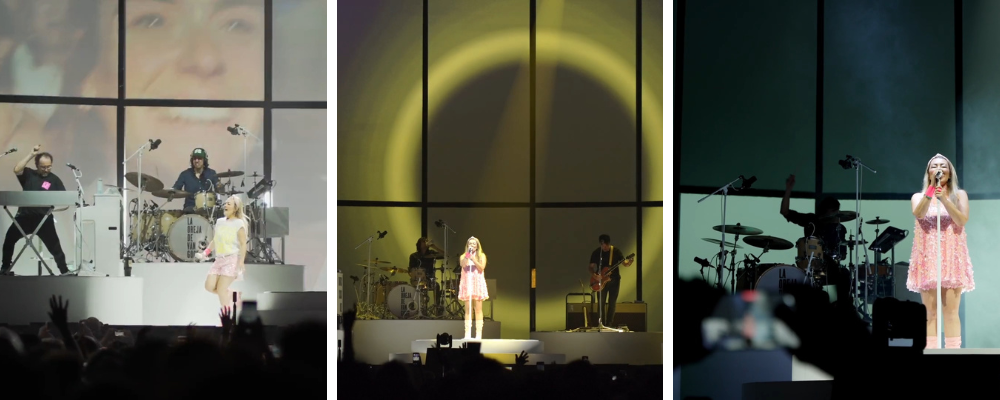
“We were looking for a concept. The idea was to hide the technology as much as possible so that the light would appear to emerge from the stage itself. The fixtures had to become part of the scenography and virtually disappear,” Gilbert explains.
The original design included many more of these structures, but budget limitations required simplifying part of the concept without altering its overall vision.
“There were many more tulipas planned, but we had to reduce their number. The important thing was preserving the original idea and making sure the stage continued to convey that feeling of cleanliness and purity we were looking for,” he says.
All of this work pursued one single objective: to make the audience stop looking at the stage and start looking back at the artist.
“I didn’t want the design to be flashy. I wanted to work with lighting, colors and color mixing on white surfaces, but without anything distracting the audience from Amaia,” Gilbert concludes.
Technology at the service of an idea
Once the artistic concept had been defined, another challenge emerged: turning that vision into a show capable of adapting to completely different venues without losing its identity.
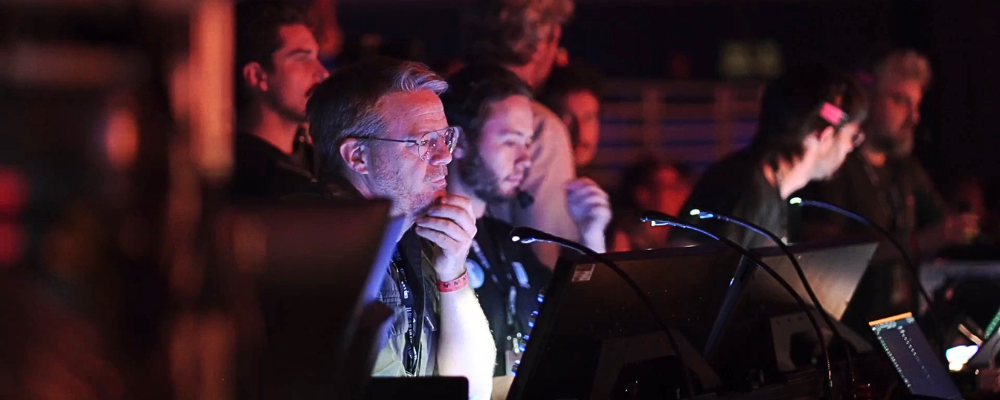
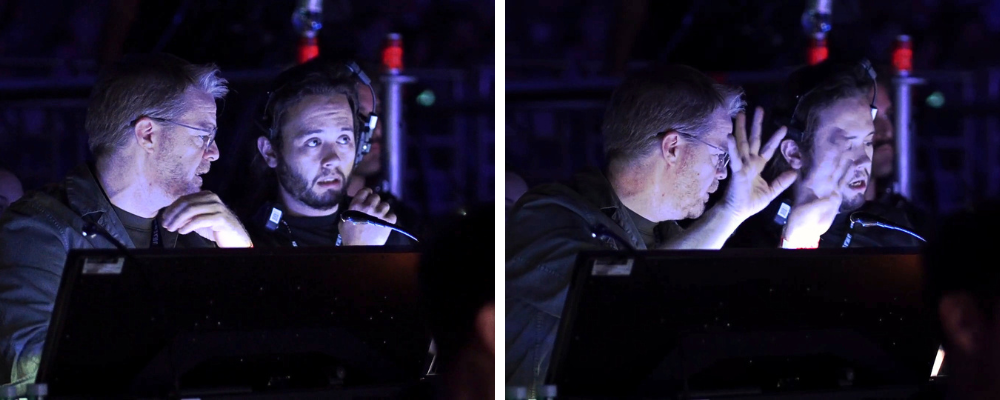
To achieve this, Gilbert chose to work alongside Diego Alarcos, a 28-year-old programmer with a background in television, whose experience proved essential for a production in which photography and visual balance carried far more weight than sheer lighting impact.
“I wanted someone who understood photography. In this show, we couldn’t push the intensity too far because any excess would completely blow out the whites. Diego has that sensitivity, and he became a fundamental part of bringing the concept to life,” Gilbert emphasizes.
The entire show was programmed on a ChamSys MagicQ MQ500M+ Stadium console. However, rather than using it simply as a lighting console, the team transformed it into the integration hub for lighting, video and scenography.
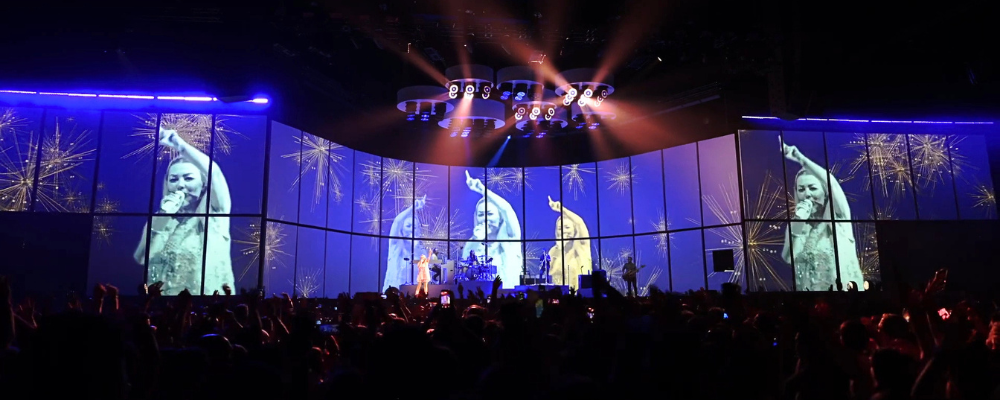
“We’re making extensive use of the Video Server functionality. We’re not just programming the lighting—we’re also programming the video directly from the console. We treat the projected content as if it were just another lighting fixture,” he explains.
Each scenic frame was individually mapped so that the projections constantly interacted with the lighting. As a result, video ceased to function as an independent element and became an active part of the lighting composition.
“This allows us to replace many traditional lighting effects with video content while maintaining a single programming logic within ChamSys. In the end, you’re no longer thinking about what the lighting is doing and what the video is doing—everything becomes part of the same concept,” he says.
The flexibility of the platform also proved essential as the tour continued to grow. Although the show was originally conceived for stadiums, it now travels through arenas, bullrings and venues of very different sizes, requiring the design to adapt without compromising its identity.
“Everything was designed for the stadium format. Then we reduce elements depending on the venue, but always making sure the concept remains exactly the same. The goal is for the show to grow without losing its identity,” Gilbert explains.
ChamSys’ new Dynamic Grouping tools made that process considerably easier.
“Whenever we have to reduce the number of fixtures, we simply modify the groups and the effects continue to behave exactly the same way. That ability to reorganize the system without having to rebuild the entire show gives us tremendous freedom to adapt the production to each venue,” says Maxi Gilbert.
Another major challenge appeared when the tour reached its first outdoor performances. The white stage, conceived to maximize both lighting and projections, now had to coexist with an opponent no one could control: natural daylight.
“It’s impossible to fight the sun. The opening songs are designed to remain almost entirely white because the scenography has to work just as well during the day as it does at night. As daylight fades, the show gradually transforms together with the natural light,” he explains.
To manage that transition, the team continuously works with different Grand Masters, adjusting intensity and color balance as ambient light changes.
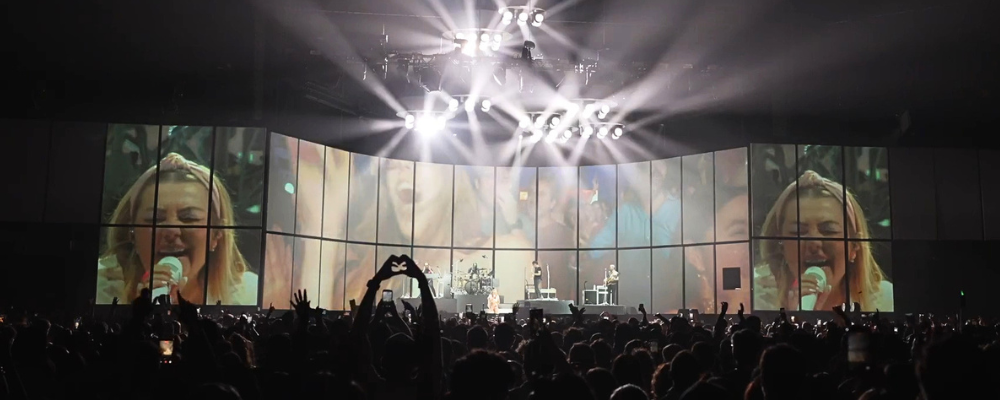
“We’re constantly balancing the stage lighting, the projections and the sun. The flexibility of the console allows us to find that balance at every venue and at every performance time,” Gilbert confirms.
Amaia herself also embraced a personal challenge within the production.
After being away from the band for nearly two decades, she agreed to begin the show emerging from beneath the stage and rising several meters above the audience on a motorized platform.
“It was a significant challenge. We didn’t know how she would feel about it, but from the very beginning she wanted to do it. She embraced it as a personal challenge, and that ultimately reinforced the entire concept of the show.”
The result was enthusiastically received by both the band and the production team.
“Everyone was absolutely thrilled. They told me they had never had a production built around such a well-defined concept, where every song responded to the same visual language. That was incredibly rewarding. Then the audience’s reaction confirmed that we had chosen the right path.”
With more than 100,000 tickets sold in just one hour, setting a new record, La Oreja de Van Gogh’s return became a phenomenon that transcended music, turning into an emotional reunion between the band and several generations of fans.
“It’s a collective emotion that’s very difficult to describe. People aren’t just coming to a concert; they’re coming to reconnect with a part of their lives,” Gilbert reflects.
Perhaps that is why one of the phrases he repeats most throughout the conversation perfectly summarizes his entire design philosophy.
“This show needed a different way of telling the story.”
And that is probably the greatest lesson this project leaves behind.
Behind every technical decision lies an idea developed over decades, shaped by influences such as Renata Schussheim and Sandro Pujía, and built upon a very particular way of understanding the stage—one in which lighting engages in a dialogue with architecture, photography, theater and music.
Throughout that journey, ChamSys is not presented as the star of the production, but rather as the tool that made it possible to integrate lighting, video and programming into a single creative workflow, preserving the designer’s original vision from the very first sketch to the final performance.
Because for Maxi Gilbert, technology is never the starting point.
It is simply the means of making an idea visible.
And when that idea is well conceived, the stage no longer demands attention—it gives the spotlight back to the one who truly belongs at the center of the scene: the artist.
Photo Credits
Cover: Lola Garcia Garrido . @lolagarciagarrido
Inside: XLR Studio . @xlr_estudio
The journalistic production, research, writing, editorial approach, and editing of this content are original works of LATAM STAGE and are protected by copyright.
Its reproduction, copying, adaptation, or publication, in whole or in part, in any medium or format, without the prior written authorization of LATAM STAGE, is strictly prohibited.


