
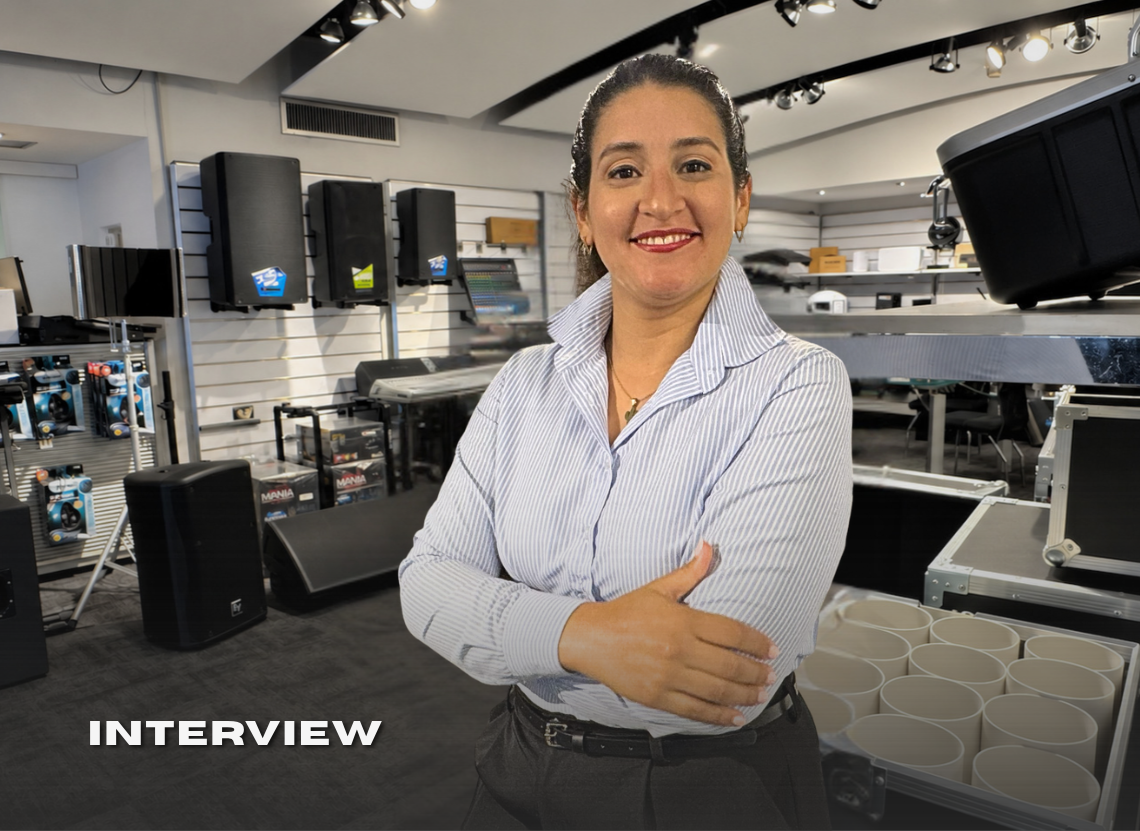
She joined Audio Concept Venezuela from the world of IT and found a new professional path in integration. Five years later, she coordinates audio, video, lighting, automation, and networking projects, with curiosity and continuous learning as the driving forces behind work that pursues a clear objective: making simple for the user what can be technically complex.
Before talking about audio, automation, or integration, understanding Mariangel Aguiar means going back to her early years of curiosity about IT. Her father introduced her to that world, and she quickly wanted to go beyond simply using technology: she needed to understand what was behind it and how it worked.
“I kept investigating, ruining a couple of computers and fixing them,” she recalls with a laugh.
By the time she finished high school, that curiosity had already defined the direction of her education. She chose a technical degree in IT and began specializing in networks and servers. Everything seemed to indicate that this would be her professional path.
Until Audio Concept appeared.
In February 2021, she joined the company as an assistant in the projects department. There, she discovered that computers were still present, although they were definitely no longer at the center of the picture: “A completely different world opened up to me. Different and with plenty of challenges.”
Suddenly, she was faced with audio, security cameras, lighting, displays, automation, blinds, motors, and different systems that she not only had to understand individually: “I realized that everything had to be integrated.”
That change could have represented a barrier. In her case, it became a stimulus. And Mariangel began to study.
Audio Concept represents different brands with their own educational platforms, and she found there a first gateway into the industry. Courses, training sessions, and many hours of research began to provide answers, but also generated new questions.
“It was incredibly interesting and exciting. The fact that there is always something to learn or something new to learn is something I love. It gives me life.”
From there, her growth within Audio Concept progressed alongside her knowledge. Training began to move into the field, projects became increasingly complex, and with them came new responsibilities. What had begun as an assistant position became a professional journey built within the company itself. Five years later, that assistant is now Project Area Coordinator at Audio Concept Venezuela.
And she says: “One of the reasons for that evolution lies precisely in something I still celebrate about my work: I never know exactly what problem I will have to solve next. It’s not a boring job. I never do the same thing.”
From a need to a complete system
When a new project arrives at Audio Concept, Mariangel’s work begins long before any equipment appears.
Following the initial requirement, the technical process begins: number of zones, type of application, videoconferencing needs, automation, residential or Hi-Fi audio, lighting, and any other technology that needs to become part of the solution.
From there, Mariangel researches which products are appropriate: “Amplification calculations are carried out when the project includes sound, and I begin interacting with the different specialists involved. If there is lighting control, I talk to the electrician. If HVAC systems need to be integrated, I need to understand how they are set up. And if the project involves other disciplines, the conversation expands. Basically, I have to talk to all the engineers involved in the project.”
There is, however, one variable she needs to know from the beginning: the budget. Not to automatically reduce the solution, but to understand the framework within which she can work and which product families make sense for that project. From there, another part of the work begins: showing the client what possibilities exist.
“The idea is always to show them all the capabilities the system has, which perhaps they had only seen in one particular way.”
That ability to listen can also completely change the solution. “Some users are fascinated by technology and are willing to automate practically every function in the house. Others want exactly the opposite: one button to turn things on, another to turn them off, and no visible complexity. Some clients simply want to enjoy music in their spaces. Others are audiophiles capable of focusing on every detail of a recording, listening to a drum kit, analyzing the highs, or identifying nuances that might go completely unnoticed by another user. Understanding that difference is part of the project.”
And it also explains why, for Mariangel, designing an integration begins with understanding the person who will ultimately live with it.
From the idea to the user
Two of the projects that challenged her most over these years show precisely how far that logic can go.
The first is currently in the installation and commissioning process: an auditorium intended for conferences, recordings, and different activities, but with an unusual requirement for this type of space: incorporating immersive Atmos-type audio. Added to this were video distribution, microphones, and lighting control requirements.
“The challenge of designing the necessary equipment so that all of this can be managed together has been interesting. Here I definitely have to mention that Q-SYS has been our ally. The complexity is not in getting each subsystem to work independently. It is in making them all respond as part of a single solution.”
The second challenge took that idea into a completely different environment: a large residence where Audio Concept had to integrate practically every area of its work.
Lighting, blinds, sound, networking, automation, a small cinema, and a Hi-Fi system for an audiophile homeowner all had to coexist within the same house. “We even had to take care of the wired Wi-Fi network. Everything Audio Concept can do was implemented in this house.”
“But the real difficulty was not only the number of systems,” she acknowledges. “It was making that complexity disappear for the user. It took weeks of calibration, testing, and adjustments to turn an enormous technological infrastructure into an everyday experience. The challenge was to achieve the simplicity the user wanted while also making sure it sounded good and everything worked smoothly.” So that the person could pick up the remote control, sit down, and enjoy. Nothing more.
That distance between what happens behind an integration and what the person using it perceives summarizes much of the philosophy with which Mariangel approaches projects. And sometimes, achieving that also means abandoning what seemed correct on paper.
In another residence, the initial lighting design had to be reconsidered in the field because of the amount of cabling required. The solution came through DALI, a technology they had not commonly used until then. “One thing was what we had in mind, and another was what we had to do in the field.” The challenge ultimately opened up a new alternative for future Audio Concept projects.
For Mariangel, this type of experience explains why the field remains her favorite place.
Design is part of her responsibility —although she admits with a laugh that it is not always what she enjoys most— but commissioning and the moment of presenting the finished system to the user have a different meaning. “I really like that part because it allows me to show them everything they can now do.”
From wondering what it is to understanding the logic of Q-SYS
Mariangel’s relationship with Q-SYS began in exactly the same way as her arrival in the integration world: not knowing it and wanting to understand it.
When she joined Audio Concept, the company was already working with the platform. During her first months, one of her responsibilities was to assist with existing installations whenever an issue arose.
Several of those systems used Q-SYS. The first time she opened the software, her reaction was immediate. “I see all these little blocks, connections, and things, and I say: ‘My God, what is this? What am I looking at?’”
But having to return to those installations again and again began to awaken her curiosity. She started recognizing elements, understanding relationships, and discovering what was happening behind an interface that had initially seemed incomprehensible.
Until curiosity won. “I have to understand what this is. I need to understand what this is all about.”
No one had asked her to specialize in the platform. She decided to do it on her own. “I started taking the Q-SYS courses and ended up going deeper into audio, video, programming, and logic. It was quite in-depth, but very interesting because it wasn’t something that was imposed on me: it sparked my curiosity, and I wanted to understand more and more about how everything works within an integration. Today, Q-SYS is part of different Audio Concept projects, especially in corporate applications and videoconferencing rooms.”
Mariangel particularly highlights the ability to bring different requirements together within a single platform. “Whether they are small rooms, very large rooms, or many rooms, you can manage them perfectly with Q-SYS.”
One of the projects that best reflects this evolution was a six-story corporate tower with six rooms, all implemented using the platform and integrating audio, video, and videoconferencing. The installation was already operational when, approximately one month later, part of the team traveled to Colombia for in-person training.
Until then, much of Mariangel’s learning had taken place through online platforms. In Colombia, a different dynamic emerged: an instructor in front of them, equipment available for hands-on labs, and the possibility of asking questions and receiving answers in real time.
And something happened there that she considers especially valuable. As the training progressed, she began connecting what she was learning with situations they had just resolved in that corporate tower.
“Absolutely everything I saw made me think: we can improve and optimize this in the project we just finished. The training didn’t invalidate what we had done. It expanded the possibilities. It opened our minds and we said: we can make this much simpler and better.”
For someone whose career in integration was built precisely by learning while working, that experience confirmed something that remains part of the way she understands the profession: finishing a project does not mean you have finished learning from it.
That same perspective appears when she thinks about where platforms such as Q-SYS, and integrated AV systems in general, are heading.
For Mariangel, the direction is increasingly toward simplicity. “That I can arrive and not have to go through a whole series of steps to connect to a videoconference or any other system. That I can simply take my laptop, sit down, connect, and that’s it. And it works.”
That simplification also transforms the work of integrators, making commissioning easier and allowing specialists to focus their knowledge on system calibration and optimization. Technology makes processes simpler, but knowledge remains essential.
Learning, proving yourself, and continuing to move forward
Building that career also meant finding her place within a technical industry where men continue to be a clear majority.
For Mariangel, it was not an entirely new experience. Even during her years in IT, she had encountered surprise when other people discovered what she did.
“You work with that? Many people’s first reaction was like: ‘That’s unusual, it’s the first time I’ve met a woman who works in this field.’”
She encountered that reaction again in the AV world. And her response was to build credibility in the same way she built the rest of her career: by learning.
“Earning the respect of your colleagues has a lot to do, first, with demonstrating the knowledge you have, but also with humility and a good sense of humor, which can break down many barriers.”
Throughout her journey, she found professionals willing to share their knowledge and support her growth. “Those are the people I have relied on and who have supported me. That has allowed me to continue growing and learning much more in this industry.”
That is why, even while acknowledging that progress toward greater female representation in technical roles remains slow, her personal experience leaves an important message: “At no point have I experienced anything that made me feel like I didn’t belong. I always try to encourage others: of course you can, and you have to learn. Start with something small.”
Perhaps because that is how she started too. With something small. And she still feels there is much more to learn.
One of her next professional goals is to obtain an industry certification, particularly CTS, and complement the knowledge acquired over these years with a more formal understanding of standards.
“Several of the things I have learned have been empirical. I would like to formalize my understanding of the standards, to clearly know where we are going, what needs to be defended, and what should not be allowed so that everything continues working the way it should.”
She does not seek certification merely as a credential. She relates it directly to doing her job better.
Perhaps that is why, when she thinks about what advice she would give today to the Mariangel who years ago opened up computers without knowing exactly whether she would be able to put them back together, the answer also becomes a summary of her professional journey.
“I would tell her: keep doing what you’re doing, keep going in the direction you’re going. Don’t worry, you’ll be able to put it back together. Don’t worry, you’ll figure it out.”
The scale has changed. Today, it is no longer about an open computer on a table. Audio Concept Venezuela became the space where that curiosity found new challenges and where Mariangel went from discovering an unfamiliar universe to coordinating some of its projects.
But the path behind it remains exactly the same. Research. Ask. Understand. Learn. And then make all those pieces fit together again. But this time, so that someone on the other side can simply press a button and everything works.


