
In just over two decades, Integrated Systems Europe went from occupying a single hall in Geneva to bringing together more than 92,000 professionals from 181 countries in Barcelona. But behind those numbers lies a broader story: that of a trade show that grew at the same time as audiovisual evolved from an industry with clearly defined boundaries into a technology that cuts across virtually every space where we live, work, learn, and entertain ourselves.
When Integrated Systems Europe opened its doors for the first time in 2004, the industry was very different. Not only because many of the technologies that are now part of everyday professional life were still taking their first steps, but also because the boundaries between different markets were much more clearly defined.
Audio, video, broadcast, lighting, communications, automation, and building technology could be understood as relatively independent worlds. Two decades later, that separation is much harder to sustain.
Today, for example, a university can simultaneously be an educational space, an audiovisual production studio, and a remote collaboration environment. A stadium combines professional audio, lighting, displays, broadcast production, connectivity, digital signage, and immersive experiences. A corporate building integrates communications, automation, energy management, video, and control. And a retail space can become a content platform.
ISE grew in the midst of that transformation.
From one hall to an ecosystem
The first edition took place in Geneva in 2004 and occupied a single hall. Since then, the organization itself states that its exhibition space has grown more than 30-fold, attendance by 20 times, and the number of exhibitors by 11 times.
The figures help illustrate the scale of that growth, but they also tell us something about the industry that grew around the event.
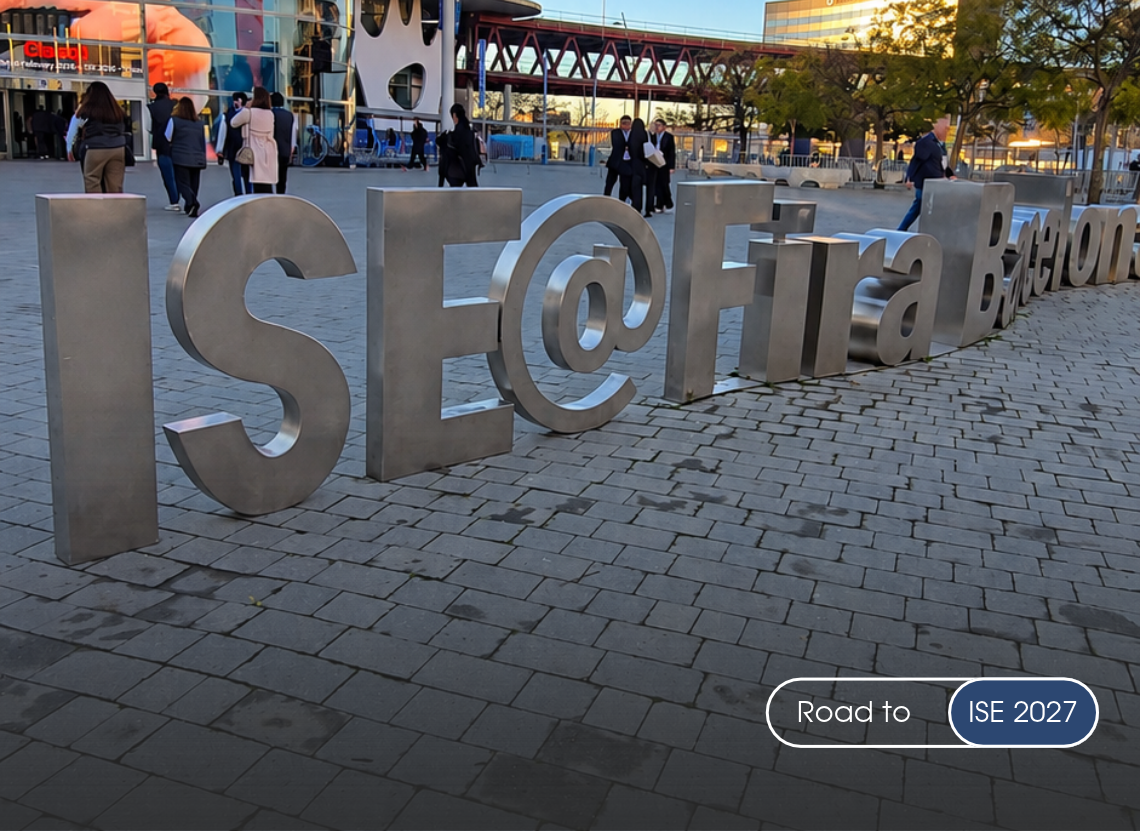
That change in scale eventually brought ISE to Barcelona, where it found at Fira de Barcelona Gran Via the space it needed to continue expanding its offering.
The 2026 edition took that evolution to a new level: 92,176 unique visitors, 1,751 exhibiting companies, and 101,000 square meters of exhibition space. Professionals from 181 countries attended the show.
But perhaps the most interesting fact is not how much ISE grew, but what it had to incorporate in order to continue representing an industry that was also changing.
When the boundaries began to disappear
ISE’s evolution can be seen in its own show floor map.
For 2027, the show organizes its exhibition space around seven major Technology Zones: Audio; Broadcast AV; Digital Signage & DooH; Lighting & Staging; Multi-Technology; Residential & Smart Building; and Unified Communications & Education Technology.
These are not simply different sectors sharing the same venue. There are increasingly more points of connection between them.
The convergence between broadcast and AV is perhaps one of the clearest examples. Companies, universities, stadiums, and organizations now produce content to standards that once belonged almost exclusively to the broadcast world. At the same time, broadcasters are incorporating technologies and platforms originally developed for the AV market.
Something similar is happening with digital signage, which is no longer simply a screen used to communicate information, but has become integrated with retail, transportation, hospitality, education, corporate spaces, and brand experiences.
And in live entertainment, an area particularly close to our target audience, the transformation is equally evident. Lighting, video, tracking, control, audio, networking, mapping, and software are all part of the same creative and technological language.
The industry did not simply continue growing upward. It began expanding across boundaries.
Impossible to define with a single word
Perhaps this is one of the keys to understanding what ISE represents today. Defining it simply as a professional AV trade show is beginning to fall short.
Audiovisual technology now extends across smart buildings, education, content production, corporate environments, hospitality, retail, stadiums, museums, entertainment, communications, and cities. And the show has incorporated these markets as they have become increasingly interconnected.
ISE 2027 once again reflects that direction. Among the initiatives already announced is greater integration with the education sector. Integrated Systems Europe will co-organize EdTech Congress Barcelona 2027, which will take place on February 3 and 4 at Fira Montjuïc, while the show runs simultaneously at Gran Via.
It is a concrete example of how the event is beginning to extend its connections beyond the show floor itself.
And Latin America?
For our region, this expansion also represents an opportunity. Latin America has an established presence in industries such as professional audio, lighting, live entertainment, and audiovisual integration. But the universe that ISE brings together today is considerably broader.
Integration as a whole and emerging technologies are part of a conversation that is also growing across our markets. For that reason, looking at ISE only through the brands or sectors we have historically known would mean seeing only one part of the event.
The 181 countries represented in 2026 help illustrate its global reach. The challenge now is for Latin America not only to be a region that visits ISE, but a community that can discover new technologies, markets, connections, and opportunities there.
The next chapter
ISE will return to Fira de Barcelona Gran Via from February 2 to 5, 2027.
The next edition will once again find an industry in transformation: artificial intelligence, immersive experiences, content production, software, connectivity, and automation continue to reshape products, spaces, and business models.
There will surely be new figures to add to the story. But they will be the consequence of something much more interesting: an industry that continues to expand its boundaries and an event that, since that first hall in Geneva, has sought to grow alongside it.
At LATAM STAGE, we are beginning our journey toward ISE 2027.
Credits
Cover Photo: LATAM STAGE
Inside Photos: LATAM STAGE
The journalistic production, research, writing, editorial approach, and editing of this content are original works by LATAM STAGE and are protected by copyright.
No part of this content may be reproduced, copied, distributed, adapted, or published, in whole or in part, in any medium or format, without the prior written authorization of LATAM STAGE.


