
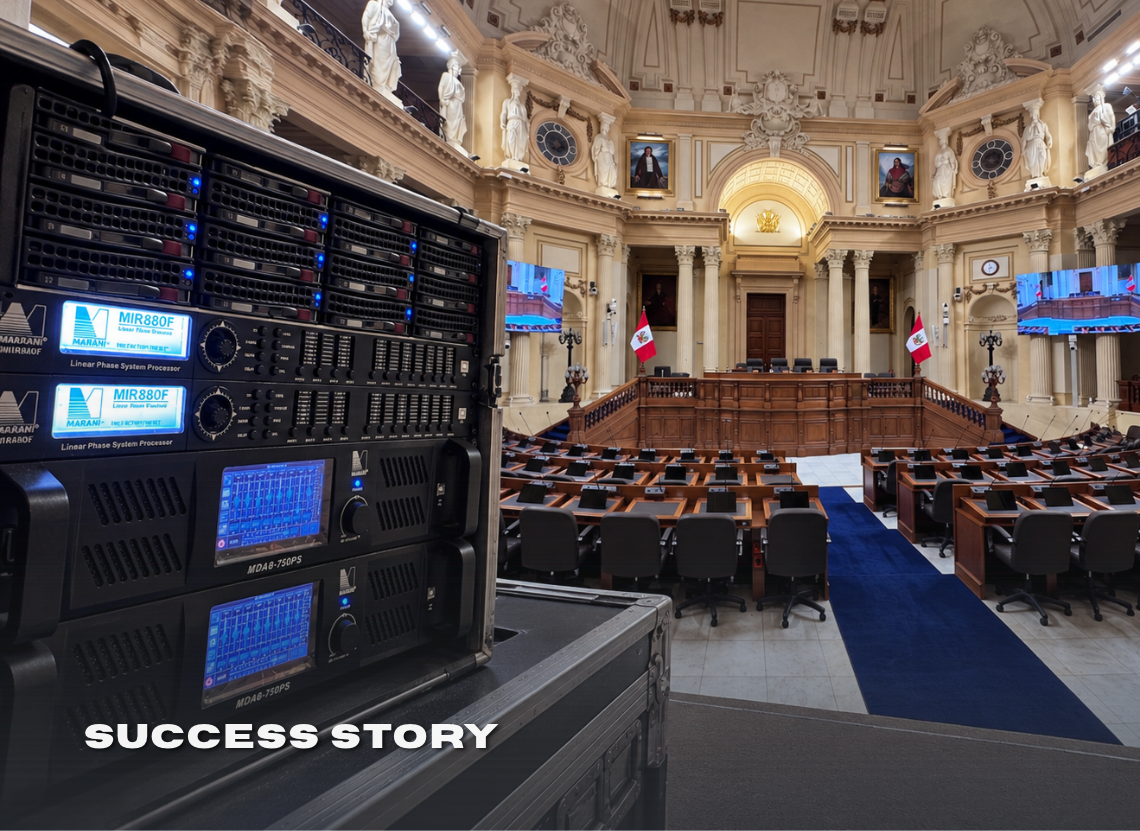
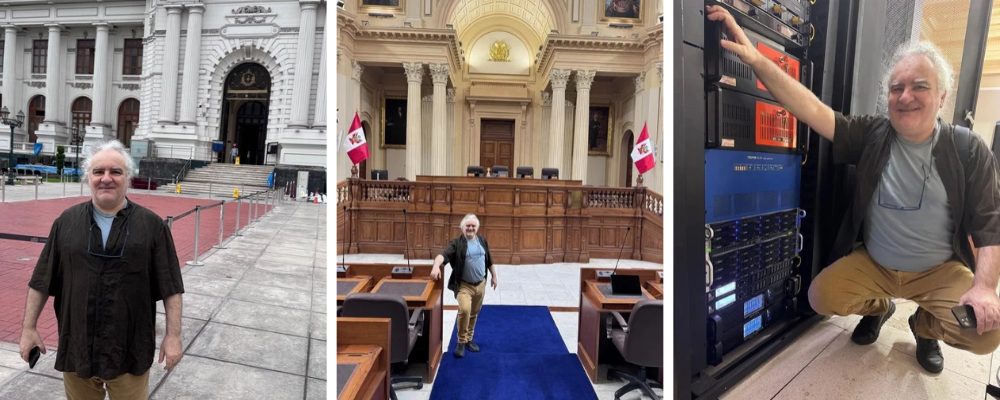
Peru — The return to a bicameral system prompted the renovation of the audiovisual infrastructure at the Legislative Palace in Lima. In a project shaped by demanding acoustic requirements, the integration of multiple spaces, and a timeframe of just five days per chamber for audio installation and calibration, MARANI processing and amplification took on a central role. SPLTEK, the brand’s distributor in Peru, supported the project with equipment supply and local technical support.
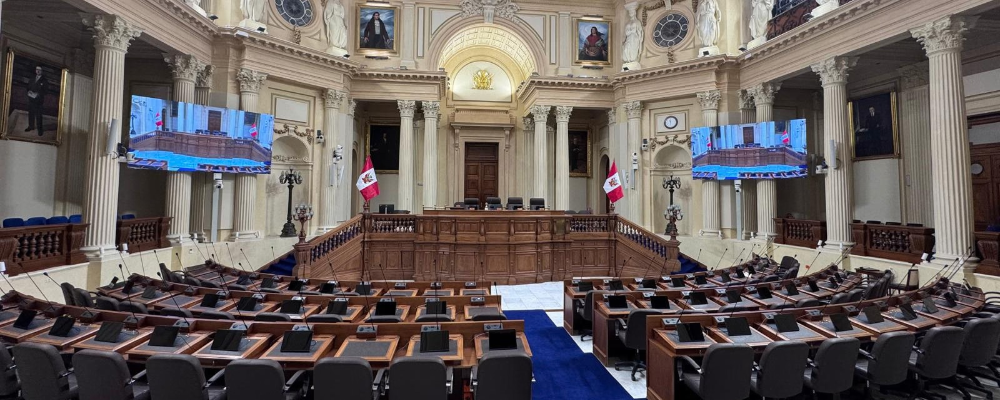
In a legislative chamber, hearing clearly is not simply a matter of sound quality. Every speech, debate, and communication is part of the institution’s activity and needs to reach both those occupying the space and the different systems involved in its recording and distribution with full intelligibility.
That was one of the starting points for the technological renovation of the Legislative Palace in Lima, a project developed in response to Peru’s return to a bicameral system and the resulting need to adapt its infrastructure to a new configuration of Congress.
The scope was extensive. Audio, video, conference systems, simultaneous recording, and metadata management formed part of a comprehensive design that had to meet the needs of both chambers as well as other areas of the Palace.
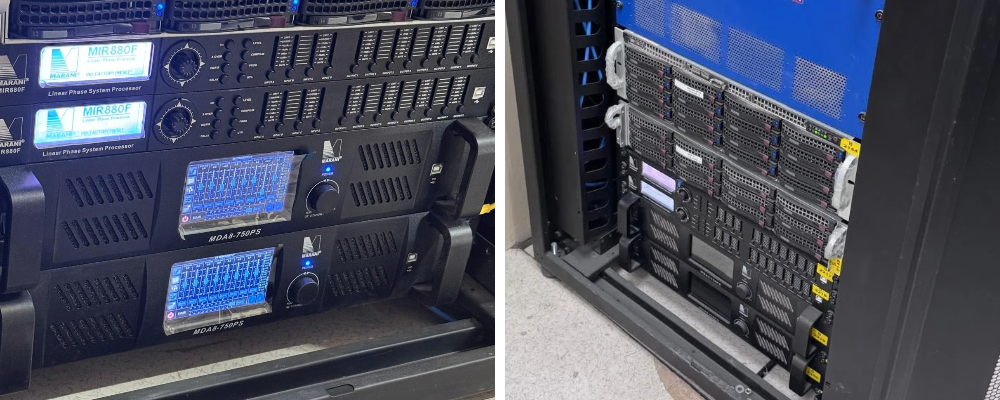
Within this infrastructure, MARANI was selected to handle processing and amplification. The solution incorporated five MIR880F processors, eight MDA8-750PS amplifiers, and one MDA2-2.4KEM, with SPLTEK acting as the brand’s distributor in Peru and responsible for local supply and support.
Behind the decision was Rafael Dextre, who was already closely familiar with the building’s infrastructure: he had previously participated in the installation of the conference system operating in Congress and was once again called upon to work on the design for this new institutional phase.
A Palace preparing for a new configuration
The return to a bicameral system considerably changed the venue’s technological requirements.
The new project had to accommodate both chambers while also bringing different systems together within a common infrastructure. The work included video, audio, conference, and recording system design, as well as metadata management. Media 5, from Argentina, also participated in this latter area as part of an integration that brought together technologies from different manufacturers.
The technology selection was also shaped by a condition that Rafael considers particularly important when working with a public institution: finding the right balance between performance, reliability, and budget.
“We can’t do things that are extremely expensive. It has to be done with the best cost-benefit ratio, without going to extremes, because these are also public funds and we have to be responsible with them,” he explains.
The complete system brought together solutions from different brands to address each area. When it came time to define processing and amplification, the evaluation focused on a series of specific requirements: processing capacity, Dante integration, redundancy, and operational capabilities within an infrastructure distributed across different areas of the Palace.
That was where MARANI entered the project.
Processing for an acoustically demanding architecture
One of the main challenges lay in the venue itself.
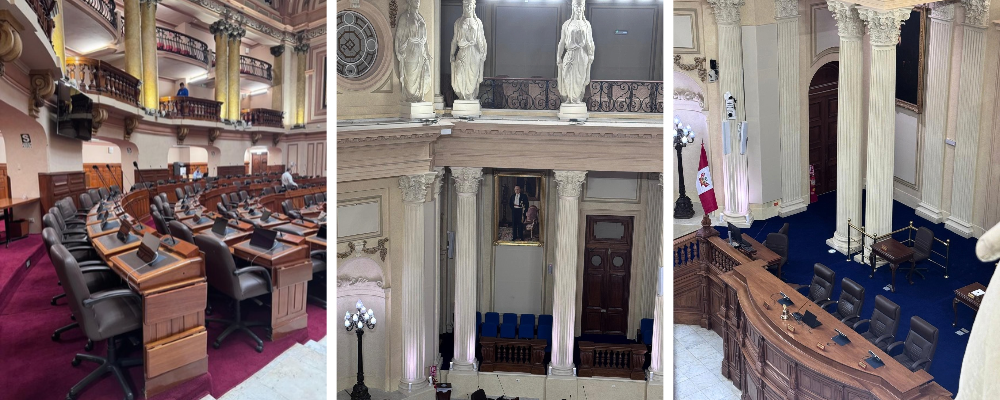
The acoustics required physical intervention through the installation of panels in different areas of the Palace. But architectural treatment was only part of the solution. The system also needed sufficient processing capacity to ensure that speech reached the different listening points correctly.
“You can have the best technology, but there still has to be at least some treatment. We needed enough processing power to ensure that the message reached every area correctly,” Rafael explains.
Five MIR880F units were incorporated for this purpose, serving as processors for the calibration of the audio systems in the chambers.
The MIR880F is an eight-input, eight-output system processor that supports analog, AES/EBU, and Dante signals, with redundancy and backup capabilities. MARANI specifically targets it at applications with demanding processing requirements, including government projects, theaters, and broadcast. Its architecture provides processing from input to output, with equalization, delays, dynamics, and FIR filters, among other tools.
At the Legislative Palace, that capability had to serve a specific objective: intelligibility and control in acoustically complex spaces.
But there was another requirement. Once the project had been handed over, Congress’ technical staff needed tools that would allow them to make subsequent adjustments without having to rely permanently on the integrator.
Rafael therefore highlights the importance of combining processing power with a platform that could continue to be operated and modified by the users responsible for the infrastructure.
Dante, redundancy, and a distributed infrastructure
The project did not end inside the chambers.
The system had to feed different areas of the Palace, including zones associated with emergency calls, making connectivity and signal distribution another determining factor.
“We needed it to have a high level of processing and Dante so that it could connect to all the different areas within the Palace,” Rafael says.
The Dante connectivity available on the MARANI platform allowed it to be integrated into this networked audio architecture. In the case of the MIR880F, the processor’s design also includes redundancy and automatic source switching, features intended for systems where signal continuity is particularly important.
Redundancy had been one of the capabilities considered during the evaluation of alternatives.
“When we looked at the amplification side, we had no doubts. We said MARANI. We had seen that it offers solutions where we can establish redundancy, they work with Dante, and we needed to feed both the system inside each chamber and outside, throughout the Palace,” he recalls.
The technical capabilities were complemented by an economic analysis. Rafael explains that alternatives from other manufacturers were evaluated and that the relationship between performance and budget ultimately tipped the decision toward MARANI, with a joint commercial effort by the brand and SPLTEK to adapt the proposal to the project’s conditions.
Amplification and processing within the same architecture
Amplification was handled primarily by eight MDA8-750PS units.
Each unit provides eight channels capable of delivering up to 750 W per channel at 4 ohms and can work directly with 70/100 V constant-voltage lines without internal transformers. The latter was particularly relevant at the Legislative Palace, as Rafael specifically notes that one of the project requirements was to operate at 100 V.
The MDA8-750PS units also incorporate 96 kHz/24-bit DSP processing, parametric equalization, delays, dynamics, and FIR and IIR filters. Dante is available as an option, and the units can be managed over a network, allowing amplification, processing, and control functions to be combined within the same platform.
This distributed processing capability complemented the work carried out by the MIR880F units and provided a second layer of control within the system.
The solution also incorporated one MDA2-2.4KEM amplifier, intended, according to Rafael, for the mobile wings.
The model belongs to MARANI’s MDA-KEM family, developed for fixed installations, and offers two channels and 2,400 W of total power. The series incorporates DSP processing, Dante and analog inputs, routing, FIR filters of up to 512 taps, MARANI’s MIR filtering technology, and direct operation with 70/100 V systems.
The result is an architecture in which processing and amplification do not operate as completely independent blocks, but rather as different layers within the same audio management infrastructure.
Five days to install and calibrate each chamber
If the technical complexity posed one challenge, the schedule added another.
The team had five days in each chamber to complete the audio installation and calibration.
Some of the cabling could be prepared in advance, but the time available to work on the completed system remained extremely limited.
“The project was stressful. For the audio installation and calibration, they basically gave us five days in each chamber. We managed it because they allowed us to do some of the cabling and other work beforehand, but the timeframe was very short for what actually had to be done,” Rafael acknowledges.
In that context, having processing tools that the team already knew, together with direct technical support, became particularly important.
SPLTEK supported this stage from Peru. The company has Alfredo Cáceres Gómez, “Alfrediño,” as the main person responsible for MARANI support, while Rafael also provides technical assistance when necessary. This local structure is complemented by direct communication with Michele at MARANI, avoiding intermediaries whenever a specific technical question arises.
For Rafael, that direct relationship between the people working technically with the systems is an important part of the support.
“Michele has a policy that technical people in general should speak directly with him. I completely agree because I’m also a technician; there’s nothing better than avoiding a broken telephone effect in communication between technical teams.”
The combination of advance preparation, processing tools, and support made it possible to complete commissioning within the established timeframe, although Rafael notes that they continued making some adjustments afterward to refine certain aspects of the system.
An immediate institutional test
Once operational, the system had little time for informal testing.
It was quickly put to use in a high-profile institutional setting. And the first feedback, according to Rafael, was positive.
The organization received congratulations from the Office of the Clerk and the area responsible for parliamentary recordings, while those participating in the activities noted that the system sounded clear and worked correctly.
“All the comments were positive. We received congratulations from the Office of the Clerk and from the management of Parliamentary Recordings, which is responsible for part of this. Everything went very well; there were no major problems,” he says.
Beyond that initial response, the result takes on another dimension when the purpose of the system is considered.
In a legislative space, technology needs to remain in the background while speech takes center stage. Processing, amplification, networking, and calibration only truly fulfill their purpose when those participating in a session can focus on listening and being heard.
SPLTEK and the development of MARANI in Peru
The Legislative Palace also represents an important milestone in the relatively recent relationship between SPLTEK and MARANI.
Founded in 2022, SPLTEK initially focused on supplying professional audio equipment, particularly processing and amplification solutions, while also offering direct sales, after-sales service, and project design.
The relationship with MARANI began following a meeting at NAMM. Rafael was already familiar with the brand through references from other professionals and its presence in nearby markets, particularly Bolivia. The challenge he identified in Peru was not so much awareness of the product, but rather the lack of solid local support.
That was one of the opportunities SPLTEK sought to address by taking on the distribution.
“What made the end user hesitant was: ‘Who is going to support this equipment here?’ Once that was resolved, sales increased,” Rafael explains.
The strategy goes beyond selling equipment. SPLTEK conducts demonstrations directly on customers’ systems, maintains agreements with training institutions such as CTAudio, and organizes regular training sessions in its showroom. Every product sold also includes an initial training session so users can understand and make full use of its tools.
For Rafael, the Legislative Palace also confirmed an area that SPLTEK had explored to a lesser extent until now.
The company had initially associated MARANI primarily with professional audio and live applications. Following this installation, it sees growing opportunities in fixed installations, particularly in projects where acoustic conditions demand greater processing capabilities: corporate buildings, commercial spaces, restaurants, and other distributed infrastructures.
When technology makes way for the spoken word
Five MIR880F processors, eight MDA8-750PS amplifiers, and one MDA2-2.4KEM make up MARANI’s presence within a much larger infrastructure integrating multiple systems and manufacturers.
But the numbers tell only part of the story.
The real challenge was to ensure that a complex technological architecture —two chambers, different spaces, networked audio, conference systems, recording, and distribution— ultimately produced something much simpler for those who use the Palace every day: allowing a voice to travel through the venue and reach its destination clearly.
In a place built around the spoken word, that is probably also the best indication that the technology is doing its job. Strengthen the opening with the project stakes.
Credits
Cover Photo: SPLTEK
Inside Photos: SPLTEK
The journalistic production, research, writing, editorial approach, and editing of this content are original works by LATAM STAGE and are protected by copyright.
No part of this content may be reproduced, copied, distributed, adapted, or published, in whole or in part, in any medium or format, without the prior written authorization of LATAM STAGE.


