
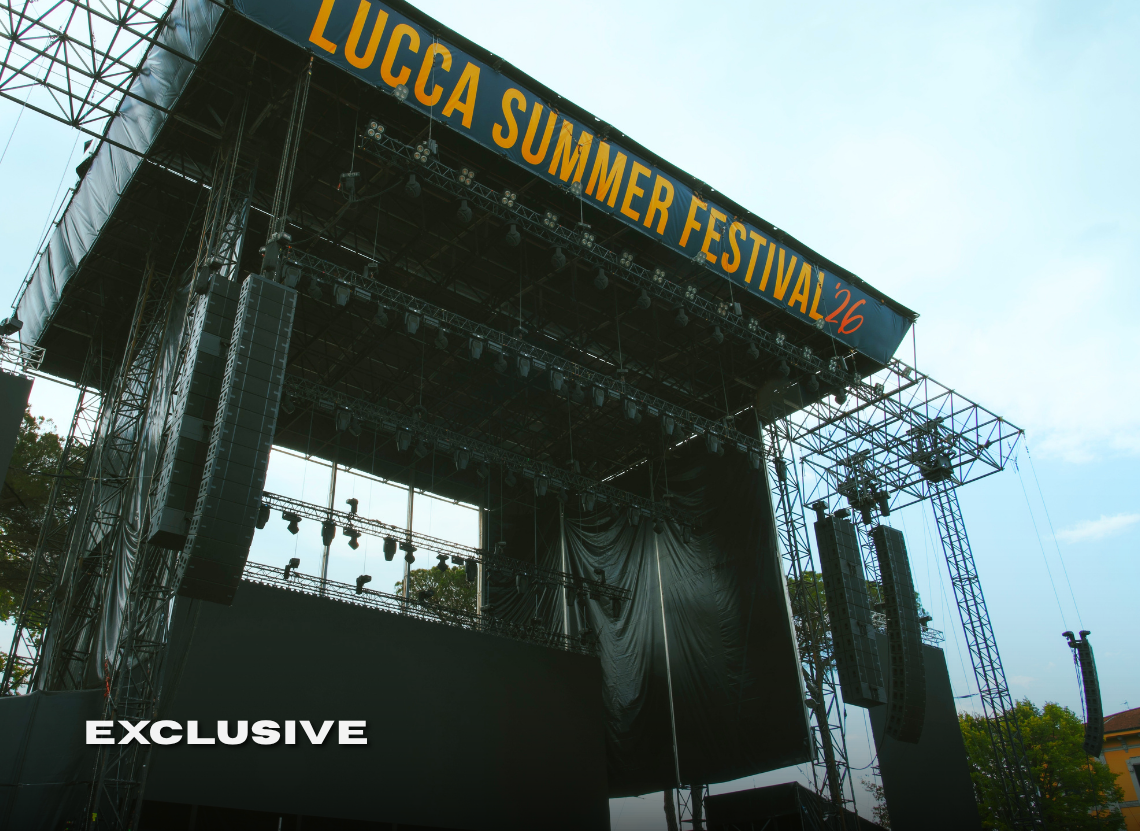
LATAM STAGE was in Lucca to take a closer look at a production that brought dBTechnologies’ VIO system to one of Europe’s most distinctive venues: the city’s historic walls.
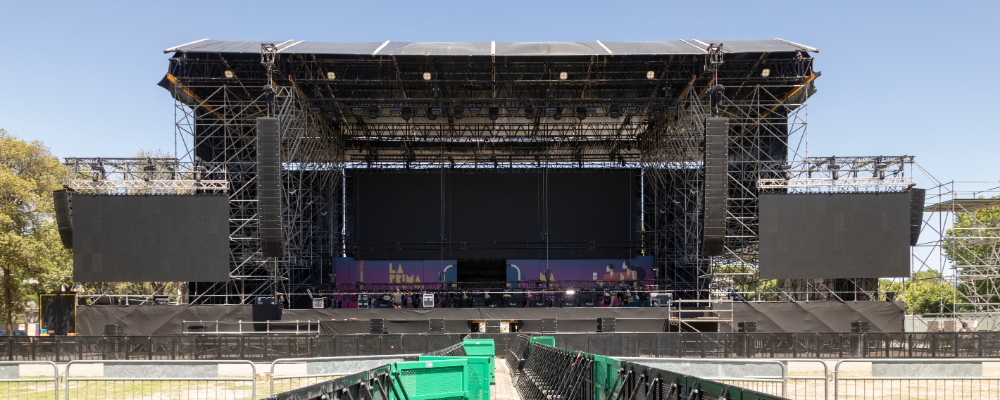
The first days of July revealed the Italy so often seen on postcards: cobblestone streets, historic buildings, small squares full of life, and the Renaissance walls surrounding the center of Lucca. The weather played its part. During our visit, the Tuscan summer brought pleasant temperatures, mostly clear skies, and evenings that invited you to walk through the city after a concert. But behind that almost perfect picture, a major technical operation was underway.
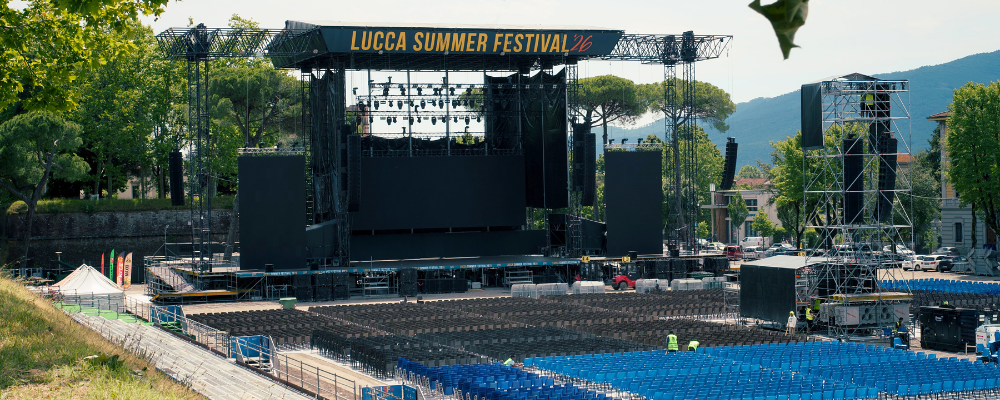
Lucca was hosting another edition of its Summer Festival, one of Italy’s most renowned music events. Since 1998, the festival has transformed different spaces throughout the city into stages for international artists and, in 2026, once again combined major names in music with a characteristic that sets it apart: the concerts take place within an architectural heritage site that requires every production to be approached in a particular way. The 2026 edition took place over approximately one month, with performances in Piazza Napoleone and the Mura Storiche area.
For LATAM STAGE, the visit also had a specific objective: to experience dBTechnologies’ deployment in one of the brand’s most important projects of the European season and understand how a large-scale sound system can adapt to a space that was not designed to host a contemporary show.
The walls as a stage
The Mura Storiche are much more than Lucca’s physical boundary. Originally built as a defensive system, today they are part of the city’s identity and have become a cultural space with exceptional characteristics.
For a concert, however, that beauty also presents a challenge. The area used for the festival extends lengthwise, with the stage positioned at one end. On one side, the historic wall runs alongside virtually the entire audience area; on the other, there is a more open environment with trees, streets, and buildings. There is therefore none of the symmetry commonly found at many large outdoor festivals.
Adding to this are eight SkyBoxes installed on the walls themselves for VIP guests. The combination of an extensive audience area, different listening zones, monumental architecture, and an open environment requires much more than power: it demands control, coherence, and precise planning for every coverage area.
In 2026, the Mura Storiche hosted some of the festival’s most notable concerts. Among them was Jamiroquai, who performed on July 4 in what was his only Italian date of the season, as well as Zucchero and Katy Perry, who later took over the same stage.
VIO: Power, control, and consistency
The technical response was based entirely on dBTechnologies’ VIO platform, with acoustic design by the company itself and deployment carried out by Tema Show Service.
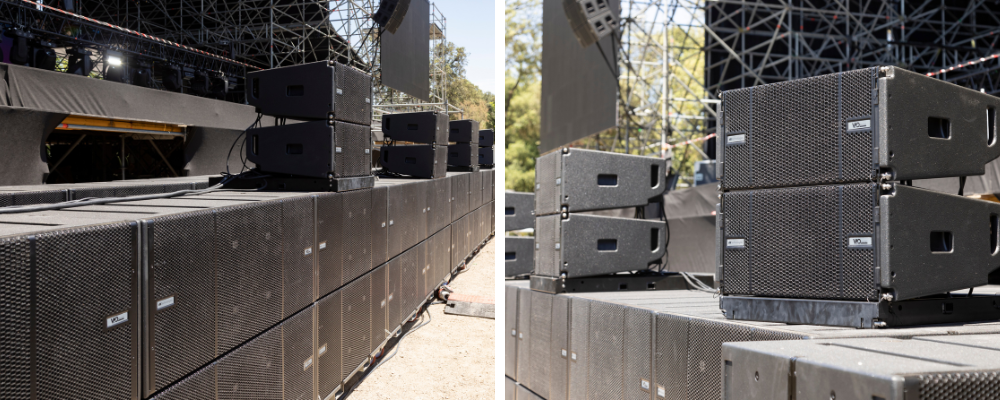
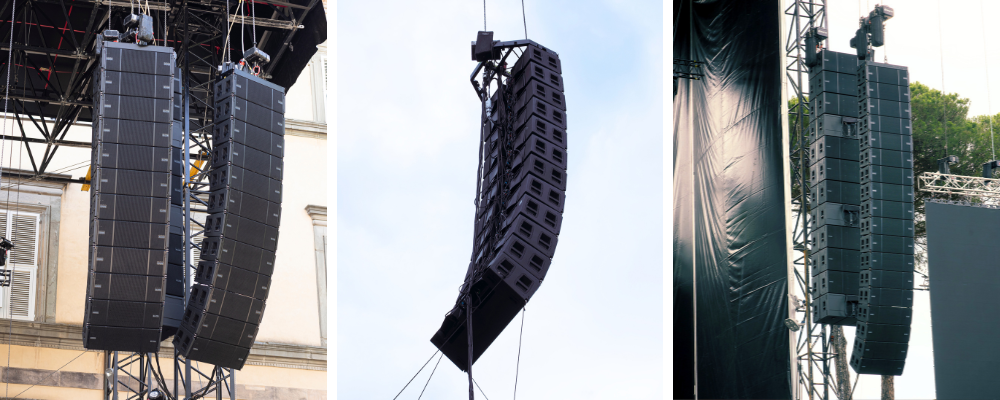
The configuration included 84 VIO L212 units, 48 VIO S218F, 20 VIO L1610, 8 VIO X310, and 8 VIO S118R.
The main system used VIO L212 as the central element of the coverage, distributed in two arrays of 18 modules per side. Additional modules were used to extend lateral coverage, allowing the system’s behavior to be adapted to the asymmetric characteristics of the space.
For low frequencies, 48 VIO S218F provided the support needed for productions that could move from the groove and funk of Jamiroquai to the energy of a large-scale pop production. Some of these subwoofers were flown, while another section was positioned on the ground to reinforce and distribute low-frequency content across the front area.
Coverage close to the stage was handled by VIO L1610, while the delay system carried sound to the rear areas of the venue, maintaining the definition and timing relationship needed to ensure that the experience did not depend on where the spectator was located.
The most complex part: Making everything sound like a single system
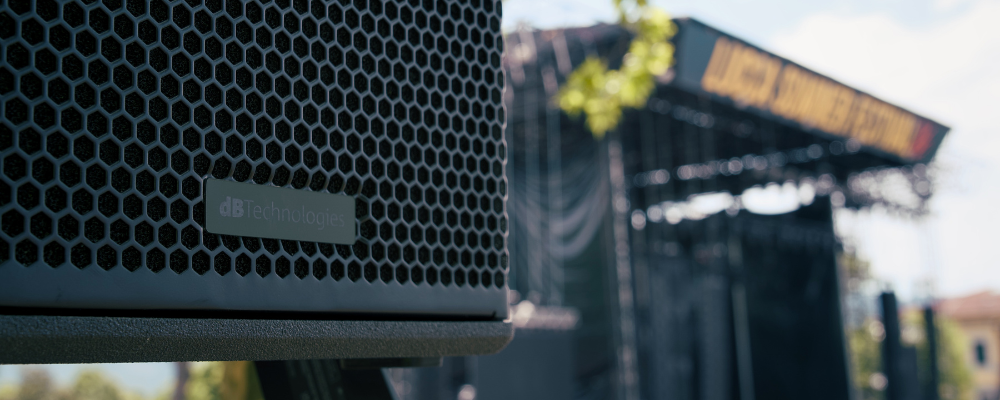
In a production of this scale, positioning loudspeakers is not enough. The real challenge lies in ensuring that different systems, located at different distances and aimed toward different areas, are perceived as a single sonic experience.
This is where one of the most interesting aspects of the work carried out by dBTechnologies comes into play. The company provided specific acoustic consulting for the characteristics of the Mura Storiche, while the design and commissioning were handled by Tema Show Service’s technical team.
The use of the control and monitoring platform made it possible to work with different coverage zones, establish specific EQ, delay, and profiles, and make adjustments throughout the system-building process.
In a space like this, time alignment becomes critically important. Spectators close to the stage, those in the central area, those farther away, and guests located in the SkyBoxes cannot receive exactly the same signal at the same time. The system must compensate for those differences so that the final result maintains clarity, impact, and consistency.
The SkyBoxes: A festival within the festival
Perhaps one of the elements that best illustrates the complexity of the project is the eight SkyBoxes located on the wall.
From there, approximately 600 guests can enjoy a privileged view of the stage. But that location also means they are farther away from the main system and in an acoustically different position from the rest of the audience.
For these areas, VIO X310 units were used together with VIO S118R subwoofers, configured as independent systems.
The objective was not simply to “bring sound” to the VIP areas. The intention was for those spectators to receive a sonic experience consistent with that of the rest of the festival, maintaining tonal response, definition, and a sense of immersion.
It is a good example of how a modern production must think about audio beyond the main PA.

An experience that goes beyond the concert
The Lucca Summer Festival also represents something more for dBTechnologies. As Eduardo Quintero, Sales Manager for Latin America at dBTechnologies, explained, the festival has become a particularly important event within the company’s calendar. The scale of the deployment makes it possible to demonstrate the performance of the VIO platform under real-world conditions while also bringing professionals from different markets closer to a large-scale international production.
For this reason, representatives from rental companies, businesses connected to the corporate and broadcast markets, and distributors from different Latin American countries also traveled to Italy during these days, including Argentina, Brazil, Chile, and Mexico.
The experience did not end at the Lucca Summer Festival. The concert visit was accompanied by a tour of the dBTechnologies factory in Crespellano, in the Bologna area, where visitors were able to learn about the manufacturing process of the VIO systems and see firsthand how the equipment that later becomes part of productions like this one is built.
In this way, the trip connected two worlds that are usually experienced separately: the manufacturing of the system and its use in a real production.
From the factory to the walls of Lucca
There is something particularly interesting about this kind of experience. It is one thing to know the technical characteristics of a product, read its specifications, or listen to a controlled demonstration. It is quite another to stand in front of a system deployed in a real space, with tens of thousands of spectators, international artists, different coverage areas, and the limitations imposed by a historic location.
In Lucca, the VIO platform had to address precisely that. It was not simply about reaching long distances. The system had to control energy, maintain intelligibility, integrate different reproduction points, and adapt to an irregular geometry without losing consistency.
And all of this had to happen without competing with the venue’s main protagonist: the walls of Lucca. When night falls and the stage lights begin to illuminate the ancient structures, the technology visually disappears. The audience hears the music, feels the impact, and experiences the show. But behind that apparent simplicity lies an enormous number of technical decisions.
That is precisely what makes the Lucca Summer Festival interesting from LATAM STAGE’s perspective.
Not only because of the artists who take its stage, but because of the way a contemporary production manages to integrate into a space that belongs to another era.
In Lucca, history is not the backdrop. It is part of the challenge. And in 2026, sound had to find a way to coexist with it.
Credits
Cover Photo: DBTECHNOLOGIES
Inside Photos: DBTECHNOLOGIES
The journalistic production, research, writing, editorial approach, and editing of this content are original works by LATAM STAGE and are protected by copyright.
No part of this content may be reproduced, copied, distributed, adapted, or published, in whole or in part, in any medium or format, without the prior written authorization of LATAM STAGE.


