

Argentina – The technological renovation at Universidad Austral in Argentina focused on simplifying operation and making the in-person and remote experience increasingly natural. Together with ABC1 Technology, responsible for the integration, and TEVELAM, Shure’s distributor in Argentina and supplier of the equipment, the institution developed an audio and microphone infrastructure based on Shure solutions for the Olivo Auditorium and different classrooms, within a project that will continue expanding into new spaces.
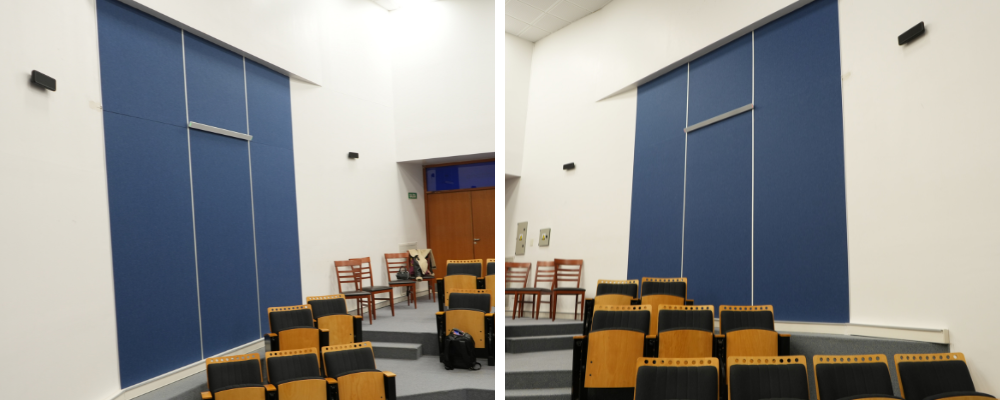
Entering an auditorium, starting a presentation, and not having to think about cables, technical movements, or configurations may seem simple from the user’s perspective. Behind that natural experience, however, there is an infrastructure that must handle much of the operation without becoming the protagonist. This was one of the principles behind the technological renovation of different spaces at Universidad Austral.
In the Olivo Auditorium, located in the institution’s main building, that transformation changed a dynamic that until then could require the involvement of external providers, installation and removal of equipment, and greater technical intervention depending on the event.
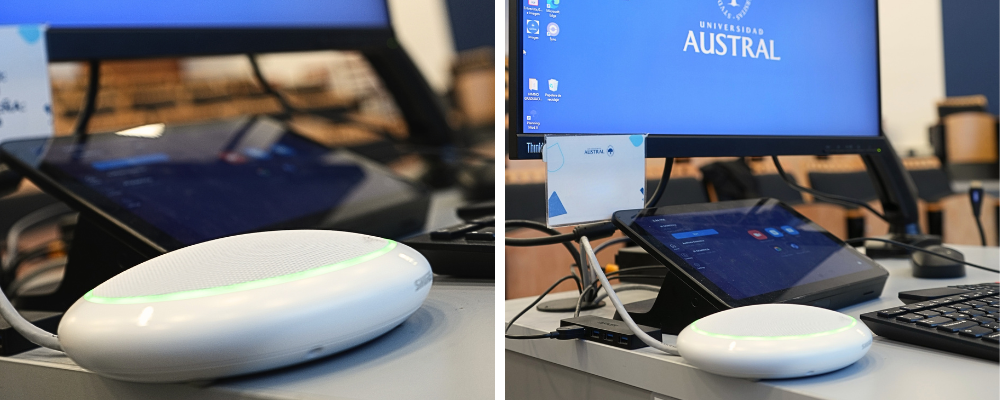
For Víctor Rojas, audiovisual services coordinator at Universidad Austral, the change was quickly noticeable among those who began using the new environment: “The first thing I notice with this new setup is the user. The user’s happiness: happy, zero cabling, zero people moving around everywhere, and being able to work without so much intervention from technology, meaning that it doesn’t invade the experience.”
Behind that experience is a project developed together with ABC1 Technology, an integrator that has worked with Universidad Austral for almost two decades, with TEVELAM, Shure’s distributor in Argentina, as the supplier of the brand’s solutions. The implemented infrastructure combines capture, processing, networked audio, and reproduction.
From equipped spaces to hybrid spaces
The renovation did not begin exclusively in the Olivo Auditorium. It was part of a broader approach by Universidad Austral to reformulate different environments and move toward spaces capable of naturally responding to new forms of teaching, presentation, and collaboration.
Alejandro Sánchez, CEO of ABC1 Technology in Argentina, has been working in the industry for more than 25 years and is closely familiar with that evolution. His company has maintained a relationship of approximately 20 years with the University, developing technological solutions for both classrooms and public spaces.
“The project began with a requirement from the University to reformulate all the spaces, especially to create spaces that were hybrid. And for those hybrid spaces to become so natural that they were practically in-person for those who were participating remotely,” he explains.
Remote participation had to be integrated into everyday activities without requiring teachers and users to substantially change the way they worked.
To achieve this, ABC1 moved toward a digital architecture that made it possible to gradually leave behind part of the analog infrastructure previously used and connect different systems within the same environment. That transition also laid the groundwork for expanding the project and incorporating new solutions as the renovation reaches other areas of the University.
“In the case of everything related to sound and microphones, Shure covered all the needs we had and also had the ability to integrate with all the video systems,” Sánchez says.
When technology stops being intrusive
The transformation can be better understood through everyday use.
For the University’s audiovisual team, reducing temporary installations means shortening operating times and reducing movement around each activity. For those using the space, the result translates into something even simpler: entering and focusing on what they have to do.
Rojas identifies precisely this as one of the main changes. Previously, certain needs could involve installing, removing, and organizing an infrastructure around the providers and technology required for each event. The permanent implementation makes it possible to reduce those times and establish a different dynamic between the space, the technical team, and its users.
Rojas introduces an idea that runs through much of the project: being able to work “without so much intervention from technology.”
“What we are looking for at the University, as I believe Shure is as well, is the user experience,” he adds.
A Shure ecosystem behind the experience
With TEVELAM as the supplier of Shure equipment and ABC1 Technology responsible for the integration, the infrastructure combines different solutions from the brand designed to handle capture, processing, connectivity, and reproduction within the renovated spaces.
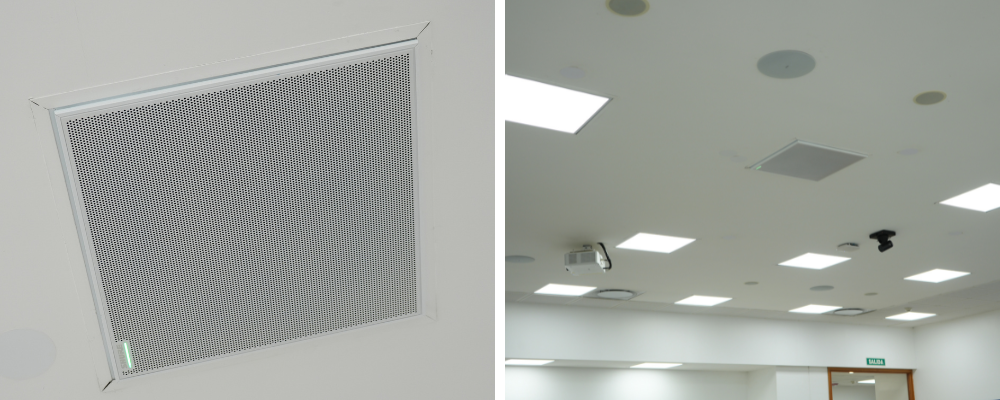
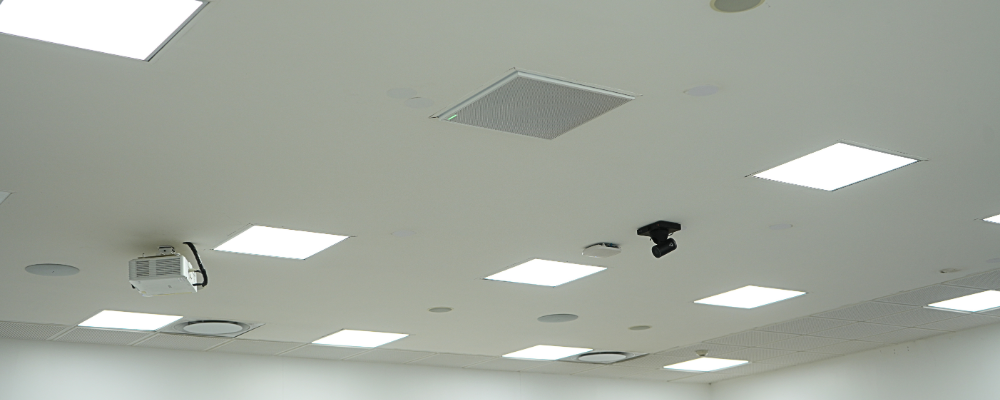
The project incorporates one Microflex Advance MXA920W-S-60CM ceiling array microphone and two two-foot Microflex Advance MXA710AL linear array microphones. The combination provides capture solutions adapted to the characteristics and requirements of the different environments.
Processing is handled by an IntelliMix P300-IMX, while two ANI4IN and two ANI4OUT interfaces make it possible to incorporate inputs and outputs into the networked audio infrastructure.
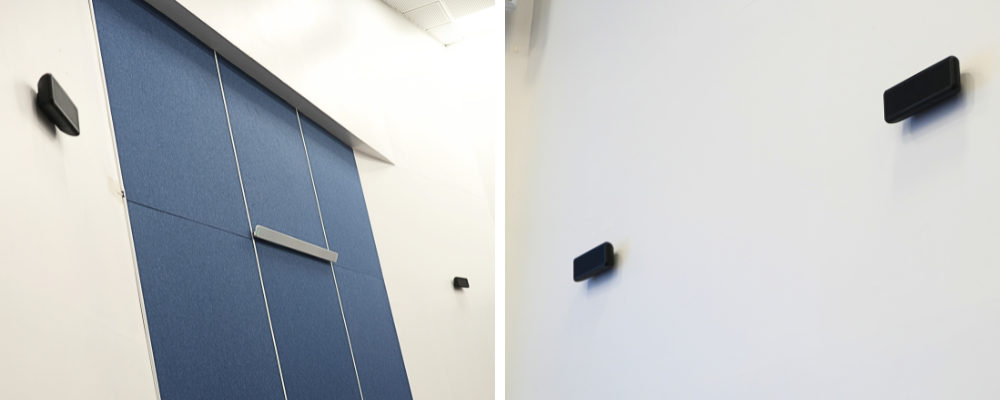
Reproduction is completed with six MXP-3 loudspeakers and one Microflex MXN5W-C networked ceiling loudspeaker.
In total, the installation includes six MXP-3, two ANI4IN, two ANI4OUT, one MXA920W-S-60CM, one MXN5W-C, one P300-IMX, and two MXA710AL-2FT units.
Rather than functioning as isolated components, these solutions are part of the digital architecture designed by ABC1 so that audio, microphones, and video can coexist within the same technological environment.
That integration capability was one of the reasons Shure found a place within the project. Alejandro recalls that the initial expectations were focused on addressing the needs presented by the University, but the experience following implementation ultimately exceeded what had been anticipated.
“The solutions they initially provided us were the right ones, but when we developed them, they turned out to be better than what we needed.”
Designing for those in the room and those who are not
The hybrid condition changes the way a classroom or auditorium is conceived. A conversation that works naturally among people sitting in the same space can lose that quality for someone participating remotely if capture, processing, or audiovisual integration introduces barriers.
From the beginning, Universidad Austral sought to reduce that difference. Alejandro describes it as the intention to make hybrid spaces feel practically in-person for those connected remotely. Technology therefore had to support two simultaneous experiences.
The solutions were tested by different members of the University before and during their implementation, including technical staff and faculty. Once activities began, feedback started to come precisely from actual use.
The response ABC1 received once again focused on what users no longer had to do: “Each person would use the classroom or the space and tell us how good it was and how naturally they could work without having to perform any additional activity beyond the class itself.”
That experience summarizes one of the project’s most relevant results: incorporating new capabilities did not mean adding complexity to the work of those teaching, presenting, or participating in an activity.
For Víctor Rojas, the new infrastructure changed the dynamics of use both in the auditorium and in the classrooms, reducing the technical intervention required for each activity. Shure solutions undoubtedly support that logic.
Shure looks at the project through the problem it solves
The installation also received a visit from Arthur Fabricio, Market Development Manager for Shure in Latin America, during a company tour through Argentina.
His visit to the Pilar campus provided an opportunity to observe the solutions already implemented and, above all, to understand how they were performing once incorporated into the University’s everyday activities.
“For Shure, it is very important to stay in contact with our customers to understand where they are applying our solutions and, above all, to know what problems they are solving.”
In this context, he particularly highlights the versatility of Shure solutions and the possibility of combining them according to the characteristics of each environment. “In complex spaces, solutions often complement one another, and that is the case here at Universidad Austral,” he says.
The current implementation does not represent the end point either. Alejandro Sánchez explains: “The initial project, the development of both the auditorium and the classrooms, is one part of the final project, which is to reach the new spaces that are being built and all the spaces within the University, both with sound and microphones.”
The decision to leave behind the analog infrastructure and develop a digital architecture becomes especially relevant from that perspective.
Universidad Austral’s technological evolution will continue into new environments, but the benchmark for measuring it has already been established in the first spaces: that teachers, students, and users can focus on what is happening inside the room while the infrastructure works behind the scenes.
At that point, more advanced technology ultimately achieves something apparently contradictory: becoming increasingly less present for those who use it.
Credits
Cover Photo: LATAM STAGE
Inside Photos: LATAM STAGE
The journalistic production, research, writing, editorial approach, and editing of this content are original works by LATAM STAGE and are protected by copyright.
No part of this content may be reproduced, copied, distributed, adapted, or published, in whole or in part, in any medium or format, without the prior written authorization of LATAM STAGE.


