
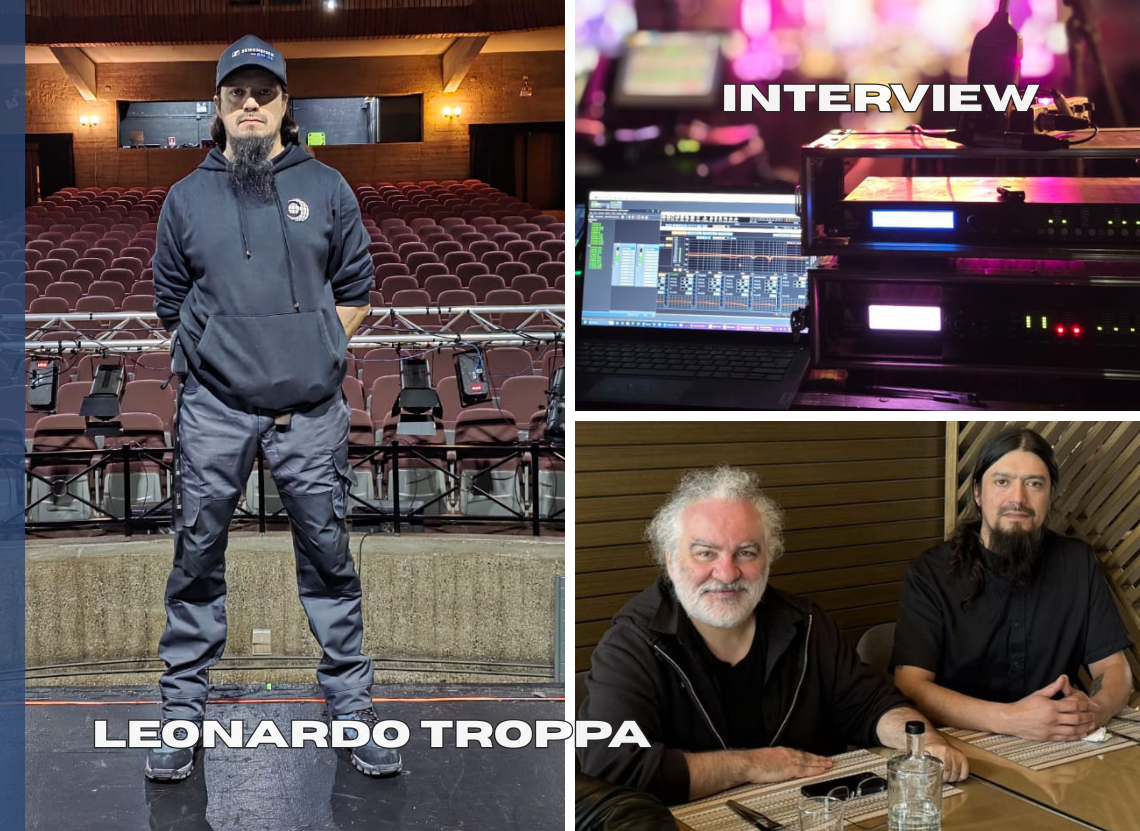
For nearly two decades, Leonardo Troppa has worked on stages, installations, and sound systems of every kind. But behind that experience lies a constant concern: understanding how sound truly behaves. That pursuit has led him from sound reinforcement into measurement, software development, digital signal processing, and a close relationship with Michele Marani, founder of MARANI, whose tools have become part of his ongoing exploration of dynamics, perception, and acoustic control.
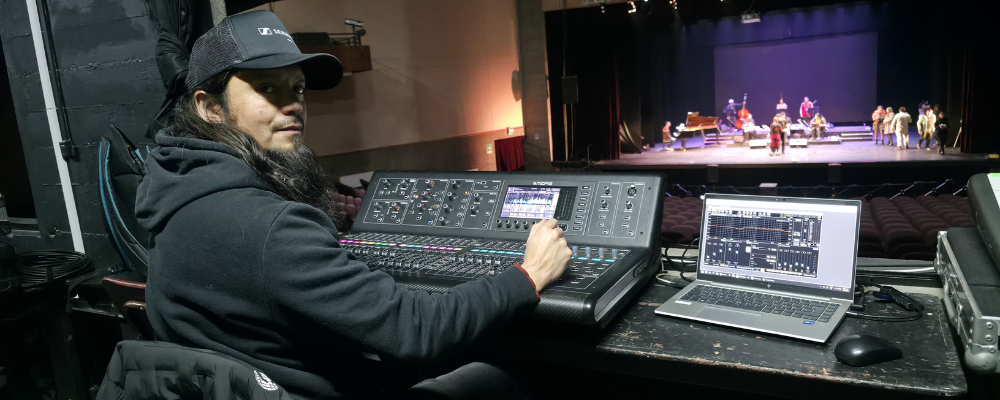
When Sound Stopped Being Just a Job
Some professionals find a specialty. Others find a question.
In Leonardo Troppa’s case, that question has accompanied him for almost twenty years: why does sound behave the way it does?
His journey began like that of many audio technicians. Load-ins, truck unloading, cable runs, endless workdays, and the responsibility of making systems work under any condition. Over time came larger stages, system tuning, tours, and the experience gained from hundreds of events. But while many professionals focused on operating tools, Troppa became interested in understanding what was happening behind them.
His fascination became especially focused on an area that still excites him today: low frequencies.
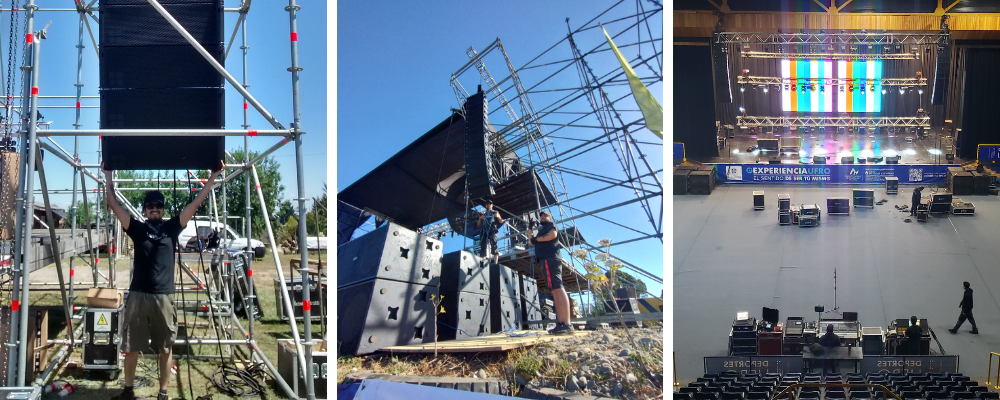
“My strength is sound reinforcement and subwoofer arrays. I’m a little obsessed with that subject,” he admits with a laugh. “I’ve tried to turn it into a method.”
What began as technical curiosity eventually became a personal line of research. For years, he studied array configurations, source interaction phenomena, and acoustic behavior patterns, trying to understand how a system’s energy is truly built.
“I’m very intrigued by how low frequencies sum and the impact they have on a system.”
His education also coincided with one of the most significant technological shifts in professional audio. As part of the first generation of sound engineers at the University of Santo Tomás in Temuco, he had the opportunity to develop professionally just as the industry was beginning its transition from analog to digital.
“I arrived in this field a couple of years before that transition. For me, it was natural to live through that change.”
However, far from focusing solely on technology, the field itself ended up teaching him a much more important lesson.
“Field work gives you humility. You have to make decisions under pressure, and in the end, what always prevails is the acoustics or the audience present in the room.”
Perhaps that is why he has never felt comfortable with extreme positions. Neither with those who rely solely on their ears nor with those who blindly trust a screen.
When he discovered measurement tools, he realized they could help answer many of the questions he had been asking since the beginning of his career.
“If a tool helps me better understand the sound phenomenon, then it’s welcome.”
But he also quickly understood their limitations.
“The microphone doesn’t have a brain. What we see is a snapshot of a specific moment and a specific point. What matters is how you interpret that image so that the message reaches as many people as possible.”
Because for Troppa, professional audio is never only about sound pressure, coverage, or frequency response. It is about communication. About making sure a voice, a song, or an emotion reaches those on the other side as clearly as possible.
“In the end, our job is to help communication happen. Everything else is just a tool to achieve that.” That philosophy also explains some of the most interesting phrases that emerge during the conversation.
“It’s like having a superpower,” he says when talking about subwoofer arrays.
And then he adds another equally vivid image:
“It’s like kneading the sound so you can deliver it to as many people as possible.” Behind both metaphors lies the same idea: sound is not static. “A sound system is alive.”
That is why he insists that tuning a system is not simply about correcting a curve. When someone tunes a sound system, they are actually trying to understand the geometry of that system.
For him, the sound phenomenon always depends on something much more complex than measurement: perception.
When Understanding Is Not Enough and the Need to Create Appears
Curiosity eventually led him to an unexpected place: programming.
After years of analyzing systems and trying to understand how they work, a new question emerged: what happens if, instead of using tools, he starts developing them?
Today, he works with Agatha Research, a Chilean company dedicated to software development, acoustic prediction, and audio processing solutions for manufacturers and industry professionals.
“I’m getting deeper and deeper into the world of programming.” What is interesting is that this is not a change of direction. It is the natural continuation of the same pursuit.
“I’ve always been interested in programming. And with the arrival of artificial intelligence, an enormous opportunity emerged to develop tools that were previously much more difficult to implement.”
Today, he participates in the development of applications capable of importing measurements, analyzing them, and generating filters that can later be implemented in audio processors. He also works on platforms aimed at manufacturers and tools designed to simplify complex processes for users at different levels.
“We’re trying to standardize platforms, connect applications, and create tools that can integrate with one another.”
That vision comes from years of observing how audio professionals coexist with multiple software platforms, different file formats, and workflows that often do not communicate with each other.
For Troppa, the future lies precisely in reducing that fragmentation. Building ecosystems where simulation, measurement, analysis, and processing can coexist within the same workflow.
In a way, the path he is following today as a developer is a direct extension of everything he learned working with real systems. The questions remain exactly the same. Only the tools he uses to answer them have changed.
“I’m almost obsessed with the DSP world.”
Then comes a phrase that perfectly summarizes his current professional stage. “I love the idea of being able to put an idea inside a chip.”
Because after years of tuning physical systems, he is now trying to transform experience into algorithms. “I’m interested in understanding machines so I can develop tools that provide real solutions. Tools that allow us to do our jobs better or even do them differently.”
MARANI as an Extension of That Pursuit
It was precisely along that path of research that an encounter occurred which would mark a new stage in his career.
The meeting with Michele Marani.
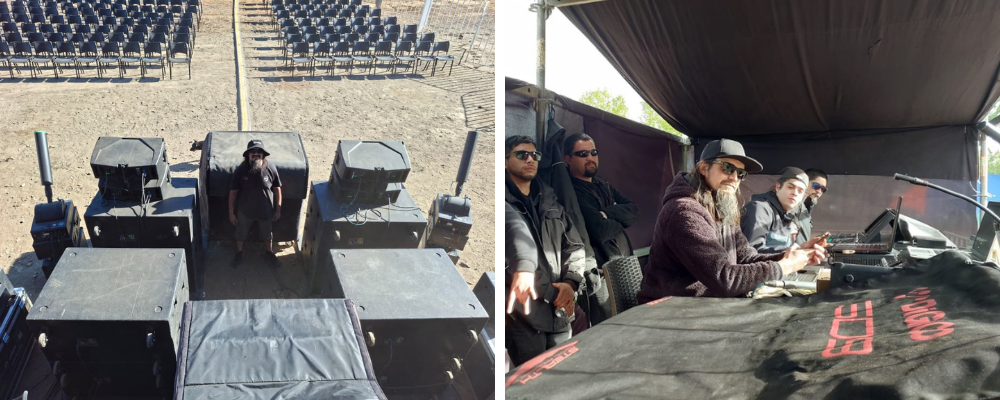
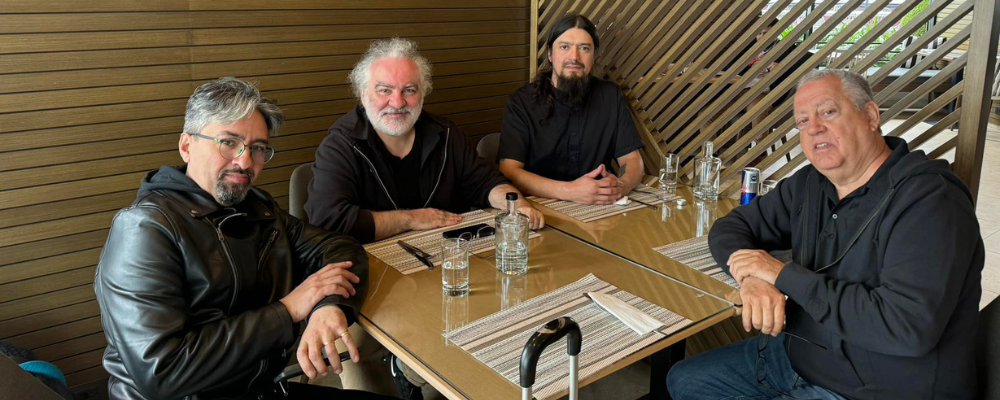
The story began almost by chance during a trip to Lima with Sebastián Rivas from Agatha Research. What initially seemed like a simple technical meeting turned into an entire day of conversations about algorithms, digital processing, dynamics, and audio tool design.
“It was quite fortuitous. But the impact was immediate. It led me to study in an almost obsessive way. Listening to him explain his machine and his algorithms made me dive much deeper into these subjects.”
However, what impressed him most was not only the technical knowledge. It was the way Michele works.
“One of the things that impressed me most is that Michele listens. He listens a lot. He analyzes feedback, field experiences, and constantly looks for ways to transform those observations into new features or new tools.”
Over time, those conversations evolved into an ongoing technical relationship. Today, Troppa participates in different projects related to the brand and also provides technical support to MARANI users in Chile.
“Yes, I provide support practically 24/7.”
That closeness has allowed him to gain in-depth knowledge of tools that are now part of his regular workflow. Among them, he especially highlights Dynamic EQ, Dynamic Loudness, and Profiler, which he directly describes as one of his secret weapons.
“All machines have equalizers, compressors, and limiters. What caught my attention was the way dynamics are handled.”
He also mentions the MIR880F as one of the most complete processors in the lineup thanks to its routing flexibility and the possibilities it offers for implementing advanced processing tools. According to him, the true value of these technologies appears when they allow specific system behaviors to be addressed without completely altering the system’s character.
“I’ve had very good experiences in highly reverberant rooms and in comedy shows. The improvement in intelligibility is considerable.”
But perhaps one of the aspects he values most is the ability to make advanced technologies accessible to a greater number of professionals.
“When more people have access to better tools, the entire industry grows.”
For someone who started unloading trucks, learning in the field, and building experience from the ground up, that technological democratization carries special meaning. It is not only about processors. It is about knowledge.
And when he imagines the future, his vision reconnects with everything he has been pursuing for years. “I would like to see simulation, measurement, and dynamic control fully integrated within the same platform.”
Not as a collection of isolated tools, but as an ecosystem capable of understanding the sound phenomenon in a comprehensive way. Curiously, that vision also summarizes his own evolution.
Because after twenty years among stages, systems, measurements, software, algorithms, and digital processing, Leonardo Troppa is still pursuing exactly the same question that has accompanied him since the beginning: understanding why sound behaves the way it does.
The difference is that today he no longer seeks the answers only in front of a PA system. He also looks for them inside lines of code, mathematical models, and DSP processors.
And for someone obsessed with understanding sound, that search seems far from over.
The journalistic production, research, writing, editorial approach, and editing of this content are original works of LATAM STAGE and are protected by copyright.
Its reproduction, copying, adaptation, or publication, in whole or in part, in any medium or format, without the prior written authorization of LATAM STAGE, is strictly prohibited.
PHOTO @ Leonardo Troppa


