
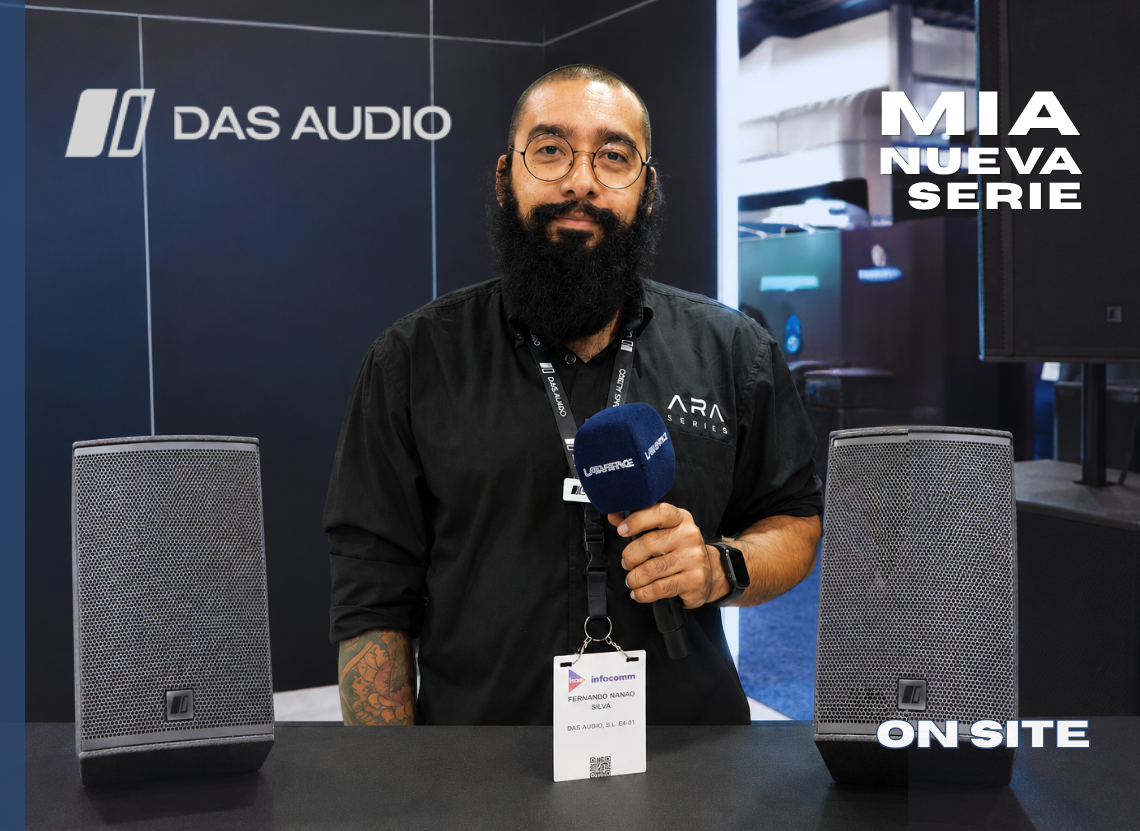
Combining coaxial systems, FIR processing, networked audio, and advanced control tools, DAS Audio expands its integration ecosystem with a platform designed to simplify the work of system integrators while delivering a consistent listening experience across installations of every scale.
The AV integration market continues to evolve at an increasingly rapid pace. Restaurants, hotels, theaters, corporate venues, houses of worship, and cultural centers are no longer looking only for high-quality sound systems; they require solutions capable of integrating seamlessly with the architecture of the space, simplifying day-to-day operation, and ensuring a consistent audio experience across installations of any size. With this vision, DAS Audio expands its offering for the integration market with the introduction of MIA Series, a new family of systems developed to operate natively alongside INTEGRAL-MA matrix amplifiers and the ALMA control ecosystem.
Fernando Nanao, Application Engineer at DAS Audio, introduced the new platform at InfoComm and explained the concept behind this new product family.
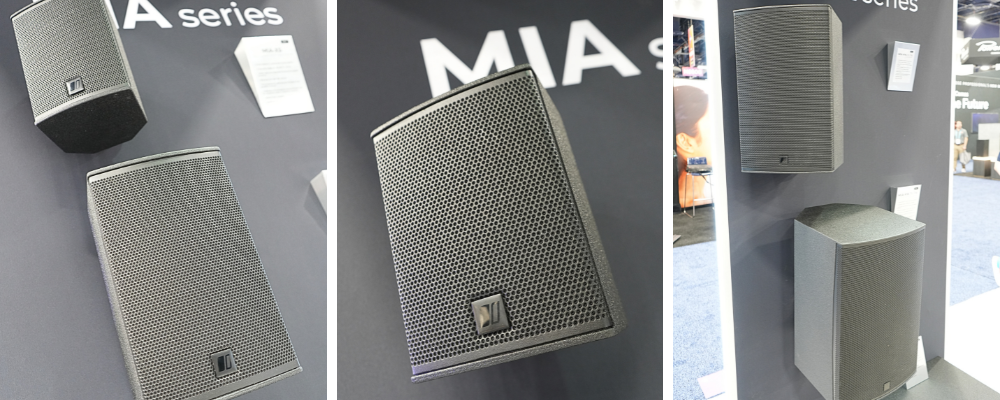
“MIA Series consists of seven models ranging from 5 to 12 inches. They are compact two-way coaxial systems with impressive sound performance,” he explained.
The family includes seven passive point-source systems designed to meet different coverage and sound pressure level requirements. The 5″, 6″, and 8″ models provide wide coverage for distributed applications, while the 10″ and 12″ versions feature rotatable waveguides specifically designed and optimized to adapt horizontal and vertical dispersion to the acoustic characteristics of each installation.
This variety enables applications ranging from small commercial spaces to more complex projects while maintaining consistent acoustic performance across the entire series.
The platform is complemented by two subwoofers specifically developed to match the performance of the new family.
“The series includes the MIA-S110 and the MIA-S115, two compact, high-performance subwoofers that complete the platform,” said Nanao.
Both models feature low-profile band-pass enclosures designed to facilitate architectural integration without compromising low-frequency extension. Their design allows both horizontal and vertical installation, while the MIA-S110 also includes dedicated wall-mount accessories, expanding installation possibilities in environments where aesthetics are just as important as acoustic performance.
Another feature that distinguishes the MIA Series is its adaptability to different architectural environments.
“The entire series is available in both black and white to better integrate into any environment,” commented Nanao.
This decision responds to a growing requirement in integration projects, where sound systems must blend with interior design rather than become visually intrusive elements.
The range of applications also reflects that versatility.
“MIA Series is designed for all kinds of fixed installations, including restaurants, theaters, churches, and hotels. It also performs perfectly for background music, electronic music, and a wide variety of entertainment environments,” explained Nanao.
An additional advantage for distributed installations is found in the MIA-X5 and MIA-X6 models. Thanks to their 16-ohm nominal impedance, up to eight loudspeakers can be connected per amplifier channel using the recommended INTEGRAL-MA matrix amplifiers, optimizing amplification in projects requiring numerous loudspeaker locations driven by the same signal.
However, the true differentiator of DAS Audio’s new offering extends far beyond the loudspeakers themselves. The company presents a complete architecture in which loudspeakers, amplification, processing, and control operate as a single ecosystem.
“MIA can be combined with systems such as ARA Series or EVENT Series because everything works through the INTEGRAL-MA amplifiers and the ALMA software. Everything is phase-aligned and acoustically designed to work together,” stated Nanao.
The new INTEGRAL-MA matrix amplifiers serve as the operational core of this ecosystem. Available in two- and four-channel configurations, with output power ranging from 250 W to 750 W per channel, they incorporate Class D amplification, DSP processing, audio matrix functionality, and 4×4 Dante / AES67 networking, allowing signal routing, zone management, priorities, and processing to be handled from a single unit.
This entire infrastructure is managed through ALMA, the DAS Audio platform developed to configure, monitor, and control the complete system from a centralized interface. On higher-end models, the addition of ALMAweb provides direct browser-based access to these functions, simplifying remote monitoring and maintenance. The matrix amplifiers also support low-impedance systems, 70 V and 100 V distributed lines, as well as OSC and GPIO integration protocols, significantly expanding their capabilities within large-scale AV projects.
Another key element of the architecture is the dedicated processing developed for each model in the series.
“Although these are passive loudspeakers, they include FIR presets that can be loaded into the INTEGRAL-MA amplifiers. ALMA treats each output as if it were an active system,” explained Nanao.
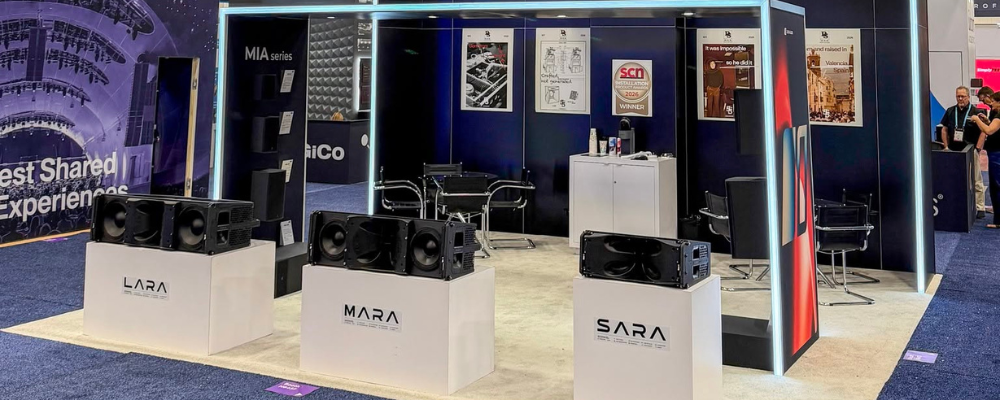
These presets, specifically developed for each MIA model, work together with optimized limiters to ensure phase consistency across the different systems within the family. This makes it possible to combine multiple configurations within the same installation while maintaining a consistent tonal response and a uniform listening experience for the end user.
The philosophy behind this new generation of solutions can be summarized in a simple idea.
“Regardless of the type of system, the tonal character remains the same,” emphasized Nanao.
That acoustic consistency represents one of the cornerstones of the DAS Audio ecosystem. Rather than simply expanding its product catalog, the company offers a platform where installed sound systems, touring solutions, digital processing, networked audio distribution, and control tools all share the same technological language.
With MIA Series and INTEGRAL-MA, DAS Audio takes another significant step in its strategy for the professional installation market, delivering a complete architecture that simplifies system design, optimizes operation, and supports projects of any scale while maintaining a unified sonic identity. It is a vision in which integration no longer depends solely on hardware, but on the ability of an entire ecosystem to function as a single solution.


