
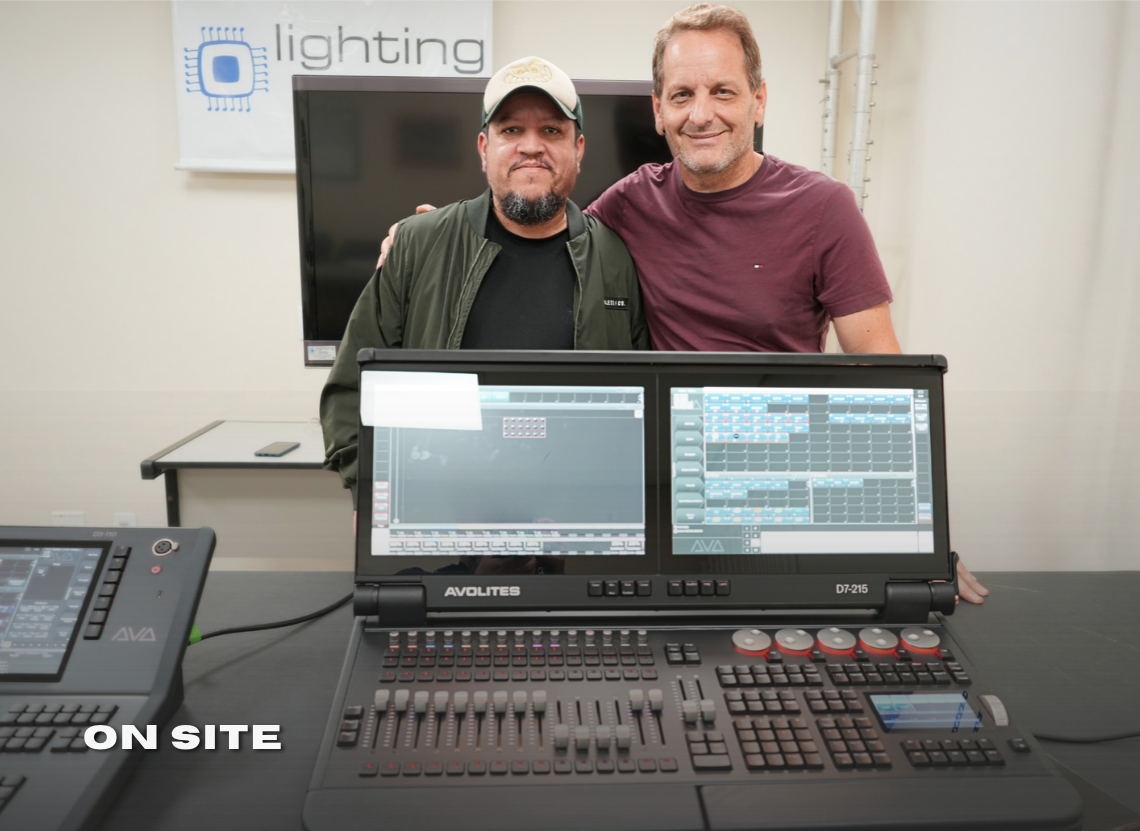
Brazil – Leandro Barros has experienced the evolution of Avolites from the inside: he grew as a designer while the platform incorporated new tools and creative possibilities. In Brazil, LIGHTING BITS has accompanied that journey by bringing the technology closer to an increasingly demanding professional community and contributing to the development of the brand in one of the most important markets in the region.
From a Pearl in 2007 to the new D3 and D7, Leandro Barros built much of his professional career working with Avolites. A relationship that began when he was 18, evolved alongside the technology and, according to the Brazilian designer himself, ultimately played a decisive role in opening the doors to the international market. LATAM STAGE spoke with him at the LIGHTING BITS facilities, Avolites distributor in Brazil.
Leandro Barros’ story with Avolites began almost two decades ago. In 2007, when he was just 18 years old, he started working with a Pearl. Since then, his career and the evolution of the platform have progressed practically in parallel.
Pearl, the move to Titan software with Tiger Touch2, D7, D3. Different generations of hardware and software passed through his hands, but something remained: the working logic that made Leandro continue choosing Avolites.
“I have been working with the Avolites system for many years, starting with the Pearl system, and I went through the transition from Pearl to the Titan system, using it with some of the latest-generation consoles such as the D7 and D3,” he explains.
For him, one of Avolites’ main strengths lies in the way it understands the user. Programming is intuitive, the tools are available in a direct way, and both the software and hardware maintain a natural relationship with the person behind the console.
“It is a very good system, very practical, very easy to use. I can always do what I want. What I need to do, Avolites allows me to do,” he says.
That confidence has also carried over into his international work. Leandro works on tours outside Brazil, in Europe and Latin America, and when he defines the equipment included in his rider, Avolites is a recurring choice. “Whenever I can, I require Avolites on my rider. The system has to be Titan.”
But behind that choice there is something that goes beyond technical specifications. There is a relationship built over many years. “Avolites introduced me to the market. It is a brand that I respect a lot. It is a brand that I like a lot. So, it is a matter of affection for the system.”
Evolving without losing its identity
One of the aspects Barros highlights most is Avolites’ ability to evolve technologically without breaking away from the concepts that made the platform recognizable.
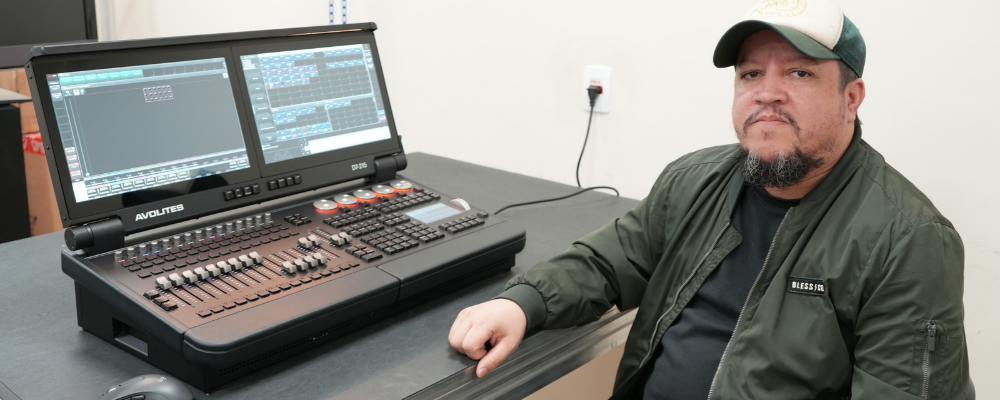
For someone who began working with Pearl, finding himself today in front of a console running Titan software, such as a D7-215, means discovering a completely different console from a design perspective, while at the same time remaining familiar in its operating logic.
“Avolites has evolved and improved a lot, but without losing the concept and without losing the identity of the Pearl.”
That link between previous experience and new tools also appears in Titan software. Technological evolution does not force the experienced user to start again from scratch. Their knowledge, way of thinking and programming logic continue to have a place within the new generations of the system.
“You can have a thought, a way of working and a design in your mind. If you are not an Avolites user, there is no problem. You can sit in front of the console and adapt to it quickly.”
For Barros, that continuity is fundamental. Technology changes, control surfaces change and capabilities increase, but the designer continues to find a tool they recognize.
And that familiarity translates into speed. “If you need to execute a command, today you have everything on one button. You can say ‘that is what I need’ and, within seconds, you already get what you need in a cue.”
When the show grows, confidence remains
Barros’ experience is also marked by large-scale productions. For him, working with hundreds or even more than a thousand lighting fixtures does not change the confidence he places in the system.
“I have already done many large events and shows. Personally, I don’t feel pressured by having 200, 500 or more than 1,000 lighting fixtures. Avolites’ delivery will be the same.”
In this context, a word that runs through much of his testimony appears: delivery.
For a lighting designer, a console is not simply a technical tool. It is the place from which they must transform an idea into a show, often under pressure, with limited time and increasingly complex productions.
Leandro even recalls an experience at Rock in Rio, on the Sunset stage, when Slayer’s lighting designer arrived with a Sapphire Touch while other consoles were available.
“They were the main band on the stage and the lighting designer arrived with a Sapphire Touch. He had three or four consoles from another brand, and the guy said: no, I’m going to use mine.”
For Leandro, that situation sums up something that can hardly be explained through a technical specification sheet alone: the confidence a designer develops after many years in front of a platform.
“You have to use Avolites to know what it feels like. You can have any console, but when you experience what an Avolites allows you to do, you don’t want anything else.”
Hardware also communicates
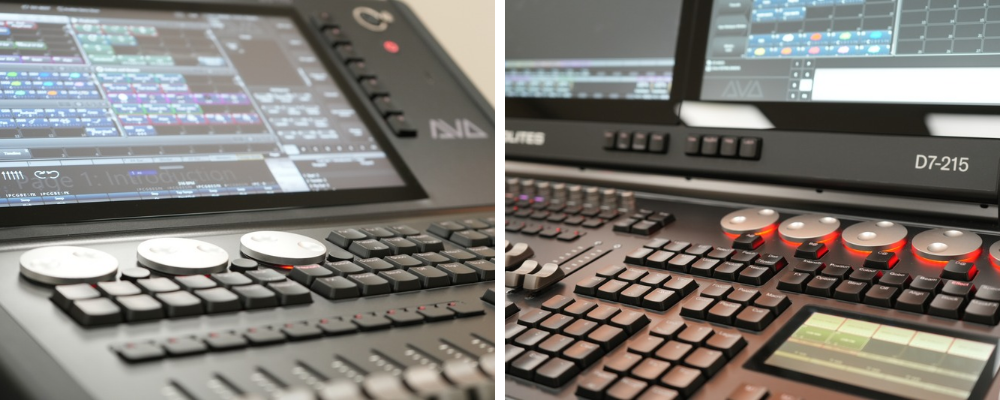
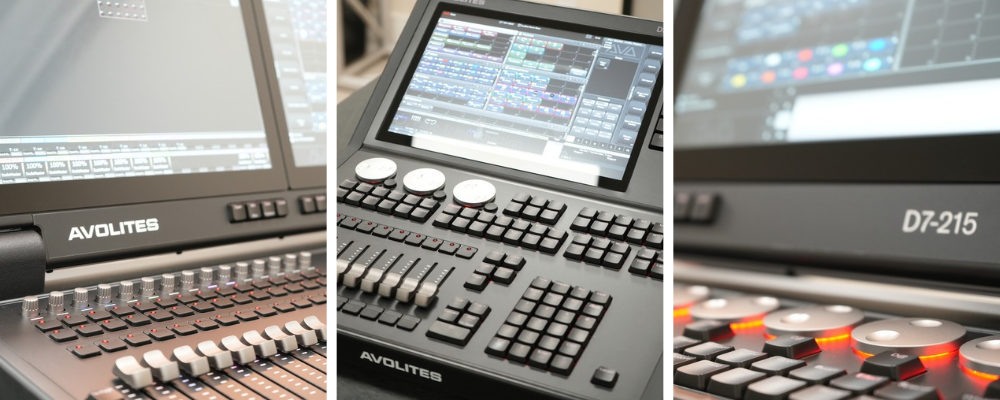
During our visit to LIGHTING BITS, Leandro had the opportunity to once again experience the new generations of Avolites hardware, including the D3-110 and D7-215.
His first impression is related to the integration of all the elements a designer needs: touchscreens, faders, commands, effects, keyboard, network connections and a layout that keeps information within the operator’s reach. “It is a complete desk for me.”
But there is also a less technical dimension. “Visually, it is very nice, very complete. It has a modern look that also gives you the pride of working on a desk like this.”
It is an interesting observation because it speaks to the relationship between the professional and their tool. The console should not only respond. It should also support the working experience and be at the level of the professional environment in which it will be used.
Speed starts before arriving at the show
Among the tools Barros highlights is the integration with Capture and the 3D environment.
For a designer, being able to build a show in advance, visualize it and subsequently transfer that work to the console represents an important difference when production times are increasingly tight.
“When you make and program your show, when you build your show with Capture, simply with the Capture software, you transfer the entire showfile into the desk.”
The possibility of preparing a large part of the work in advance means arriving at the show with a foundation already built. “This preparation of the show is already largely done.”
Leandro considers this synergy between Avolites and Capture one of the platform’s major successes. It is not simply about visualizing the stage on a screen, but about using that visualization as part of the design and programming process.
At major festivals, where there are specific spaces for 3D programming, this tool becomes even more relevant. The designer can work in advance on a representation of the stage, prepare the fixtures and subsequently transfer that work to the console. “This part helps quite a lot. It is fantastic to have the real visualization of the show.”
Even when the show will take place during the day and actual lighting conditions make programming difficult, the designer can work in advance in a controlled environment and arrive at the stage with much of the work already solved.
Avolites as part of a career
Perhaps the most significant phrase of the entire conversation comes almost at the end. “Avolites was the one that put me into the international market.”
It is not a statement related to a specific feature of Titan, a particular function or a specific generation of consoles. It is the result of almost twenty years of working with a brand that accompanied different stages of his career.
Leandro Barros evolved while Avolites evolved. The consoles, software, tools and creative possibilities changed. But the relationship between the designer and the platform remained.
And this is where one of the great strengths of professional technology emerges: when it stops being simply a tool and becomes part of the way a professional thinks, programs and creates.
LIGHTING BITS a distributor that also builds the market
The interview took place at LIGHTING BITS, Avolites distributor for Brazil. And the setting is not a minor detail.
In a market as large, competitive and demanding as Brazil, distributing an international brand means much more than having products available. It requires bringing them closer to professionals, creating demonstrations, developing knowledge and building confidence around the technology.
The meeting with Leandro is precisely an example of that work. A professional who started with a Pearl, went through different generations of Avolites and today reaches the new D3 and D7 can once again meet the brand in a space dedicated to showcasing its tools and possibilities.
LIGHTING BITS therefore occupies a role that goes beyond distribution. It is part of the process of positioning and developing Avolites in Brazil, bringing the technology closer to designers and operators who, like Leandro Barros, need much more than a console: they need a tool they can trust when the scale of the show, the pressure and the professional demands increase.
Because ultimately, behind every console there is a story of work. And in Leandro Barros’ case, that story began almost twenty years ago with a Pearl and continues today with the new Avolites generation.


