
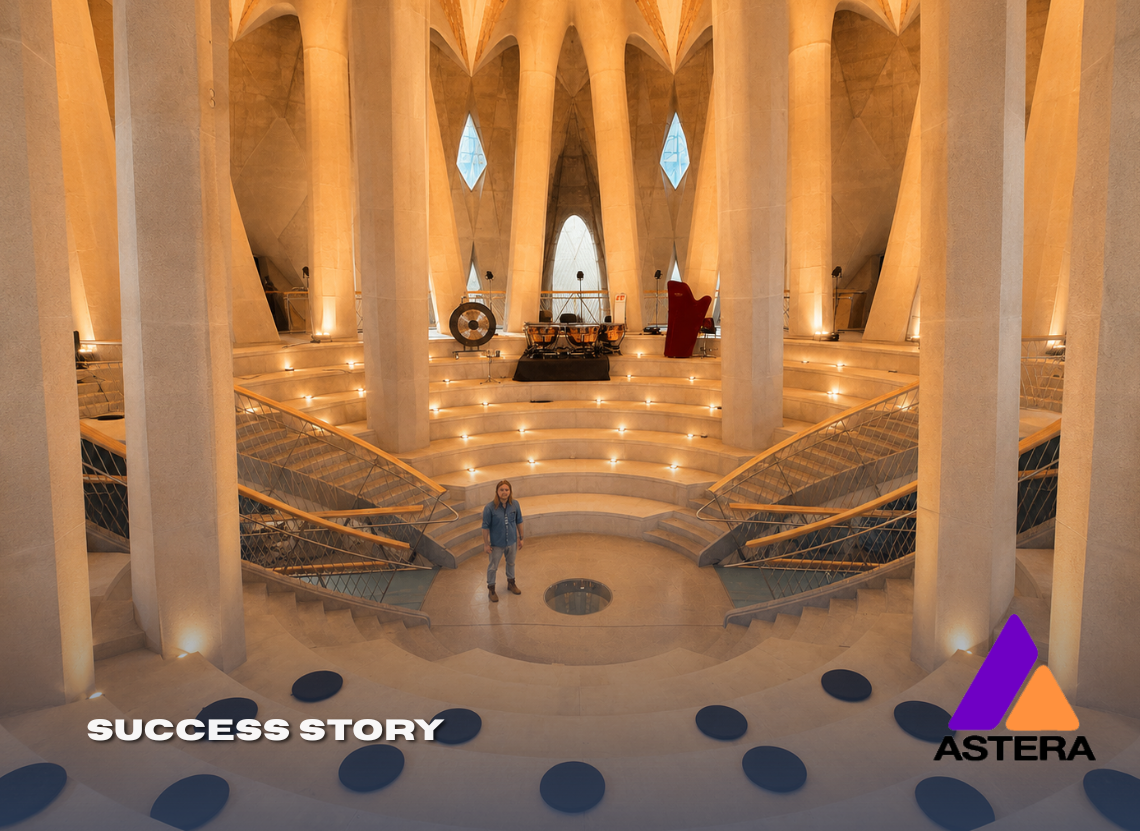
Lighting the inauguration of the Tower of Jesus Christ at the Sagrada Família involved far more than designing a show. For lighting designer Juanjo Saunier, the challenge was to transform an artistic concept into an experience capable of engaging with one of the world’s most iconic architectural masterpieces. Throughout that process, Astera’s solutions proved essential in delivering a production where visual integration, technical precision, and lighting quality were inseparable.
The inauguration of the Tower of Jesus Christ at the Basílica de la Sagrada Família represented far more than another milestone in the construction of Antoni Gaudí’s masterpiece. It was an event of enormous symbolic significance for Barcelona and for the millions of people who have followed the evolution of one of the world’s most celebrated architectural landmarks.
The production needed to match the magnitude of the occasion—a performance in which light, music, and architecture would merge into a single narrative capable of moving both the thousands gathered in front of the basilica and those watching the live broadcast from around the world.
Within that production, lighting played a leading role. The creative concept envisioned light emerging from inside the basilica, traveling through its interior spaces before rising toward the cross crowning the new tower, becoming the narrative thread that connected the entire ceremony. Translating that vision into a technically achievable production became the responsibility of the Argentine lighting designer, who found in several Astera solutions the tools needed to solve some of the project’s most demanding challenges.
After more than twenty-five years living in Spain, Juanjo is no stranger to high-profile productions. His career has developed primarily across corporate events, television, and fashion shows—an environment where technical precision and aesthetic refinement coexist with extremely tight installation schedules.
That professional journey shaped a very distinctive approach to lighting.
“Fashion gave me an extremely high standard of excellence. It’s not just about creating something surprising; the quality of the light also matters. It has to work for photography, for broadcast, and everything has to happen very quickly because there is virtually no room for error.”
Although his name was already well established within Europe’s corporate event industry, the past year marked a turning point in his career.
First came the opportunity to design the lighting for Alejandro Sanz’s tour—an artist he had always dreamed of working with. Shortly afterward came an even more unexpected challenge.
It all began with a voice message received on December 31.
On the other end was Igor Cortadellas, creative director of Igor Studio, who had spent more than a year developing the artistic concept for the inauguration of the Sagrada Família’s new tower and was looking for someone capable of transforming that narrative into a lighting design.
The proposal was as exciting as it was intimidating.
“He showed me a storyboard where the entire story of the show had already been developed. What he was looking for was someone who could translate that idea into reality and begin turning it into something technically achievable.”
Over the following months, both teams worked around a principle that remained unchanged until the day of the event: light should not simply illuminate the basilica—it had to become a storytelling element capable of supporting the narrative the production sought to convey.
The concept was straightforward.
“Light was the narrative thread. It emerged from inside the basilica, connected with the community gathered outside, and then rose back up toward the cross.”
Turning that idea into reality meant facing a series of challenges that would have tested even the most experienced lighting designer.
The first was understanding the true scale of the project.
From the very beginning, the organizers provided the team with a complete three-dimensional model of the Sagrada Família, including the building’s final appearance once every phase of construction is completed.
“I constantly felt like everything I designed was too small. I would draw structures or lighting positions, but when I placed them on the basilica model, everything looked tiny.”
That perception remained throughout much of the design process. Every decision had to account for extraordinary distances, heights exceeding 170 meters (558 feet), and an architectural environment where almost no element followed conventional geometry.
The scale of the building, however, was only part of the challenge.
The other was the production’s visual language.
Much of the action took place inside spaces that had never before been used for a production of this kind. Every fixture had to blend seamlessly with the architecture without compromising the site’s aesthetic integrity, especially considering that the event would be captured by drones, cinematic cameras, and a sophisticated television broadcast.
It was at this stage that Astera began to play a central role in the project.
As testing progressed, increasingly specific challenges emerged, requiring solutions capable of combining high-quality light, compact dimensions, wireless control, and an almost invisible visual integration within the architecture.
The first challenge arose during the development of one of the scenes featuring the children’s choir.
The original plan called for small light sources integrated into the candelabras, but testing revealed that the light quality fell short of the standard required for a broadcast production.
The solution involved completely redesigning those fixtures by integrating Astera AX3 LightDrop units into the candelabras using custom 3D-printed adapters.
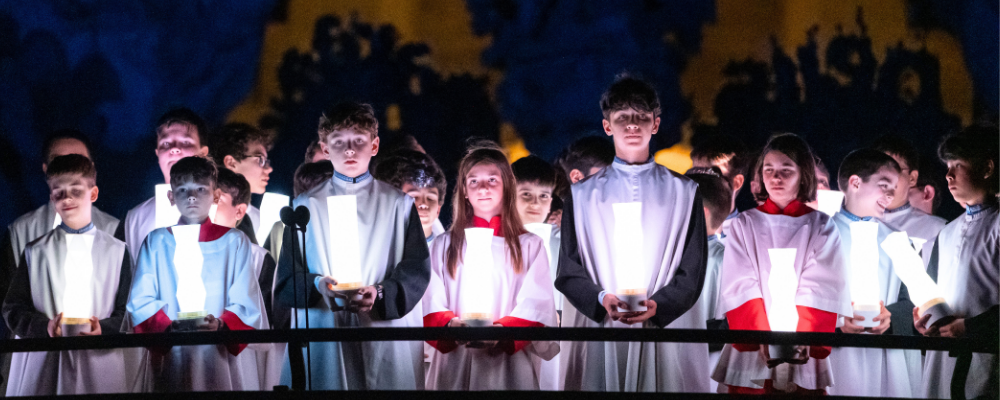
This approach preserved the aesthetic envisioned by the creative team while providing complete lighting control and the image quality required for television.
For Juanjo, that decision perfectly summarized the philosophy that guided the entire project. “We needed superior light quality, but we also needed complete control over that moment because it was part of the show’s narrative.”
Choosing a lighting fixture is never based solely on its photometric performance. “Beyond the quality of the light, the appearance of the fixtures is extremely important to me. The installation had to be delicate enough not to visually interfere with such a special place.”
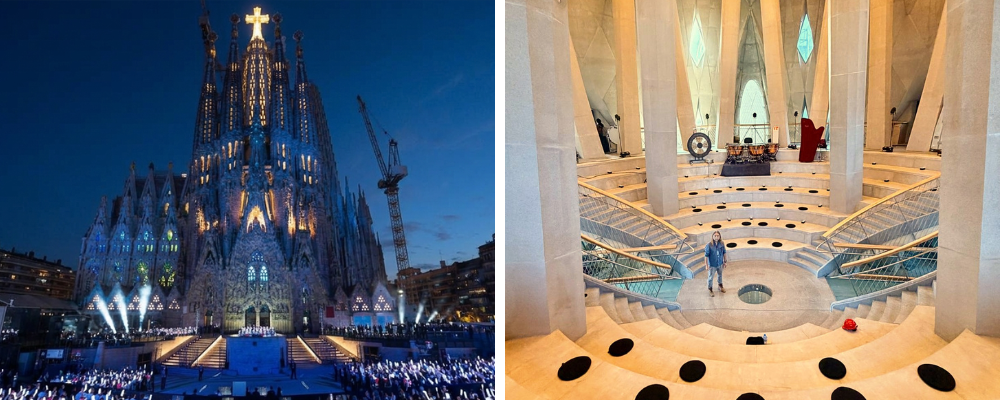
That criterion became especially important in the Sala Crucero, located approximately 65 meters (213 feet) above ground at the base of the new Tower of Jesus Christ.
Some of the production’s most intimate scenes took place there, featuring both the orchestra and the choir, in a space where cameras would continuously move through the architecture from every possible angle.
To illuminate that environment, Juanjo chose a combination of Astera QuickSpot and HydraPanel fixtures.
The decision to use QuickSpot reflected a principle that remained constant throughout the lighting design: technology should support the performance without drawing attention to itself.
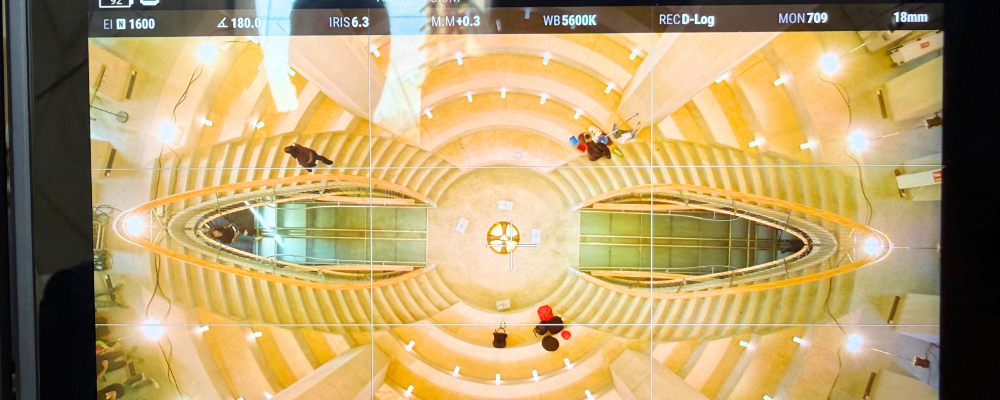
In a production designed to be filmed from multiple perspectives, every element of the installation had to integrate naturally into the basilica’s architecture, avoiding visible stands or cabling that could disrupt the visual purity of the space.
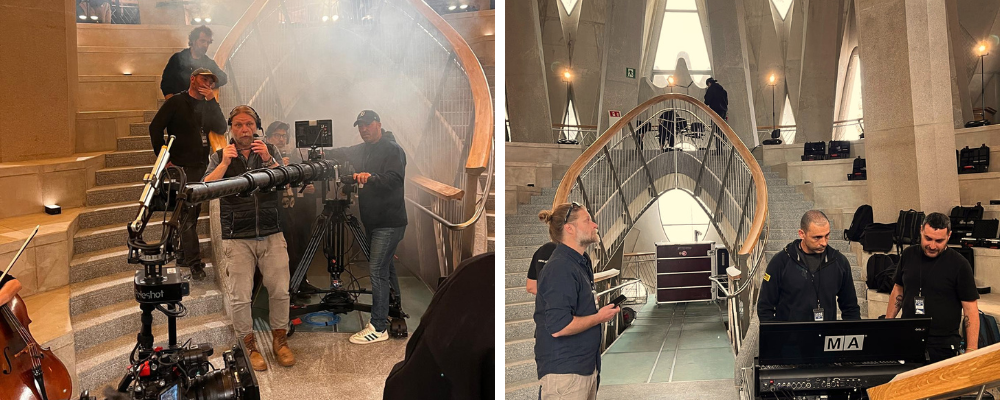
“I knew from the beginning that I wanted to use QuickSpot fixtures mounted on microphone stands. I knew we would have overhead camera shots, and I wanted the installation to look as clean as possible, with the fewest visible cables.”
The HydraPanel, meanwhile, fulfilled a different role. Its compact form factor made it possible to integrate the fixtures around the large central oculus while respecting the geometry of the space and reinforcing the show’s visual concept.
“The HydraPanel’s form factor fit perfectly. From an aesthetic standpoint, it made much more sense than using a conventional lighting fixture.”
For Juanjo, decisions like these are just as much a part of lighting design as programming a console. Lighting had to engage in a dialogue with the architecture rather than compete against it.
Logistics as complex as the design itself
While the audience experienced a show lasting only a few minutes, months of planning and an unusually complex logistical operation unfolded behind the scenes.
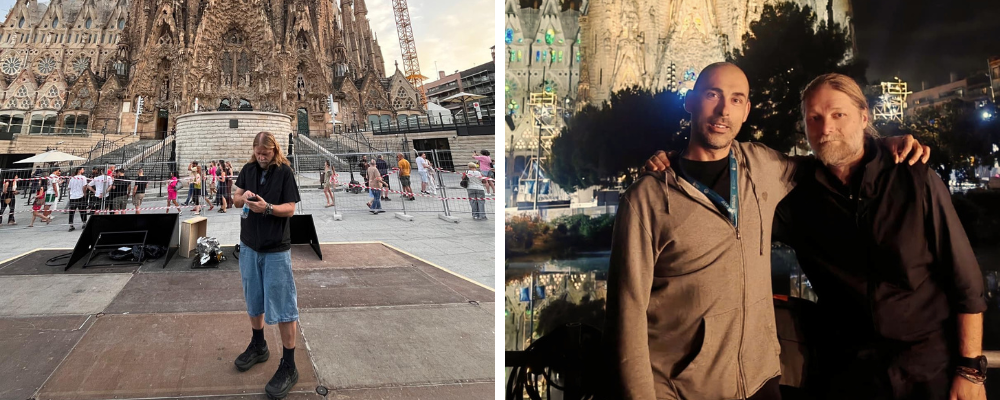
The Sagrada Família remains under construction, and many of its interior spaces continue to function as an active construction site.
That reality shaped every aspect of the installation.
Transporting equipment inside the tower meant navigating stairways, scaffolding, and extremely narrow passageways.
“To reach the Sala Crucero, every piece of equipment had to be brought in through a window using pulley systems. Not only the lighting fixtures—the orchestra’s instruments as well.”
In that context, fixture size and portability became far more important than they would be in a conventional installation.
Every kilogram mattered. Every trip required valuable time. The combination of Astera solutions proved ideally suited to those demands.
The equipment was supplied by Alba Audiovisuales, which worked alongside the production team by supplementing its inventory with additional fixtures to meet the project’s specific requirements—a level of coordination that proved essential in an installation where every phase had to be executed with absolute precision.
When technology disappears
One of the most compelling aspects of Juanjo’s work is the way he understands the role of lighting within a production.
For him, the objective is never for the audience to admire a lighting fixture. Quite the opposite. “Technology should disappear, leaving only the emotion created by the light,” he says with conviction. That principle guided every decision throughout the project.
“If the audience stopped thinking about the lighting fixtures and focused solely on the story unfolding before their eyes, then we had achieved our goal.”
The impact of the production became evident almost immediately after the ceremony concluded. Images of the event quickly appeared in media outlets around the world, and messages soon began arriving from fellow designers, colleagues, and lighting professionals who had followed the broadcast.
“I never truly realized the magnitude of the project while I was working on it. I only began to understand it when people started writing to tell me how emotional the experience had been.”
That international recognition was accompanied by an extraordinary setting. Watching the ceremony from the front row were the King of Spain and Pope Leo XIV, while an unprecedented television production captured every moment using more than twenty cameras and specially deployed cinematic technology.
A tool that continues to support new challenges
For Juanjo, the experience confirmed something that extends well beyond this particular project. The best technology is not necessarily the most visible—it is the technology that allows an idea to come to life without imposing itself upon it.
During the inauguration of the Tower of Jesus Christ, Astera’s solutions embodied that philosophy. The result was a production in which light did far more than illuminate one of the world’s most iconic architectural landmarks.
It became an essential part of the story the audience had come to witness.
It is no coincidence that, when speaking about the equipment, Juanjo leaves technical specifications aside. “I’m in love with the QuickSpot. Its light quality and the amount of output it delivers are simply incredible.”
Like the Sagrada Família itself—a project that began with Antoni Gaudí’s vision and continues to be built more than a century later—the inauguration of the Tower of Jesus Christ was the result of the talent and dedication of countless people.
The creativity of Igor Cortadellas, Juanjo Saunier’s lighting design, the commitment of the entire technical team, and Astera’s solutions came together to create a truly unforgettable production, where light did far more than illuminate the architecture—it became part of its history.
Credits
Cover Photo: Juanjo Saunier (@juanjosaunier)
Inside Photos: Juanjo Saunier (@juanjosaunier)
The journalistic production, research, writing, editorial approach, and editing of this content are original works by LATAM STAGE and are protected by copyright.
No part of this content may be reproduced, copied, distributed, adapted, or published, in whole or in part, in any medium or format, without the prior written authorization of LATAM STAGE.


