
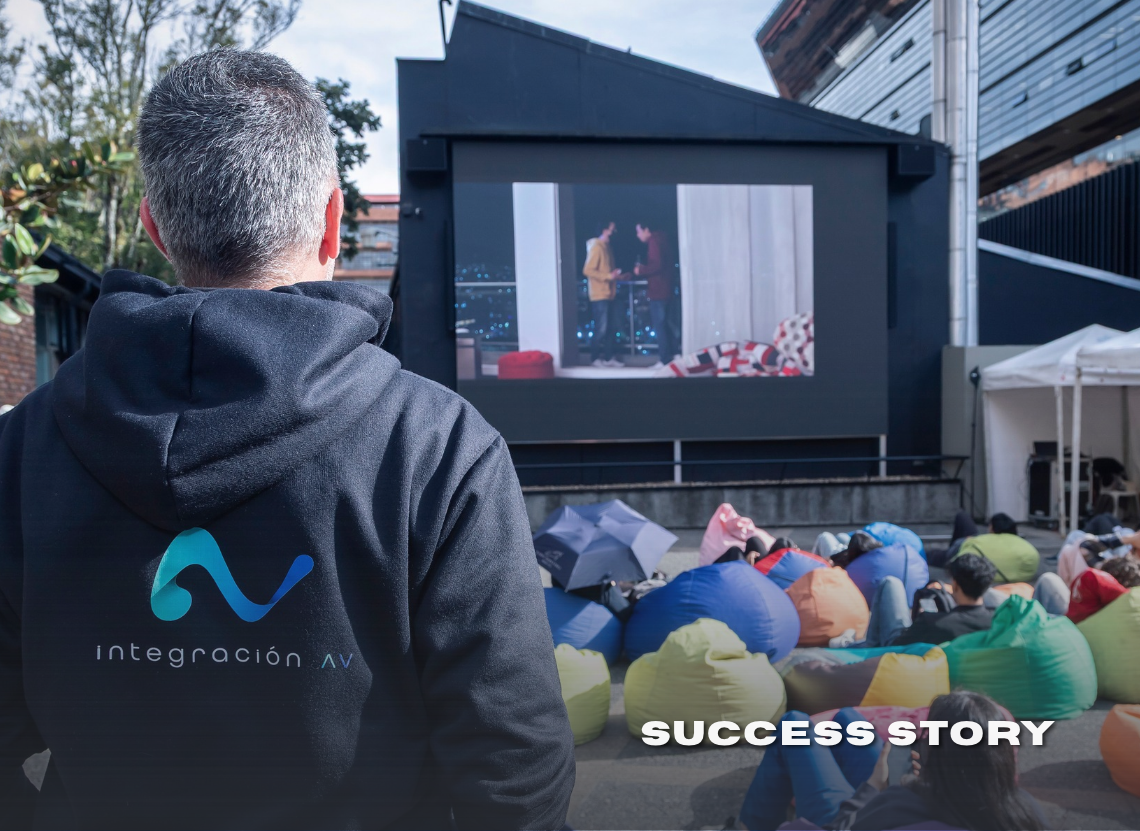
Colombia – AV Integration developed the project with FOHHN Audio technology, under a fundamental acoustic condition: to offer a quality audiovisual experience without interfering with classrooms or the nearby hospital.
Juan Gutiérrez and Carolina Sosa, from Integración AV, together with Ole Meyerrose, International Sales Manager at FOHHN Audio, share the journey of an installation in which directivity, sustainability and working together with the factory were decisive.
A screen with clear and precise sound can communicate information, but it can also become the center of a shared experience. On a university campus, this difference opens possibilities ranging from the projection of academic content to cultural gatherings and activities designed to encourage students to enjoy the spaces they inhabit every day.
That was the opportunity identified by the Pontificia Universidad Javeriana in Bogotá when it decided to replace an LED screen installed in 2018. After years of operation and maintenance, the equipment had reached the end of its useful life. The renewal, however, was not conceived simply as a technology replacement: the institution wanted to expand the uses of an area that until then had image, but no associated sound system.
Movies, short films, presentations and live events began to form part of the proposal. The new infrastructure could also offer opportunities for programs related to the visual arts and support a broader initiative of the university: to create spaces that would invite students to remain on campus and make it their own.
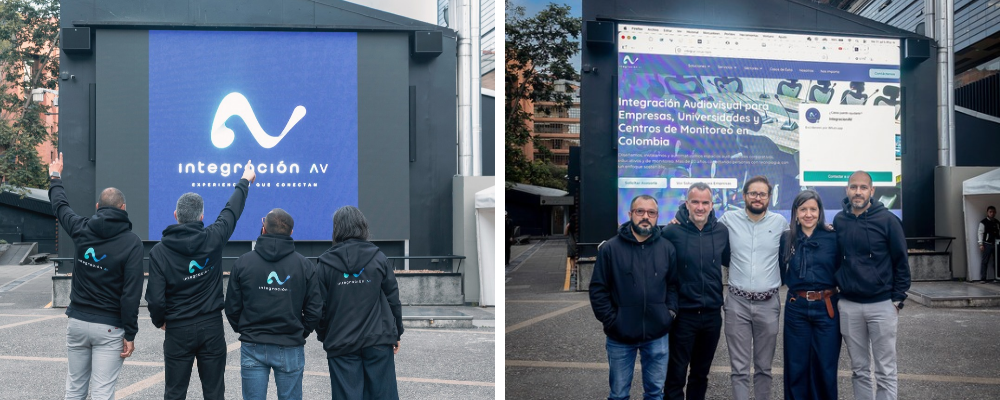
The development was entrusted to Integración AV, a Colombian company whose history is closely linked to Javeriana University itself.
A relationship that began with the company
Founded in 2010 by Juan Gutiérrez, Integración AV specializes in adapting spaces through audiovisual technology, automation and lighting control. Its activities include consulting, design, supply, installation, commissioning, training and maintenance, mainly for the educational and corporate sectors.
The company was founded in Bogotá and later expanded its operations to Medellín, maintaining a presence in both cities. It currently has a team of ten people.
Juan is in charge of management, while Carolina Sosa participates in areas such as finance, sustainability, marketing, public relations and business development. Both share an interest in identifying technologies that make it possible to address projects with particular needs, even when they involve an unusually high level of technical demands.
Javeriana University has a special significance for them. One of the institution’s projects gave rise to Integración AV and, since then, both organizations have maintained a working relationship that has allowed the company to develop a close understanding of the spaces, needs and expectations of the client.
“Integración AV was born thanks to this client in 2010. So, since that year we have been working with them,” Juan recalls.
That continuity was important in interpreting the screen renewal as an opportunity for use and not simply as an equipment replacement.
From ISE to Stuttgart: a decision that began by listening
In February 2026, Integración AV accompanied representatives of the university to ISE in Barcelona and subsequently organized a visit to the FOHHN Audio factory in Stuttgart, Germany.
“That journey allowed us to learn about the company’s production processes, speak directly with its team and listen to its systems in the demonstration room. Among the participants was a representative of the university together with our team, whose experience there was especially important for the development of the proposal,” Juan explains.
For Integración AV, bringing the client to the factory meant giving them the opportunity to evaluate the technology beyond a technical datasheet. The sound experience, contact with specialists and knowledge of the manufacturing criteria helped build a more complete view of what FOHHN could bring to the institution.
Ole Meyerrose recalls that visit as a central moment in the project: “Ingrid told us about the problem they had with this project, which is a fairly large space, with complex acoustics, even though it is outdoors, because there is this hospital next to it and they did not want a lot of sound power to reach this place.”
The conversation made it possible to move from a general need to incorporate sound toward defining a solution with specific acoustic requirements.
The visit also brought another university criterion to the table: sustainability. Integración AV had identified an affinity between the institution’s environmental policies and FOHHN’s approach to manufacturing, repair and product lifespan. And learning about these processes firsthand reinforced the interest in the brand.

Sound for students, without interfering with the environment
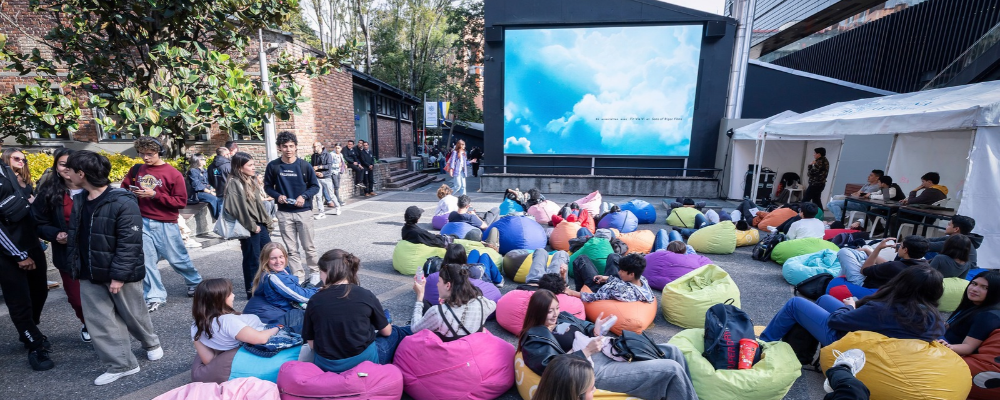
The space where the screen was installed is a large, open area of the campus. Around it, there is student circulation, classrooms and a university hospital in operation. Until then, the screen had no sound. Incorporating it meant introducing a new sound source into an environment where academic and hospital activities had to continue normally.
Carolina explains the project’s main concern: “One of the challenges we had was being able to add sound without affecting, for example, the quality of the classes being taught in the rooms near the screen or affecting the movement of the clinic and the hospital. The system had to provide sufficient coverage for movies, music and presentations, but without indiscriminately distributing sound energy toward nearby areas. The location of the loudspeakers, their vertical behavior and the orientation of the coverage became fundamental decisions.”
The open-air nature of the space did not eliminate the acoustic difficulties either. In addition to the distance between the system and the listeners, it was necessary to consider which areas would receive sound and which should remain outside the main coverage.
For Ole, the project brought together two requirements that FOHHN had to solve jointly: directivity control and resistance to the environmental conditions of Bogotá, where rain and humidity are part of the variables of an outdoor installation.
The solution was developed around columns from the LXP family, accompanied by subwoofers and amplification from the brand.
The FOHHN solution: directivity, coverage and frequency response
The system installed at Javeriana University consists of two LXP-150 columns, two AS-22 subwoofers with polyurethane coating and a DI-4.1000 AES amplifier with a Dante input card.
During the specification stage, longer columns were initially evaluated. The available budget led to an adjustment of the proposal and the selection of the LXP-150, while maintaining as a priority the sound performance required for the space.
The choice of these columns responds to a characteristic that is especially useful for the installation: their sound emission has a vertical pre-inclination that allows the coverage to be directed downward even when the loudspeaker is mounted straight on the wall.
Ole describes the operating principle: “It is a passive column, but with a pre-inclination in the vertical direction of the sound. So we can mount that column straight on the wall and the sound is inclined 5 degrees downward.”
At Javeriana University, this orientation allows a greater proportion of the sound energy to be directed toward the area occupied by students and reduces the amount reaching surfaces or areas that are not part of the intended listening area.
The solution does not depend solely on achieving sound pressure. Its value lies in how that energy is distributed: the audience needs to hear clearly, while the classrooms and hospital require that the audiovisual activity not interfere with their functions.
The two LXP-150 columns are complemented by two FOHHN AS-22 12-inch subwoofers, which extend the system’s response into the low frequencies. This combination makes it possible to reproduce musical and audiovisual content across a wider frequency range, without losing the ability to use the space for spoken presentations.
The system is designed for different uses within the same infrastructure. A movie, a short film, a presentation with a microphone and a musical event do not place identical demands on the system, but they are all part of the activities that the university wants to develop.
The AS-22 units feature a polyurethane coating — PU coating — intended to provide protection against moisture and water in this outdoor application.
Amplification is handled by a DI-4.1000 AES processor with a Dante input card, allowing the system to be integrated into a digital audio infrastructure through that protocol.
The system thus responds to four project conditions: directing sound toward the audience, completing low-frequency reproduction, taking environmental exposure into account and facilitating system integration.
A discreet installation in a circulation area
Integración AV assumed the coordination and execution of the project, including the work with the university, the replacement of the screen and the incorporation of the sound system.
Juan explains: “Part of the existing infrastructure could be reused, such as some ducts that were already part of the previous installation. The loudspeakers, however, required new mounting provisions. The columns were installed on a wall, so it was necessary to review structures and anchoring points following the manufacturers’ recommendations. Safety was especially important because it was an educational institution and an area frequented by students.”
Visual integration was another aspect of the result. The black columns were mounted on a wall of the same color, becoming discreetly incorporated into the architecture.
Carolina explains that the size of the loudspeakers aroused curiosity among those observing the installation. In such a large space, the columns, approximately one and a half meters tall, did not appear, at first glance, capable of providing the expected coverage: “People passing by would be amazed and would stop, trying to understand where the sound was coming from, because the loudspeakers blend into the wall.”
Commissioning was supported by Ole in Colombia. His presence made it possible to carry out the first adjustments together with the integrator and the university, while they completed the tasks required to finish calibrating the system. Integración AV maintains a direct commercial relationship with the factory, which facilitated technical exchange from specification through installation.
The first listening experience: the result from the user’s perspective
Once the system began operating, the university’s reaction made it possible to assess how the new audiovisual experience was perceived in the space.
Carolina highlights the initial response with a spontaneous expression: “Let’s say that what the client said, in a folkloric way, was: ‘Oh, that sounds good!’”
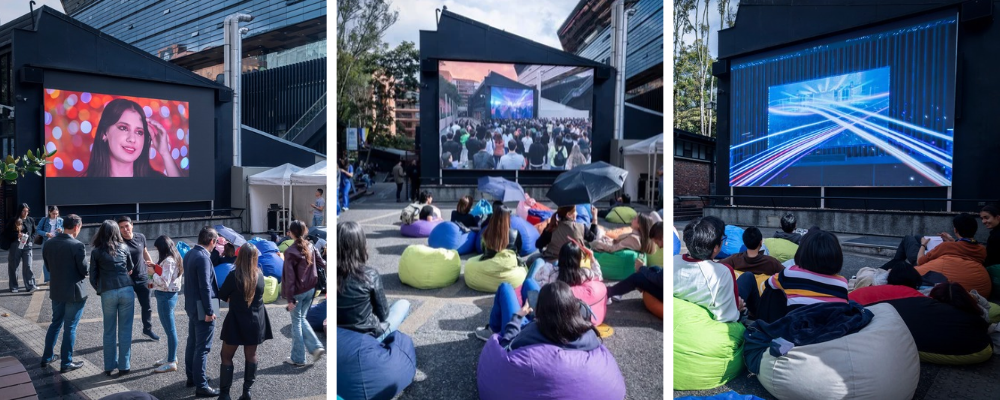
During the tests, the system’s reach and intelligibility caught the attention of those who participated in the presentation. The screen, which had previously been used without associated audio, now incorporated a dimension that expanded the possibilities of the content.
The university also took advantage of the sound quality in the project’s presentation video, using excerpts from FOHHN materials to communicate the experience.
The reception was especially valuable for Integración AV because the choice of the system had started from a specific concern: adding sound without compromising the coexistence of the different activities on campus.
The result demonstrated that coverage did not depend on the apparent size of the loudspeakers, but rather on appropriate technology selection and its application within the space.
Sustainability and support: a relationship that goes beyond the product
The experience at Javeriana University also made it possible to deepen the relationship between Integración AV and FOHHN Audio.
For Carolina, one of the most important aspects was the factory’s response during the project’s development. An incident that occurred while transporting the equipment from Germany to Colombia required managing the replacement of a unit, and the brand responded quickly to support the continuity of the installation.
“Often it is not only about the quality of the equipment, because I think that Juanca, who is a sound engineer, fell in love with FOHHN from the first time he heard it.”
Technical and commercial support was added to an aspect that had already been relevant during the visit to Stuttgart: the possibility of maintaining the systems over time.
Carolina highlights FOHHN’s approach to repair and spare-parts availability, characteristics that she considers especially valuable for a university that incorporates environmental criteria into its investment decisions.
At an educational institution, equipment is generally planned for years of use. The possibility of maintaining and repairing it forms part of that evaluation, together with its performance and the needs it must address.
For FOHHN, the project also reflects the role of Integración AV in the development of the brand in Colombia. “Juan and Caro and Integración AV in general are a very, very important partner for us,” Ole points out.
A project that opens possibilities for other spaces
The new infrastructure at Javeriana University expanded the use of an area that was already part of everyday campus life, and the experience also began to extend to other areas of the institution. According to Carolina, the university is considering specifying FOHHN for new projects.
For Integración AV, this continuity is linked to a way of working that has accompanied its growth since 2010: understanding the client’s needs, studying alternatives and bringing solutions capable of responding to specific conditions. The project thus brings together the experience of a relationship between client and integrator, the direct participation of the manufacturer and a technological choice oriented toward a specific purpose: to make a space designed to display content also become a place to listen to it, share it and experience it.


