
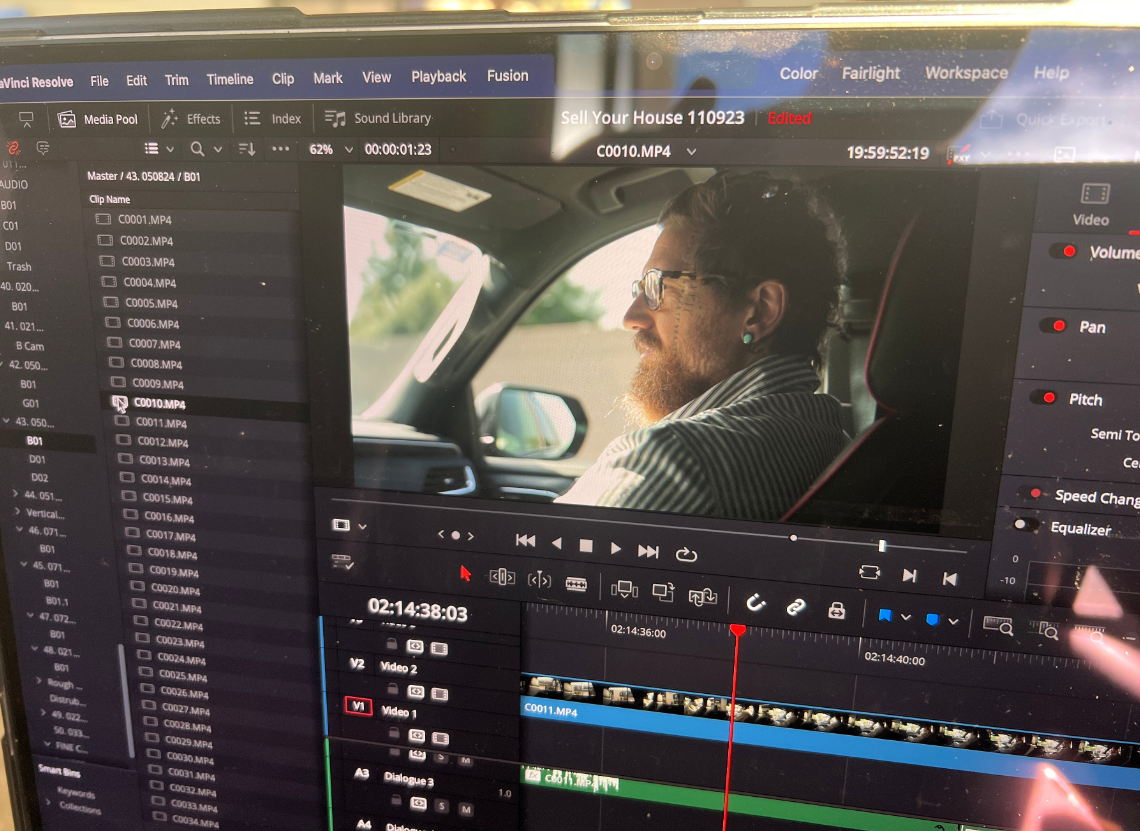
USA – Blackmagic Design today announced that the feature documentary “Sell Your House” was edited and graded with DaVinci Resolve Studio editing, color grading, visual effects (VFX) and audio post production software, using Blackmagic Cloud’s remote collaboration tools to finish post while spread across the US.
Directed and shot by Eric Foss, with Brandon Pickering serving as codirector and editor, “Sell Your House” tells the story of James Claeys, founder of the clothing brand The Local Boogeyman, who sold his house to finance “The Last Stop in Yuma County,” the feature film written and directed by his best friend, Francis Galluppi.
The documentary project began as a short promotional featurette before the real story came into focus. “That idea started to grow about three days into filming when I realized what the story was. James sold his house to make his best friend’s movie. Can their friendship survive that kind of pressure?” said Foss. “From there, our little featurette just continued to grow. Eventually, we had 250 hours of footage.”
For the first three months, Foss handled everything himself, shooting, producing, recording audio, and editing alone; drawing on a technique honed during his years in survival based reality television. “I was using a style of shooting people call single camera follow doc,” said Foss. “You shoot with one camera in one take and must provide the editor with enough coverage so they can turn 30 minutes into three. It’s rewarding but pretty exhausting.”
Help came from Pickering, a longtime collaborator. “I met Foss in a swamp in Florida back in 2020,” said Pickering. “We were working on a reality show called ‘Naked and Afraid.’”
When Pickering spotted a post about the project on Instagram, he immediately reached out to ask if he could help. Distance shaped the workflow as much as money did. With Foss in Joshua Tree, CA and Pickering in New York City, the pair built post production around DaVinci Resolve Studio and Blackmagic Cloud’s collaboration tools.
“We broke the film up into scenes we called pods. Brandon would take one pod and I would take another,” said Foss. “After each of us was done cutting our respective pods, we would trade and cut our own versions of each pod. Then we would get on the phone together and consolidate our cuts on every scene. This ended up creating a very strong edit that has already been getting us some attention.”
Working with 8TB of footage, Foss mirrored two drives, keeping one and sending the other to Pickering, then shared a single cloud project between them. “We started using cloud collaboration in 2022 when it was still relatively new, and it blew my mind,” said Foss. “It opened up a whole new world of opportunities and sped up a process that would have required time consuming data sharing or an expensive shared server. Cloud collaboration was cheap and easy.”
For the grade, Foss turned to Colorist Mac Fisken, a longtime collaborator with an unusual connection to the story. “I’ve known Eric for more than a decade and colored a few different projects with him along the way,” said Fisken. “I was also the DP on ‘The Last Stop in Yuma County,’ the movie that ‘Sell Your House,’ is about, so I was already in his documentary years before Eric was ready for color.”
The documentary’s footage came from a wide range of sources, and unifying it became the central task of the grade. “Throwing a bunch of different camera formats on the same DaVinci Resolve timeline has gotten to the point where it works nearly flawlessly on a technical level, due to the software’s ability to manage almost any file format. We had different resolutions, different frame rates, like ten different file extensions from five different cameras plus screen recordings, animations, stills, and many other wrinkles,” said Fisken. “It used to be that you’d have to do a ton of tinkering and converting to get this whole mess of footage to play well together, but now that challenge is gone, and we’re left with the other half, the more creative process of how you make these visuals from all over work together and feel like a unified project. DaVinci Resolve is huge on that front with so many ways to sharpen, soften, up rez, and denoise. We put those tools to work more than I’ve ever done before.”
Fisken’s approach was to make each shot look as good as it could on its own, then go back with an eye for continuity and nudge outlier clips into the scene. One sequence stood out. “The fuel truck explosion was a favorite for me because it was such a challenge. The explosion happens halfway through dusk, so you end up bouncing back and forth between full daylight and nighttime, but it’s the colorist’s job to keep that from interrupting the story’s flow,” said Fisken. “It’s incredibly satisfying to grade a shot from bright day to moody dusk and then realize weeks later you’ve forgotten it wasn’t a dusk shot in the first place.”
Power Windows did much of the heavy lifting. “I use them constantly, and it makes me so happy every time I draw an insane power curve and DaVinci Resolve somehow manages to track it across a wild, moving handheld shot,” said Fisken. “Add in a good qualifier, and you can basically do magic on an image.”
The handoff between edit and grade stayed inside DaVinci Resolve Studio as well, with Foss and Fisken passing the project file back and forth. “It made the conform much less of a nightmare,” said Fisken.
“We had many, many long days working together on separate coasts, editing and coloring footage as if we were in the same room,” added Pickering. “We took it for granted by the end, but I don’t think this movie would exist if we had used any other software.”
“Sell Your House” is currently on the festival circuit after a recent screening at Dances With Films.


