
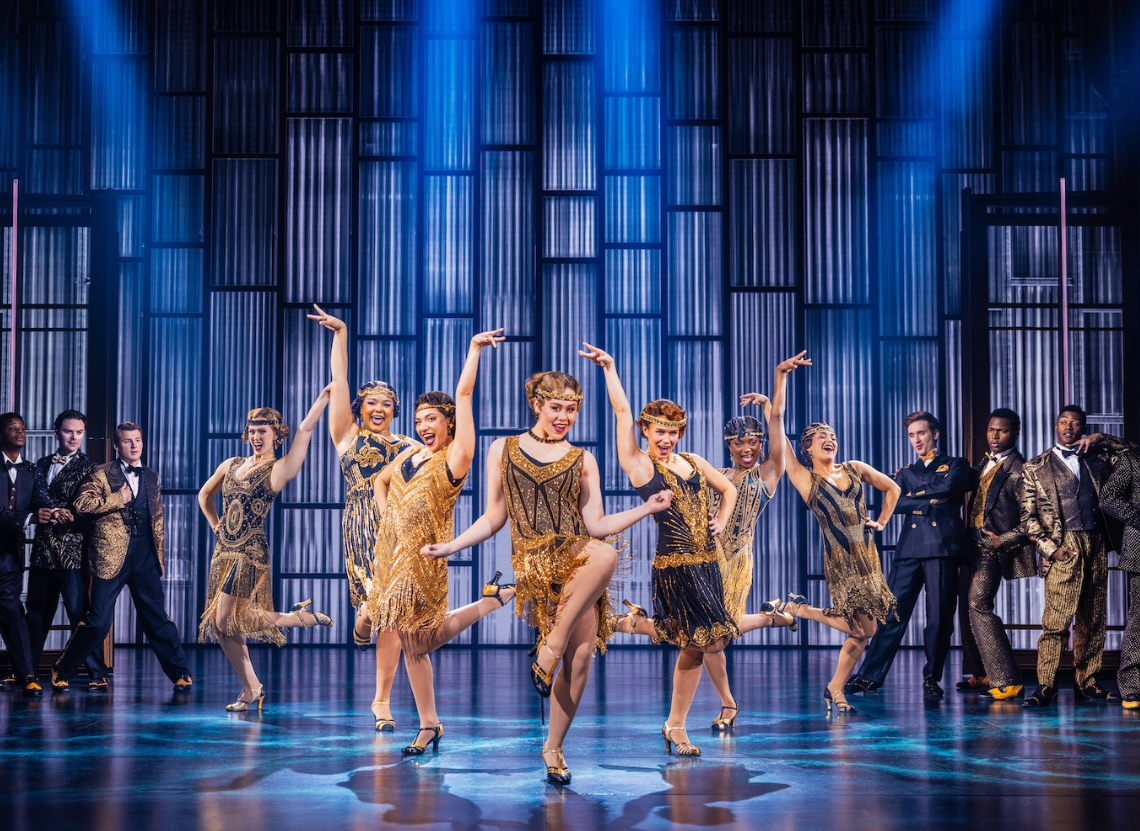
USA – It has been called the most misunderstood novel in modern English literature. Even its author complained that not one single critic “had the slightest idea of what the book was about.” F. Scott Fitzgerald had a point. Say “The Great Gatsby” to most people and the first (and perhaps only!) thing that comes to mind is Roaring Twenties glitz. But there is also a darker more shadowy force driving the narrative in this timeless novel.
Cory Pattak reflects this story’s baleful side, as well as its lavish opposite in his artful lighting design for the North American tour of The Great Gatsby musical, which began January 31 at the Hippodrome in Baltimore and runs through next year.
“Everyone thinks about the parties in Gatsby, but of course the original novel is really telling a tale about the dark side of the American dream,” Pattak said when sharing the vision behind his design. “We contrast Gatsby’s shiny, luminous world with the world of George and Myrtle Wilson and the Valley of Ashes. We also use darkness in the opening number of Act 2, ‘Shady.’ Here, we catch up with all our main characters through a series of small scenes while Wolfsheim sings about how ‘everybody is a tiny bit shady.’ Through the use of smoke and shadow, we are able to create a visual style unlike anything else in the show.”
Of course, glitz is also very much present in the show. There was a full set LX in nearly every piece of the Broadway production. Understandably, this had to be trimmed for the touring production, Pattak and his colleagues still brought a lot of boldness to the show, packing the overhead trusses with fixtures and squeezing as many lights as possible on to side towers.
Helping Pattak add an extra level of brightness to the design were the touring rig’s 10 CHAUVET Professional COLORado Solo Edge 3 low profile footlights. Positioned at the edge of the stage, the one-meter long RGBwWL fixtures fill a variety of roles in the production.
“The footlights do a lot in Gatsby” noted Pattak. “Sometimes they are lighting the cast in big dance numbers; other times they help to uplight the scenic portals or other hard pieces. Since front light is so limited in a tour, the footlights become really critical in getting even light onto the cast’s faces. We have each fixture divided into four individually controlled cells so we can get really granular and use them for specific performers or moments as necessary.”
Pattak recalled how he came to include the COLORado Solo Edge 3 in his touring rig. “I had recently lit the Spamalot tour, which had no deck, and we used a footlight fixture that I thought would be short enough, but I was wrong. We struggled to see dancers’ feet, and it was a real problem that I was determined to solve for the Gatsby tour. In the short amount of time I had between the two tours, I looked at various other footlight solutions, and our lighting shop, PRG, was able to set up a demo of some options.”
The results of that demo convinced Pattak that the new footlights were right for his design.
“I was immediately smitten with the Solo Edge,” he said. “For starters, it is VERY short, which was the number one problem I was trying to solve. The three-inch tall fixture worked perfectly with our inch show deck.”
“There are so many other features I love about this fixture,” Pattak continued. “It’s also extraordinarily bright; we barely ever run it over 50%. It has built-in safety markers that we run at a low level to indicate the edge of the deck for the cast. Additionally, the fixture profile is extremely clean and streamlined. All the cables and connectors are hidden, and often from the audience, you can barely tell there are footlights because they blend in so well with the show deck and the stage floor. I was so excited about these fixtures; I was sending photos and videos to other LD saying, “look at this amazing fixture we have; it’s the most invisible footlight I’ve ever seen, and it’s screaming bright!””
Pattak’s carefully curated rig is backed by a tightly knit production team, some of whom have been with the musical since it’s out-of-town tryout at Paper Mill Playhouse. “I’m really grateful,” he said, “for the work of our Associate LD Paul Vaillancourt, Assistant LD Natali Arco, Programmer Scott Tusing, Production Electrician Robbie Virzera, Head Electrician Mike Anderson, and Assistant Electricians Jameson Bernhagen, and Matthew Sallee.”
Backed by this team, Pattak’s thoughtful design came to life, allowing the full spectrum of this iconic story, from its brooding underbelly to its glitzy surface flourish on stage.


