
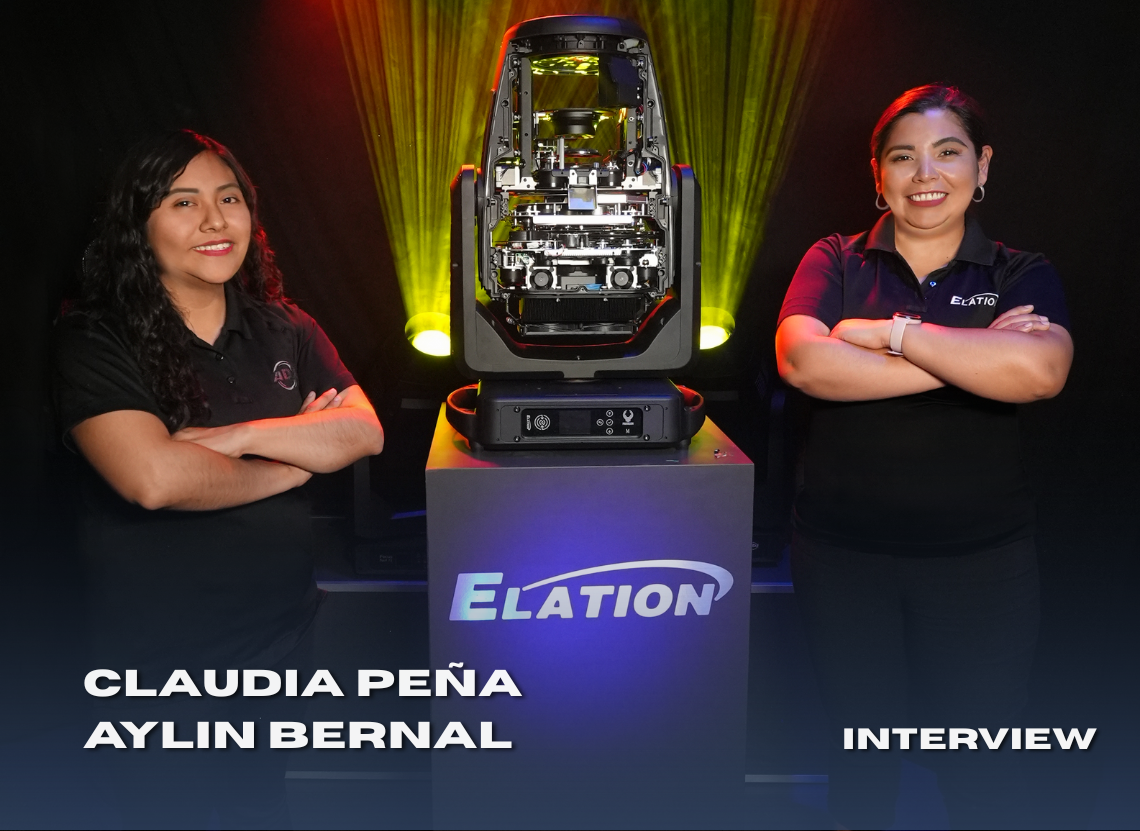
For nearly two decades, Claudia Peña has transformed technical service into much more than a repair department. Together with Aylin Bernal, they represent two generations of engineers who today uphold one of the silent pillars of Elation Mexico, where technology and shared knowledge are just as important as every fixture that comes back to life.
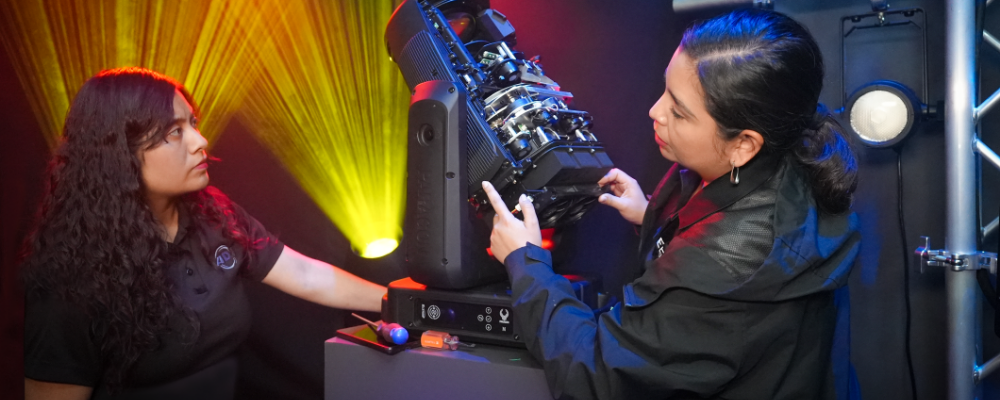
The success of a show is usually measured by what the audience gets to see: a flawless production, perfectly synchronized lighting, and a concert that unfolds without a hitch.
However, behind that apparent normality lies a quiet effort that only takes center stage when something stops working. That is when the real race against time begins.
A fixture that fails just before a tour, a unit that develops a fault in the middle of a busy season, or a customer who needs to recover an essential tool as quickly as possible to keep working. Different situations, but all with one thing in common: someone has to find the solution, do it quickly, and provide enough reassurance so that, on the other end, they know the problem is already in the hands of those who can solve it.
That place is Elation Mexico’s Technical Service Department. A place where routine rarely exists and every day brings a different challenge. Completed projects and applause after the show never arrive there. Instead, it is where questions, urgent requests, and equipment that needs to return to operation as quickly as possible arrive. It is a job that combines engineering, experience, and a deep understanding that behind every fixture there is a production in progress and a company that depends on it.
And few people know that reality as closely as Claudia Peña. After eighteen years with the company, she now leads a team that provides daily support to distributors, rental companies, system integrators, and professionals throughout Mexico. Her experience has allowed her to witness how technology has evolved, how customers’ needs have changed, and how technical service has gone from being simply a department dedicated to repairing equipment to becoming a true source of support for the entire value chain.
Working alongside her is Aylin Bernal, an Electronics Engineer who represents a new generation of professionals who discovered in this industry a field far broader than they had ever imagined.
Their careers began at different times, yet they both arrived at the same working philosophy: learning every day, sharing knowledge, and understanding that every repair also means nurturing a long-lasting relationship with every customer.
One year that turned into eighteen
When Claudia Peña graduated with a degree in Bionic Engineering, her professional future seemed far removed from the entertainment industry. As happens to many young engineers at the beginning of their careers, the challenge was finding an opportunity that would allow her to gain experience and put into practice everything she had learned at university. At that time, the job market offered few opportunities within her specialty, and the alternatives were limited.
An opportunity related to technical service appeared almost by chance. The decision seemed simple and, above all, temporary.
“I accepted and said, ‘Well… one year to gain some experience,'” she recalls with a laugh. “And that year never ended… Over time, I discovered that repairing a lighting fixture meant much more than fixing a specific fault. Behind every unit that arrived at the workshop there was a different story, a production waiting for a solution, and a customer whose operation often depended on getting that fixture back up and running as quickly as possible.”
That realization completely changed the way she understood technical service. It was no longer just about repairing equipment. It also meant supporting people, understanding the urgency of every situation, and responding with responsibility.
Over the years, new challenges emerged. Technology evolved. But one thing never changed: the pressure of knowing that whenever a customer contacts the service department, it is because something has stopped working.
Claudia sums it up with a phrase that is as simple as it is revealing: “When a fixture is working properly, customers don’t even call. All the problems come here.”
More than repairing equipment, sustaining trust
As time went by, Claudia realized that the technical side was only one part of the job. Diagnosing a fault, replacing a component, or updating a fixture are part of the daily routine, but there is another responsibility that is far more difficult to learn: understanding what is happening on the other end of the phone.
Every inquiry comes with a specific need. “For them, a machine that is out of service can represent a financial loss.”
That is one of the reasons why Claudia insists that technical service cannot be limited to repairing products. “Some customers call very worried, and we try to reassure them. First, we understand what’s happening, and then we look for the best solution.”
Over time, she learned that this support begins long before a repaired fixture is returned. It starts with the very first conversation—with the way you listen, ask the right questions, and demonstrate that the person on the other end truly understands the situation.
It was not always easy. At the beginning of her career, many of those conversations included an unspoken test. “Yes, they asked me technical questions… they wanted to know how much I actually knew. But rather than making me uncomfortable, those situations became a motivation.” Over time, that distrust gradually disappeared.
Claudia especially remembers one conversation that has stayed with her to this day. After solving a particularly complex problem, a customer told her, “You’re going to hang up, and you’re never going to call me again,” she recalls with a smile. “That was when I realized he wasn’t talking about the fixture. He was talking about the responsibility he was placing in me.”
It is a philosophy that Claudia has built step by step and now strives to pass on to everyone who joins the team.
“It doesn’t matter who finds the answer first. What matters is that the customer chooses us again.”
And perhaps that is the greatest paradox of technical service. The better it does its job, the less visible it becomes to the rest of the industry. The shows go on, the fixtures return to the stage, and the equipment continues to perform. The audience will never know there was ever a problem.
But according to Claudia, “That anonymity isn’t a disadvantage. On the contrary, it’s the clearest sign that the job was done well.”
Two generations, one shared philosophy
There is something Claudia repeats several times throughout the conversation, and it helps explain how she understands her role as a leader. After so many years solving problems, she discovered that the greatest challenge is no longer simply repairing equipment, but preparing others to do the same.
For that reason, mentoring people has ceased to be a secondary task and has become part of her everyday responsibility.
“When I graduated from university, I needed someone to trust an inexperienced engineer and give me an opportunity. That changed my career. That’s why I enjoy teaching and sharing what I’ve learned. If someone believed in me when nobody knew who I was, why shouldn’t I do the same for those who are just getting started?”
That philosophy explains the arrival of Aylin Bernal, an Electronics Engineer who joined the Technical Service Department just over a year ago. Electronics was her field of interest. Professional lighting appeared as a job opportunity that would ultimately reveal a world far broader than she had imagined.
“I thought it was a very small niche, but as you move forward, you realize it’s actually incredibly broad. Every detail is fascinating.”
For someone just starting out, that process could easily feel overwhelming. However, according to Aylin, “In this work environment, asking questions is not a weakness; it’s a natural part of learning. In an area where new problems arise every day and where there often aren’t immediate answers, learning also means researching together, discussing ideas, and building solutions. Here, everyone learns from everyone else.”
For Aylin, that trust also meant taking on responsibilities much sooner than she had expected. Not long after joining the team, she began participating in technical training sessions for customers.
Speaking in front of professionals with many years of experience in the industry could have been intimidating. However, the support of the team turned that concern into an opportunity to continue growing.
Claudia watches that process with a mixture of satisfaction and pride. Not because she sees her own journey reflected in it, but because it confirms that the department can continue evolving through new generations of professionals capable of taking on ever greater challenges.
Without a doubt, it is a way of working. And, above all, a way of building the future.
That approach to service is also reinforced by the vision of Abraham Levit, General Manager of ADJ Product Group Mexico. Both Claudia and Aylin highlight that his leadership has been fundamental in creating an environment where continuous training, knowledge sharing, and professional development are part of everyday work.
Leadership that drives growth
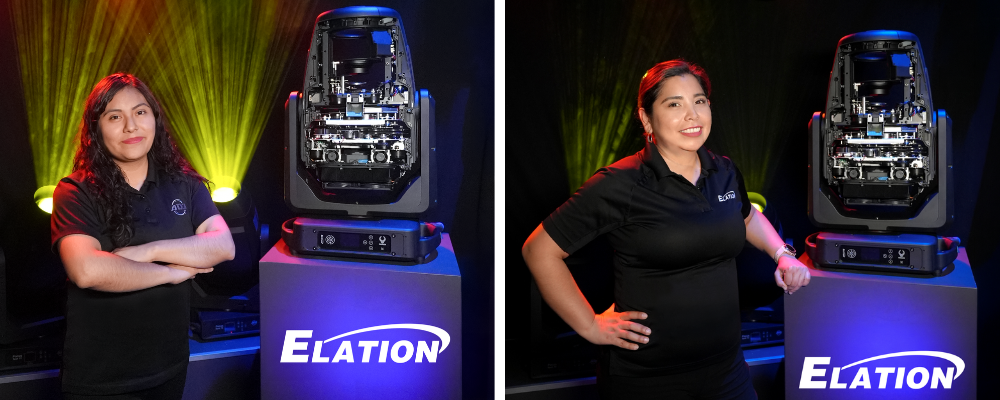
Over the course of nearly two decades, Claudia Peña Núñez has seen virtually every aspect of the business evolve. Lighting fixtures have changed, light sources have advanced, new communication protocols have emerged, equipment has become increasingly sophisticated, and the pace of innovation has accelerated year after year.
What once remained current for many years is now constantly being renewed, requiring technical departments to stay in continuous training.
However, when asked what has changed the most over all these years, her answer is not about technology.
She talks about people.
She talks about the way the industry has opened its doors to new professional profiles, about the growth of increasingly diverse teams, and about the satisfaction she feels when she sees people who arrived looking for their first opportunity now taking on responsibilities that once seemed far beyond their reach.
“It used to be very unusual to see women in certain positions. Today you see women doing rigging, programming consoles, working in technical service… and that makes me incredibly proud. The only things that remain essential are preparation, curiosity, and the willingness to keep learning.”
That same conviction also defines the way she leads her team.
And it is a philosophy that Aylin experienced from her very first day. Rather than finding a competitive environment or one defined by rigid hierarchies, she discovered a team willing to support her through every stage of the learning process. Questions were never a problem. Neither were mistakes, as long as they became an opportunity to improve.
While Claudia shares years of experience, Aylin brings a fresh perspective, new questions, and a different way of approaching technology. That constant exchange keeps the team evolving and prevents knowledge from becoming static.
After all, no one ever stops learning in a department where innovation is part of everyday work.
Far from becoming a barrier, the generational difference has become one of the team’s greatest strengths. While Claudia contributes nearly two decades of experience, Aylin brings a fresh perspective to an industry that continues to evolve.
Both agree that it is this constant exchange that allows them to keep growing.
“There is room for everyone to succeed.”
After eighteen years, Claudia has reached one certainty: the true value of experience does not lie in accumulating answers, but in sharing them. Because the Technical Service Department at Elation Mexico contributes far more than simply returning a lighting fixture to the stage. It builds a way of working, develops professionals, and leaves behind knowledge that endures long after every repair has been completed.
Knowledge that endures
Beyond the technology and the equipment that passes through the workshop every day, the true impact of Elation Mexico’s Technical Service Department is built elsewhere: in people.
Every repair represents an opportunity to support a customer, train new professionals, and pass on a way of working in which experience only gains value when it is shared.
Because when the lights come back on and the show finally begins, almost no one thinks about the people who made it possible.
And for them, that remains the clearest sign that they have done their job well.
Credits
Cover Photo: Polo Nuncio
Inside Photos: Polo Nuncio
The journalistic production, research, writing, editorial approach, and editing of this content are original works by LATAM STAGE and are protected by copyright.
No part of this content may be reproduced, copied, distributed, adapted, or published, in whole or in part, in any medium or format, without the prior written authorization of LATAM STAGE.


