
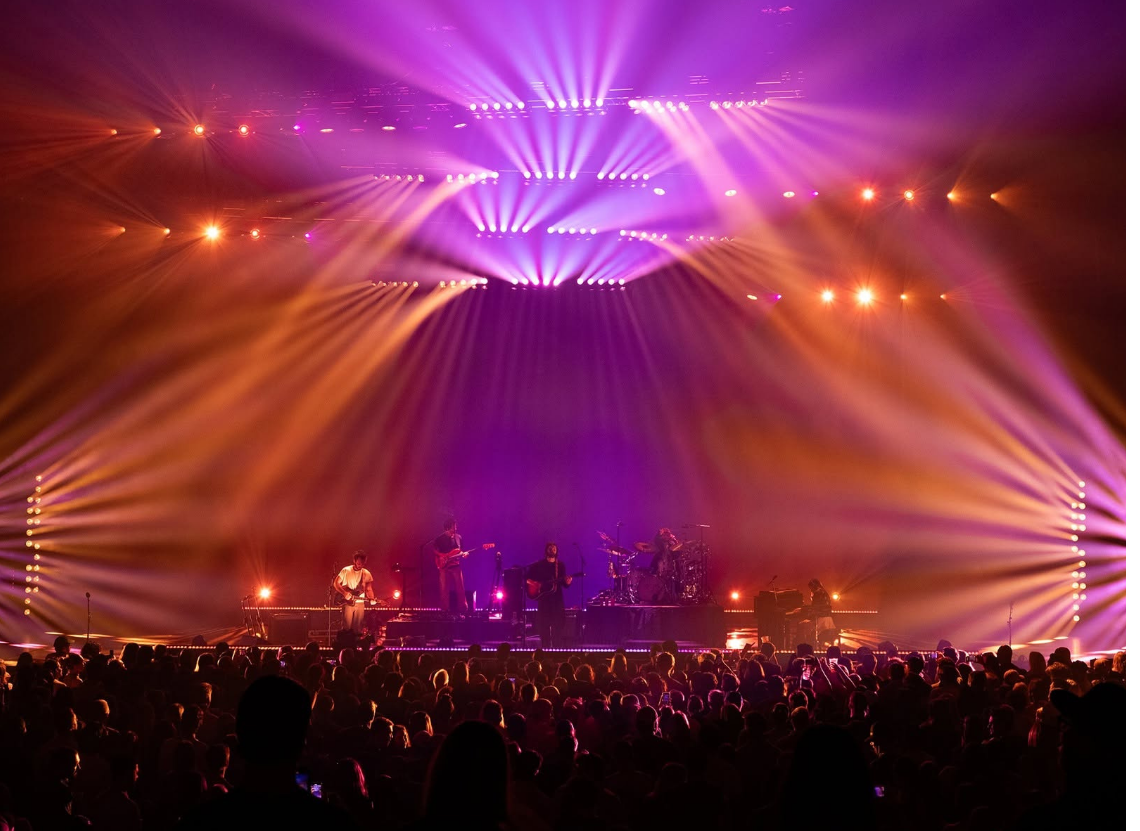
USA – Authenticity exerts a special sway over emotions, being far more powerful, say those who study such things, than sheer force, brilliance, wit and other more glitzy attributes at touching hearts. Perhaps this may be one of the reasons why Mt. Joy has earned such an intensely devoted following since the band first appeared 10 years ago. Sure, the brilliant musicality is there with the distinctive vocals, groovy jams and gnarly guitar solos, but beyond that there is also the distinct authenticity of the band’s music and live performances, a quality that moves fans and reminds them each time why they love going to concerts.
LIGHTSWITCH’s John Featherstone understands this power, which is why he and his colleagues Ignacio Rosenberg and Haley Featherstone, worked diligently to reflect the essence of the band’s character in their production and lighting design for the current Hope We Have Fun Tour.
“Mt. Joy live somewhere between intimacy and lift-off,” said Featherstone. “They’re not a “look at me” band—they’re a “come with us” band. The lighting has to honor that, and Cory Sperry, the bands long time Lighting Director, makes sure everyone is along for the ride!”
In keeping with this vision, the design team, created a rig that was asymmetrical. “We leaned into asymmetry because Mt. Joy aren’t a symmetrical band,” explained Featherstone. “Their music has a looseness to it—beautifully imperfect, slightly off-center, human. A perfectly balanced rig would feel too polite, too predictable. By breaking the grid, the rig breathes more like the music. It creates tension and release, pockets of focus, and a sense that the show is evolving rather than repeating. It also gives us more compositional flexibility—every song can feel like it’s found its own shape rather than being forced into one.”
Playing a role in this diverse and carefully curated rig were 31 CHAUVET Professional Color STRIKE M motorized strobe-blinders. The majority of these fixtures are integrated into the overhead system, while the remainder are strategically places on the trusses behind the vanish screen to provide added texture.
“What they give us is punch without harshness,” Featherstone said of the Color STRIKE M units. “That fixture sits in a lovely space—it can be a classic audience blinder, but it’s also capable of color and nuance. We used them as emotional punctuation. When the band hits a chorus or a musical peak, they don’t just light it—they announce it. But because we can color them, they still feel part of the palette rather than a bolt-on effect.”
Like the Color STRIKE M, most of the tour’s rig is in an overhead system. There is a limited floor package. This is because, the designers wanted to keep the band clearly visible and connected to the audience, not “boxed in by a forest of fixtures,” according to Featherstone.
“Also, we felt that having a limited floor package gave us the desired tone for this band,” elaborated Featherstone. “Floor packages can very quickly tip into something that feels more ‘showbiz’ than ‘band.’ There was also a pragmatic element – fewer fixtures on the deck means faster changeovers, cleaner touring, and less visual clutter. Every unit that is there has a job to do.”
The designers also went with soft gradients and hue choices for this show, often conveying the sense of nature that runs through Mt. Joy’s music. “We deliberately avoided hard color cuts most of the time,” said Featherstone. “The music feels more like a slow blend rather than a sharp turn, so the palette leans into gradients—colors that drift into each other rather than snap. Austin Schneider, our amazing programmer, is a master of this.”
Flexibility was also an essential element of the lighting design, allowing it to follow what Featherstone calls “the emotional arc” of the band’s music. “There is a warmth and vulnerability in the verses,” he says, “then these expansive almost euphoric moments when everything opens up.” It is a range of emotions, joined together by a common denominator that runs through them – something best described as genuine!


