
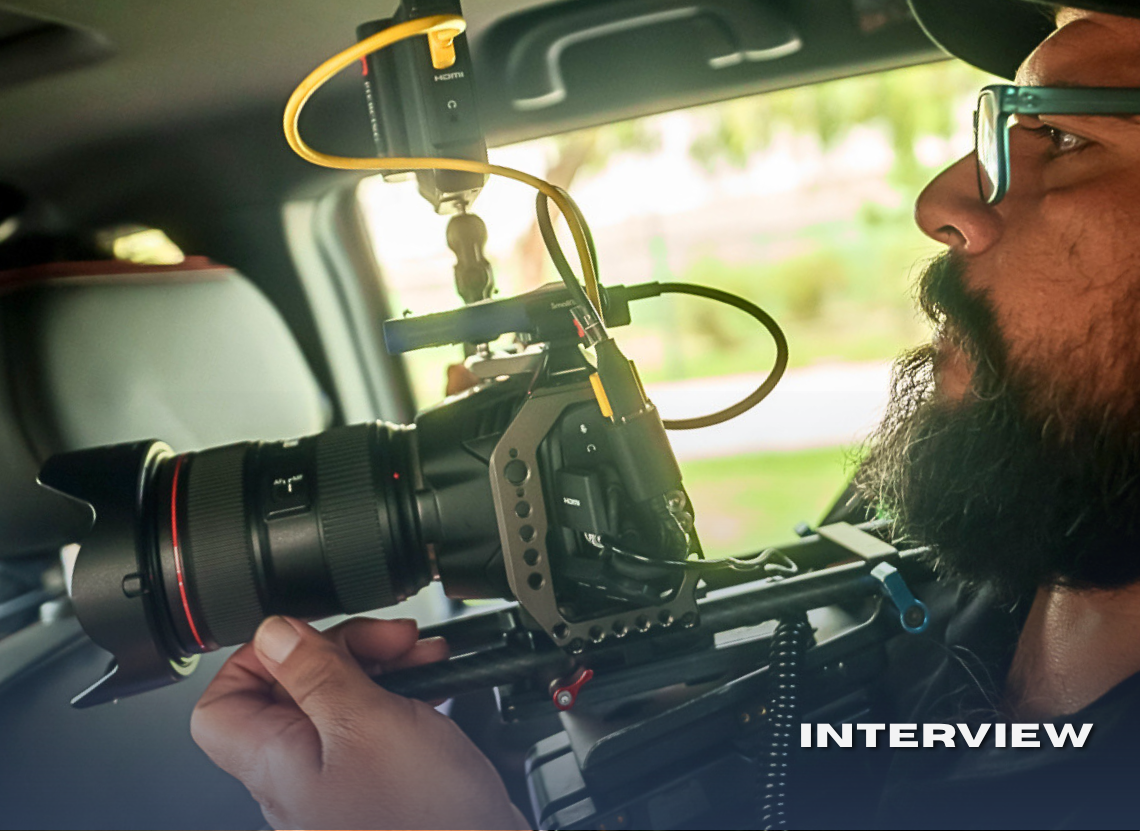
For more than two decades, Robert Díaz has worked across virtually every area of the audiovisual industry: sound, theater, post-production, television, directing, color, and production. But behind each stage, the same concern remained: finding a visual identity of his own and new ways of telling stories. That search eventually crossed paths with Blackmagic Design, making the brand an inseparable part of his work, Insomnia Films, and a philosophy that sees technology as a tool, but never as a substitute for creative judgment.
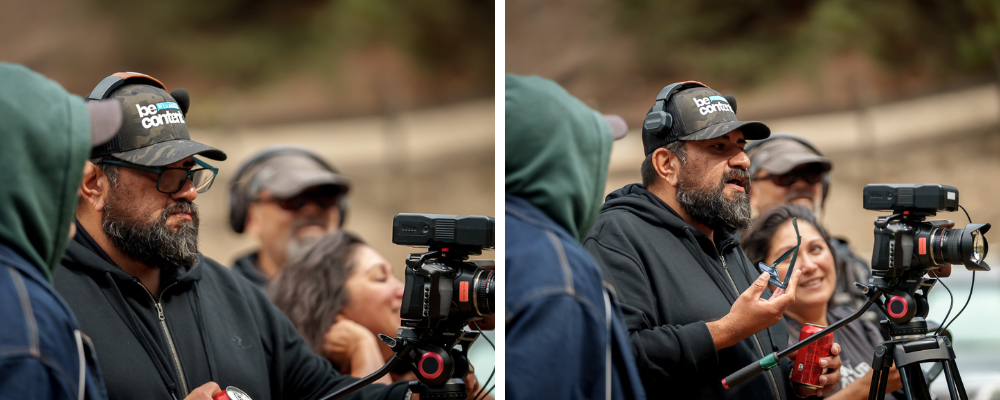
Before becoming the man many in Chile directly associate with Blackmagic Design, Robert Díaz was a sound engineer, post-producer, audiovisual director, DVD and Blu-ray authoring specialist, colorist, and filmmaker. His journey could hardly be described as a straight line. Rather, it seems like a succession of experiences that, over time, eventually converged into a comprehensive perspective on the audiovisual industry.
Born in Santiago, Chile, in 1979, he studied audiovisual communication with a specialization in post-production and later earned a degree in Arts with a specialization in Sound. His first professional experience in television came as an intern at Canal 13, where he remained until 2002. Then came one of those turns that would become common throughout his career: he temporarily left television to become audiovisual director at Matucana 100, one of Santiago’s most renowned cultural centers.
In 2005, he changed direction once again and went on tour as a sound engineer with the theater company La Tropa. The experience was brief, but his connection with the performing arts continued and, after the company disbanded, he participated in Gulliver, a production that would later remain on stage in France for several years.
Upon returning to Chile, he continued working in cultural spaces. From there came another unusual specialization: DVD and Blu-ray authoring, meaning the construction and design of the internal structure of those physical formats.
“I think I was one of the few people doing DVD and Blu-ray authoring in Chile.”
That knowledge led him to Cinecolor Chile, where he worked on different films and productions, and eventually opened the doors of Canal 13 to him once again. Díaz worked on the DVD editions of the first seasons of Los 80 and, shortly afterward, received an offer to return to the channel, this time as a post-producer.
In a way, it meant returning to the starting point with many more tools. “I went back to where it all started.”
And it was precisely there that he ultimately confirmed where he wanted to take his career.
“Working on Los 80 was a very important milestone in my desire to create audiovisual content. But I realized that I could tell other kinds of stories, more along the documentary side. So I started doing each of these things while looking for the corresponding technology.”
Today, all that experience converges at Insomnia Films, his own production company, where he produces television programs, commercials, music videos, and other audiovisual pieces. His current projects include De Plata en Plata, Incluidos for Canal 13C, and new projects connected to Mega’s B-Content division, focused on commercials and advertising-oriented audiovisual content.
“Insomnia was born out of the need to do things differently from what I was working on. When I started in television, at a very young age, I decided that having my own production company would allow me to do my own projects outside the channel: music videos, small projects, explore photography, and find a way to become a director in the future.”
And more than twenty years later, that same drive continues to define his work.
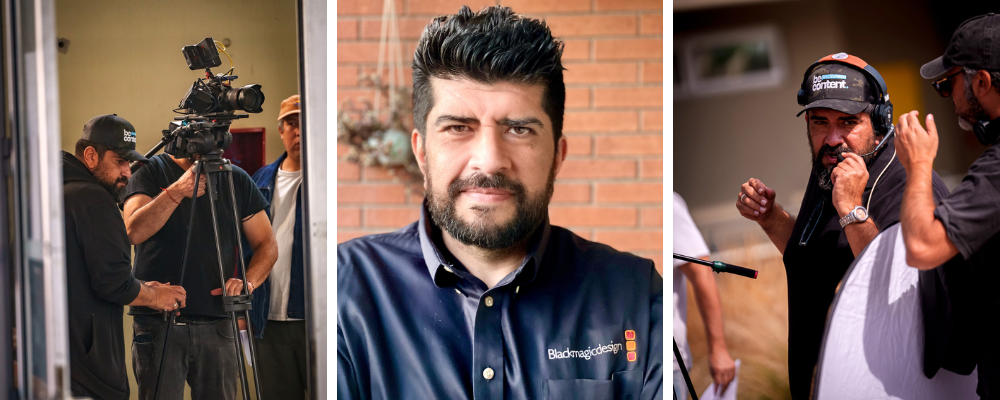
Blackmagic Design and the search for an image that did not look like television
Díaz did not come to Blackmagic Design looking for a brand. He came looking for an image.
“My goal has always been to pursue a certain aesthetic in the image. I have always tried to achieve a more cinematic result. As Latin Americans, we always look toward the biggest powerhouse in Latin America, which is Brazil, and I kept wondering how they achieved the look of their telenovelas.”
The research led him to understand that it was not simply about the type of camera, but about the entire treatment of the image. And if he wanted to move closer to a cinematic aesthetic, he needed tools that would allow him to experiment with a different approach. That was when the option of buying a Blackmagic Design camera appeared.
He started with one of the company’s first cameras and quickly began experimenting with it within the channel. Then came the URSA Mini 4K, and the tests began to become increasingly ambitious.
That process also produced a concrete result within Canal 13. Preciosas became one of the projects Díaz remembers as a milestone in that transition, introducing a 4K fiction workflow with Blackmagic Design technology at a time when this type of production still represented a significant change within Chilean television.
From the camera to DaVinci Resolve without leaving the workflow
Currently, Insomnia Films’ main workflow relies on two Pocket Cinema Camera 6K cameras and a PYXIS 6K, regularly used in its television productions. But talking only about cameras would considerably reduce the role Blackmagic Design plays in his work today.
The integration continues throughout the entire post-production process. “Everything is done in DaVinci. We shoot with Blackmagic and finish in DaVinci. As my American friends say, ‘from glass to glass’.”
For someone who has gone through different stages of post-production and spent years working with workflows built around multiple applications, that integration represents one of the company’s greatest advances.
“It is very well designed so that the filmmaker can do everything with Blackmagic and does not have to leave that ecosystem, because it is convenient, very stable, gives you security, peace of mind, and, on top of that, quality. You can use it for anything from a podcast to making a series for Netflix, Amazon, or HBO. It has been proven time and again.”
He is not speaking hypothetically. Insomnia uses Blackmagic Design in television, but Díaz also works on podcasts and mentions his experience with CNN Chile, where this type of content is also produced using the brand’s technology.
Of all the recent transformations, however, there is one that stands out for him: “I think that software unification is the most powerful thing Blackmagic has done recently.”
“For years,” he explains, “an editor could start on one platform and be forced to move to another application to handle graphics, compositing, sound, or color, only to then export and import the files again. Resolve progressively brought those stages together within the same workflow.”
But Díaz also observes this evolution from the hardware side. Having used different generations of cameras has allowed him to closely follow the development of Blackmagic Design’s sensors and the way the company has scaled from those early solutions he began experimenting with to much larger-format, higher-resolution digital cinema systems.
For someone whose introduction to Blackmagic Design was motivated precisely by the financial impossibility of accessing certain cinema cameras at the time, that evolution has a special meaning: the possibility of working today with increasingly advanced tools without abandoning the philosophy of accessibility that initially drew him to the brand.
Artificial intelligence adds another dimension to this. Díaz particularly highlights one difference: “The good thing about DaVinci’s AI is that it helps you solve processes; it doesn’t replace them. It really helps turn tedious processes into faster ones.”
Among the examples he mentions is Multicam SmartSwitch, which assembles a timeline using different camera angles according to the person who is speaking.
When it comes to the camera, his essential tools are much more straightforward. When asked which function he cannot do without, he immediately replies: “False Color. I can’t live without it.”
He uses it to control exposure on the sensor and complements it with Focus Peaking to check focus. Two monitoring tools that, for Díaz, are essential when making decisions during capture.
That same logic appears when someone asks him which Blackmagic Design camera they should buy to start a production company.
His first answer is not a model. “It will depend a lot on your final output. What do you want it for? Television, cinema, podcast? It will depend a lot on what you need to tell.”
For a production company focused on content for platforms, his approach is to start with a larger-format, higher-resolution camera—he mentions options such as the PYXIS 12K or URSA Cine 17K 65—to capture at the highest possible quality and then adapt the material to its different destinations.
“Blackmagic cameras are versatile. You can do anything depending on the accessories. Even the smartphone has become part of my workflow. I use the Blackmagic Camera App as a production tool and have even used the phone as a second camera on television projects.”
The concept remains the same: there is no single valid tool. There is a narrative need and, afterward, a tool capable of addressing it.
The professional who works alone, but is never really alone
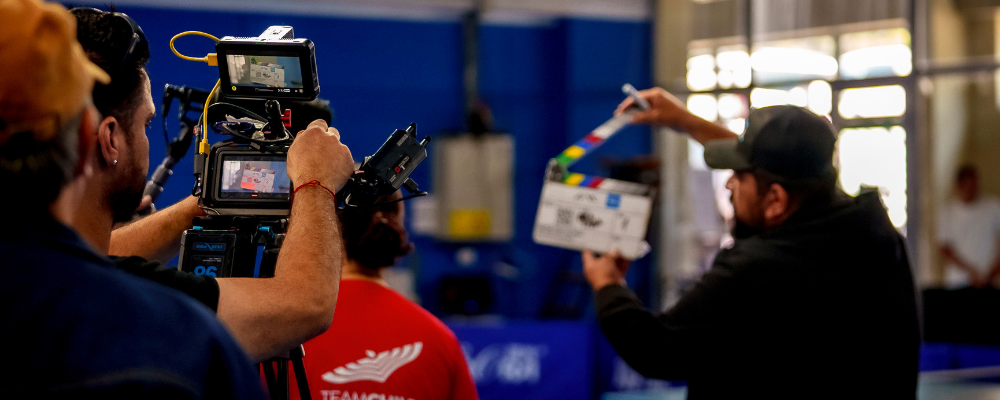
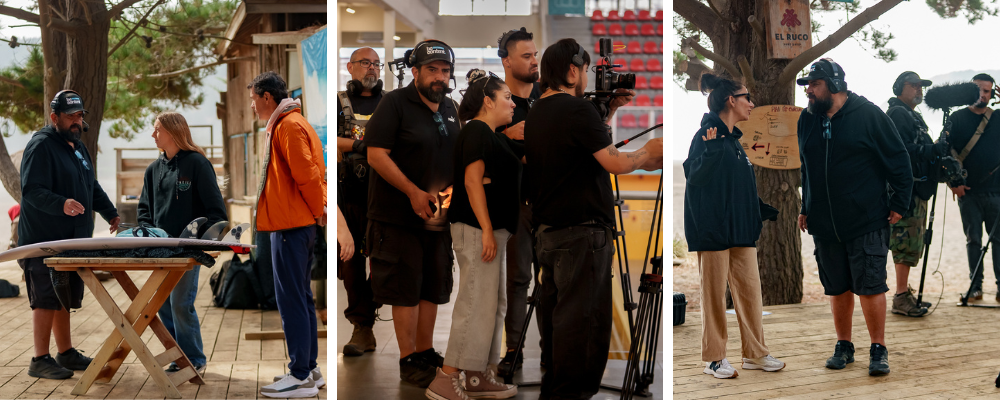
There is an apparent contradiction in Robert Díaz’s work. For much of his career, he has operated as a one-man crew. He shoots, edits, does color, sound, and even directs. But that autonomy does not mean isolation.
Quite the opposite.
“Working alone forces you to be very organized, but also to know when you need help. There are things you can solve by yourself and others where you need to rely on people who know more than you do.”
That philosophy has led him to build a network of collaborators with whom he works depending on the needs of each project.
For Díaz, the key lies in understanding that technology can make a workflow more efficient, but it does not replace the experience and perspective that each professional brings to a production.
“I can do many things by myself, but that doesn’t mean I always should. Sometimes the best decision is to bring in someone who specializes in a particular area because that person is going to make the project better.”
That same idea also defines his relationship with training.
Throughout his career, Díaz has maintained a strong connection with education, both as a student and as someone who shares his own experience with other professionals.
He believes that one of the most important transformations in the audiovisual industry has been the democratization of access to knowledge and technology.
“When I started, learning how certain things were done was much more difficult. Today you have access to tutorials, courses, forums, and communities where people share information all the time. That completely changes the way new generations enter the industry.”
But having access to information does not necessarily mean knowing how to use it.
For Díaz, the real challenge lies in developing judgment.
“You can watch a thousand tutorials, but at some point you have to understand why you are making a decision. Why you choose a certain lens, why you expose in a certain way, why you move the camera, or why you decide not to move it. That is where experience comes in.”
And that is perhaps one of the ideas that best summarizes his relationship with technology.
Tools evolve. Cameras change. Software incorporates new functions. Artificial intelligence accelerates processes that once took hours.
But the responsibility for deciding what story to tell and how to tell it remains in the hands of the creator.
“Technology gives you possibilities, but it doesn’t tell you what to do with them. That decision is still yours.”
Technology as a language, not as the story
After more than two decades moving between sound, television, post-production, directing, and filmmaking, Robert Díaz has reached a point where technology is no longer the destination of his search.
It is the language through which he expresses it.
Blackmagic Design became part of that journey because its ecosystem allowed him to connect different stages of the creative process without losing control over the final image.
From the first cameras he experimented with at Canal 13 to the Pocket Cinema Camera 6K, PYXIS 6K, DaVinci Resolve, and the Blackmagic Camera App he uses today, each tool has become part of a workflow that continues to evolve alongside his own way of telling stories.
But when Díaz talks about his work, the conversation always returns to the same place.
The image. The story. The reason behind every technical decision.
Because after years of testing cameras, learning new software, exploring formats, and adapting to an industry that never stops changing, one principle remains intact.
Technology can transform the way a story is produced.
But it is still the person behind the camera who decides what that story means.
“My generation looked for ways to tell stories and how to tell them in the best possible way. Now, because everything is so simple, filmmakers have unfortunately ended up oversimplifying things and focusing too much on immediacy and speed.”
That is precisely why he considers spaces such as Blackmagic Week, and the commitment of a partner like MMT, so valuable.
“Not everything is automatic. You have to understand that cinema comes from somewhere else. Not everything can rely on autofocus, not everything can be automatic. You have to find your own language.”
For Díaz, expanding access to technology does not mean automating creativity, and it is precisely there that he recognizes one of Blackmagic Design’s greatest contributions: putting professional cameras, software, accessories, and tools within reach of independent producers, students, small studios, and new creators. “I believe democratizing audiovisual production is what Blackmagic has achieved through the way it works,” he says, highlighting an ecosystem that makes it possible to achieve professional results with more accessible investments.
For him, that accessibility explains why many young attendees come to events such as Blackmagic Week looking to make the transition from a stills camera to a cinema camera. They are no longer asking only what a piece of equipment can do, but how much of what much more expensive systems offer they can achieve within an affordable investment.
For Díaz, access to technology gains real value when it is accompanied by curiosity and constant learning. “We’re good with technology here. We like talking about technology, we like learning about technology,” he says about Chile, finding an example of that attitude in Claudio Jara, a former professor of his who continues to attend Blackmagic Week to discover new tools and bring them to his students.
That same philosophy runs through the way he shares knowledge: “I think I pass on knowledge better to people who come to work with me. Rather than teaching a class, I prefer to work with that person.” And he sums it up with a simple idea: “I believe children and adults learn by playing. And these are our toys now: our cameras and our computers.”
The search never ends
After more than twenty years of experience, Robert Díaz continues to approach technology in practically the same way he did at the beginning: testing, researching, and asking himself what else he can do with it. Blackmagic Design now occupies a central place in that process, not only because of the tools he uses every day at Insomnia Films, but also because of everything he has learned around an ecosystem that, he says, has also led him to expand his own way of working.
That experience extends to his relationship with MMT, a Blackmagic Design partner in Chile, and to spaces such as Blackmagic Week Chile, where contact with other professionals and new generations once again brings learning to the forefront.
But sharing what he has learned does not mean he has finished learning. Robert continues to approach every new technology with curiosity and, above all, by considering what it can contribute to a story.
At the same time, his next creative search is once again taking him into different territory. “I want to explore vertical fiction. I want to make a vertical fiction project.” The project already has a script and proposes combining real actors with artificial intelligence and virtual reality elements. “I want to combine artificial intelligence with human acting. There is a mix of virtual reality, AI, and flesh-and-blood actors.”
That is precisely why his enthusiasm for new tools coexists with a conviction he has built through experience: technology can accelerate processes, expand possibilities, and make resources that once seemed out of reach more accessible, but judgment remains in the hands of the creator.
And then comes a phrase that summarizes much more than his position on artificial intelligence. In a way, it summarizes his entire journey.
“We need to return to artisanal intelligence, not artificial intelligence.”
There is no contradiction in hearing this from someone who works with AI, experiments with new formats, and has built much of his career around Blackmagic Design. On the contrary: for Díaz, evolving technologically has never meant stopping thinking, researching, or searching for a language of his own.
Blackmagic Design gave him new tools to do so; experience, encounters with other professionals, and spaces such as those promoted together with MMT continue to fuel that learning. After more than two decades, technology continues to change, but his starting point remains intact: first understand what he wants to tell, and then find the tool capable of making it possible.
Credits
Cover Photo: Robert Diaz
Inside Photos: Robert Diaz
The journalistic production, research, writing, editorial approach, and editing of this content are original works by LATAM STAGE and are protected by copyright.
No part of this content may be reproduced, copied, distributed, adapted, or published, in whole or in part, in any medium or format, without the prior written authorization of LATAM STAGE.


