
For decades, lighting was the undisputed protagonist of a show’s visual design. Today, the stage has changed. LED screens, multimedia content, real-time graphics, and immersive experiences have transformed the way emotions are created. In this new reality, true innovation is not only about controlling more equipment, but about making all the technology work as a single creative tool.
The stage is completely dark. Thousands of people wait for the first beat of music. For a few seconds, everything seems frozen. Then something happens that the audience perceives as a single moment: a screen comes to life, a beam of light cuts through the space, an image appears at exactly the right moment, and dozens of fixtures react in sync with the music.
For those in front of the stage, it is an emotion. A feeling. A memory. But behind that apparently simple moment lies enormous technological complexity.
Hundreds of different devices work simultaneously. Lighting systems, media servers, LED screens, video processors, and communication networks exchange information in fractions of a second to build a single experience.
And this is where one of the major transformations currently taking place in the professional entertainment industry emerges.
The audience continues to see a show. But those who create it know that the show is no longer made up of separate elements. Today, light, video, and digital content are part of the same language.
The day lighting stopped being alone
For many years, designing a show primarily meant designing lighting.
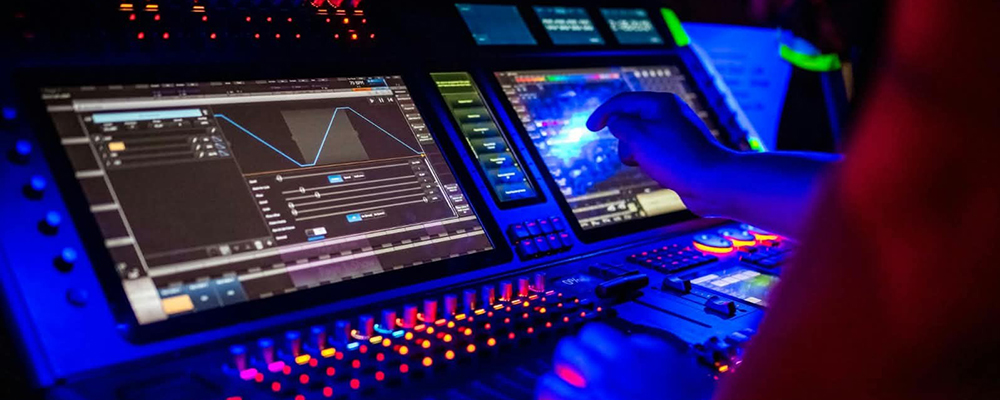
The creative work focused on the selection of fixtures, colors, movements, intensities, and timing. The console was the control center, and the designer built the visual narrative through light.
Video existed, of course, but it occupied a different space. Screens had their own operator. Content was played back from independent systems, and synchronization between the two worlds required planning, communication, and, often, a good deal of patience.
That model worked for decades, until the stage began to change. LED screens stopped being an accessory and became a fundamental part of the visual production. Content stopped being simple decorative backgrounds and became narrative elements. Productions began incorporating live cameras, generative graphics, extended reality, and immersive experiences.
The modern show stopped asking: “What lights do we need?” And began asking: “What experience do we want to create?” That difference changed everything.
The new generation of designers
Today’s lighting designer faces a completely different environment from previous generations. They no longer work solely with light. They work with visual information.
A scene can begin with an artistic idea and develop using hundreds of variables: a video texture that modifies an LED surface, an image that accompanies a lighting movement, a visual effect that responds to music, or content that completely transforms the perception of a space.
Creativity has become broader, but also more complex. Because every new tool incorporated into a show brings with it a new question: How do we make everything work as a single thing?
For years, the answer was to add more systems, more operators, and more coordination processes. But the industry began to understand that adding technology does not always mean simplifying. Sometimes exactly the opposite happens.
Technology should not demand attention
There is a paradox in technological development. The best tools are those that ultimately stop feeling like technology. When a tool works properly, it disappears.
Nobody thinks about the communication protocol when a song moves them. Nobody analyzes the data network when a perfectly synchronized scene generates a reaction from the audience. Nobody remembers the software that made a spectacular moment possible.
And yet, all of it was there. That is one of the major questions facing the industry today: How do we develop increasingly powerful technologies without making the work of those who use them more complex?
The answer seems to lie in a word that has become fundamental in recent years: Integration.
But not integration understood simply as connecting equipment. An integration conceived from the perspective of creativity.
Avolites: a history of constant evolution
This is where Avolites comes in. The British company, which is celebrating 50 years of history, has built its identity alongside the evolution of professional lighting control.
From its earliest generations of consoles to today’s digital platforms, the company has gone through the major technological transformations that have changed the way shows are created.
But the industry once again presented a new challenge. The question was no longer simply how to control more fixtures. The question was: How do we make lighting and multimedia content stop working as two separate worlds?
Avolites’ answer was to develop an ecosystem in which both worlds could coexist within the same working logic.
This is where Ai comes in. But understanding Ai simply as a media server would be to remain at the surface.
Because the real concept behind this platform is much broader. It is not only about playing back content. It is about turning that content into an active part of the show design.
More than a media server: a new way of thinking about the show
When an industry changes, the best solutions do not appear because someone tries to add more functions to an existing tool.
They appear when someone understands that the problem has changed. That is precisely what happens with Ai, the multimedia control platform developed by Avolites.
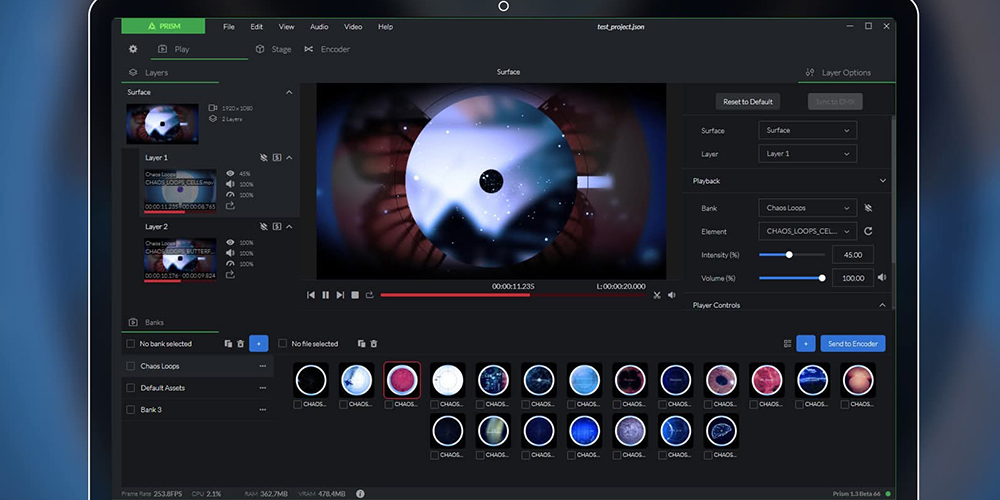
For a long time, media servers were understood as systems responsible for playing back content. They received images, videos, or graphics and sent them to a screen or projector.
That definition remains correct, although today it is incomplete. Because content is no longer a passive element. It is no longer simply about displaying an image behind an artist or accompanying a scene with a video.
Content has become part of the narrative. It can change the mood of a show. It can modify the perception of a space. It can react to music. It can interact with lighting. It can become an extension of the designer’s creativity.
And for that to happen, it needs to stop living in a separate world.
When light and image begin to speak the same language
Let us imagine a modern production. An artist performs a song. The LED screen changes texture. The fixtures change color. A visual effect appears exactly on the beat of the music. A live camera integrates into the content.
Everything happens as if it had been created by a single tool.
For the viewer, it is an experience. For the technical team, it is the complex coordination of multiple systems.
For years, achieving this level of synchronization meant combining different platforms, establishing communication between systems, and developing specific processes for each production.
The evolution of Avolites presents another possibility: that this complexity can be addressed through a single working philosophy.
It does not mean eliminating specialization. It means allowing each specialty to communicate more effectively with the others.
The true value lies in the workflow
When new technologies are discussed, the conversation often focuses on technical specifications.
How many channels. How much power. How many outputs. What resolution it supports.
All of this data is important.
But there is a much more relevant question for those working on a show: Does this technology allow me to create better?
Because a professional does not buy a tool solely because of its specifications. They adopt it because they expect it to solve a need.
A designer seeks creative freedom. A programmer seeks efficiency. A rental company seeks reliability and versatility. An integrator seeks a platform capable of adapting to different projects.
In all these cases, the ultimate goal is the same: Work better.
Titan, Ai, and Synergy: an ecosystem designed to create
One of the central points of Avolites’ strategy is that its platforms were not conceived as isolated products.
Titan, its renowned lighting control system, and Ai, its multimedia platform, are part of the same vision.
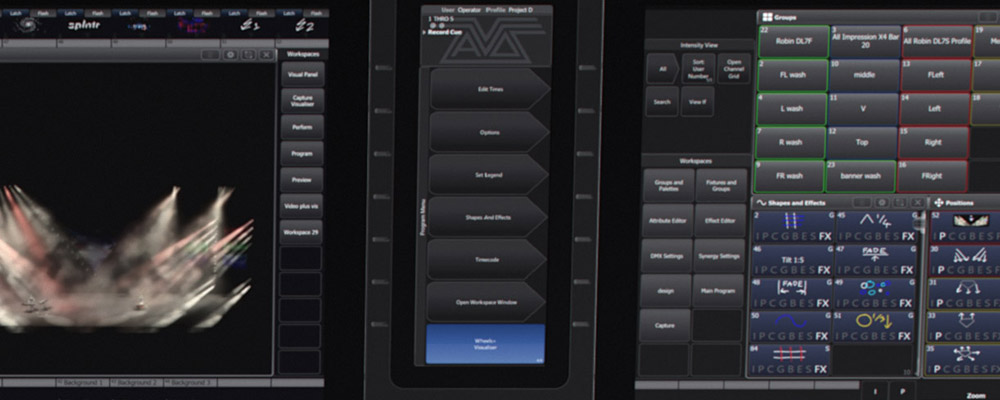
Integration through Synergy allows lighting and content to coexist within the same operational workflow.
And this has a very important consequence: The operator does not need to think about two different shows. There is no lighting show and another video show. There is a single show.
Programming becomes more coherent because the creative intention can be transferred more directly into technical execution.
A lighting change can be accompanied by a visual transformation. Content can trigger a lighting response. A scene can be built by simultaneously considering all the elements that form part of it.
Technology stops dividing the creative process. It begins to bring it together.
Less time solving problems. More time creating.
There is a resource in the entertainment industry that is almost as valuable as the equipment itself: Time.
Today’s major shows do not always have weeks available for programming.
Many times, a tour arrives in a city, unloads equipment, builds structures, conducts tests, and must be ready just a few hours later.
Festivals operate on extremely demanding schedules. Corporate events change constantly. Television demands speed.
In that context, every minute gained during programming represents a creative opportunity.
Because the time that was previously used to solve incompatibilities between systems can now be used to improve a scene, test an idea, search for a different emotion, or make a show memorable.
And this is where one of the major values of an integrated platform emerges: It does not simply make the work more efficient. It expands the possibilities for creation.
The designer as an architect of experiences
Technological evolution is also changing the profile of those who create shows.
The lighting designer of the past had to master light. Today’s designer must understand the relationship between multiple visual languages. This does not mean they need to become an absolute specialist in every technology. But they do need tools that allow them to think holistically.
Lighting has stopped being an island, and video has stopped being an accompaniment. Screens have stopped being simply surfaces onto which images are projected. Everything is part of the same composition.
In this new scenario, integrated platforms do not replace human creativity. They do something much more important: They give it more space. And in this new reality, Avolites has become the foundation of every creative process.
The question is no longer “what equipment do I need”
For decades, the industry built its processes around specific pieces of equipment. A console for lighting. A server for video. A processor for screens. A tool for every need.
But the evolution of the show is taking the conversation somewhere else. The question is beginning to change. It is no longer simply: “What equipment do I need?” Now it is: “What experience do I want to create, and what technology allows me to do it most efficiently?”
That change in mindset is probably one of the deepest transformations currently taking place in the industry.
Because it forces manufacturers, designers, and production companies to look beyond hardware.
To think about solutions. Workflows. The future.
D3: when technological evolution responds to a new reality
The major transformations in the industry rarely happen overnight. They do not simply appear because a company introduces a new product.
They happen because the market has changed. Because professionals need new tools. Because the way experiences are created is no longer the same.
The arrival of Avolites’ D3 Series should be understood within that context.
Not as a replacement for previous technology, but as the logical evolution of a vision that began years ago: developing platforms capable of supporting the growing integration between lighting, video, and multimedia content.
Today’s shows demand much more. More resolution. More content. More surfaces. More creative possibilities.
But, at the same time, they need something that seems contradictory: More power with less complexity. That is one of the major technological challenges facing the industry today.
The future will not be about controlling more equipment
For a long time, technological evolution was measured according to a very specific logic: More channels. More processing. More capacity. More functions.
And, without a doubt, those advances were fundamental in allowing shows to reach their current level.
But the next stage seems to be defined by another concept. The intelligence of a system will no longer be measured solely by how much it can control. It will also be measured by how much it can simplify.
Because in a modern production, the problem is usually not a lack of technology. Many times, the opposite is true. There are too many technologies available.
The real challenge is getting all of them to work together efficiently. The industry does not only need more powerful tools. It needs smarter tools.
D3 and the new generation of visual productions
In this scenario, the D3 Series represents a new chapter in Avolites’ development.
A platform prepared to respond to productions where visual content occupies an increasingly important role and where integration has stopped being an additional feature and become a necessity.
The new generation of media servers arrives at a time when the boundaries between disciplines continue to disappear.
A concert can incorporate elements traditionally associated with cinema. A television production can use resources from a live show. A corporate event can become an immersive experience. An architectural space can become a narrative surface.
The possibilities are constantly expanding, and technology must support that evolution. But there is something more important than technical power: The ability to adapt.
Because nobody knows exactly what shows will look like ten years from now. What we do know is that they will be different. And the platforms that survive will be those capable of evolving alongside them.
The most important investment is the one that looks ahead
For a production company, rental company, or integrator, adopting a new technology is always a strategic decision.
It is not simply about purchasing equipment; it is about investing in a way of working.
In an industry where tools evolve rapidly, choosing a platform prepared to grow represents a competitive advantage.
Because a system should not only respond to today’s show. It should be prepared for the show we have not yet imagined.
That is one of the most relevant aspects of the ecosystem developed by Avolites.
The investment is not limited to a specific function. It is related to a working philosophy, to a way of facing the challenges that lie ahead.
Fifty years of evolution looking toward the future
Reaching fifty years in the professional entertainment industry means having gone through some of the most important technological transformations in the history of live entertainment.
Avolites began its journey at a time when lighting had a very different relationship with technology.
Since then, the industry has gone through the transition to digital control, the arrival of LED, the incorporation of networks, automation, and the explosion of multimedia content.
Each stage presented new challenges. And each stage required a new way of thinking. Today, the challenge is changing once again.
The question is no longer how to control a fixture. The question is how to build an experience where all visual elements form part of the same story.

Technology that does not seek to be the protagonist
Perhaps the greatest paradox of innovation applied to live entertainment is this:
The best technology is the technology that manages to disappear.
Because when a tool works really well, it stops drawing attention.
The audience does not remember the media server. They do not remember the console. They do not remember the systems that made the experience possible.
They remember the emotion, the moment. The feeling of having experienced something special.
And that is the true measure of technological success. Not how many functions a platform offers. But how many creative possibilities it allows users to develop.
In that sense, Avolites enables creations ranging from stadiums to broadcast, from rock to opera.
An old Avolites advertisement carried the slogan “Making light work”. Today Avolites goes much further: “it is about making light and the entire visual canvas come alive.”
Avolites provides visual control of creativity, allowing users to create a configuration that adapts to their needs.
The new language of live entertainment
The entertainment industry has always been driven by one pursuit: Finding new ways to create emotion.
Light was one of them. Music was another. Image. Movement. Scenography.
Today, all these disciplines are beginning to converge. The show of the future will not be defined by a single technology. It will be defined by the ability to integrate them.
That is why the evolution proposed by Avolites represents much more than a new generation of tools. It represents a different way of understanding creation.
A vision in which lighting, video, and multimedia content stop competing for space and begin working together to build something greater.
Because in the end, the goal was never to control more equipment. The goal has always been to tell better stories. And in that pursuit, technology finds its true purpose: Not to replace creativity, but to give it new ways to express itself.
Credits
Cover Photo: Avolites
Inside Photos: Avolites
The journalistic production, research, writing, editorial approach, and editing of this content are original works by LATAM STAGE and are protected by copyright.
No part of this content may be reproduced, copied, distributed, adapted, or published, in whole or in part, in any medium or format, without the prior written authorization of LATAM STAGE.


