
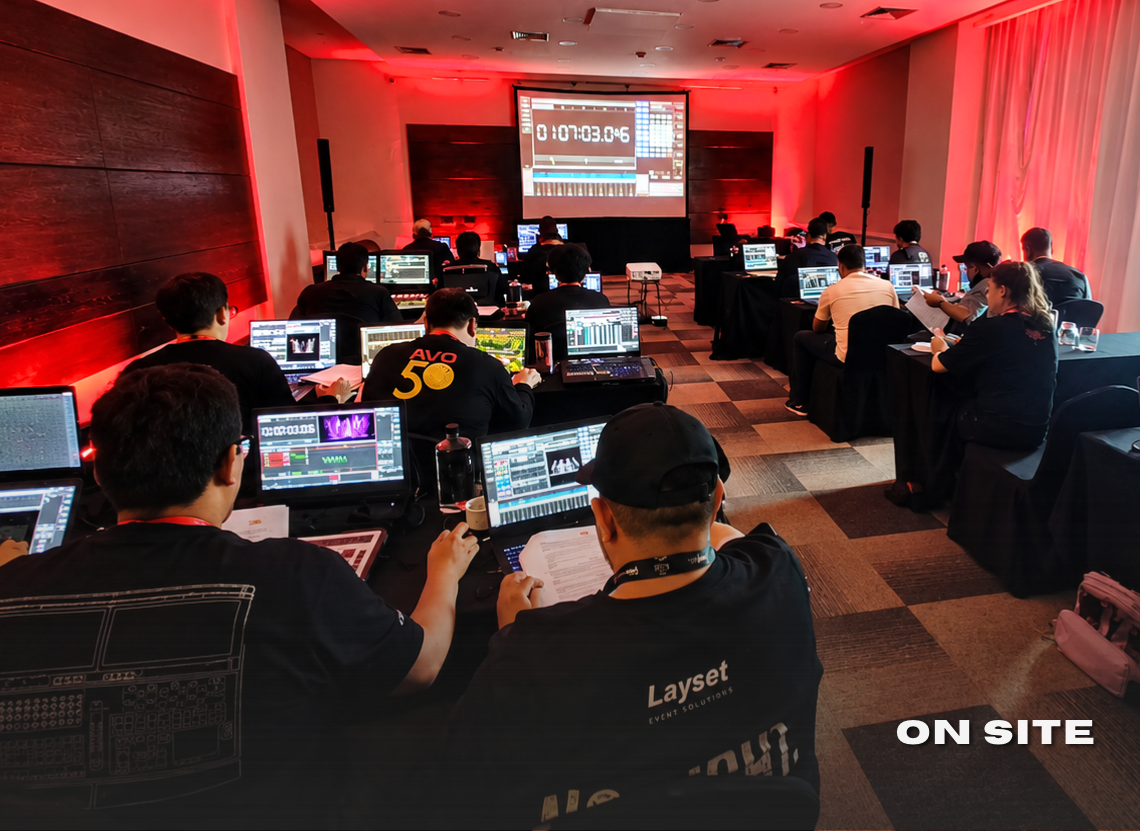
In the Dominican Republic, Avolites once again brought together professionals from different Latin American countries for a new edition of AvoCamp. Three intensive days of training, programming, design, lighting and certification that reflect a much deeper evolution: moving from teaching how a console works to contributing to the professionalization of those who work behind it.
Learning a console can be relatively simple. Learning how to create lighting is something else. Between these two ideas there is a difference that may seem subtle, but is fundamental to understanding where professional training in the entertainment industry is heading. A console is a tool; lighting is a language that combines technique, knowledge, creativity and sensitivity.
That seems to be precisely the direction AvoCamp has taken, the training program developed by Avolites together with Kyo Academy, the educational arm of Kyo Production. What began as an initiative focused primarily on the Titan operating system grew into a program that integrates programming, design, lighting theory, visualization and certification.
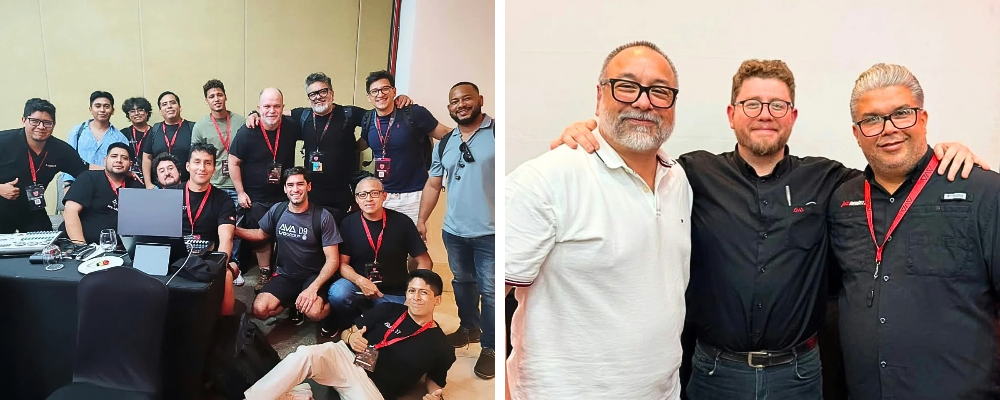
The recent edition held at the Catalonia Hotel in Santo Domingo once again highlighted this change. Over three days, 27 participants from 10 Latin American countries shared training and experiences in an activity that, in addition to technical learning, seeks to build something that is not always easy to find in the industry: a community of professionals willing to share knowledge.
Five years of evolution
For Francisco Yañez Valdivia, Avolites Area Manager for Latin America, AvoCamp has become a particularly relevant moment within the brand’s strategy in the region. “It is a good time to educate users and also standardize work methodologies with the Titan software,” he explains.
But the intention goes beyond teaching functions. AvoCamp brings together professionals from different areas of lighting: concerts, theater, television, broadcast and other segments. This diversity transforms the training into a space where participants learn not only from the instructors, but also from the experiences of other professionals.
Yañez specifically highlights this aspect as one of the program’s most valuable results. Over the years, a community has been formed that remains connected after each meeting, exchanging information, sharing experiences and even helping one another when they work in different countries.
What happens during AvoCamp, therefore, does not end when the classroom lights go out. Communication groups are formed, new professional contacts emerge and participants begin to recognize themselves as part of a regional community. For an industry in which much of the practical knowledge has historically been passed on informally, that network can be just as important as the training itself.
From learning Titan to understanding light
José Antonio Bermúdez, responsible for the educational component through Kyo Academy, explains that the evolution of the program responded to a need they identified over time.
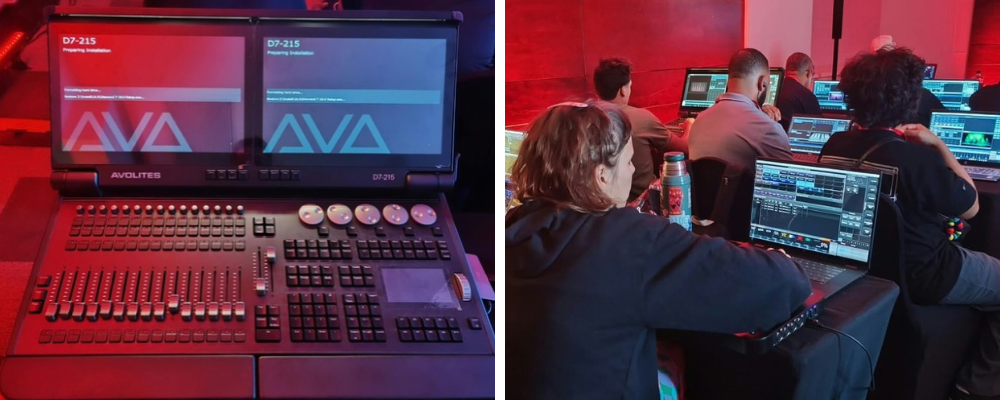
Originally, AvoCamp was focused almost entirely on the operating system. It later incorporated Prisma and Capture and progressively added new content.
But the most important change came when they began incorporating lighting fundamentals. “Many times we noticed that people are very focused solely on using the console, on learning how to use the console, and they have no understanding of what lighting itself would be,” Bermúdez points out.
The observation is relevant because it raises an issue that runs through the entire industry: knowing a tool does not necessarily mean understanding the profession.
For that reason, the program began addressing concepts such as color temperature, color psychology, types of sources, how lighting fixtures work, white balance, cameras and focus, as well as the fundamentals of design.
The objective is not to turn AvoCamp into an academy specialized in each of the lighting disciplines, but to provide a global perspective that makes it possible to understand why a particular tool is used before reaching the moment of programming it.
The process, then, begins long before touching a console. First comes light. Then comes design. Then visualization and, finally, programming and operation.
In that journey, Titan ceases to be the absolute center and takes its natural place: that of a tool within a much broader creative and technical process.
“They don’t pay you to use the console”
Perhaps one of the strongest reflections in the conversation emerges when Bermúdez and Yañez analyze one of the problems that still exists in the market.
There is a tendency to confuse mastery of a platform with mastery of the profession. For them, it is necessary to clearly differentiate between an operator, a designer and a lighting engineer. A person may know how to turn on a lighting fixture, program a memory or execute an effect and yet still not have the knowledge required to develop a lighting design.
The phrase perfectly summarizes the concept: “They don’t pay you to use the console, they pay you to create lighting.” The control system is a language. It is a tool for achieving a result.
The difference seems obvious, but it has profound consequences for the professionalization of the market. When the focus is placed exclusively on the console, there is a risk of losing sight of what really determines the value of a professional: their ability to interpret an artistic proposal, design a solution, understand light and solve the needs of a show.
That is why technical training takes on another dimension. It is not simply about knowing more functions. It is about better understanding what to do with them.
The knowledge that is not in any manual
One of the most interesting moments of AvoCamp occurs, paradoxically, outside the formal content. It is the moment when participants begin sharing how they solve their own problems.
Yañez recalls, for example, the experience of professionals such as Eduardo Guzmán, who uses timing and Fixed Orders from memories to develop effects in a particular way; Jefferson Barrantes, taking Pixel Mapping to highly advanced applications; or different users from Chile, Colombia and Argentina who have developed their own solutions using Titan tools.
This exchange allows a solution developed by a professional in one country to become a tool for another professional on the other side of the region.
José Antonio particularly highlights the case of Keni Calderón, from Peru. This young lighting designer works on consecutive productions where he does not always find the same equipment. Sometimes he arrives at an event and has to deal with different lighting fixtures, generic equipment or configurations that do not necessarily meet an ideal rider.
His experience has allowed him to develop an enormous capacity for adaptation and problem-solving. That knowledge can hardly be transmitted solely through a manual. It is learned through practice. And, especially, by listening to someone who has already had to solve the problem.
That is where one of AvoCamp’s great values emerges: bringing people with different experiences into the same room so that this knowledge can circulate.
A community without selfishness
During the edition in the Dominican Republic, this dynamic became especially visible. Professionals from different countries and specialties exchanged experiences about programming, design and problem-solving.
One of the most important aspects of this edition of AvoCamp is that a community has been created where knowledge circulates openly.
One professional shares a solution. Another complements it. A third finds a different application. And that process continues after the meeting. The result is the construction of a common language.
It does not necessarily mean that everyone works in the same way. Quite the opposite: the richness lies precisely in the different ways of solving the same problem.
But it does allow professionals to better understand the possibilities of the tools while, at the same time, expanding their own creative repertoire.
Dominican Republic: five years building community
For Juan Méndez, Avolites distributor in the Dominican Republic, the continuity of the program has had a concrete impact on the local market.
Training sessions began approximately five years ago and, since then, users’ level of knowledge has continued to grow.
“It is improving quite a lot,” Méndez confirms. There are already several professionals certified as Titan operators and more and more companies are sending members of their teams for training. This year, for example, one company sent five people to the training.
This figure shows another important transformation: training is no longer exclusively an individual initiative. Companies are also beginning to understand that training their teams has a direct impact on the quality of the service they can offer.
For Méndez, there is also a direct relationship between knowledge and confidence. When a user better understands a platform’s capabilities, they can make better use of it and also more clearly assess which tools they need. Training, in this sense, is not separate from market development.
When training also transforms the market
Méndez acknowledges that the training sessions have also had a commercial effect. Some users, after gaining a better understanding of the system’s possibilities, end up incorporating new tools or investing in higher-capacity consoles.
Keni’s case is an example: after his experience with the system, he added a D7 to his setup, complementing his previous equipment.
But reducing this phenomenon to a matter of sales would mean missing the most interesting part. The real point is that an informed user can make better decisions.
Training makes it possible to understand what a tool can do, what its limits are and which solution is best suited to a particular production.
Instead of simply selling a console, a deeper relationship is built between the user, the technology and the brand.
Five years, more experience and a more demanding format
AvoCamp has also evolved in its own structure. The activity began with smaller groups and then grew in different countries. Over time, editions have been held in the Dominican Republic, Mexico, Argentina and Chile, with the one held in the city of Santiago de Chile achieving the greatest impact.
In one of the Chilean editions, around 55 people participated, while other versions brought together groups of between 20 and 30 participants.
However, growth does not necessarily mean seeking increasingly larger groups. In fact, the experience led Avolites to place particular value on smaller groups.
The reason is simple: AvoCamp is an intensive and advanced training program. Addressing the questions of 50 people simultaneously can ultimately affect the quality of the experience.
For this reason, the current format seeks to maintain a certain level of selection. Participants should arrive with prior knowledge and, ideally, should have previously gone through programs such as AvoWeek.
The objective is for AvoCamp to work from a common foundation and move toward more complex content. In Yañez’s words, it is not simply about arriving and starting from scratch. The language used during the camp is different and requires a prior level of knowledge.
The challenge of raising the standard
Behind this entire process is a concern that goes beyond Avolites. The Latin American industry needs better-prepared professionals.
Yañez recalls that approximately five years ago, he conducted a small survey among advanced users from different countries. The average level of software knowledge was, according to that assessment, around 30 or 35%.
The problem was not necessarily a lack of interest. Many times it was simply a lack of knowledge. Users did not know that certain functions existed or were unaware of how far they could take the system. Questions such as how to create a Chase or a memory were still common among professionals who were already working with the platform.
Today, according to his perception, that average level has increased. The difference is not only in knowing more commands. It lies in having developed a technical language that makes it possible to use the tools according to a creative proposal.
That change can be much more important than any new function added to a console.
Education also means building a market
For Avolites, education is part of the brand’s development strategy in Latin America. Yañez explains it from a perspective that goes beyond traditional marketing: if a company develops a specific technological solution for an industry, it also needs those who work in that industry to truly understand its possibilities.
But there is also a parallel effect. A better-trained professional can provide a better service. They can solve more problems. They can develop more sophisticated proposals. They can communicate technically with other professionals and better understand the needs of a production.
The consequence is a more professional industry. And that professionalization ultimately also benefits brands, distributors, production companies and, fundamentally, end customers. It is a circle that begins with knowledge.
What comes after AvoCamp
The experience accumulated over these five years is also giving rise to a broader educational project. José Antonio Bermúdez anticipates the development of an online platform aimed at the Latin American market, with on-demand content and live sessions.
The proposal seeks to make training accessible to professionals who often cannot regularly attend an educational institution or dedicate large amounts of time to traditional training because they need to continue working.
The idea is to begin with the fundamentals of lighting and progressively move toward its different applications: stage lighting, theater, live shows, streaming, television, architectural lighting and other specialties.
The plan also includes incorporating design, Capture, work methodologies and aspects related to industrial safety. The objective is to build a training path that allows participants to move from theory to practice and subsequently toward specialization.
The in-person AvoCamps would form part of that ecosystem as practical and advanced sessions, while other activities, such as AvoWeek and local training sessions, would allow a broader audience to be reached.
The vision is clear: to make education more accessible and ensure that knowledge no longer depends exclusively on the possibility of physically accessing an academy.
Technology as a language, not the protagonist
Perhaps this is ultimately the concept that best explains the evolution of AvoCamp.
Technology continues to be fundamental. Titan remains a powerful tool and Avolites continues to develop new capabilities, integration and solutions for an industry that is constantly changing.
But a console cannot replace the designer’s judgment. It can accelerate programming. It can make it possible to execute complex ideas. It can integrate different systems. It can expand creative possibilities. But first, there has to be an idea.
That is why, when AvoCamp incorporates lighting theory, design, visualization and practical experience alongside Titan, it is doing more than expanding the curriculum.
It is changing the question; it is no longer simply “How do I do this on the console?” The question begins to be: “What do I want to do with light and what is the best way to turn that idea into a show?”
An industry learning to speak the same language
After five years, AvoCamp seems to have found its own identity. It is not just a course. Nor is it simply a product demonstration.
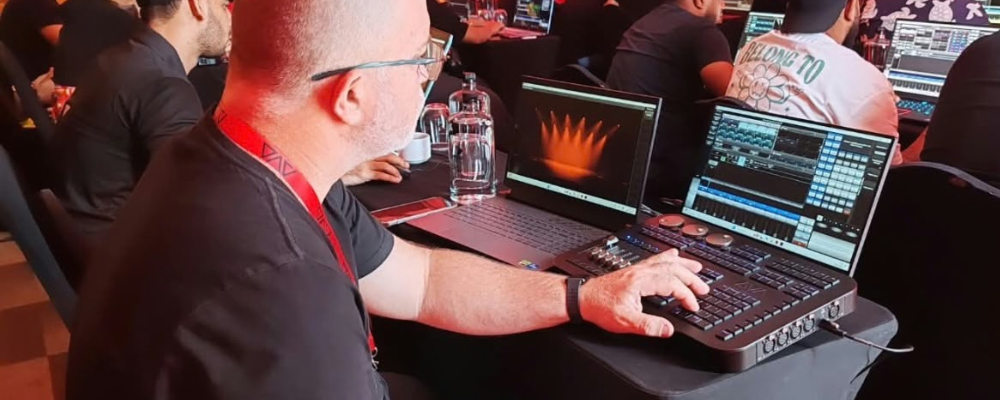
It is a meeting point. It is a training space where technology intersects with design, where one professional’s experience can become knowledge for another and where users from different countries begin to build a community around a common language.
In the Dominican Republic, 27 participants from 10 countries once again put that concept into practice. And the most important fact may not be how many people attended, but what happens afterward.
If a professional returns to their country with a better understanding of light, designing better, programming better and sharing that knowledge with someone else, the impact of AvoCamp is no longer measured in three days of training. It is measured in every show that professional will create afterward.
Because, ultimately, learning a console is learning how to use a tool. Learning lighting is learning how to think with light. And if AvoCamp succeeds in getting a new generation of Latin American professionals to do precisely that, then its true contribution will not simply be teaching Avolites. It will be helping to raise the standard of an entire industry.
Credits
Cover Photo: LATAM STAGE – FRANCISCO VALDIVIA
Inside Photos: LATAM STAGE – FRANCISCO VALDIVIA
The journalistic production, research, writing, editorial approach, and editing of this content are original works by LATAM STAGE and are protected by copyright.
No part of this content may be reproduced, copied, distributed, adapted, or published, in whole or in part, in any medium or format, without the prior written authorization of LATAM STAGE.


