
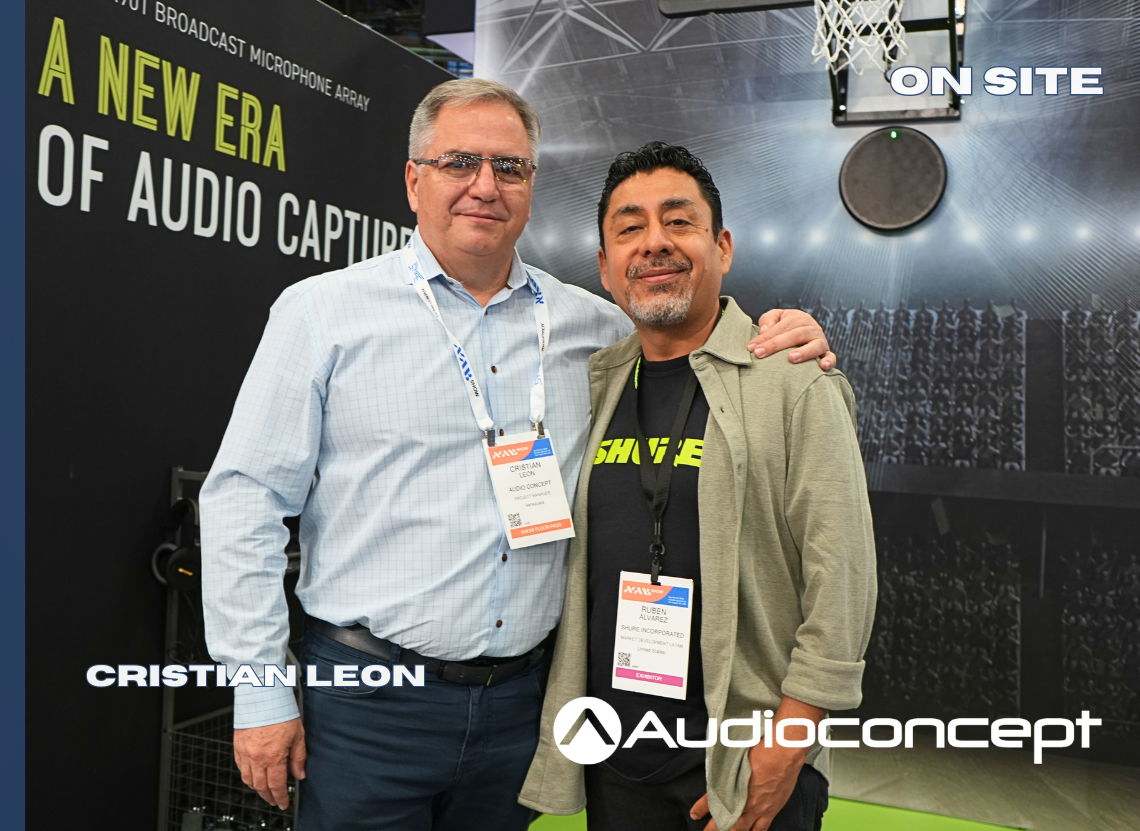
ONSITE | NAB 2026 – Las Vegas, USA
From the NAB Show, the AUDIO CONCEPT Venezuela team focused on one of the most disruptive innovations in professional audio today: the Shure DCA901, presented by Shure as a new way of understanding sound capture in complex environments.
The question that drives this technology is as simple as it is revealing: “How do you capture audio in a stadium without filling it with microphones?”
That challenge, a long-standing one in sports broadcast and live production, is the starting point for a system that proposes a paradigm shift: moving from multiplying devices to intelligent capture.
Cristian León, from AUDIO CONCEPT Venezuela, explains it from a real-world application perspective: “It’s a digital array microphone designed for live productions, where audio is critical, that integrates multiple capsules into a single device and allows you to generate up to eight separate audio outputs.”
This is where the first breakthrough appears: a single system capable of replacing traditional multi-microphone setups, simplifying operation without sacrificing quality.
But the real difference lies in its internal architecture. The DCA901 does not function like a conventional microphone, but rather as an intelligent capture system.
Rubén Álvarez, Shure product specialist for Latin America, describes it precisely: “Internally it has more than 78 small microphones, but through processing we can generate eight pickup lobes, as if they were eight independent shotgun microphones.”
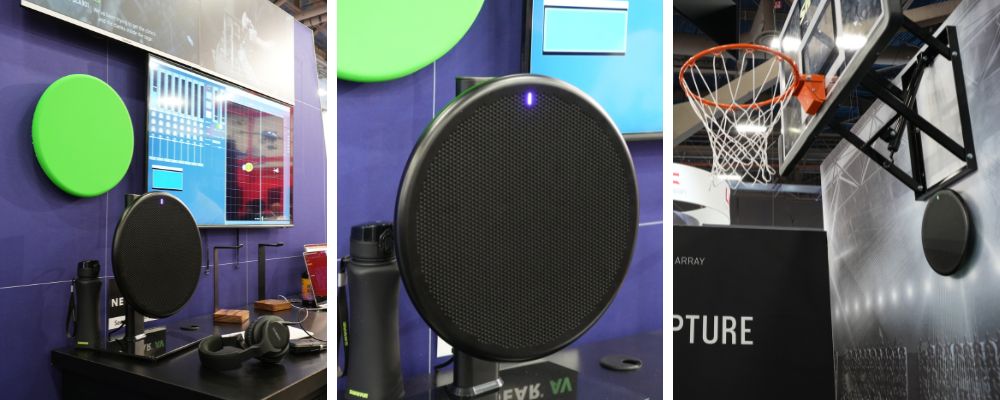
This concept—based on beamforming technology—completely transforms the logic of capture.
“I can direct, open, and close those lobes and create a mix of all of them or have individual control,” highlights Cristian León, showing how control shifts from the physical domain to the digital one.
The result is clear: audio no longer depends on where a microphone is placed, but on how the system is controlled.
In terms of infrastructure, the impact is equally significant. The DCA901 operates entirely over network, using protocols such as Dante and AES67, and PoE power, allowing audio, control, and power to be carried through a single cable, reducing complexity and points of failure.
This is complemented by internal processing that enables the direct application of tools such as equalization, compression, automix, and delay, eliminating the need for external equipment and optimizing the workflow in live productions.
The conclusion from the Audio Concept team is clear: “In practice, this translates into a simple but powerful idea: fewer microphones, more control.”
In addition, the system not only captures audio, but also allows it to be structured according to the needs of each production. The ability to generate up to eight independent channels and build mono, stereo, or even 5.1 mixes positions the DCA901 as a tool aligned with current immersive production workflows.
This level of flexibility is especially relevant in scenarios such as:
• sports stadiums
• live shows
• remote productions (REMI)
where precision in capture and reduction of ambient noise are critical.
But beyond the technology, what validates the system is its real-world use. “It is already available in Latin America and we have several success cases in basketball, football, and boxing tournaments,” says León.
For AUDIO CONCEPT Venezuela, this type of development marks a shift in how professional audio projects are approached. The ability to centralize capture, reduce the number of devices, and increase operational control opens new opportunities in both quality and efficiency.
From NAB 2026, the message is clear: audio capture is no longer defined by the number of microphones deployed, but by the intelligence of the system that replaces them. And in this new scenario, the DCA901 is not just a tool, but a new way of thinking about live sound.
Credits
Cover Photo: LATAM STAGE
Inside Photos: LATAM STAGE
The journalistic production, research, writing, editorial approach, and editing of this content are original works by LATAM STAGE and are protected by copyright.
No part of this content may be reproduced, copied, distributed, adapted, or published, in whole or in part, in any medium or format, without the prior written authorization of LATAM STAGE.


