
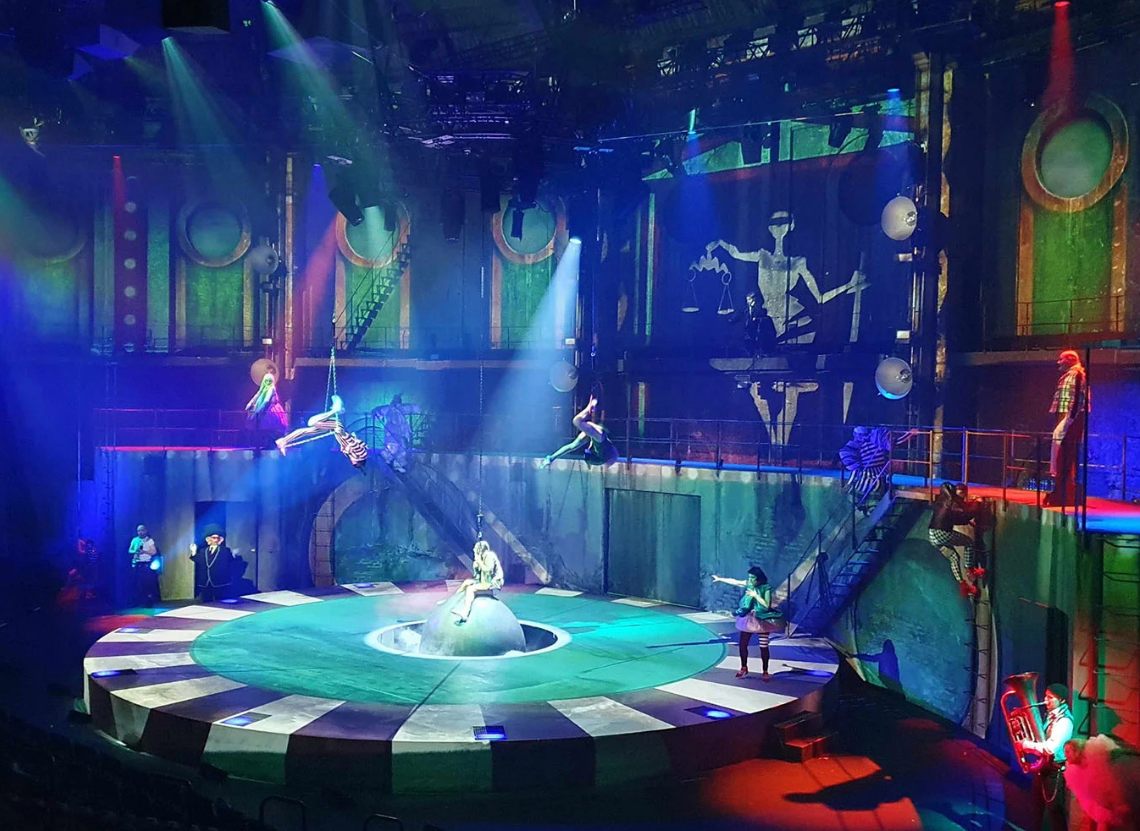
Denmark – The Østre Gasværk Teater in Copenhagen provided the setting for an ambitious theatrical interpretation of Pink Floyd’s The Wall, where music, scenic movement, performer flying and visual effects were brought together through a sophisticated automation system supplied by Motor Stage Automation (MSA).
For Another Brick in the Wall, Part 5, the Denmark-based entertainment automation specialist delivered performer flying winches, scenic-motion hoists, stage lifts and a complete MOVEKET control system, combining its technology with the creative and technical expertise required to execute one of the production’s most demanding elements.
Automation became a central part of the production after Østre Gasværk’s stage manager Rumle Dons, artistic director and creative producer Søren Møller, production manager Markus Schulin-Zeuthen and director Heinrich Christensen evaluated the technical requirements of the show.
“We needed so many elements precisely executed at specific times to fit the musical timeline and narrative,” explained Søren Møller, who had previously worked with MSA Managing Director Christian Vigsø on several projects. The decision to introduce automation quickly proved to be the right one.
The production marked the first theatrical adaptation of Pink Floyd’s seminal studio album The Wall. The complete album was performed live, with the musicians themselves becoming part of the scenic language. Throughout the show, members of the band repeatedly appeared and disappeared from different locations, rising from stage lifts and emerging from behind scenic elements to create a carefully choreographed visual illusion.
Making those transitions possible required a combination of precision, safety and timing.
MSA Technical Project Manager Jimmy Johnson was responsible for developing the technical solutions and determining the safest and most accurate way to integrate the automation into the production. On site, he worked closely with set designer Kim Witzel, choreographer Sofie Akerø, aerial designer Sita Bhuller Otto and the Østre Gasværk team.
MSA also supplied two automation operators, Erik Jensen and Mathias Kromann, who were responsible for preparing, operating and running the automation system throughout the performances.
Stage lifts reveal and conceal the musicians
Four Alfa System M stage lifts formed an important part of the scenic system. Three of the units were installed behind the set, allowing musicians to appear and disappear from view.
Each of these 1 x 2 metre scissor lifts could move from a lowered position of 0.6 metres to a maximum height of 2.4 metres, creating controlled vertical movements that became part of the show’s visual storytelling.
The fourth Alfa System M was one of two Serapid-style units used in the production. Equipped with a 2.3-metre circular riser, it was positioned centrally in the “basement” beneath the main stage.
In addition to moving performers, this lift was used to bring roll-on/roll-off scenic elements onto the stage. When raised, it also became part of the choreography involving actors and dancers.
Aerial performance meets scenic automation
Above the main stage, MSA installed a circular truss carrying four MOVEKET VMW-S 125 three-wire winches and four chain hoists. The latter consisted of three MOVEKET VMK-S 125-40 units and one VMK-S 500-24.
The system provided the infrastructure required for the production’s aerial performers, who used hoops, straps, slings, ropes and trapezes at different points throughout the performance.
Although MSA supplied and operated the performer-flying hardware, the movement of the aerialists was coordinated with specialist flying consultancy provided by Troels Frydensberg of Frydensberg Production.
The same automation infrastructure was also used to move scenic elements on and off stage, including an inflatable wrecking ball that became one of the production’s most striking visual moments.
During the sequence, the main character, “Pink”, was attached to the flying ball while singing. At the same time, moving video content was projected onto its surface using PSN protocol transmitted from the MOVEKET Expert III console to the disguise video server.
The sequence required precise coordination. The ball entered the performance space and began swinging while the actor emerged from beneath the stage on one of the lifts before jumping onto it. Although the result appeared seamless to the audience, the sequence depended on a tightly coordinated series of technical movements.
Another highlight was a five-person flying “sculpture”, which changed shape and emphasis at key moments in the production, adding another layer of movement to the visual language of the show.
One control system for the complete automation package
All four winch wires, the chain hoists and the stage lifts were individually controlled through the MOVEKET Expert III console running i-Motion software.
The system was configured by Jimmy Johnson, while programming and operation throughout the production were handled by Erik Jensen and Mathias Kromann.
For Jensen, one of the strengths of the MOVEKET system was the balance between flexibility and straightforward operation.
“The MOVEKET system is solid, modern and straightforward and efficient to program once you have received the requisite training,” he explained.
The console’s combination of assignable buttons and handles proved particularly useful for a production where different types of movement had to be executed according to different timing requirements.
As Jensen explains, fixed cues can be triggered using buttons when a movement requires a predetermined speed and timing. Handles, meanwhile, provide greater flexibility when the timing of a sequence depends on human activity.
“If there is a dynamic routine playing out that relies on human activity which may vary slightly in timing each time, you can simply tweak the speed or timing accordingly,” he noted.
The Expert III also provides the operator with a visual indication of whether the dead man’s handles (DMH) on the stage lifts are activated.
Even though the production team used intercom communication, Jensen considered this additional information particularly useful.
“It’s always nice to know when the DMH is on or off!” he said.
Automation supporting creative ambition
The technical complexity of Another Brick in the Wall, Part 5 ultimately served a larger creative objective: allowing the production team to turn The Wall into a theatrical experience without compromising the timing, movement and visual impact required by the narrative.
The combination of stage lifts, aerial movement, flying scenic elements and video interaction created a production in which automation was not simply a technical tool, but an integral part of the storytelling.
The result proved highly successful with audiences. The production sold out its original scheduled run and subsequently added further performances, ultimately extending the engagement by another two months to accommodate as many additional dates as possible within the already busy schedule at Østre Gasværk Teater.
For MSA, the project represented an opportunity to combine engineering expertise with an unusually creative theatrical concept.
“We were extremely proud to be part of this spectacular and ground-breaking original performance, and to work alongside so many brilliant people enabling some properly creative engineering solutions,” said MSA Managing Director Christian Vigsø.
For Søren Møller, however, the technology was only one part of the equation. The success of the production also depended on bringing together the right creative and technical people and creating an environment in which each discipline could contribute its expertise.
The combination of artistic direction, technical knowledge, engineering and collaboration ultimately allowed the production to achieve its ambitious visual language while maintaining the precision and reliability required for a technically demanding live performance.
Photo @ Østre Gasværk


