
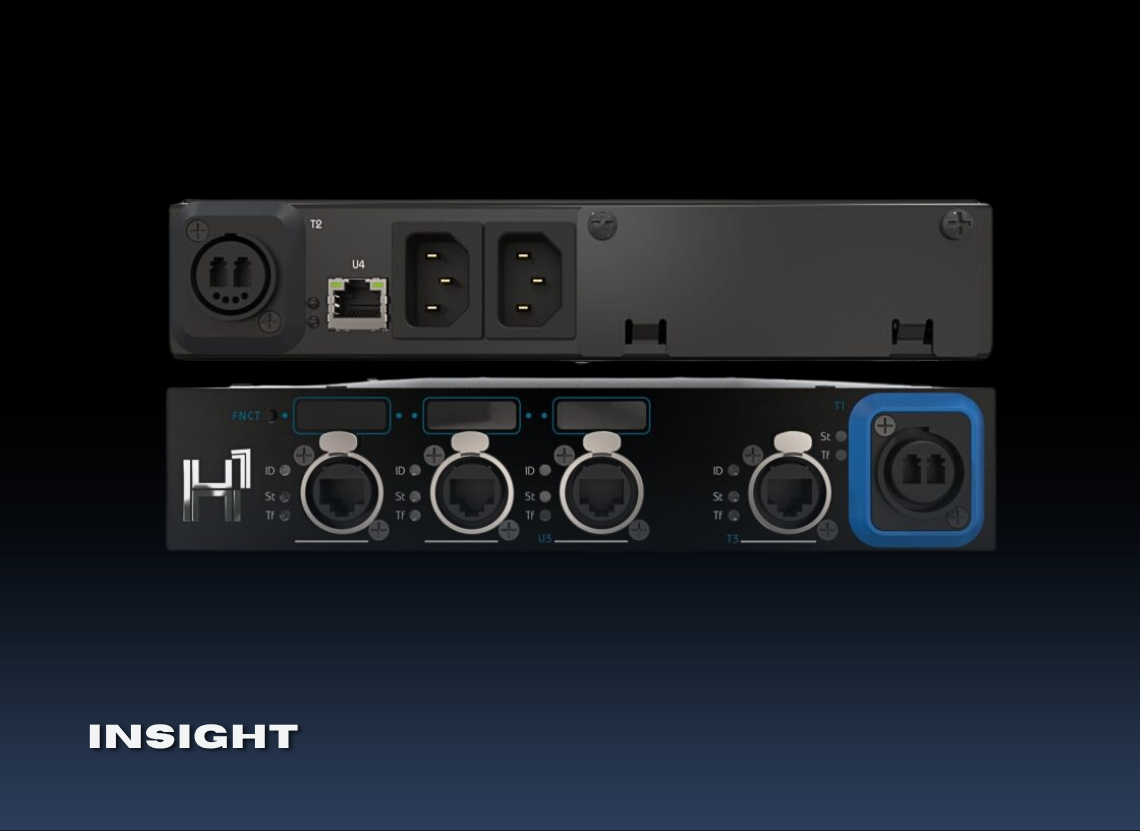
In a market where professional audio is progressively migrating toward IP-based architectures, network infrastructure is playing an increasingly decisive role. AGORA H1 proposes a different approach: combining a manageable Gigabit switch, a 128 × 128-channel Dante matrix, and a modular architecture capable of integrating multiple audio protocols and formats into a single platform. More than a networking device, H1 raises a relevant question for the industry: how can systems be built to coexist with today’s technologies without being limited by them?
For decades, thinking about an audio system meant thinking primarily about consoles, processors, amplifiers, loudspeakers, stageboxes, and cables. The network was, in many cases, a complementary element. Today, that relationship has changed.
The growth of Audio over IP has transformed the network into a fundamental part of system architecture. Audio can travel alongside control, monitoring, and other data, while technologies such as Dante, AES67, and AVB-Milan make it possible to distribute large numbers of channels between different points within an installation or production.
But this evolution also introduces a challenge: what happens to all the equipment that already exists? The answer is not necessarily to replace it.
More than a switch
It is precisely in this scenario that AGORA H1 becomes particularly relevant.
H1 combines within a compact 19-inch, 1U format — with a half-rack configuration — different functions that traditionally require separate devices. Its architecture integrates a manageable Gigabit Ethernet switch with a Dante audio matrix and a modular interface system.
The result is a device that can operate simultaneously as network infrastructure and as an audio processing and signal exchange point.
The H1 features Gigabit Ethernet ports for user connections and links between switches, while certain configurations allow connectivity via optical fiber. It also features two internal interfaces connected to the primary and secondary Dante interfaces, providing redundancy and flexibility to the architecture.
But the element that probably best defines its concept is the 128 × 128-channel audio matrix at 48 kHz.
This means that H1 is not limited to transporting information between devices. It can establish connections between its internal and external interfaces, functioning as a true signal exchange point within the network.
Modularity as a strategy
The modular concept is another aspect that differentiates H1.
On its rear panel, the unit incorporates a slot for AuviTran AxC interface cards, allowing the platform to be adapted to different connectivity requirements.
Depending on the installed card, H1 can incorporate interfaces for AVB-Milan, Dante, EtherSound, CobraNet, MADI, AES3, ADAT, analog signals, GPIO, and other processing and conversion functions.
This capability has an important consequence: H1 can act as a bridge between technologies belonging to different generations of professional audio infrastructure.
An installation may, for example, have MADI equipment that needs to communicate with a Dante network. In another project, it may be necessary to integrate AES3 signals, analog audio, or an AVB-Milan-based infrastructure.
Instead of turning each of these situations into an independent system, H1 allows different functions to be centralized within a single platform.
And here one of the most important concepts for understanding its value emerges: interoperability.
The future does not start from scratch
The transition to audio over IP is not taking place on empty ground.
Professional systems installed over the past few years continue to operate and, in many cases, will continue doing so for a long time. Theatres, studios, radio and television stations, stadiums, rental companies, convention centers, and large installations have equipment based on different standards.
Therefore, technological evolution does not necessarily mean replacing everything that came before, but rather finding intelligent ways to make it coexist with new architectures.
In this context, H1’s ability to act as a bridge between different protocols takes on strategic value.
Modularity is not simply a technical feature: it is a way of protecting the investment made in infrastructure.
A system can evolve by incorporating new technologies without every upgrade necessarily requiring the entire architecture to be rebuilt from scratch.
When the network becomes part of the audio
There is also a less visible but fundamental transformation.
When an audio system depends on a network, the quality of that infrastructure is no longer exclusively an IT concern.
Traffic stability, priority management, redundancy, and the physical architecture of the network can have a direct impact on the operation of the audio system.
H1 incorporates functions specifically designed to manage this environment, including QoS, IGMP Snooping, traffic management, root bridge selection, and different network topologies, including bus, star, ring, and hybrid configurations.
In a small production, these concepts may seem exclusively technical.
But when it comes to a festival, a stadium, a television production, an international tour, or an installation with hundreds of channels, they take on another dimension.
The network is no longer simply the path along which data travels. The network becomes part of the audio system.
The Ghost philosophy
This concept also helps explain AGORA’s philosophy around its Ghost networks.
The company presents these architectures as a kind of highway for audiovisual media, where different streams can travel independently and in an organized manner, preventing network growth from ultimately creating a global traffic problem.
The analogy is interesting because it reflects a profound transformation in the design of professional systems.
The challenge is no longer simply to transport more channels. It is to transport them efficiently, predictably, scalably, and in a controlled manner.
In this sense, H1 functions as a node within a much broader infrastructure.
From rack to infrastructure
Another relevant aspect is its physical adaptability.
Although its format is designed for rack mounting, AGORA offers different accessories for wall or truss mounting. This feature can be particularly useful in touring, event, and production applications where networking equipment needs to be located close to connection points and not necessarily inside a conventional rack.
This is complemented by a fanless construction, a 100/240 V power supply, and the option of incorporating a redundant power supply.
These elements may not be as eye-catching as the number of channels or compatible protocols, but they become important when a device stops being an accessory and becomes part of critical infrastructure.
A platform prepared for different scenarios
The possible applications reflect precisely this breadth.
H1 can be integrated into live productions, tours, concerts, broadcast, mobile radio and television, studios, OB vans, stadiums, theatres, museums, theme parks, entertainment venues, corporate buildings, and other audiovisual installations.
In all these environments, there is one common characteristic: the need to transport large amounts of information reliably while maintaining the ability to modify, expand, or reorganize the system.
This is where another of the strengths of the H1 concept emerges.
A network-based system makes it possible to modify routes and relationships between devices without having to physically change every audio connection. When this capability is combined with an internal 128 × 128-channel matrix and different interfaces, the device can become a strategic point for managing the entire architecture.
Why does H1 matter?
The real interest of the AGORA H1 lies not only in its list of specifications. Its importance lies in what it represents.
The professional audio industry is moving toward systems in which audio, control, monitoring, and connectivity converge over network infrastructures. In this context, the boundaries between an audio device and a networking device are beginning to disappear.
H1 is a concrete expression of this trend.
A switch is no longer simply a switch. A matrix is no longer simply a matrix. A converter is no longer simply a converter. All of them can become different functions within a single intelligent infrastructure node.
And perhaps that is the most important question AGORA H1 raises: the future of professional audio will depend not only on how many channels a system can transport, but on how intelligently it can connect, manage, and make them coexist.
In a market that must integrate new technologies without necessarily discarding previous ones, this adaptability can be just as important as power, channel count, or network speed.
Because, ultimately, when audio becomes data, designing the system also means designing the network.
Credits
Cover Photo: LATAM STAGE
Inside Photos: LATAM STAGE
The journalistic production, research, writing, editorial approach, and editing of this content are original works by LATAM STAGE and are protected by copyright.
No part of this content may be reproduced, copied, distributed, adapted, or published, in whole or in part, in any medium or format, without the prior written authorization of LATAM STAGE.


