
Brazil – To meet today’s increasingly large and complex production needs, Brazilian audiovisual production company Zebra Streaming outfitted its new OB truck from front to back with a fleet of Blackmagic Design gear, further enhancing its ability to scale up and down depending on the needs of its customers, ranging from broadcast to livestreaming to large events.
Founded in 2019 by Felipe Lemes, Zebra Streaming has evolved and integrated Blackmagic Design gear as the backbone to its productions. The company currently works primarily with large scale productions, shows, DVDs, conferences, festivals, television, and streaming content, with a strong presence in the gospel market. In 2025, Zebra Streaming built its own 4K/UHD OB truck, developed for highly complex operations and equipped with a comprehensive Blackmagic Design setup that includes over 30 Blackmagic Design cameras, a combination of ATEM live production switchers and panels, HyperDeck recorders and more.
“The decision to equip our truck with Blackmagic Design products arose primarily from the need for an integrated and reliable infrastructure. We needed a solution that offered quality, flexibility, connectivity, and, above all, reliability for working with large volumes of signals,” said Lemes. “Blackmagic Design enabled us to build a much more integrated workflow and the evolution of its products positions us to be futureproof without having to completely overhaul later on the entire infrastructure we’ve built.”
TAKING PRODUCTION TO THE NEXT LEVEL WITH SBT
Zebra Streaming worked with the Sistema Brasileiro de Televisão (SBT), a Brazilian free to air television network, on Vira Brasil 2026, a Christian and music festival celebrating New Year’s Eve. The event drew over 50,000 people in person, and reached 15 million households via its live broadcast and thousands more through YouTube and streaming.
“Vira Brasil was our first project with SBT, and it was very important because it marked our company’s entry into television production with a broad national reach,” Lemes said. “It was one of those projects that demonstrates that all the investment in technology, equipment and technical knowledge really makes a difference when facing a production of this level.”
He explained, “We designed the entire system, defined the signal flow, the equipment needed, and structured the OB truck to meet the standards of a television broadcast, while maintaining the flexibility needed for a live event. The idea was to arrive at the event with everything perfectly planned so that during the broadcast, the team could focus on the operation and the quality of the transmission. It was an intense preparation, but essential to guarantee the safety and technical level that the project required.”
THE WORKFLOW BEHIND THE SUCCESS
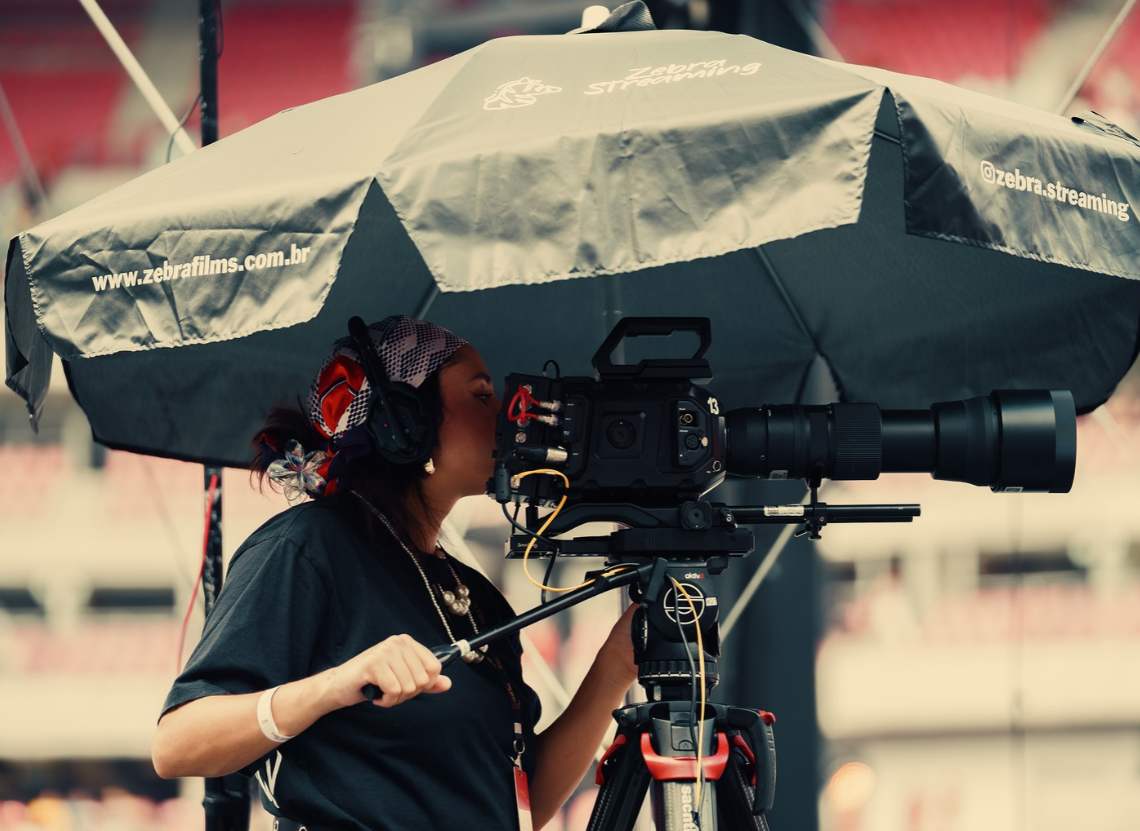
Zebra Streaming relied on 13 Blackmagic URSA Broadcast G2 cameras to capture different angles, especially in positions requiring wider shots and camera movements, such as tracking, crane, handheld audience, and instrument shots.
Lemes added, “They were essential in adding dynamism to the broadcast and were chosen because we needed complete control of the cameras from our truck. We were able to remotely adjust various internal parameters, such as exposure, gain, white balance, and other image characteristics. This is crucial for an event that begins in daylight and ends at nightfall, allowing us to monitor all these lighting changes and keep the cameras perfectly adjusted and standardized throughout the broadcast.”
Adding to the mix were 10 Blackmagic URSA Mini Pro 12K digital film cameras for close ups and shots requiring telephoto lenses with focal lengths, four Blackmagic Studio Camera 6K Pros to send signals to the event’s LED screens, four Blackmagic Pocket Cinema Camera 6K Pro and three Blackmagic Pocket Cinema Camera 6K G2 digital film cameras , and a Blackmagic Micro Studio Camera 4K G2 that were all placed in very compact spaces on stage and near other instruments.
“Having all these Blackmagic Design cameras allowed us to capture each moment with great detail and ease,” Lemes added. “Each camera was placed strategically across the venue, complementing each other and giving us the ability to capture every moment for attendees and viewers enjoying at home.”
“All camera signals were fed into the truck via fiber optic cable,” he said. “From there, all signals were distributed and routed internally to different areas of the operation, allowing the team to access the sources needed for cutting, monitoring, recording, and color grading in DaVinci Resolve Studio, as well as for other production needs.”
He continued, “The main processing and cutting were performed using an ATEM Constellation 8K with a Blackmagic Videohub 120×120 12G, ensuring high integration between the different systems. For a production with a large number of cameras and sources, having 4 M/Es, 40 inputs, and 8K compatibility gives us a very wide range of options.”
Inside the truck, Zebra Streaming had a dedicated video monitoring setup with four ATEM Camera Control Panels and DaVinci Resolve Live for onset color grading.
He explained the setup further, “We also had three HyperDeck Studio 4K Pros to record the main and backup program, as well as clean feed signals, while fifteen HyperDeck Studio HD Pros and twenty HyperDeck HD Plus units were distributed for recording individual sources.”
“In addition, we relied on ATEM 2 M/E Advanced Panel 40, ATEM 2 M/E Advanced Panel 20 and ATEM 1 M/E Advanced Panel 10 working in a complementary manner. The ATEM 2 M/E Advanced Panel 40 was dedicated to the main operation, allowing the director to work with a large number of sources and M/E quickly and accurately, selecting all the cameras that would be used for SBT’s television broadcast,” Lemes said. “The ATEM 2 M/E Advanced Panel 20 was used for a second operation, providing greater autonomy and flexibility for auxiliary cuts and mixes of the signal destined for YouTube while the ATEM 1 M/E Advanced Panel 10 was intended for more specific operations, such as auxiliary cuts and image signals for LED panels.”
After the program was produced, the final signal was made available for transmission and distribution, thus satisfying SBT’s needs via satellite.
The OB truck also features more Blackmagic Design gear that is put into use depending on the project, including ATEM 4 M/E Constellation HD, ATEM 2 M/E Constellation HD, ATEM 4 M/E Constellation 4K, and ATEM Television Studio Pro 4K live production switchers, ATEM Streaming Bridge converter, DeckLink capture cards, and more.
“All of the gear plays a vital role in ensuring the standardization of our production workflow,” Lemes said. “We take advantage of each piece of equipment we have on board and can offer our clients exactly what they’re looking for.”
REACHING MILLIONS WITH BLACKMAGIC DESIGN
Other major events that Zebra Films has worked on include the tour finale of pagode singer Thiaguinho “Tardezinha 10 Anos Edição Final” and The Send, a Christian gathering event. Each event has reached over 2.1 million views on YouTube.
“The workflow adopted for the Tardezinha and The Send events maintained the same philosophy and technical architecture used in other productions, adapting the truck’s structure to the complexity and specific needs of each event,” he explained. “While each project presented different challenges, we maintained the same premise: to preserve signal quality, ensure color consistency between cameras, and provide safe and efficient operation even in large scale, long duration productions.”
LOOKING INTO THE FUTURE WITH 2110 IP BASED WORKFLOWS
Zebra Streaming’s future is focused on continued growth, investing in technology, and expanding its capacity to handle increasingly larger and more complex productions. “Today, the market recognizes us as one of the leading providers in Brazil for major events using Blackmagic Design, and we want to continue raising the bar,” Lemes concluded.
“Our next major goal is to build a second, even more technologically advanced truck that incorporates a 2110 IP based infrastructure from Blackmagic Design. The first truck represented a major leap forward in Zebra Streaming’s history, and we believe a second one with IP 2110 architecture could represent an even more significant new chapter in this journey and prepare us for the future of broadcasting.”


